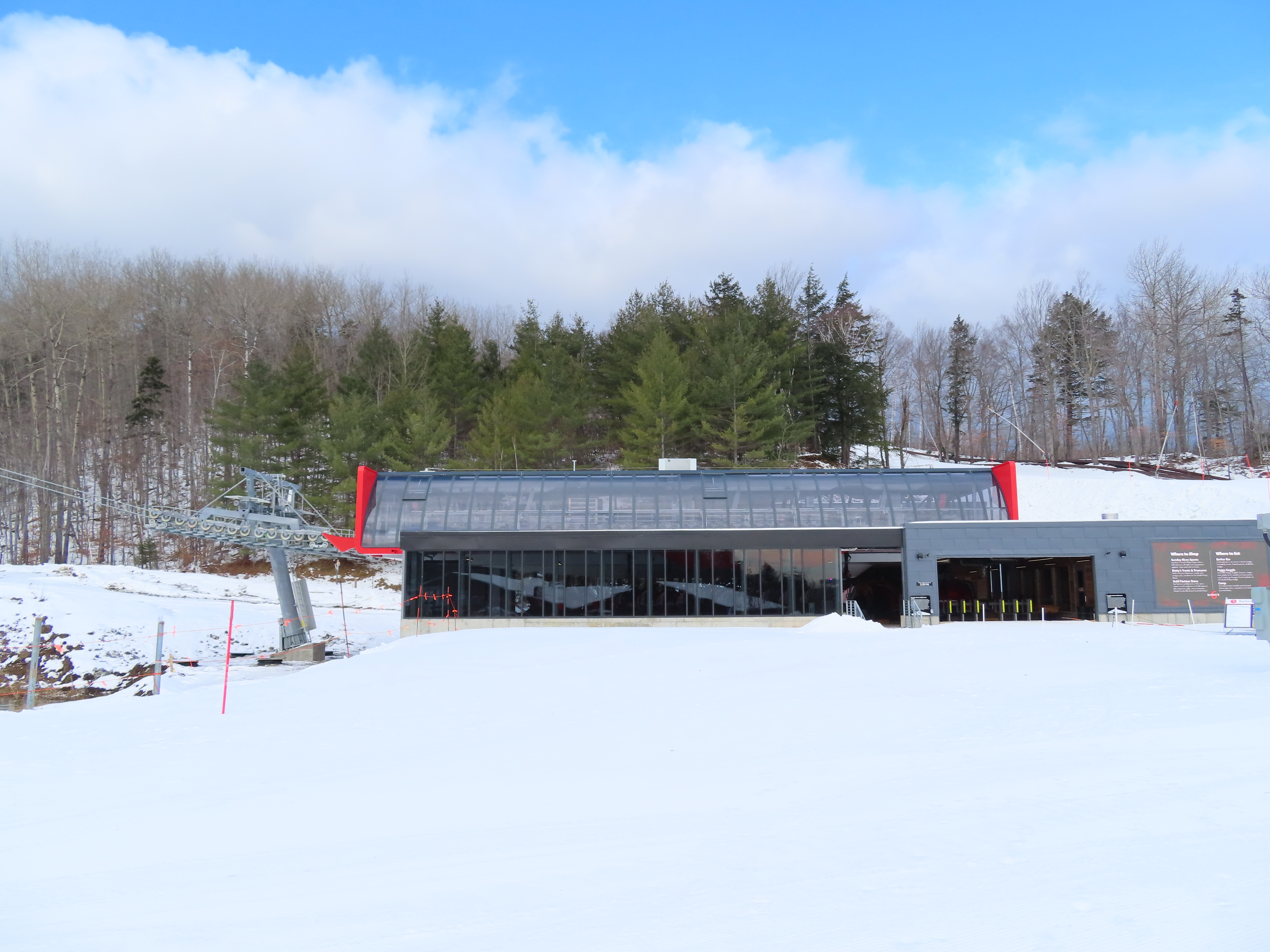
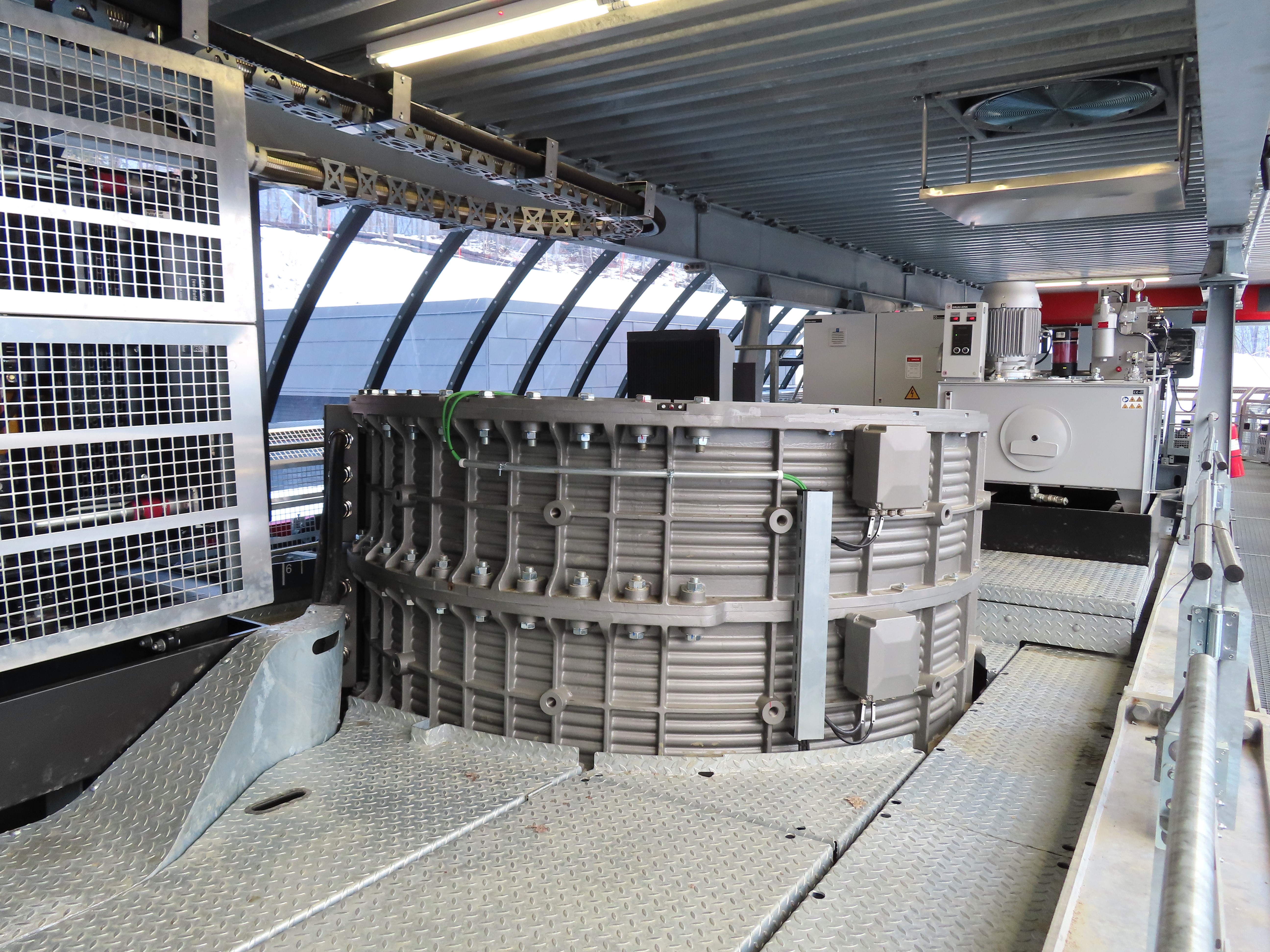
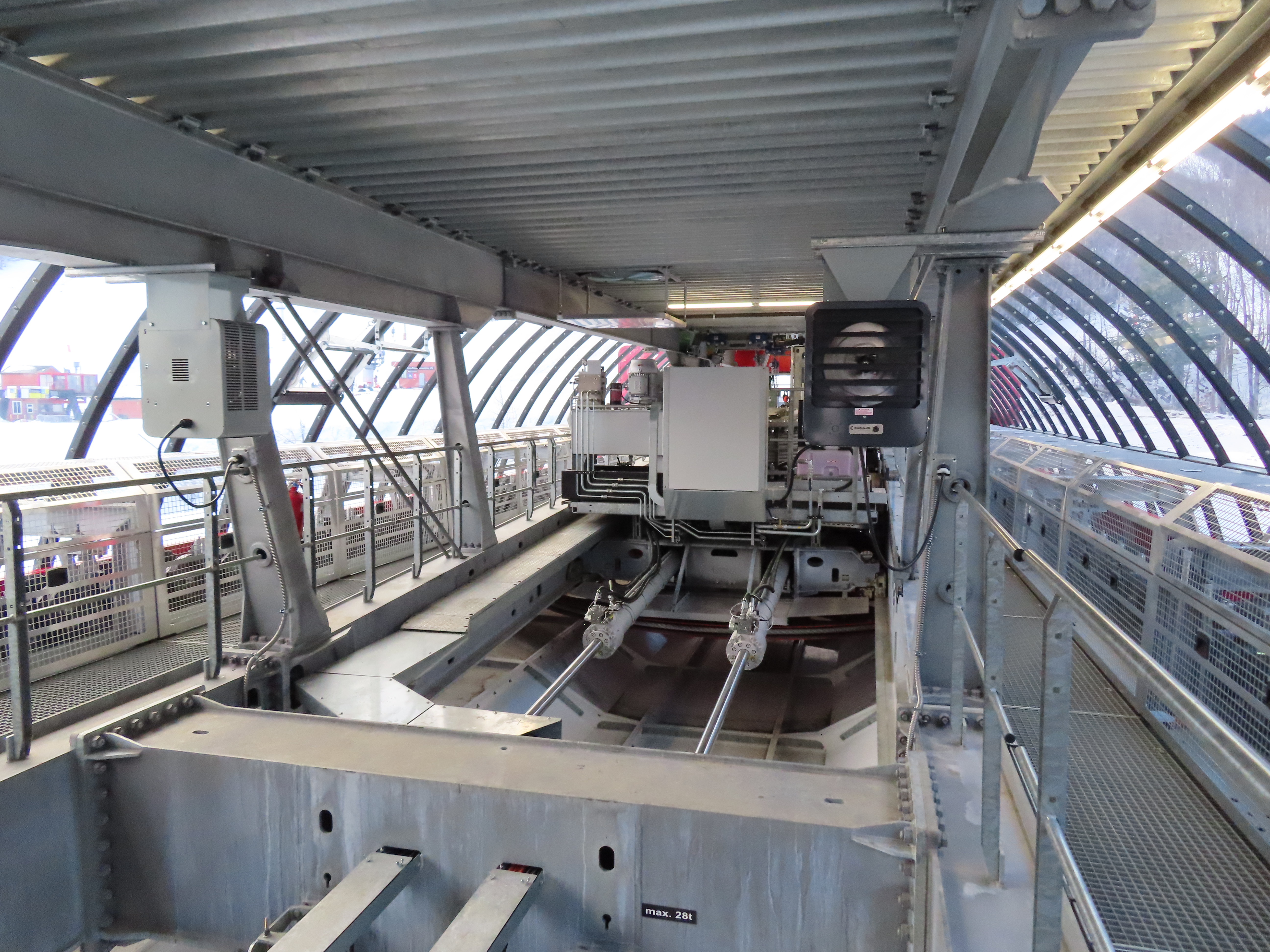
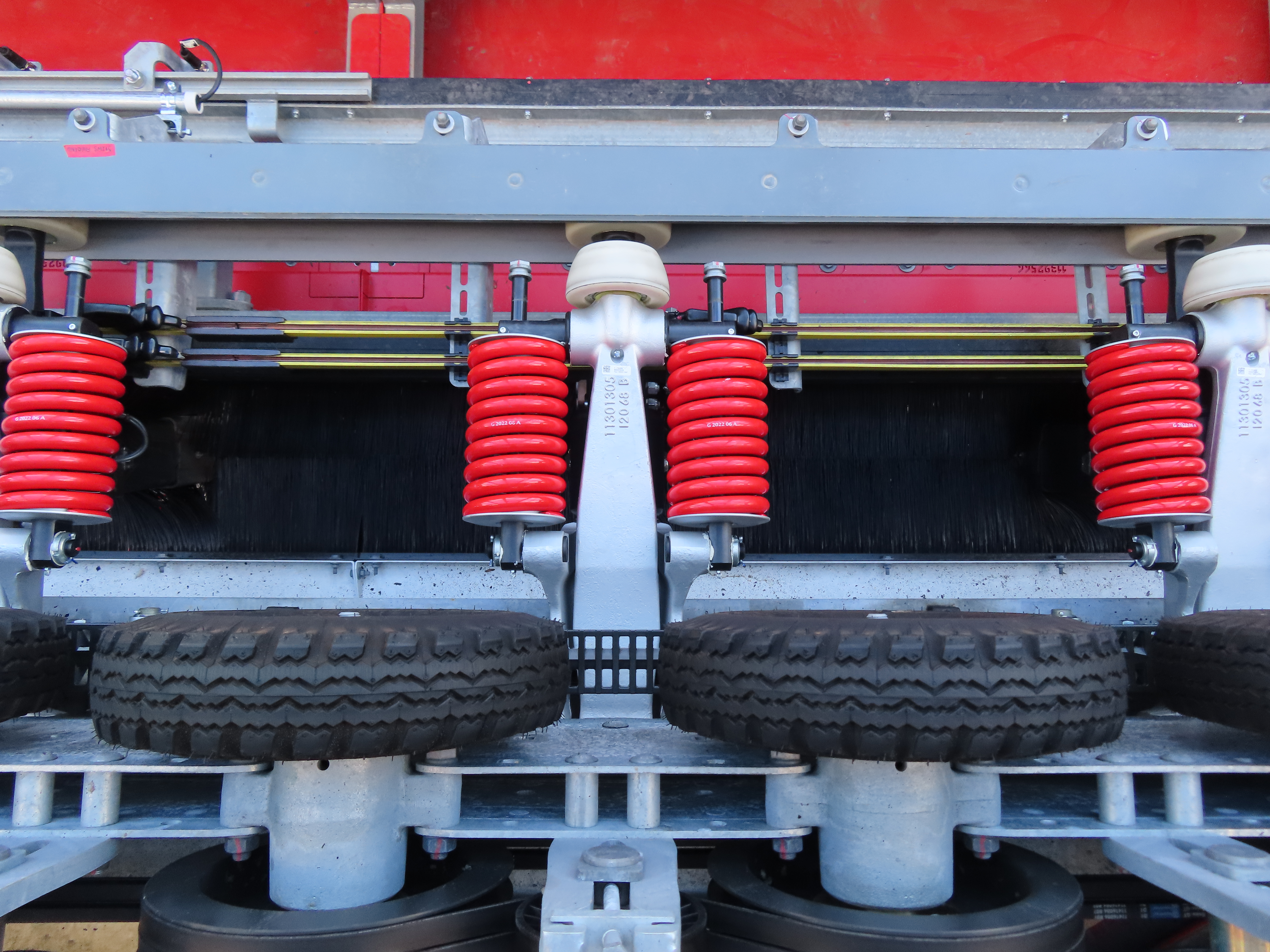
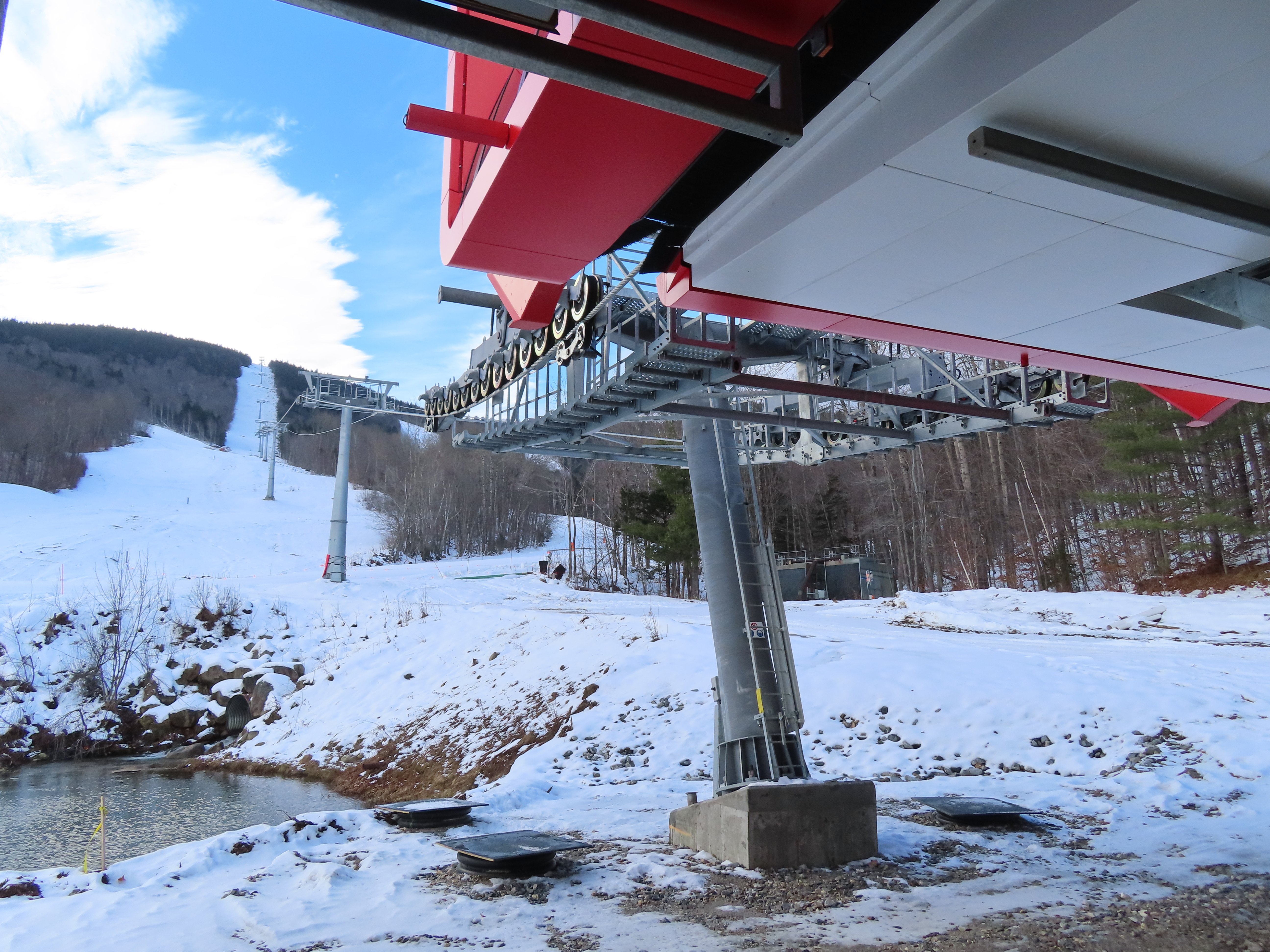
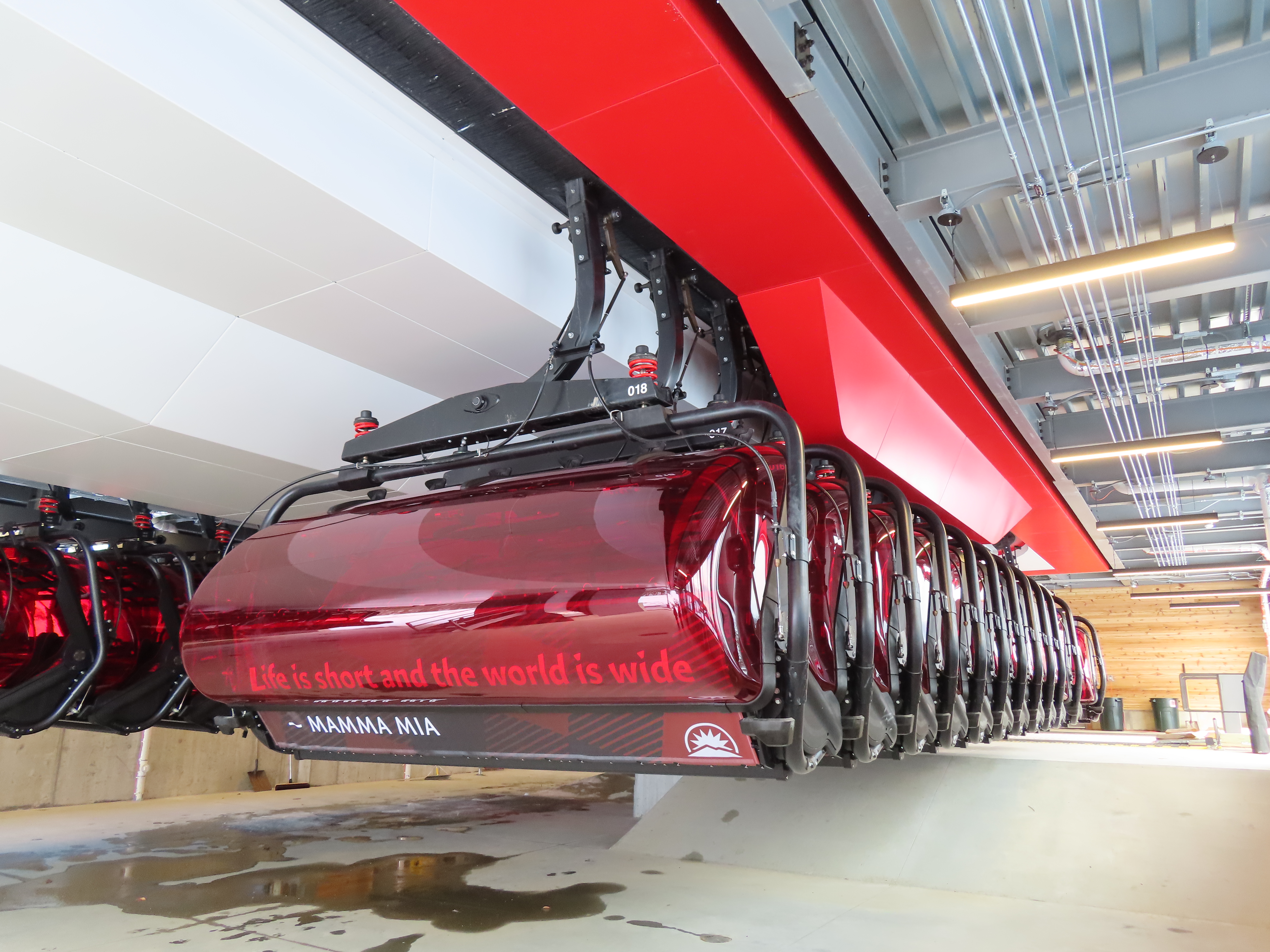
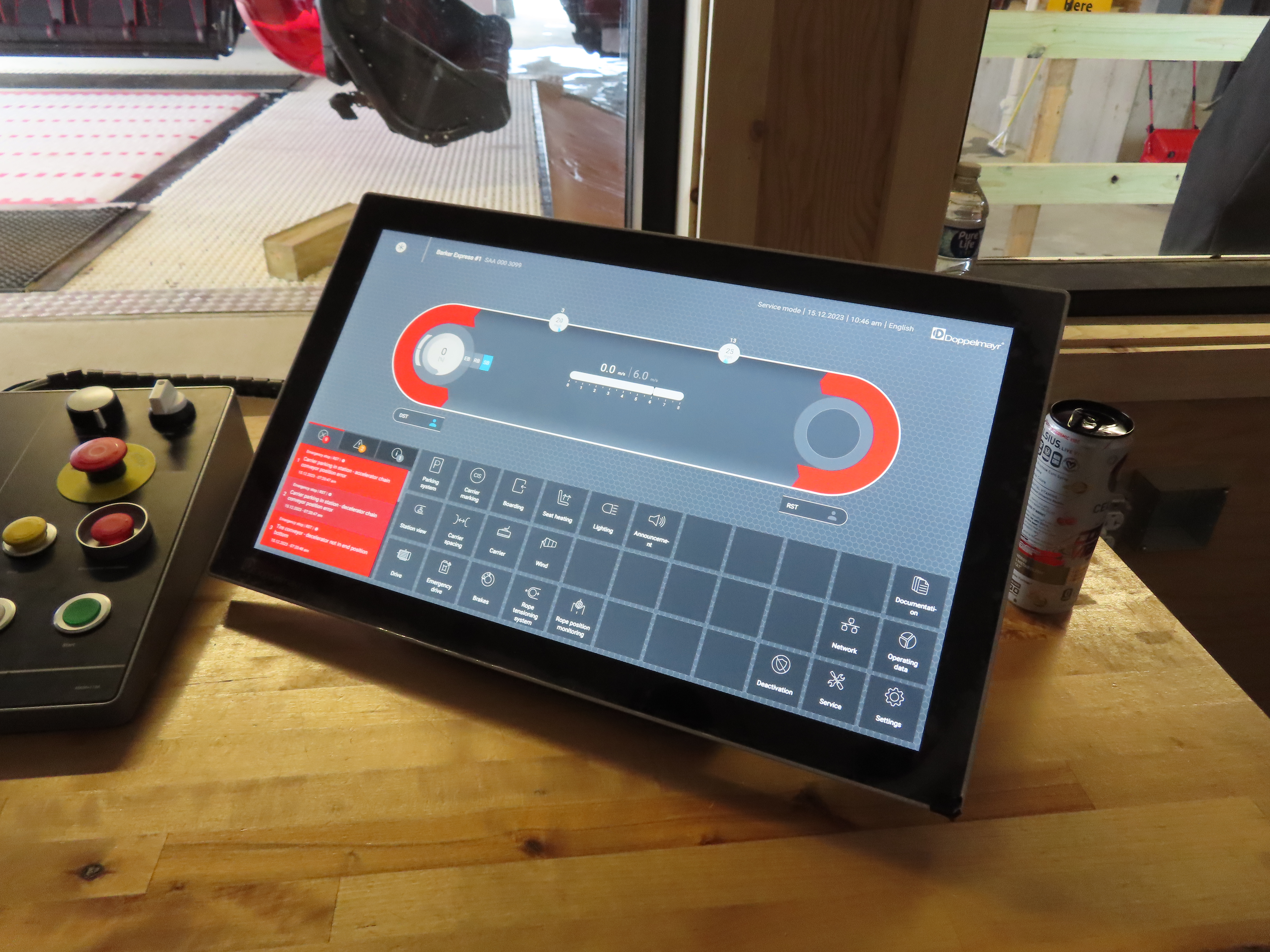
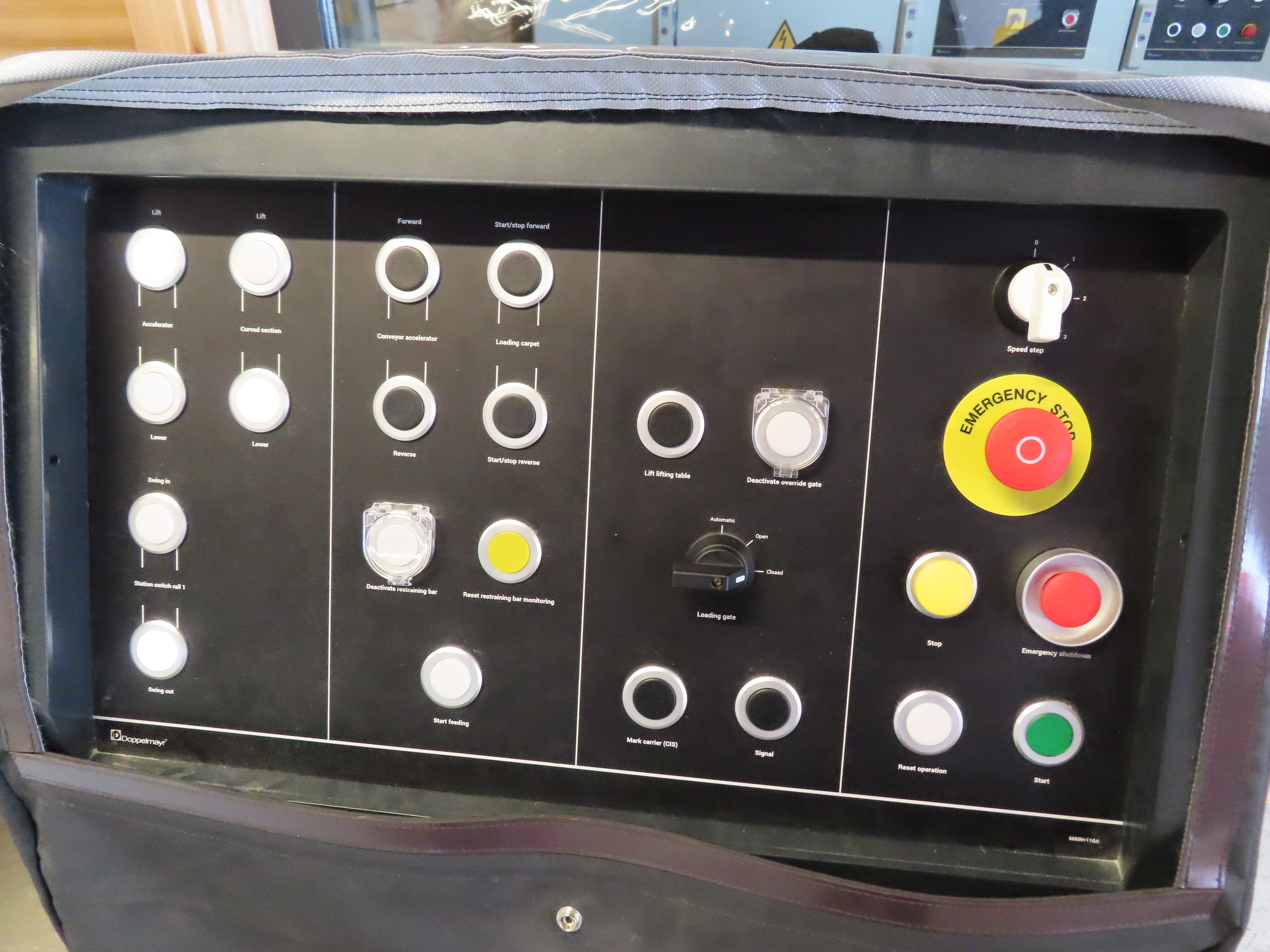
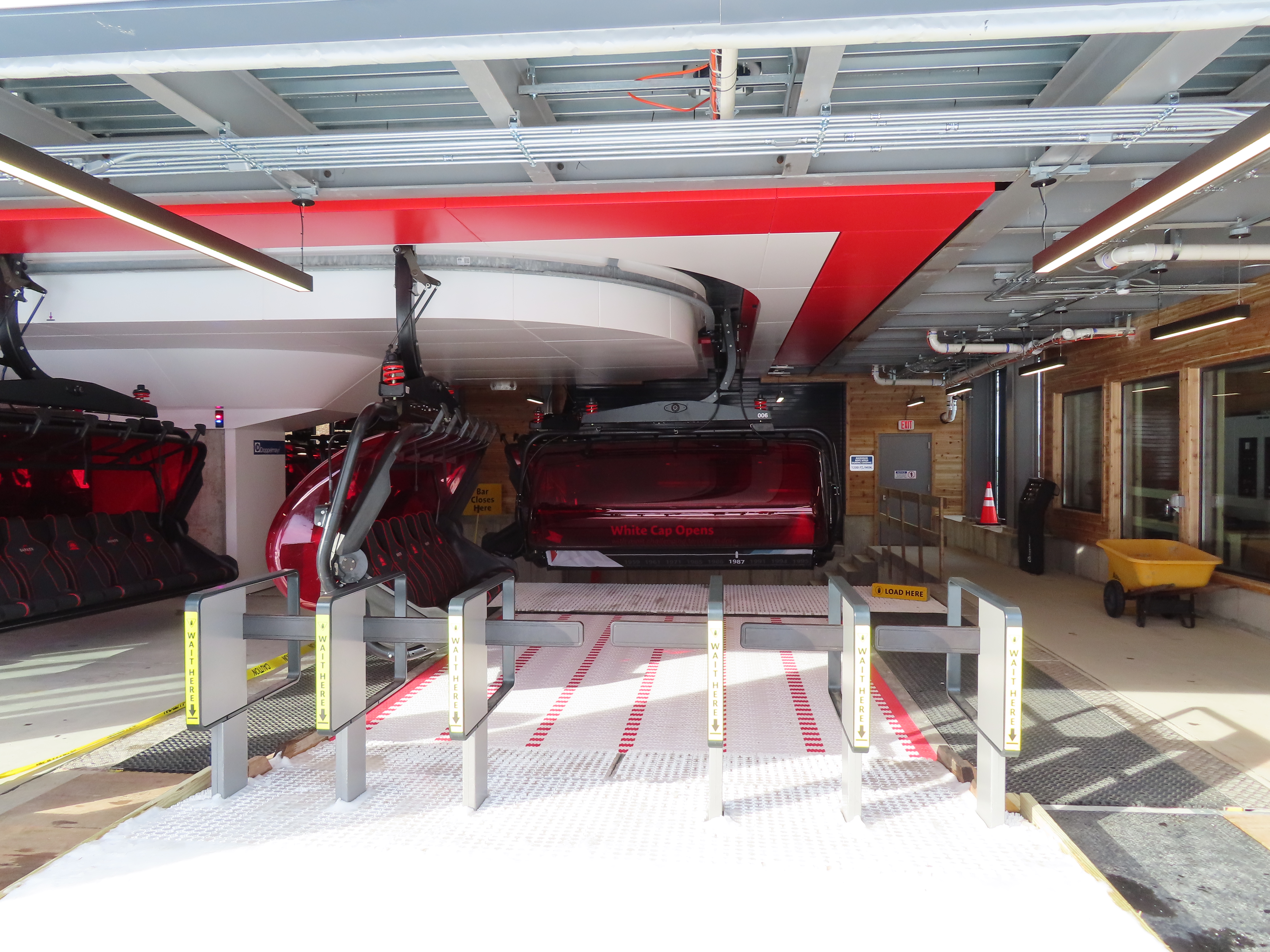
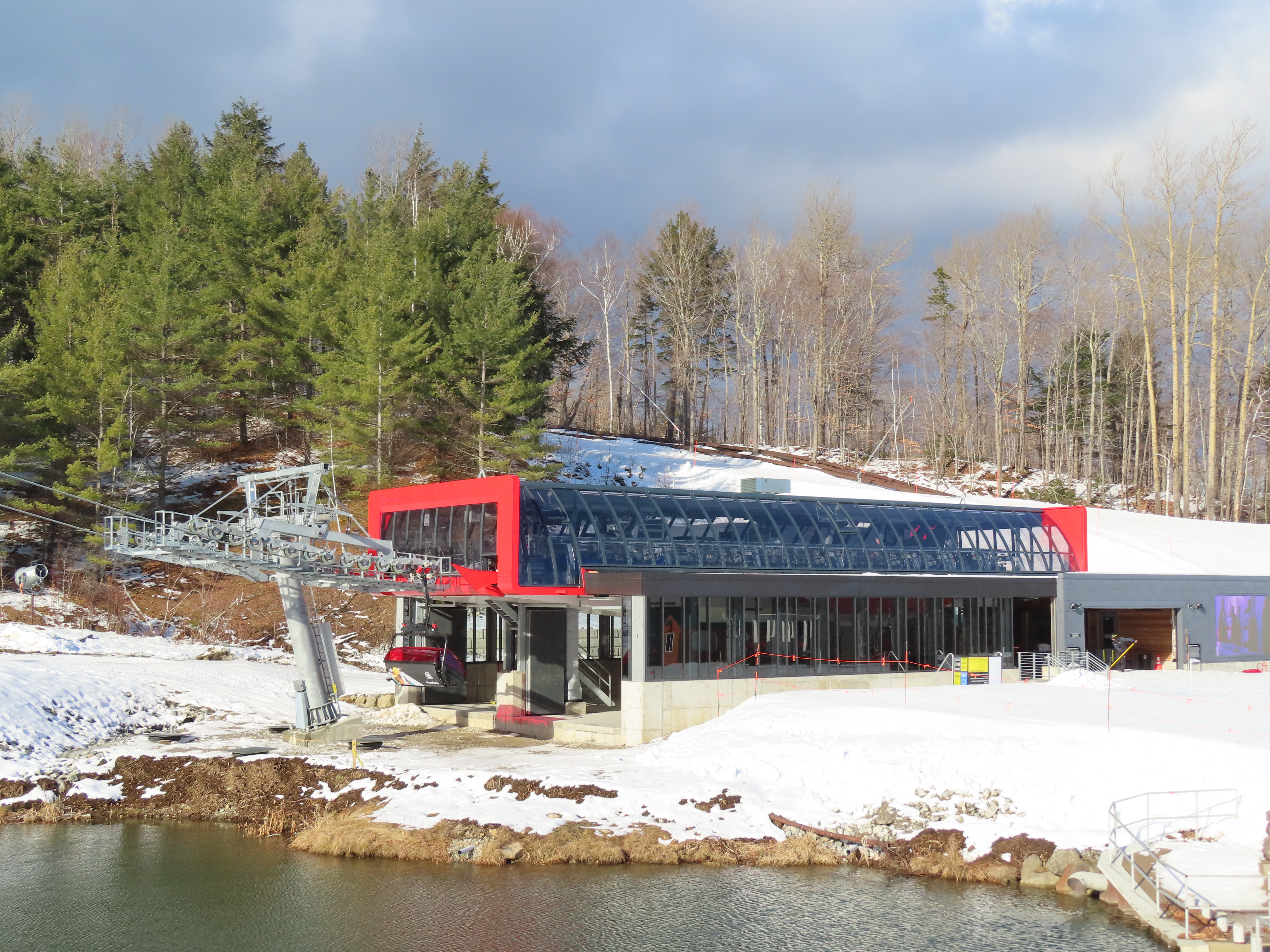
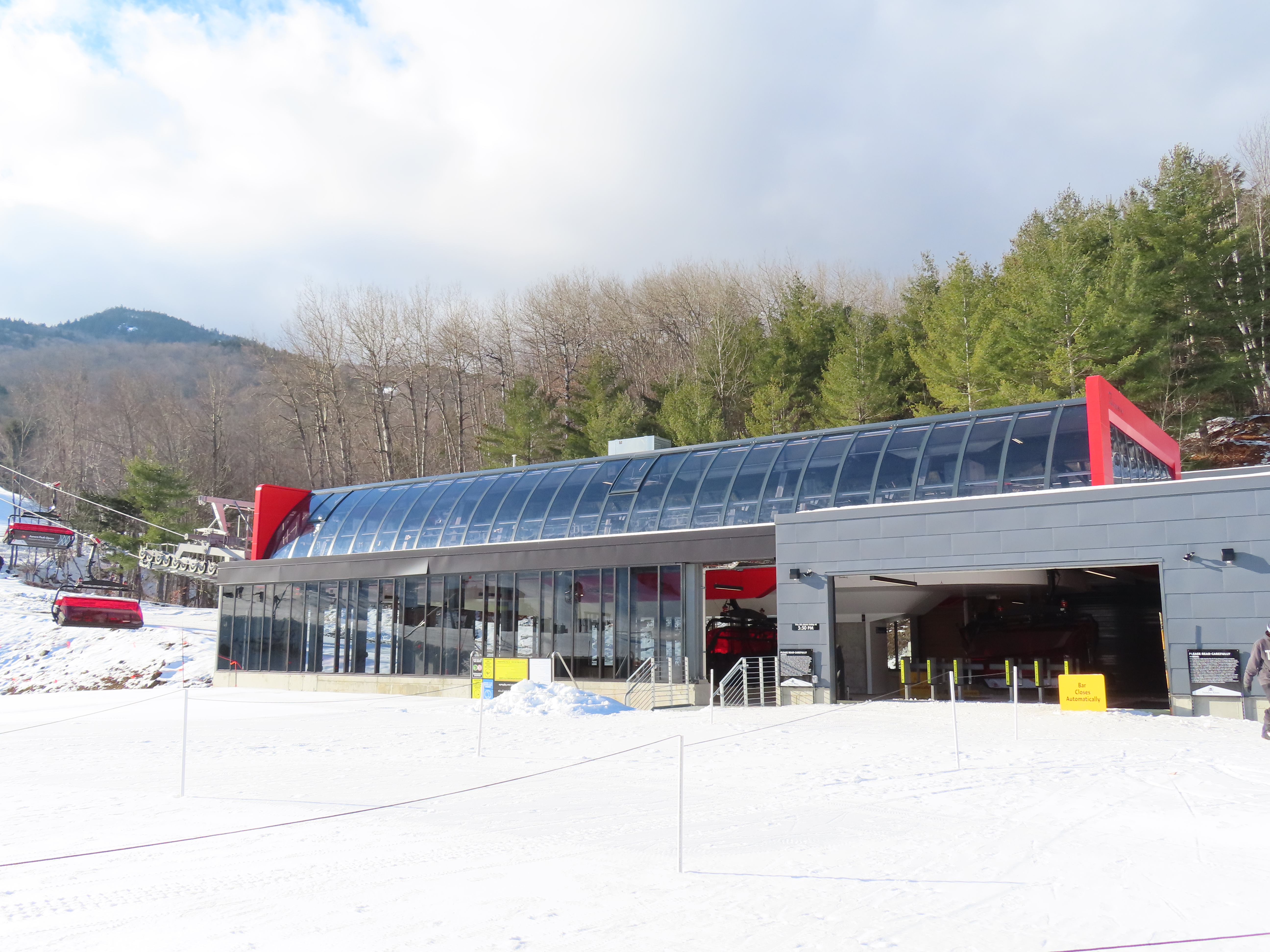
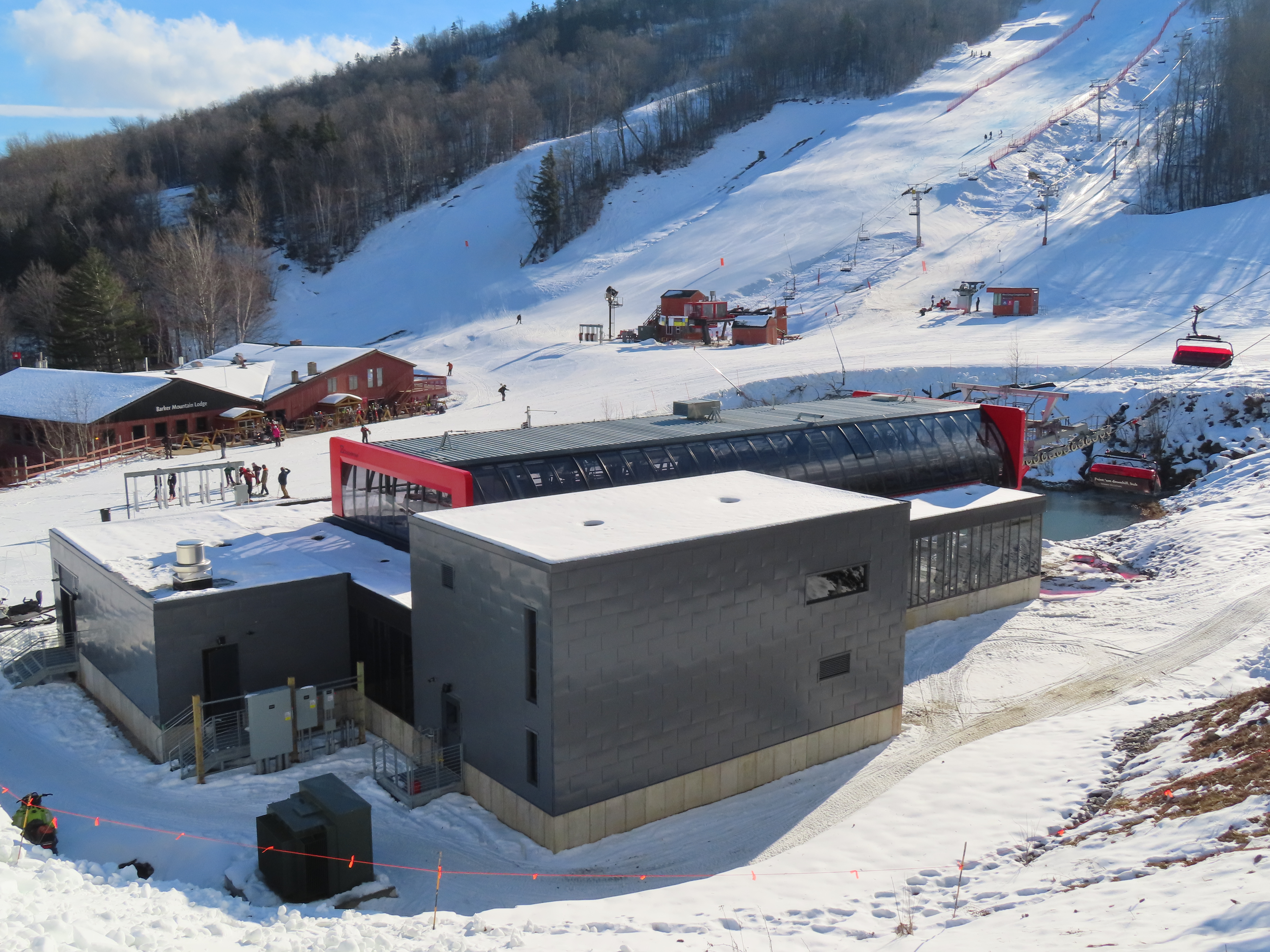
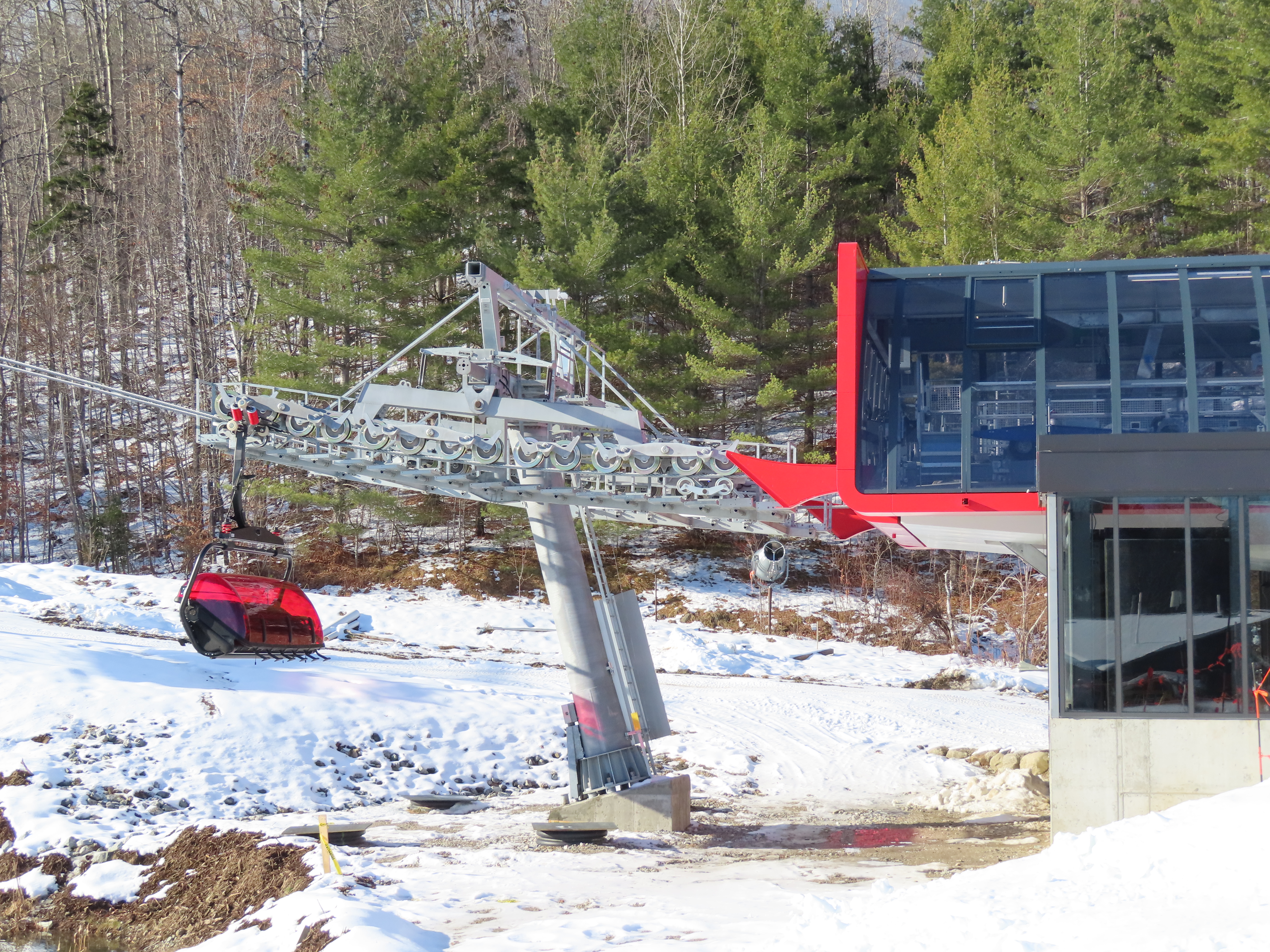
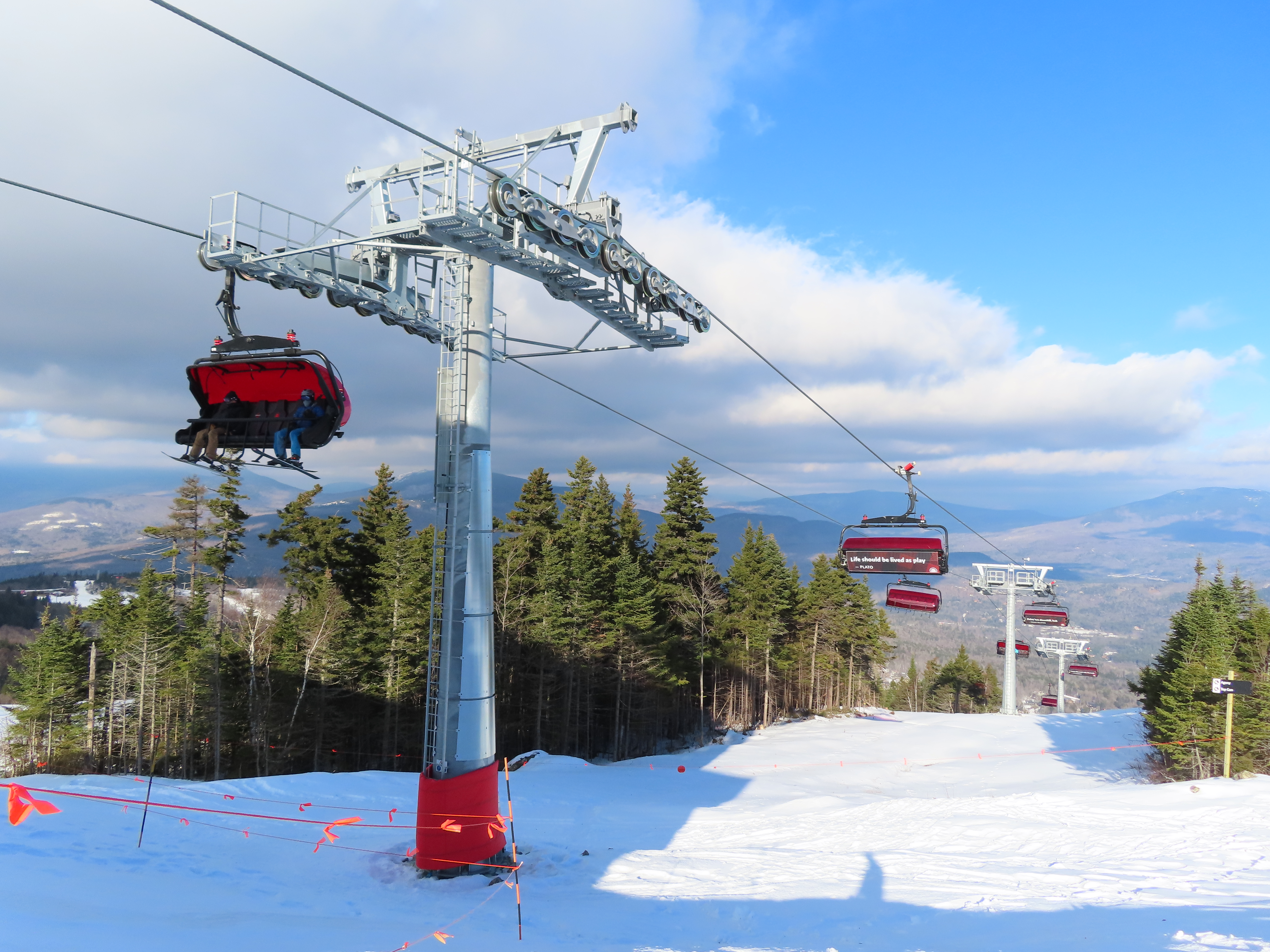
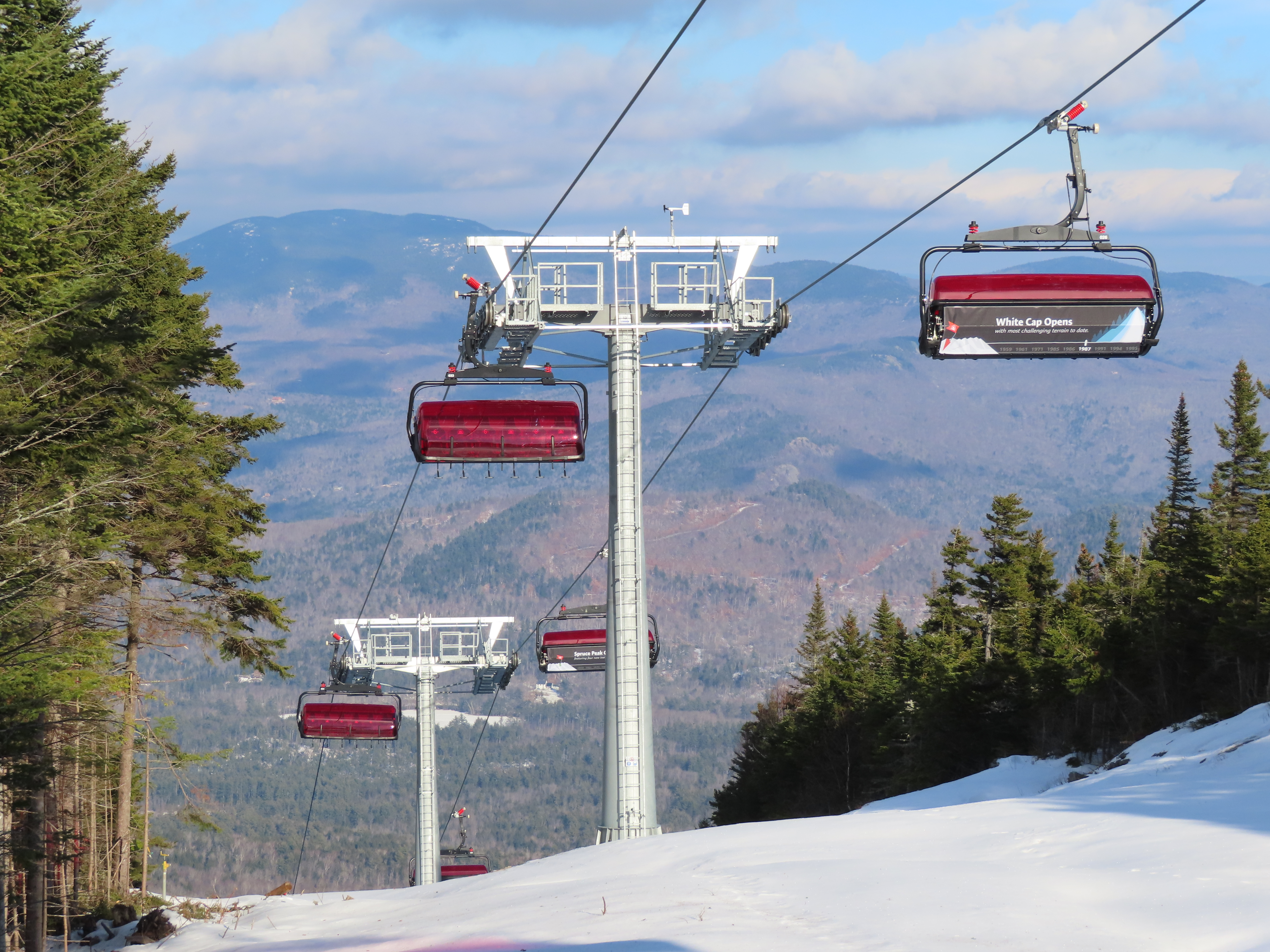
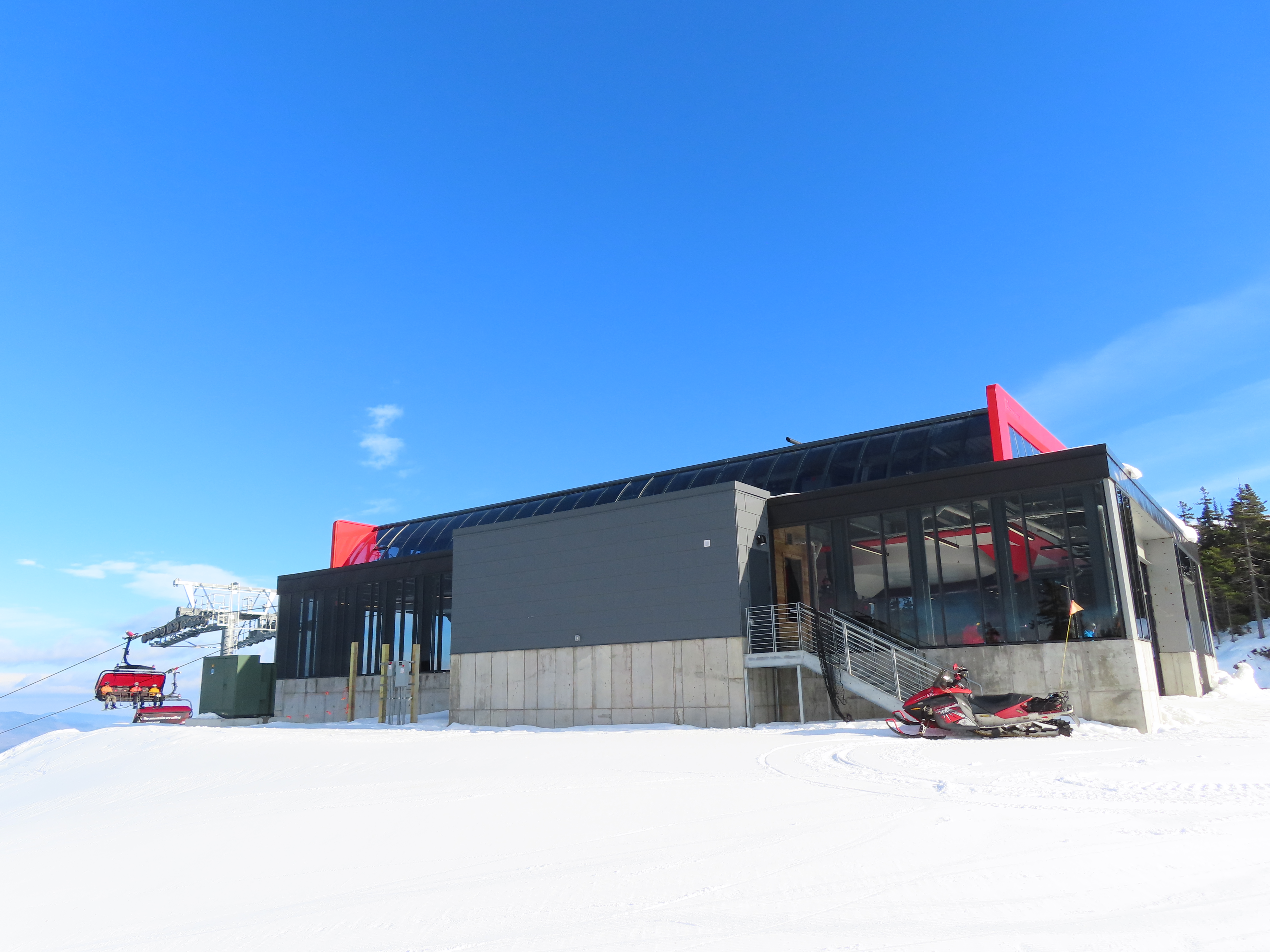
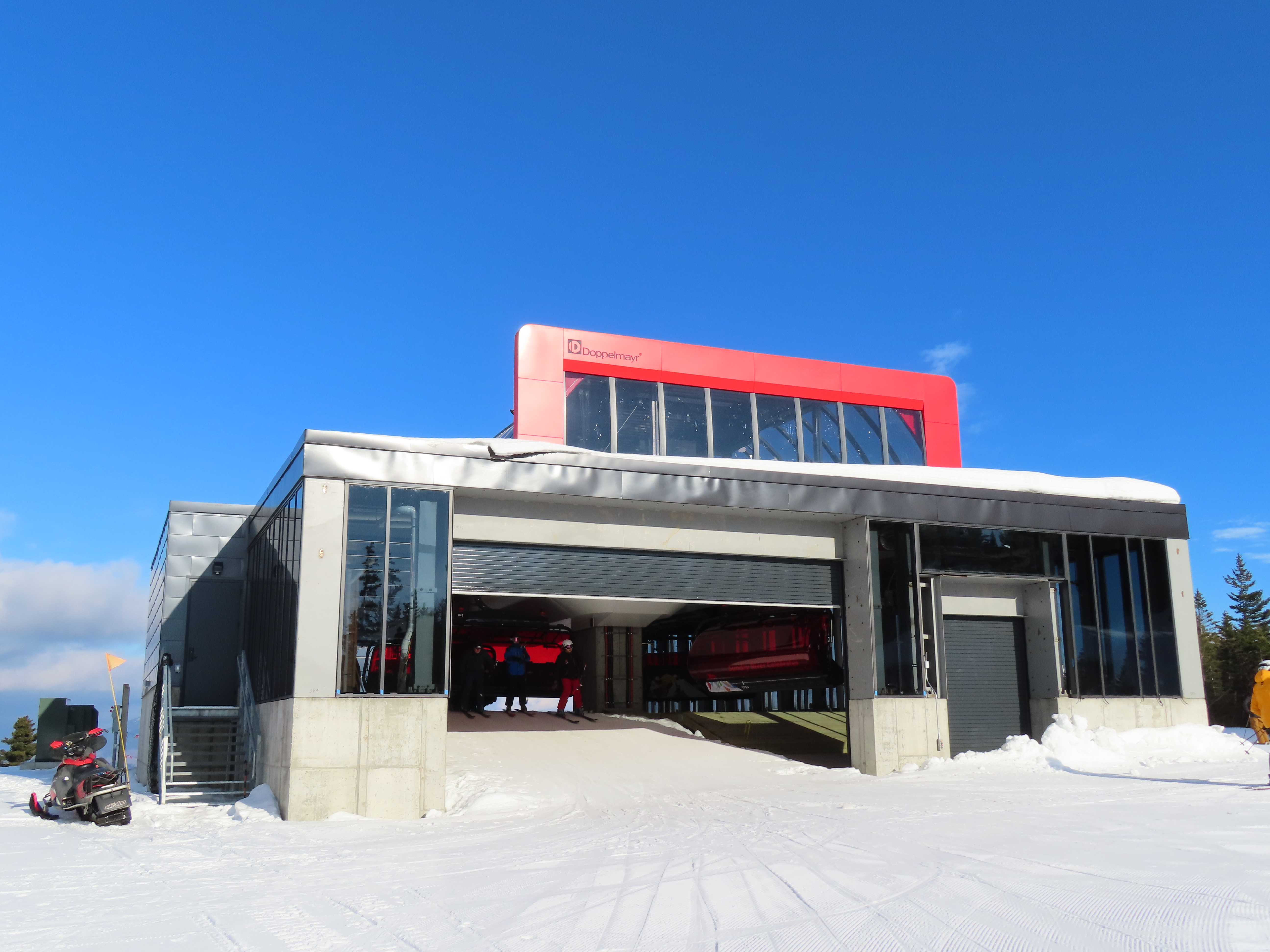
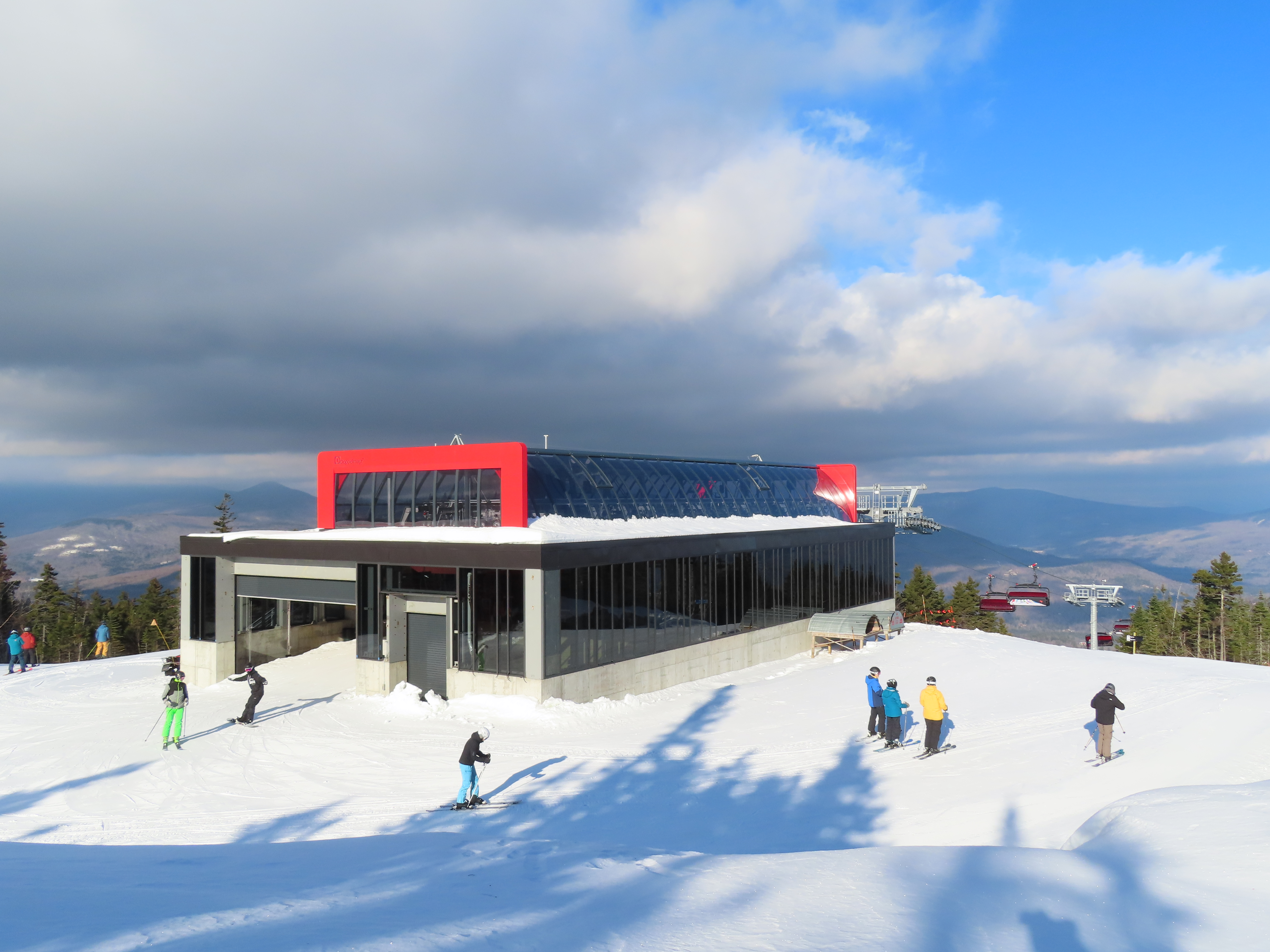
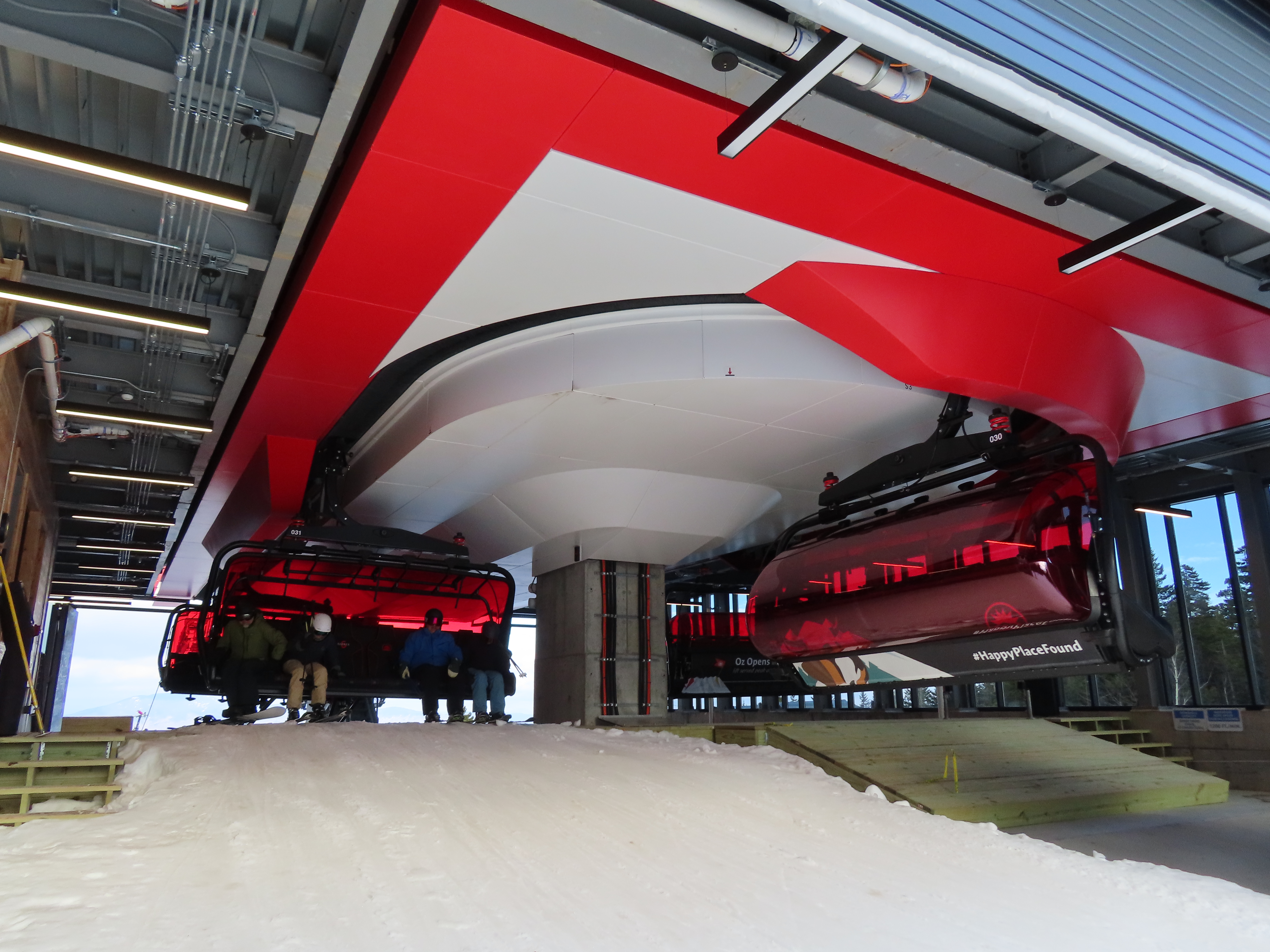
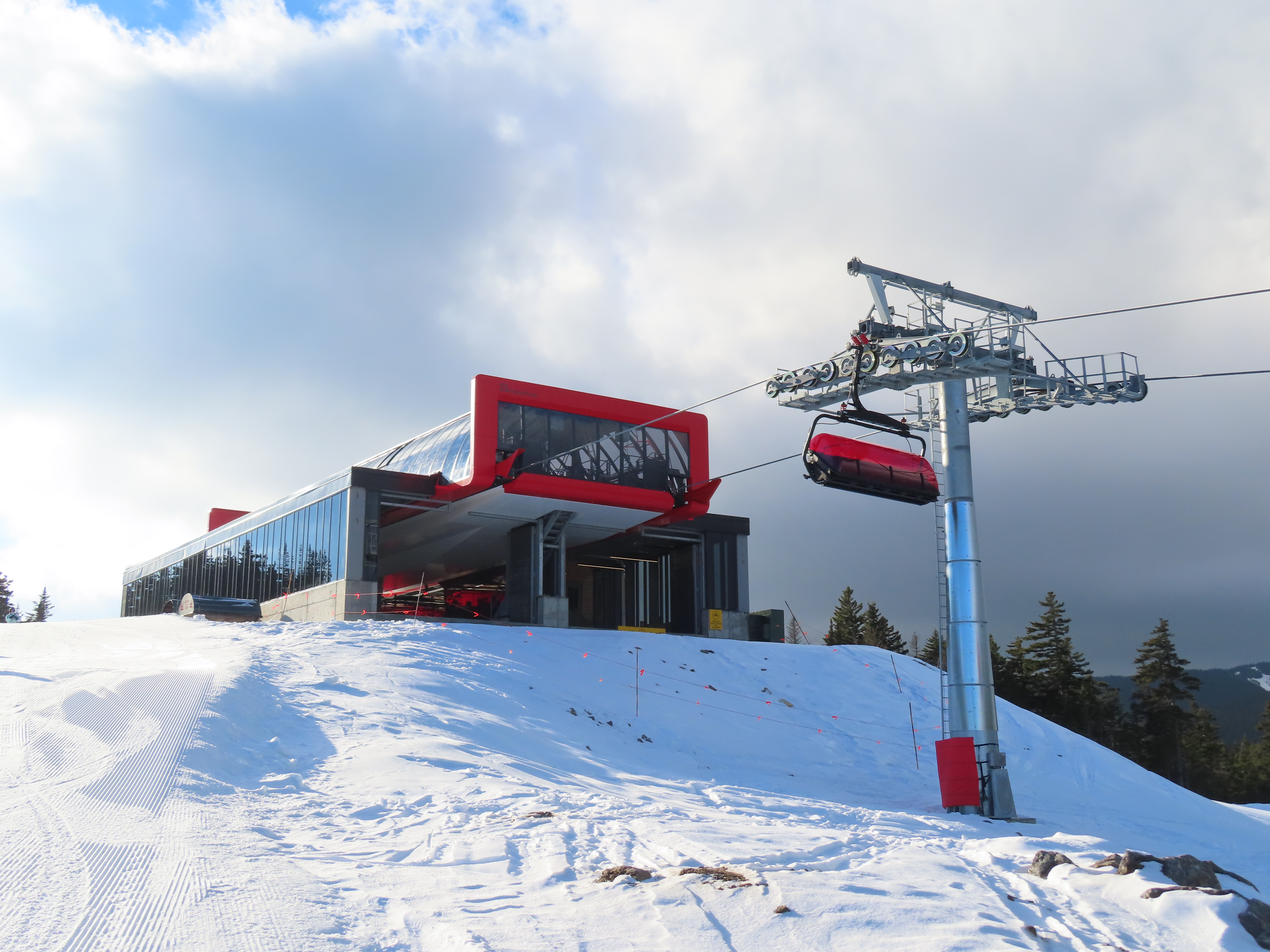
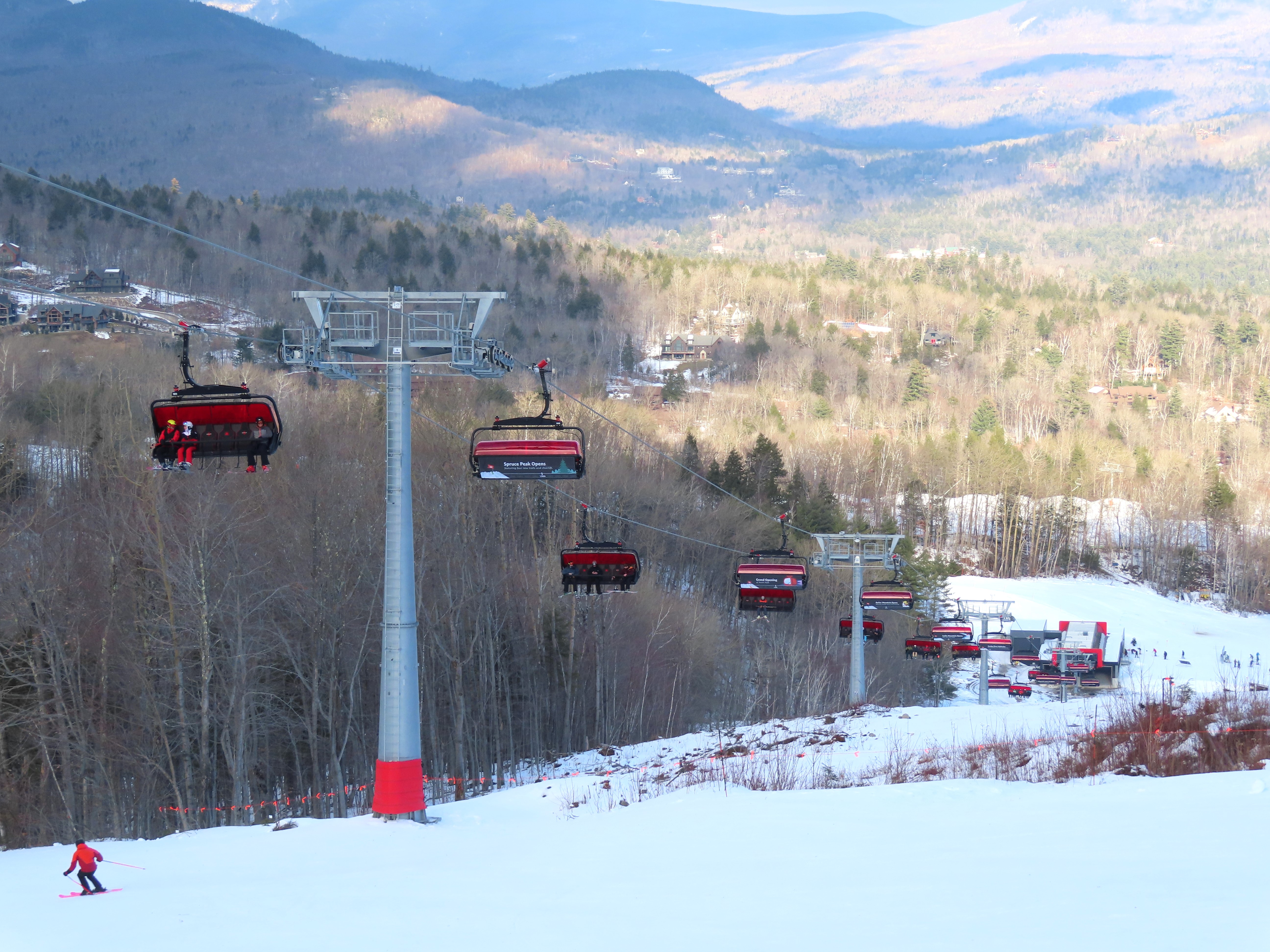
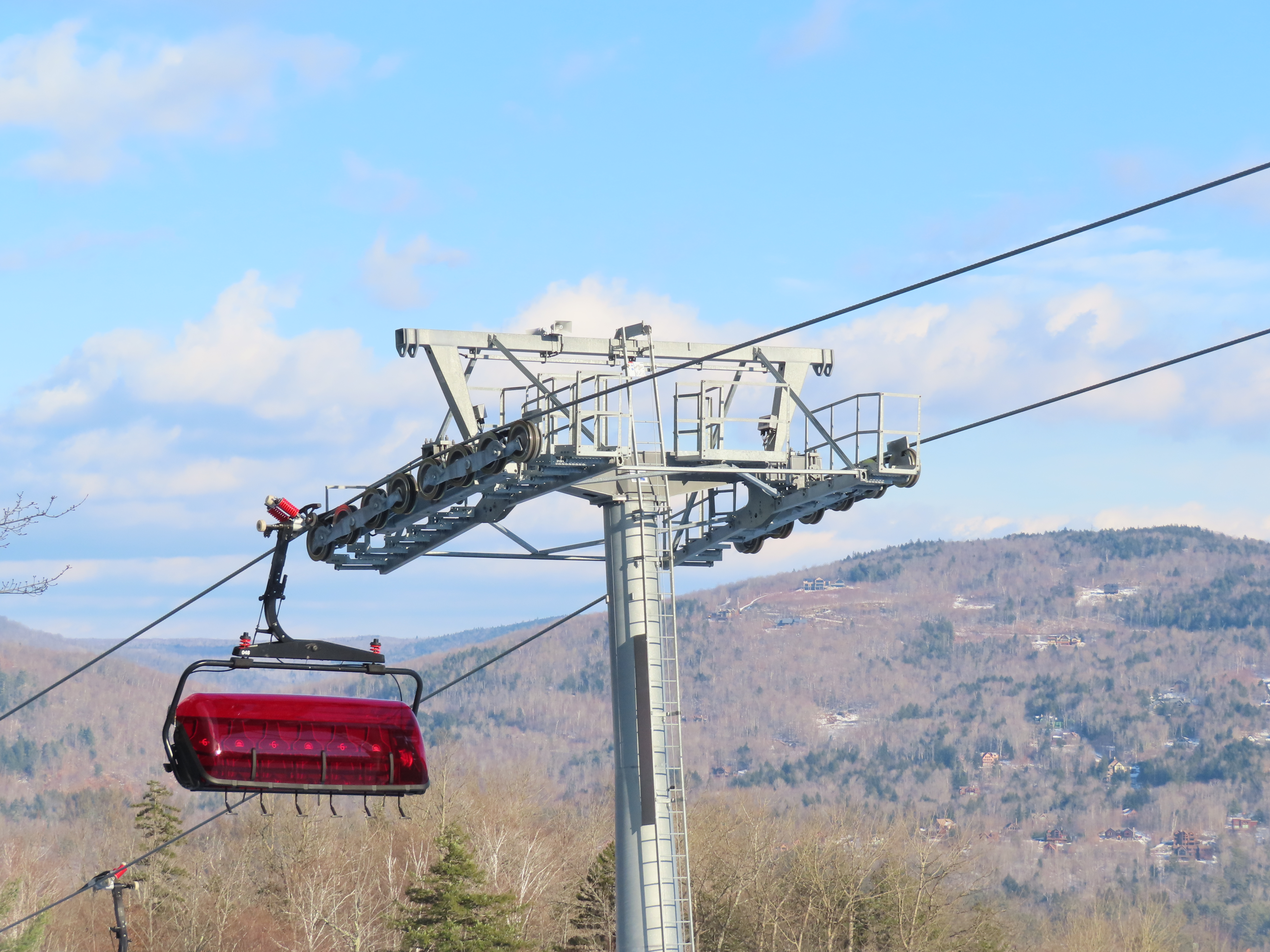
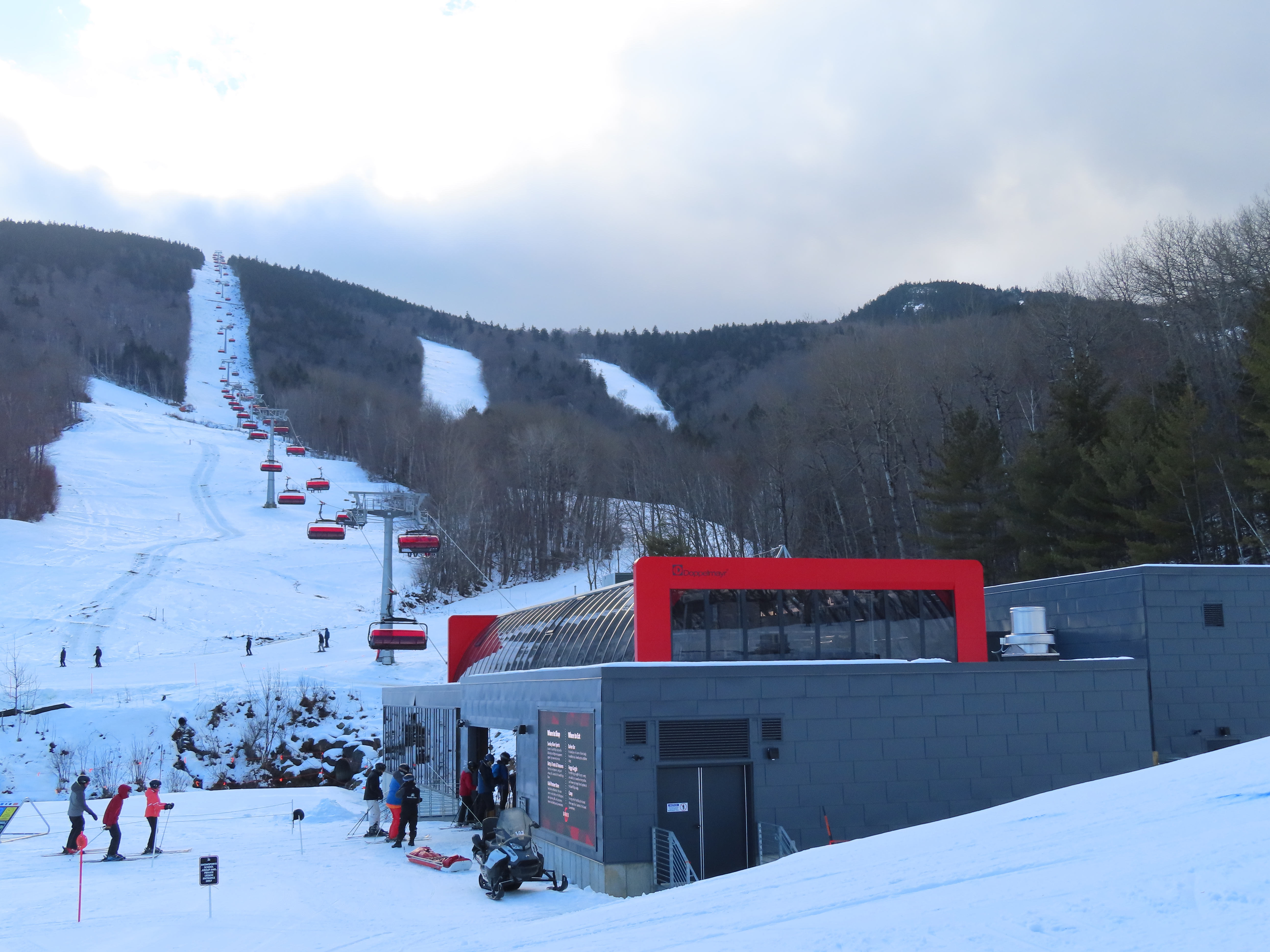
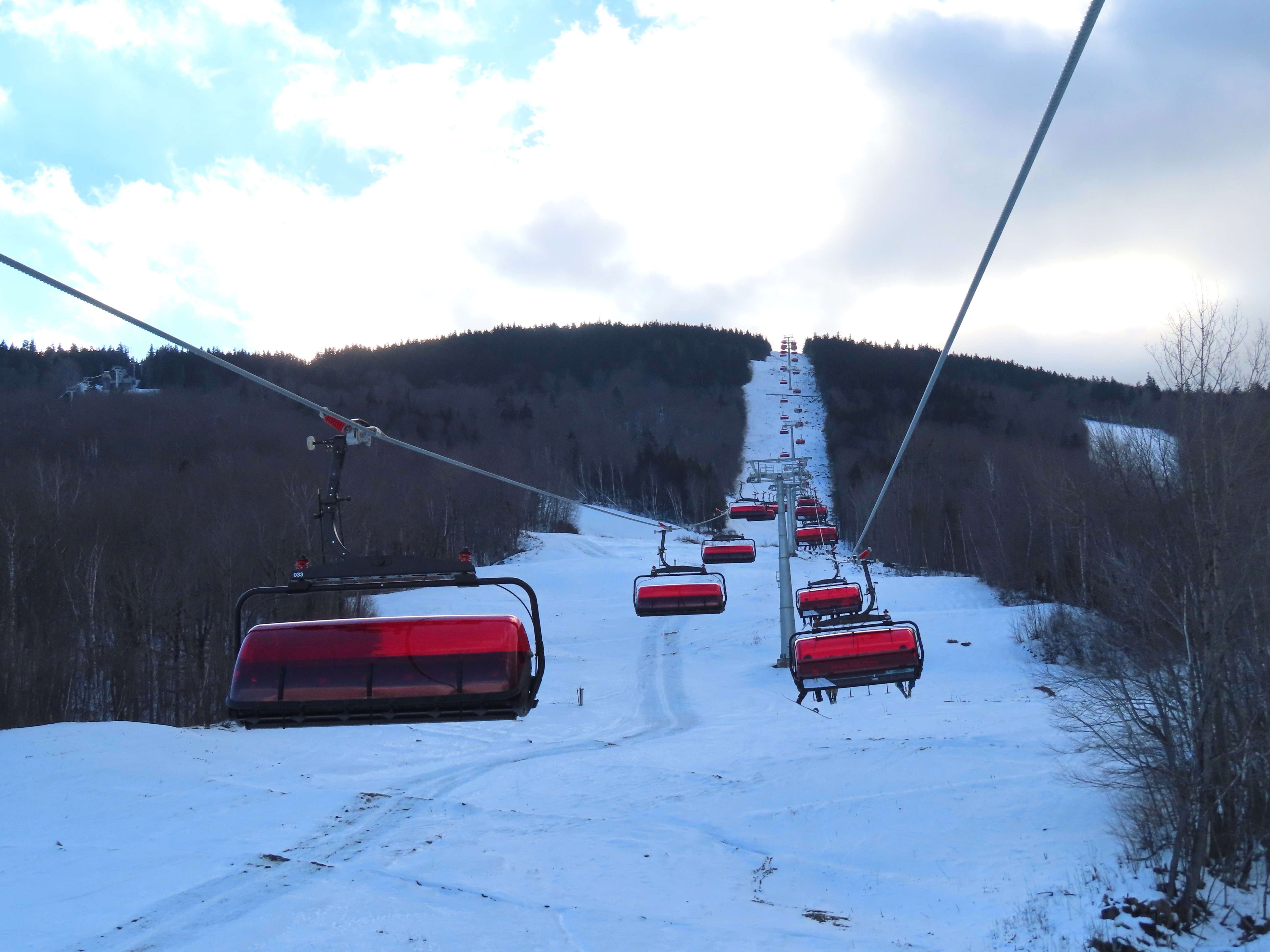
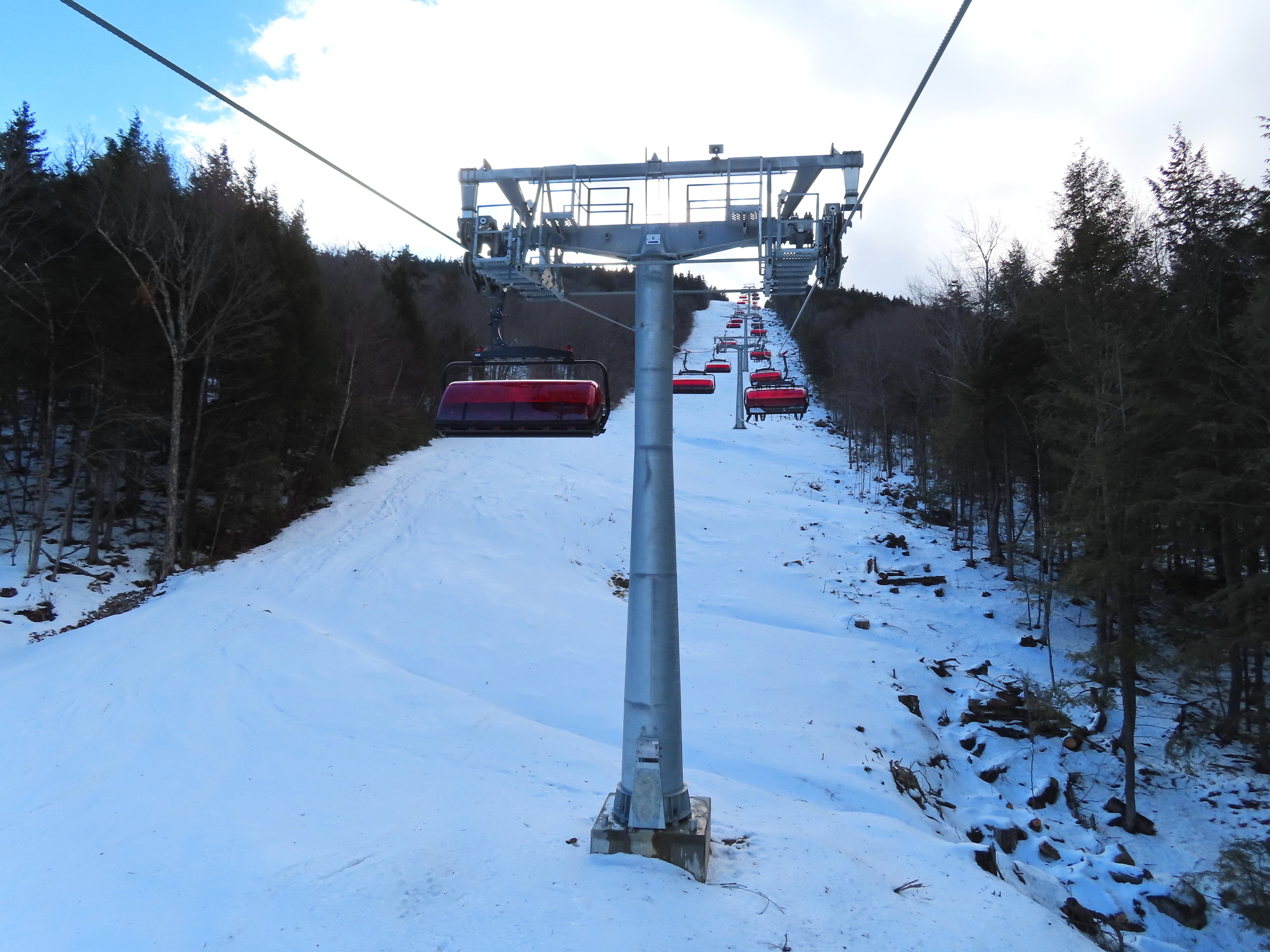
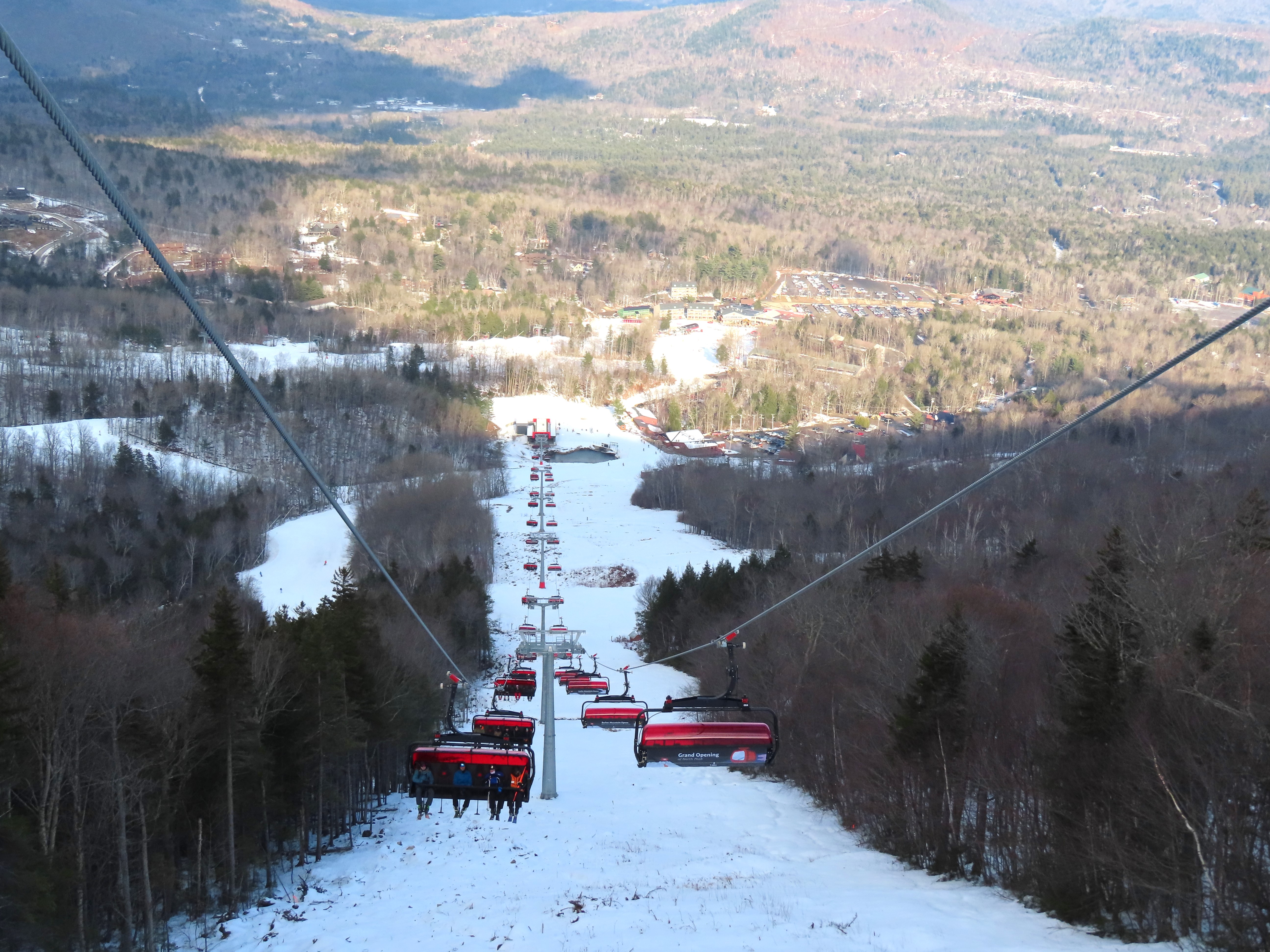
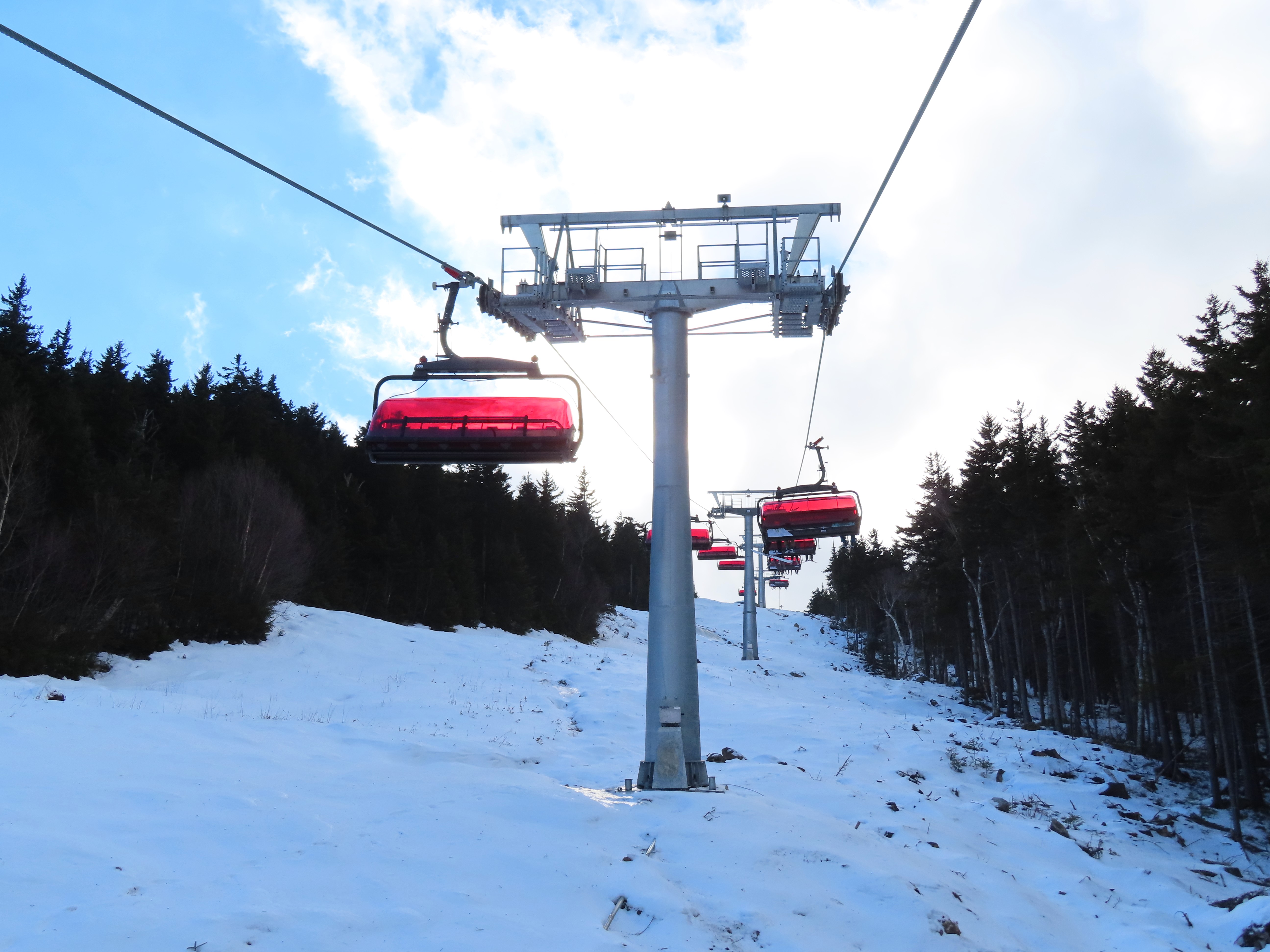
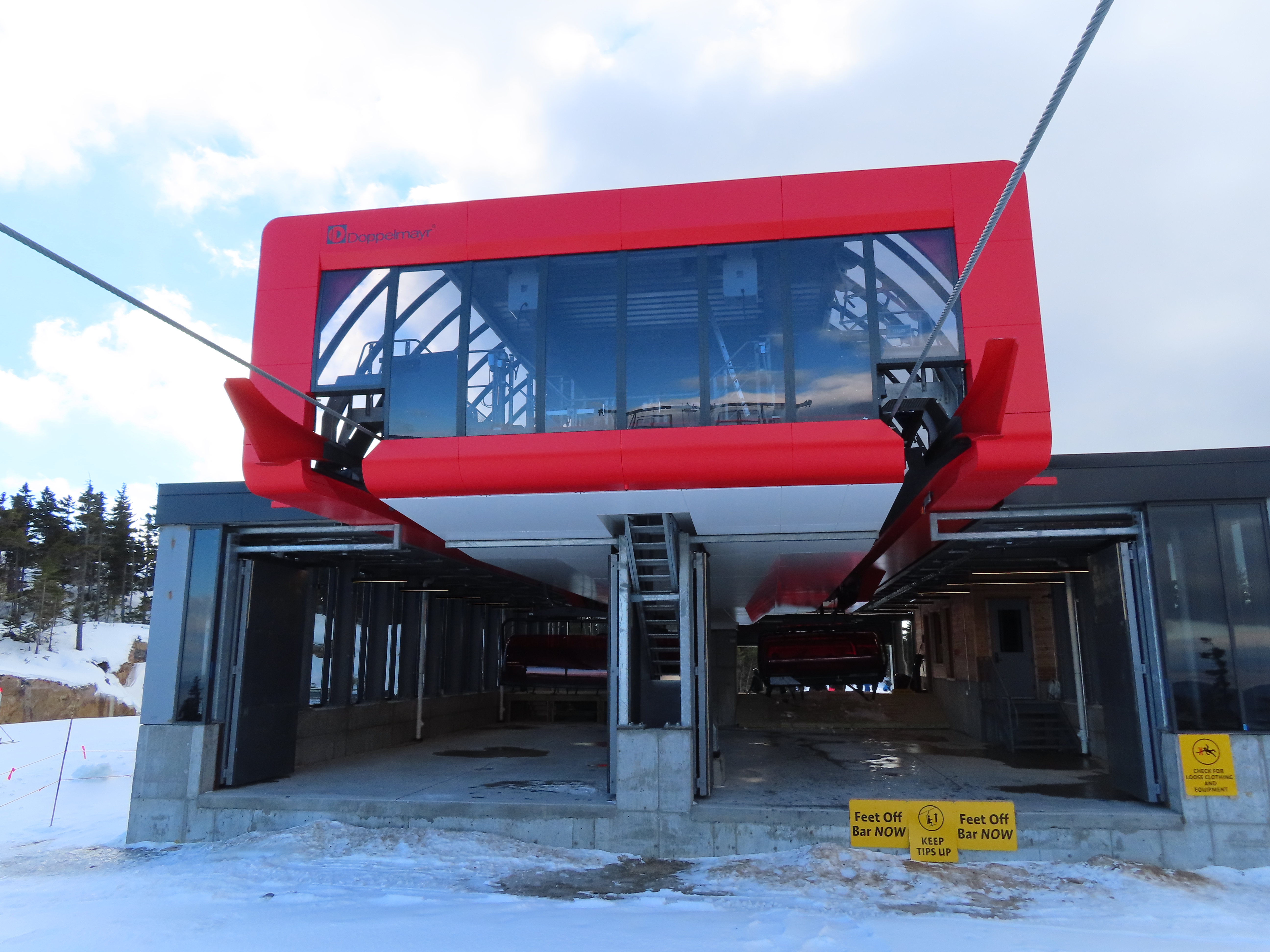
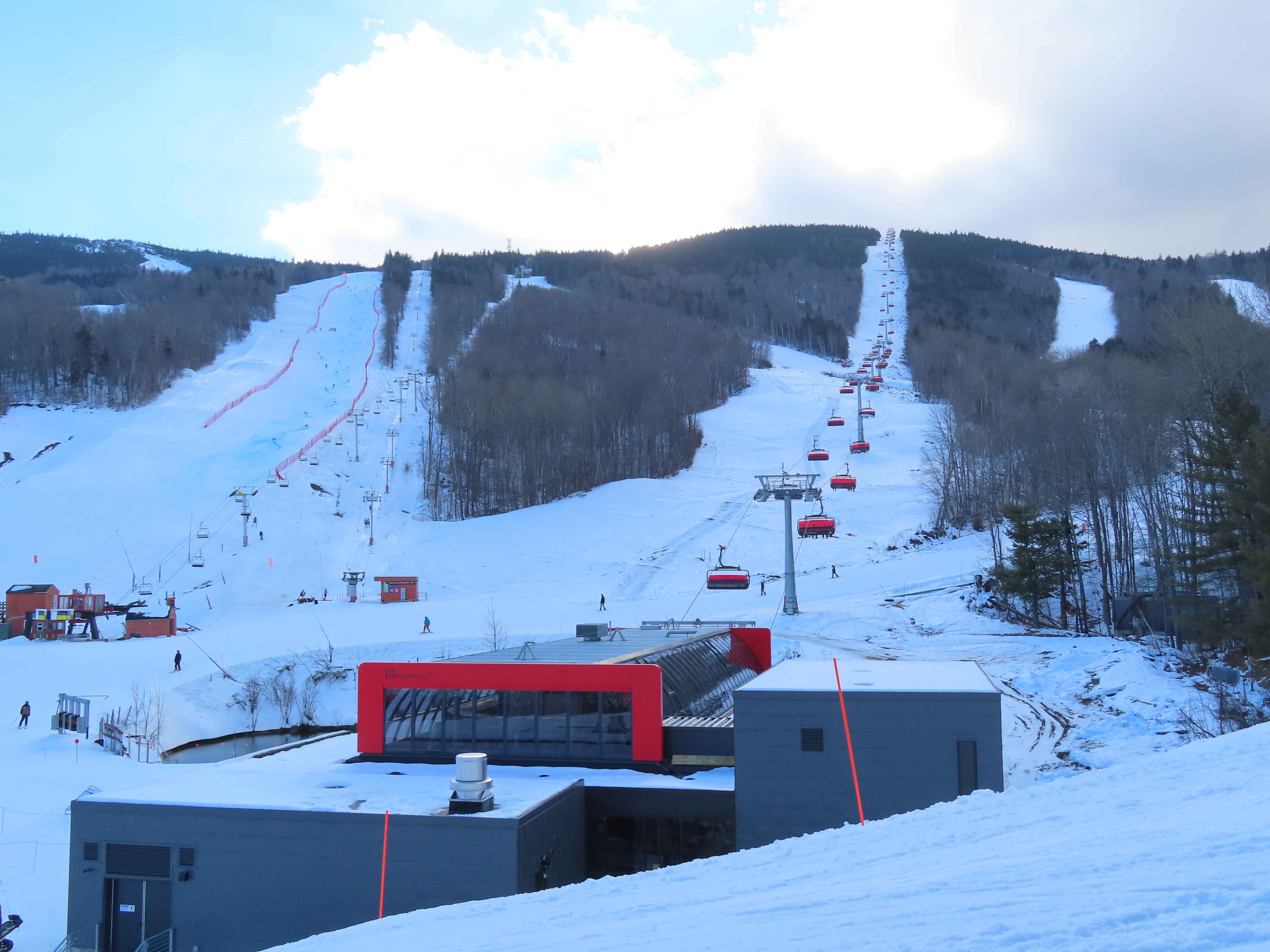
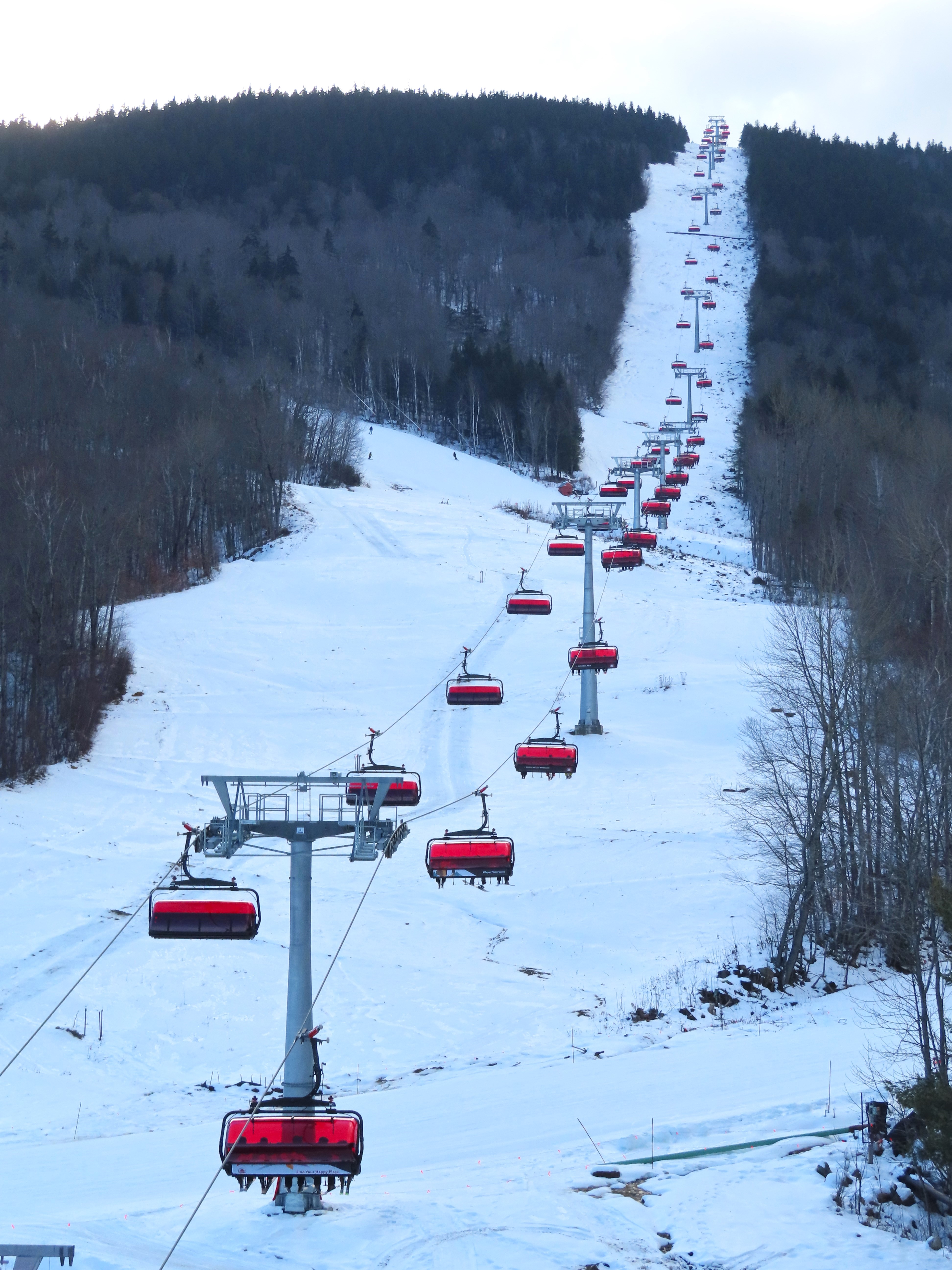
Barker 6 is the third lift to service the main face of Barker Mountain following a high speed quad and double chair before that.This lift is the first six pack in North America with auto closing and locking restraint bars.Each station features parking for around 30 carriers to avoid the need for a separate parking facility.Inside the D20 bottom station.Two ring direct drive motor.Backup diesel engine.Tensioning system in the bottom terminal.D3000 grips.View up the lift line devoid of carriers.Another view of parked carriers.Doppelmayr Connect touch screen.Outside operator controls.Another view of a grip with red springs.90 degree loading with conveyor and gates.The bottom station and tower 1.Tower 2.The bottom station has a small maintenance bay.Maze and loading area.The lower station building.Tower 1.View from the summit.Breakover towers.Side view of the top terminal building with additional chair parking.Unloading area.Upper station overview.Six place D-Line chairs with heated seats.View riding up the line.Looking back down.A support tower.Unloading ramp inside the top building.Tower 14 and the upper station.Lower lift line.An empty chair passing a tower.Lift overview.Riding out of the base area.Tower with combination assemblies.Another look down the line.Nearing the summit.Arriving at the top terminal.Steep middle section of the line.Barker base area with two other lifts.Lift line.
The 90-degree loading and repositioned bottom terminal are much better for crowd flow at the base. However, it is a bit disappointing to see how wide they made Agony with all of that tree-cutting.
I’d call Agony getting widened a necessary compromise, given that they had to realign the lift so it didn’t cross over the middle of the snowmaking pond.
Ski guy whistler localDecember 16, 2023 / 11:06 pm
Why build a fancy lift and make it less capacity then the original. What’s the point there. Yes you get an extra two ppl on the chair and it’s faster but 2700ppl p/h vs the original 3000ppl p/h. I don’t live there so I don’t know what the lines are like on the lift but I don’t rlly understand the whole purpose of that.
The original Barker Mountain might’ve been rated for 3,000 pph, but that assumes it was operating at 1,000 fpm with no stops for misloads/misunloads. Given that it was a lemon of a lift in its final years that had to run at a significantly reduced speed, its actual uphill capacity by the end was somewhere more around the 2,000-2,200 pph range or less. Barker 6 thus is a capacity upgrade because it’s not a lemon that has to run at reduced speed due to maintenance issues.
A lot of older high speed quads had capacities over 2400 per hour, but as mentioned in a different thread, it was usually anticipated that the lifts would not run at full speed during normal operations. Barker ran at 700 fpm, for a capacity of 2100 per hour. If it ran full speed, then the loading interval would be 4.8 seconds. The new lift can run full speed with a much more comfortable 8 second interval.
beyond sheer capacity numbers, Barker was often just down, both from age and from the not entirely successful yan/poma frankenlift design. It wasn’t uncommon for it to go down for somewhere between 30 min to half a day.
On a powder day or during a peak holiday, that would instantly overwhelm the surrounding fixed grip lifts and even start to overload other terrain pods like Jordan. Even on a slow midweek day, it services a key junction and a big chunk of the better lapable terrain at SR.
Having a reliable lift, even if it matched the 2,100ish effective pph of the old Barker, would have been worth the upgrade.
Scary video, but the resort is planning to reopen with this lift on Saturday. Maybe those giant concrete bunkers SR’s built around their D-Line terminals helped!
How does the parking system work on this? It looks like the tires are connected with belts like a standard detachable setup, but there’s not a clear picture of the full tire banks. Are there clutches on each tire so they can stop turning once there’s a chair parked under each individual tire?
Most likely. Leitner offers a pneumatic clutch setup, and all manufacturers have supplied electromagnetic spacing clutches (which can e adapted for station parking) for decades, so that’s my assumption.
Here is a video of the parking sequence on Sunday River’s other D Line. https://www.youtube.com/watch?v=YruOH6T-7Bk You can hear the whole line speed up and slow down as they come into the station, if that helps at all.
Thanks! That’s really cool. Especially with all the first chairs being parked coming into the station with the bubbles down like normal. Then all the ones being parked on the decel bank coming into the station with the bubbles up already so that they all fit. It looks like when you initiate parking, the rails that normally drop the bubbles on the empty chairs going up and all the chairs coming down get moved out of the way.
It’s funny to see Barker’s maze looking so small in these photos. I think since it’s opening it’s looked like that for about a week and a half. At full size it usually looks 3 times as big, LOL!
Peter, it was great to meet you in person to you the day you were here. Keep up the great work!
The ticket checkers have an easier time making full chairs at Barker because the loading corral at Barker is designed for optimal crowd flow. The design works by having your ticked scanned first, put into groups second, than loading the chair last. All tickets are scanned first, and “problem solving” with customers happens before you even enter the maze. When your in the maze skiers make minimal left or right turns to get onto the lift to load, and makes the line move way faster when people do not have to worry about last second issues or not having to shuffle around as much when trying to sit down. At most lifts when you are grouped, the entire party must move around the maze together just to load the chair, which is not the case at Barker.
Jordan’s placement of the RFID creates problems for many reasons; which is why it’s harder to get 8 people to get onto a chair properly. At Jordan, you are put into groups first, tickets scanned second, and then loaded last. The RFID gates are in the exact same position as the loading gates but just farther back. This might not sound bad in theory, but having 8 guests move together in a line when you’ve grouped them together almost never works, as people either take their time (slower skiers) or trying to rush from one side of the maze to the other trying to get to their gate. This confuses most people on which gate to enter in general as they are not numbered. As if that’s not bad enough, when you try to get an entire group of 8 through, if only ONE person has a ticket issue it holds up the entire line of 8 people. Sometimes by the time the issue is solved, the group that’s been paired is split up onto multiple chairs, or just sitting in the cue in limbo wondering if they are still grouped.
It is more stressful when your entire party of 8 get held up because you had your ticket in the wrong spot, inadvertently holding up the entire line in the process!
TL;DR Barker’s maze makes it easier for people to load, while at Jordan the RFID holds people up more.
Hi guys, in this post, Peter mentioned that Barker was a D20 terminal. I know that D-lines come in different sizes, but does anyone know the names? And does it have to do with the number of windows? Thank you!
I’ve counted the windows here, on Colter, Swift Current, and Ramcharger and came out with 17 windows on Colter, 25 on Ramcharger, and 27 on this and Swift Current. So it probably doesn’t have anything to do with windows, but please still tell me what you know about this.
The designation refers to the length of the straight section of tires in meters. So this lifts stations being D20s means the length of the station from the grip entrance to the start of the contour is 20 meters. Ramcharger has D18’s and Camelot has a D26 and a D24.
Everett, would you happen to have any insight as to why the lengths of the three Boyne D-Line sixs’ terminals were selected? It’s interesting to me that Barker 6 has the shortest terminals of the three despite the six m/s speed and in-terminal chair parking. Crest 6 looks to have a shorter (D20?) bottom terminal and a longer top terminal; I think I read that was a D26 with a grip maintenance space. Then there’s Camelot 6, which, as you say, has a D24 and D26; what on that lift would require such long terminals?
Camelot’s stations are so long primarily due to the auto lowering restraining bars and chair storage. The lengths of Barker and Camelot’s bottom stations are different due to Barker having 90 degree loading and thus there is no need for the extra straight section of tires. Both lifts have the same D24 top station though.
Crest also has the same D20/24 combination as Barker, although since that lift lacks auto lowering bars I am not sure why the top station is longer, I would assume it is to allow full terminal parking.
It is a motor and gearbox intergrated in one cylinder style motor. It removed the gearbox which is the cause for most problems, it is also much quieter and maintenance friendly :)
Me and my dad’s first automated locking bar six-person chairlift. It’s such a gorgeous lift: the bubbles and terminals. Great views off this lift and our fastest six-person lift ever! Does get packed very quickly so get here first thing in the morning!










 Lift Blog
This is technically the more advanced of Sunday River’s two D-Lines, given that Jordan 8 doesn’t have auto-locking safety bars.
LikeLike
Speaking of, how those auto-kneemashers even legal?
LikeLiked by 3 people
Looks pretty cool
LikeLike
What’s the capacity?
LikeLike
The 90-degree loading and repositioned bottom terminal are much better for crowd flow at the base. However, it is a bit disappointing to see how wide they made Agony with all of that tree-cutting.
LikeLike
I’d call Agony getting widened a necessary compromise, given that they had to realign the lift so it didn’t cross over the middle of the snowmaking pond.
LikeLike
Videos of the lift:
LikeLiked by 1 person
Why build a fancy lift and make it less capacity then the original. What’s the point there. Yes you get an extra two ppl on the chair and it’s faster but 2700ppl p/h vs the original 3000ppl p/h. I don’t live there so I don’t know what the lines are like on the lift but I don’t rlly understand the whole purpose of that.
LikeLiked by 1 person
The original Barker Mountain might’ve been rated for 3,000 pph, but that assumes it was operating at 1,000 fpm with no stops for misloads/misunloads. Given that it was a lemon of a lift in its final years that had to run at a significantly reduced speed, its actual uphill capacity by the end was somewhere more around the 2,000-2,200 pph range or less. Barker 6 thus is a capacity upgrade because it’s not a lemon that has to run at reduced speed due to maintenance issues.
LikeLiked by 1 person
A lot of older high speed quads had capacities over 2400 per hour, but as mentioned in a different thread, it was usually anticipated that the lifts would not run at full speed during normal operations. Barker ran at 700 fpm, for a capacity of 2100 per hour. If it ran full speed, then the loading interval would be 4.8 seconds. The new lift can run full speed with a much more comfortable 8 second interval.
LikeLike
beyond sheer capacity numbers, Barker was often just down, both from age and from the not entirely successful yan/poma frankenlift design. It wasn’t uncommon for it to go down for somewhere between 30 min to half a day.
On a powder day or during a peak holiday, that would instantly overwhelm the surrounding fixed grip lifts and even start to overload other terrain pods like Jordan. Even on a slow midweek day, it services a key junction and a big chunk of the better lapable terrain at SR.
Having a reliable lift, even if it matched the 2,100ish effective pph of the old Barker, would have been worth the upgrade.
LikeLike
I’m wondering if the storm will have any significant operational impact on the lift: https://www.facebook.com/groups/370214754012000/permalink/1073716656995136/?mibextid=oMANbw
LikeLike
Scary video, but the resort is planning to reopen with this lift on Saturday. Maybe those giant concrete bunkers SR’s built around their D-Line terminals helped!
LikeLike
Aesthetically this is one of the coolest lifts out there
LikeLike
How does the parking system work on this? It looks like the tires are connected with belts like a standard detachable setup, but there’s not a clear picture of the full tire banks. Are there clutches on each tire so they can stop turning once there’s a chair parked under each individual tire?
LikeLike
Most likely. Leitner offers a pneumatic clutch setup, and all manufacturers have supplied electromagnetic spacing clutches (which can e adapted for station parking) for decades, so that’s my assumption.
LikeLike
Here is a video of the parking sequence on Sunday River’s other D Line. https://www.youtube.com/watch?v=YruOH6T-7Bk You can hear the whole line speed up and slow down as they come into the station, if that helps at all.
LikeLike
Thanks! That’s really cool. Especially with all the first chairs being parked coming into the station with the bubbles down like normal. Then all the ones being parked on the decel bank coming into the station with the bubbles up already so that they all fit. It looks like when you initiate parking, the rails that normally drop the bubbles on the empty chairs going up and all the chairs coming down get moved out of the way.
LikeLike
D-Lines are my favorite Doppelmayr model!
LikeLike
It’s funny to see Barker’s maze looking so small in these photos. I think since it’s opening it’s looked like that for about a week and a half. At full size it usually looks 3 times as big, LOL!
Peter, it was great to meet you in person to you the day you were here. Keep up the great work!
LikeLike
SR certainly did a better job of trying to load chairs to the max during busy times at Barker than they do at Jordan.
LikeLike
The ticket checkers have an easier time making full chairs at Barker because the loading corral at Barker is designed for optimal crowd flow. The design works by having your ticked scanned first, put into groups second, than loading the chair last. All tickets are scanned first, and “problem solving” with customers happens before you even enter the maze. When your in the maze skiers make minimal left or right turns to get onto the lift to load, and makes the line move way faster when people do not have to worry about last second issues or not having to shuffle around as much when trying to sit down. At most lifts when you are grouped, the entire party must move around the maze together just to load the chair, which is not the case at Barker.
Jordan’s placement of the RFID creates problems for many reasons; which is why it’s harder to get 8 people to get onto a chair properly. At Jordan, you are put into groups first, tickets scanned second, and then loaded last. The RFID gates are in the exact same position as the loading gates but just farther back. This might not sound bad in theory, but having 8 guests move together in a line when you’ve grouped them together almost never works, as people either take their time (slower skiers) or trying to rush from one side of the maze to the other trying to get to their gate. This confuses most people on which gate to enter in general as they are not numbered. As if that’s not bad enough, when you try to get an entire group of 8 through, if only ONE person has a ticket issue it holds up the entire line of 8 people. Sometimes by the time the issue is solved, the group that’s been paired is split up onto multiple chairs, or just sitting in the cue in limbo wondering if they are still grouped.
It is more stressful when your entire party of 8 get held up because you had your ticket in the wrong spot, inadvertently holding up the entire line in the process!
TL;DR Barker’s maze makes it easier for people to load, while at Jordan the RFID holds people up more.
LikeLike
Hi guys, in this post, Peter mentioned that Barker was a D20 terminal. I know that D-lines come in different sizes, but does anyone know the names? And does it have to do with the number of windows? Thank you!
LikeLike
I’ve counted the windows here, on Colter, Swift Current, and Ramcharger and came out with 17 windows on Colter, 25 on Ramcharger, and 27 on this and Swift Current. So it probably doesn’t have anything to do with windows, but please still tell me what you know about this.
LikeLike
The designation refers to the length of the straight section of tires in meters. So this lifts stations being D20s means the length of the station from the grip entrance to the start of the contour is 20 meters. Ramcharger has D18’s and Camelot has a D26 and a D24.
LikeLike
Everett, would you happen to have any insight as to why the lengths of the three Boyne D-Line sixs’ terminals were selected? It’s interesting to me that Barker 6 has the shortest terminals of the three despite the six m/s speed and in-terminal chair parking. Crest 6 looks to have a shorter (D20?) bottom terminal and a longer top terminal; I think I read that was a D26 with a grip maintenance space. Then there’s Camelot 6, which, as you say, has a D24 and D26; what on that lift would require such long terminals?
LikeLike
Camelot’s stations are so long primarily due to the auto lowering restraining bars and chair storage. The lengths of Barker and Camelot’s bottom stations are different due to Barker having 90 degree loading and thus there is no need for the extra straight section of tires. Both lifts have the same D24 top station though.
Crest also has the same D20/24 combination as Barker, although since that lift lacks auto lowering bars I am not sure why the top station is longer, I would assume it is to allow full terminal parking.
LikeLike
What about Black Bear and Colter?
LikeLike
What is a direct drive and what are its benefits?
LikeLike
It is a motor and gearbox intergrated in one cylinder style motor. It removed the gearbox which is the cause for most problems, it is also much quieter and maintenance friendly :)
LikeLiked by 1 person
Me and my dad’s first automated locking bar six-person chairlift. It’s such a gorgeous lift: the bubbles and terminals. Great views off this lift and our fastest six-person lift ever! Does get packed very quickly so get here first thing in the morning!
LikeLike