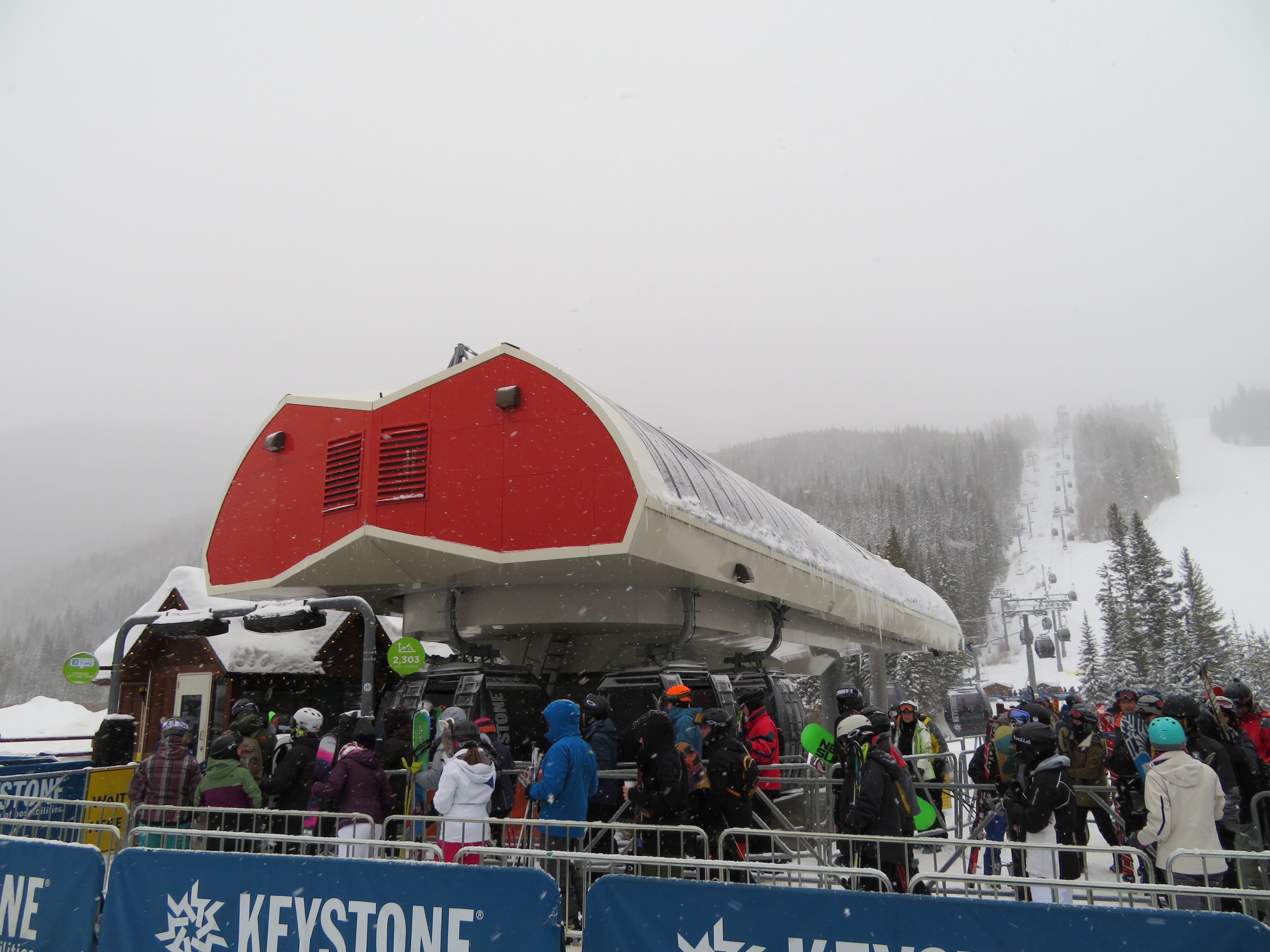
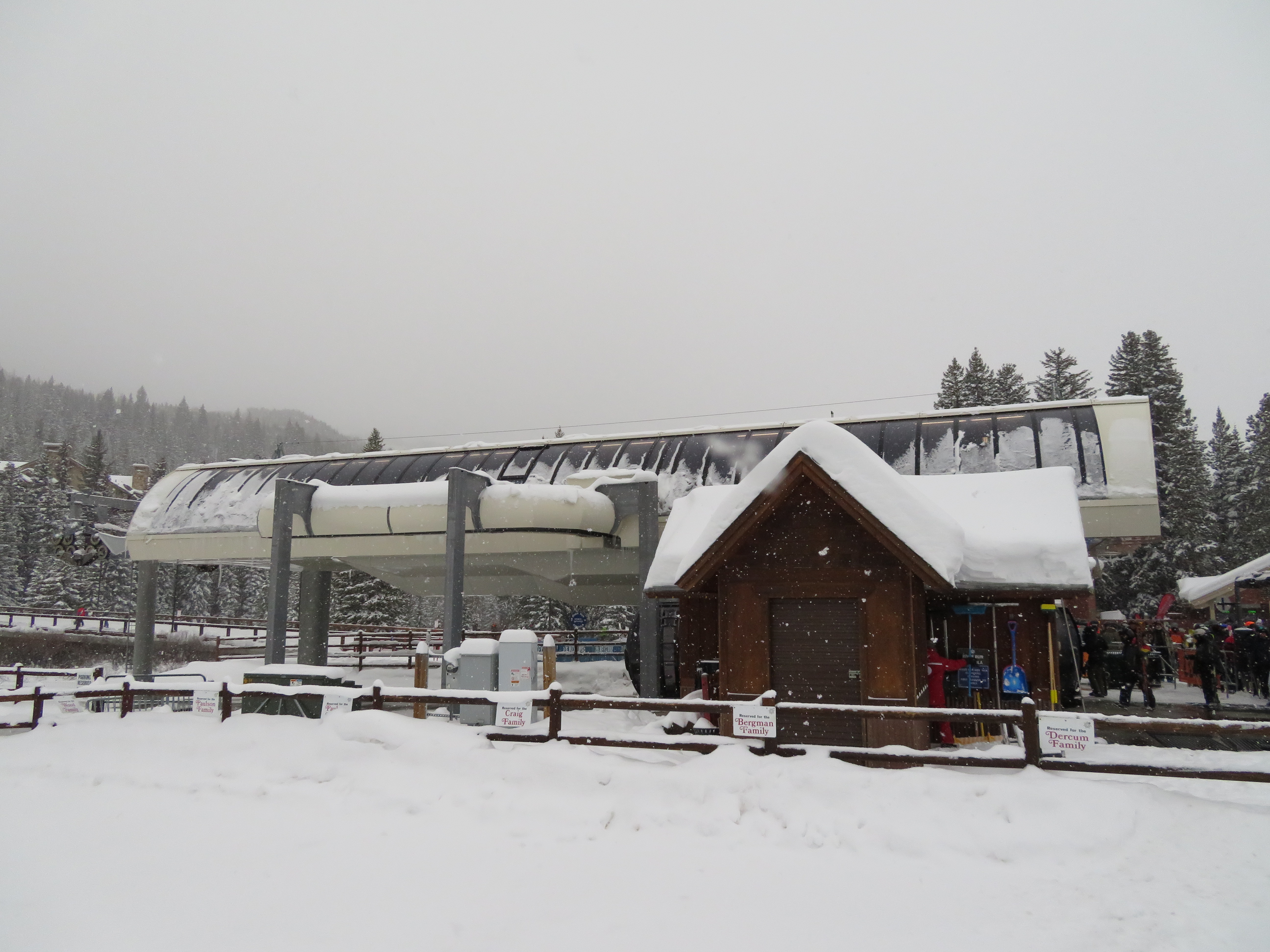
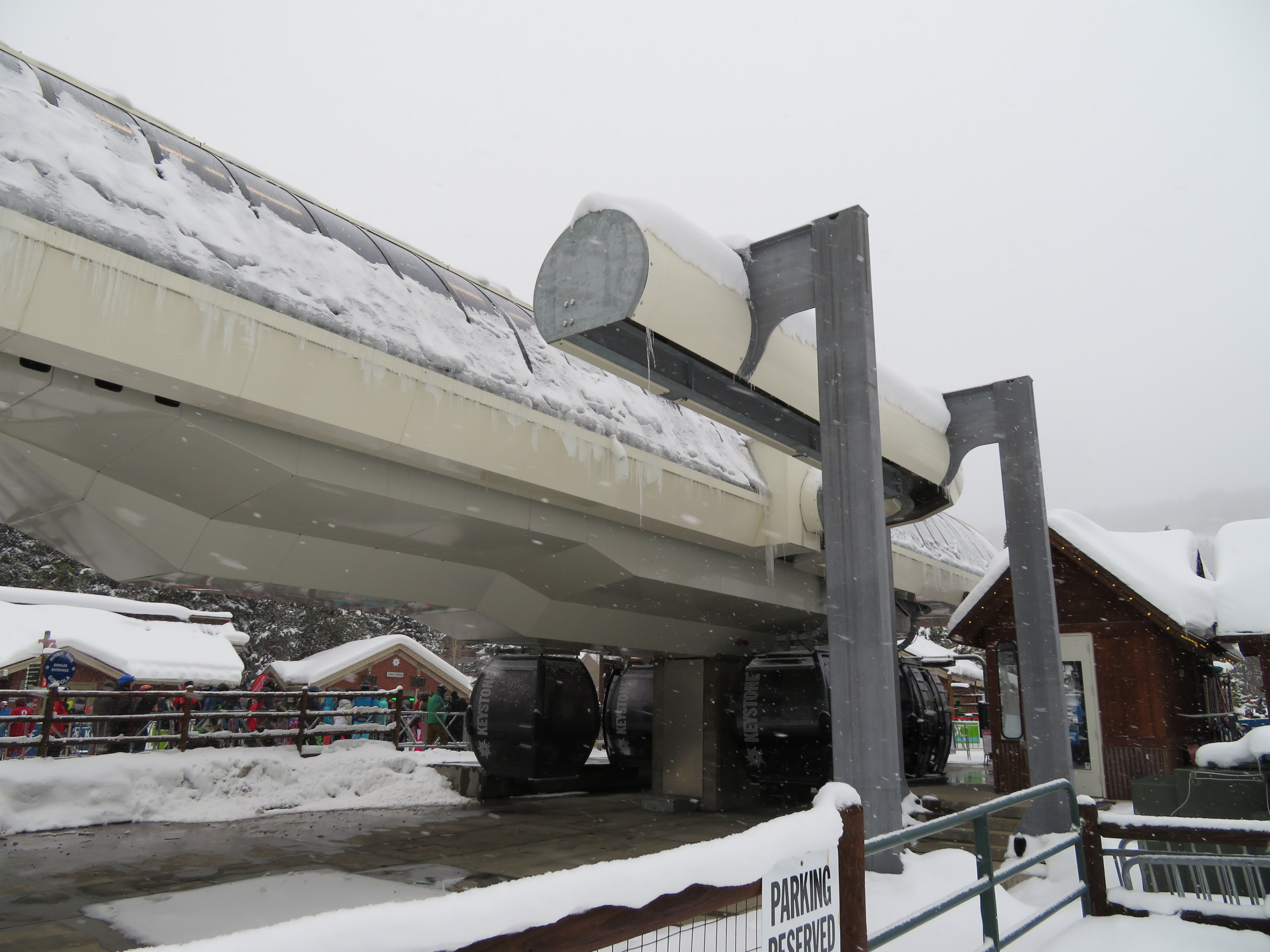
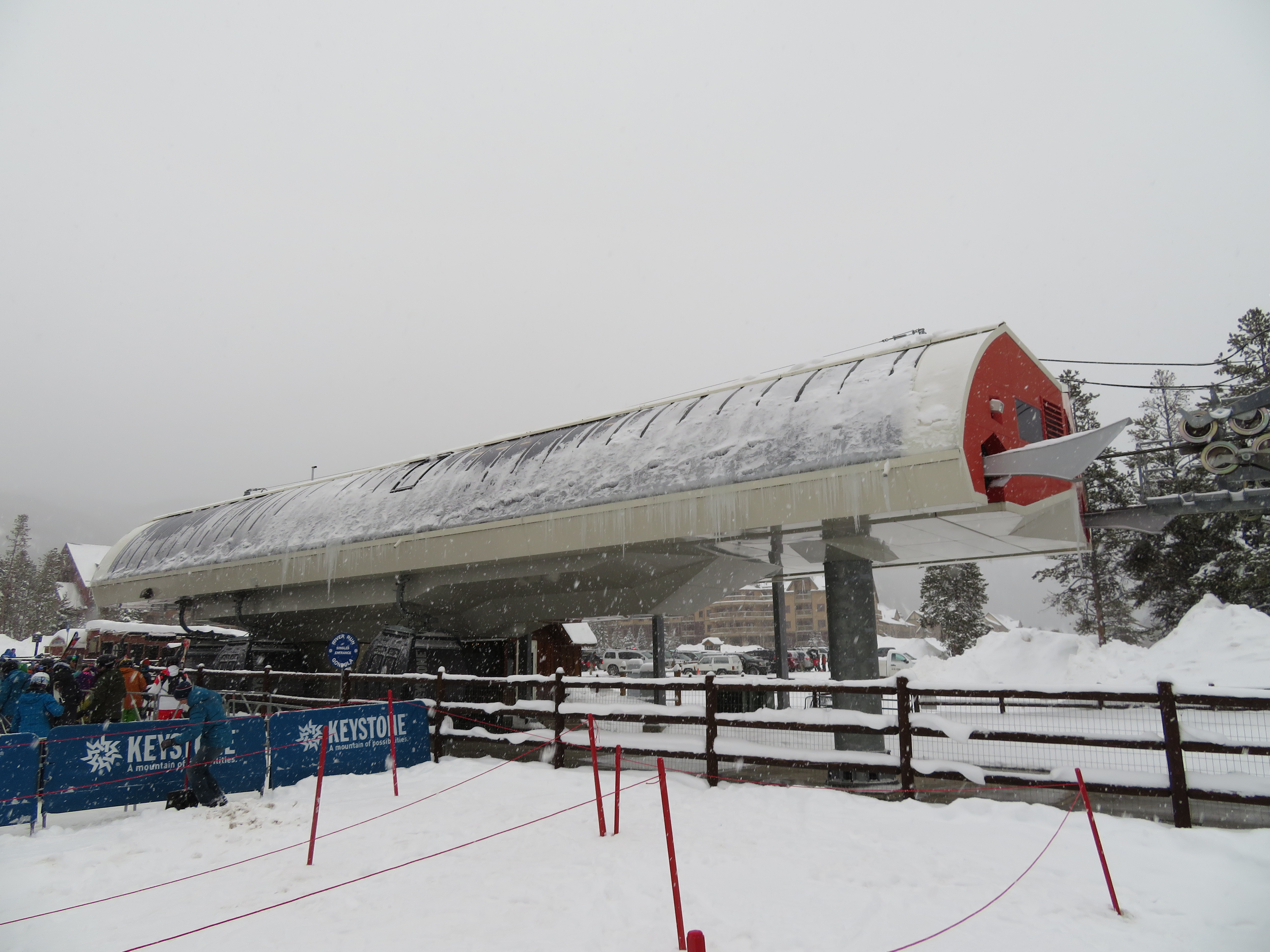
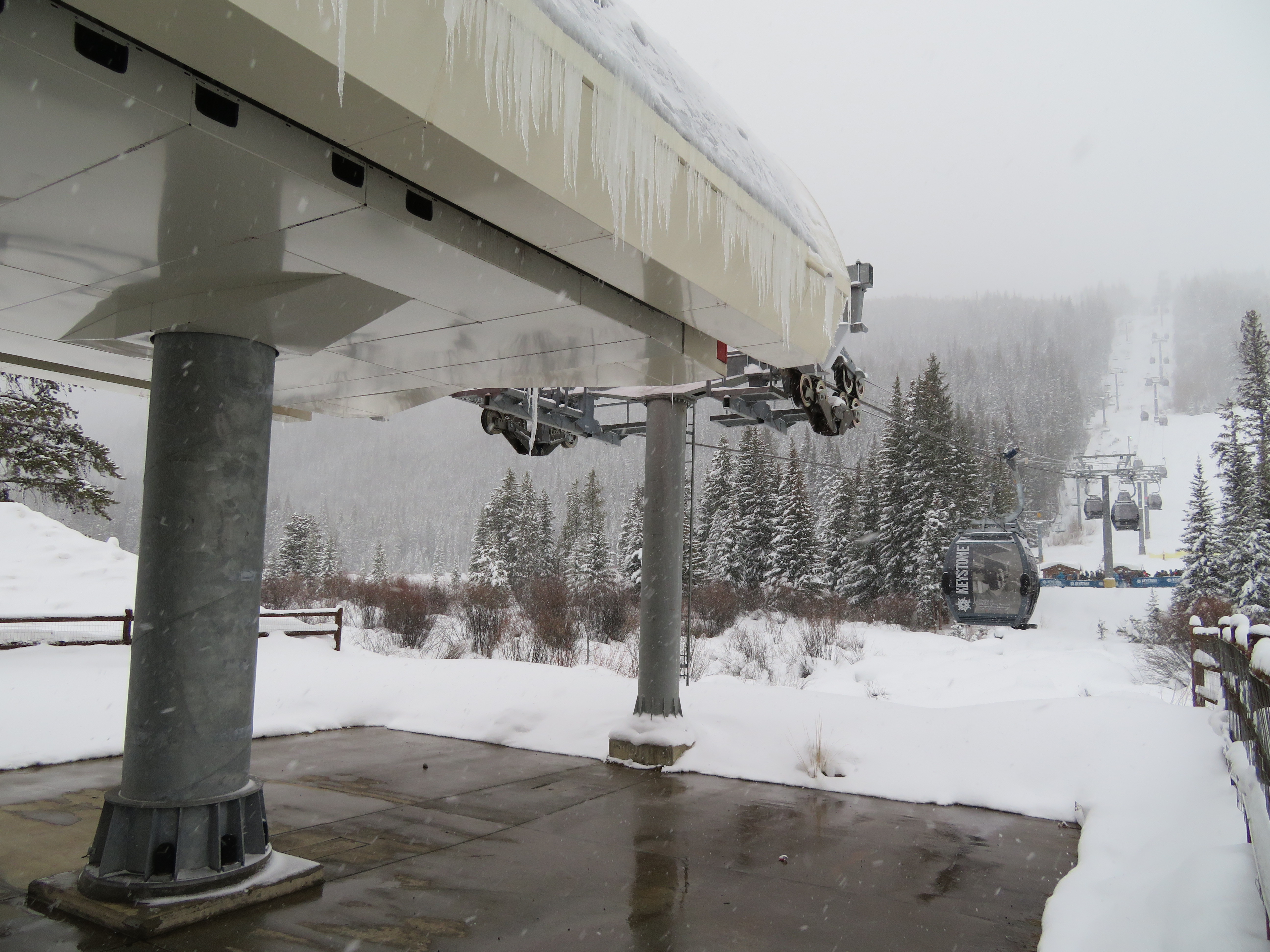
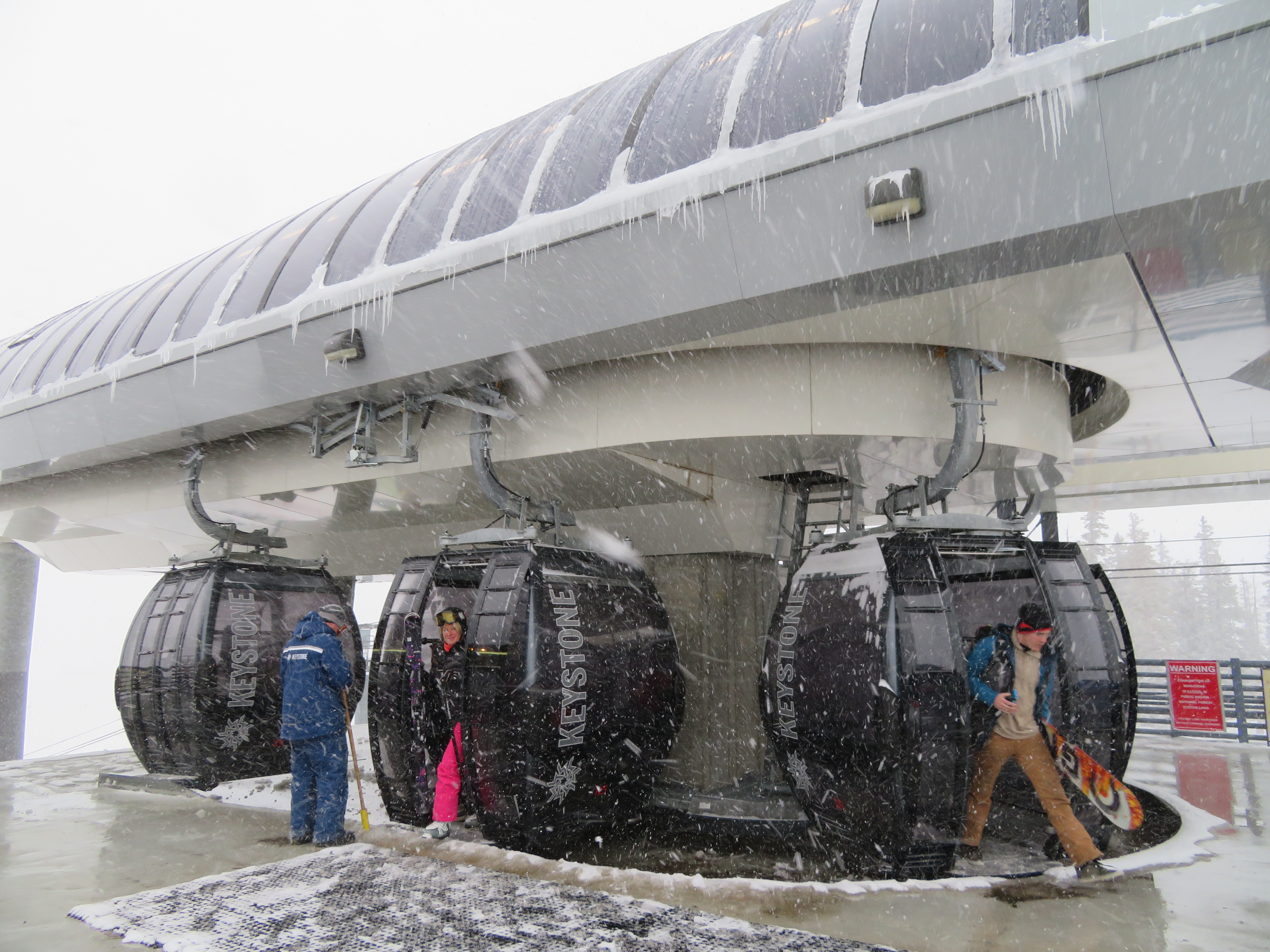
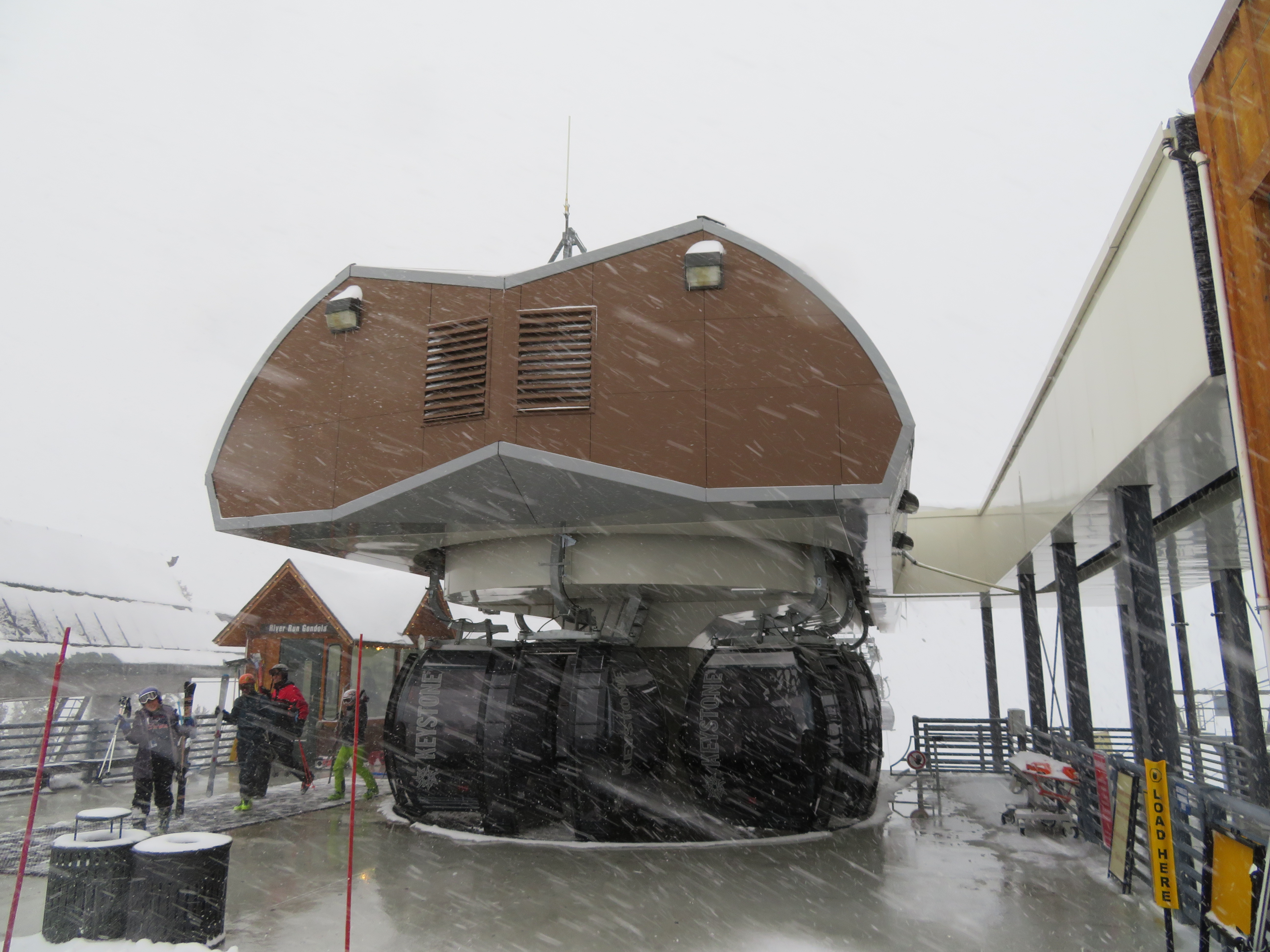
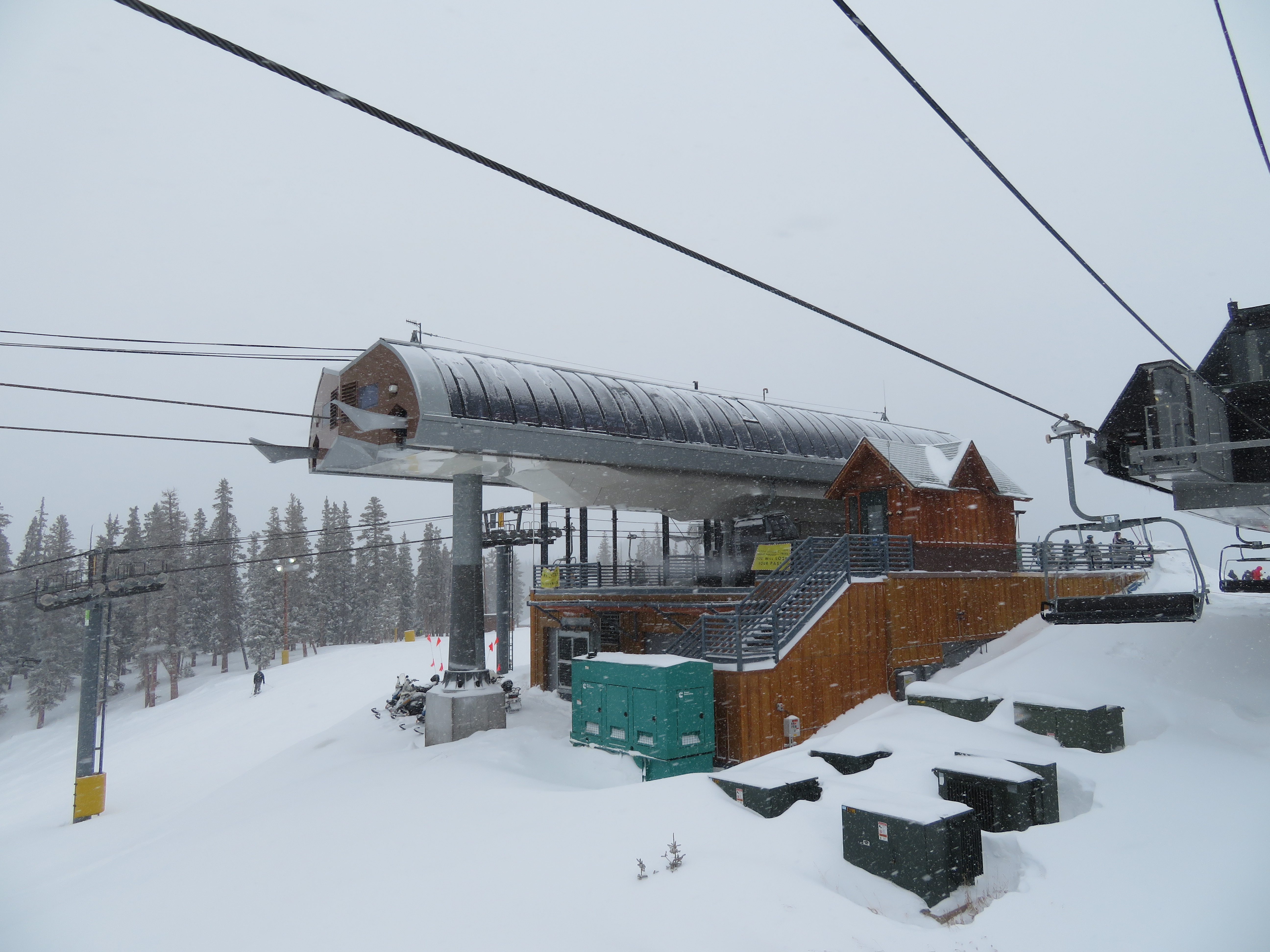
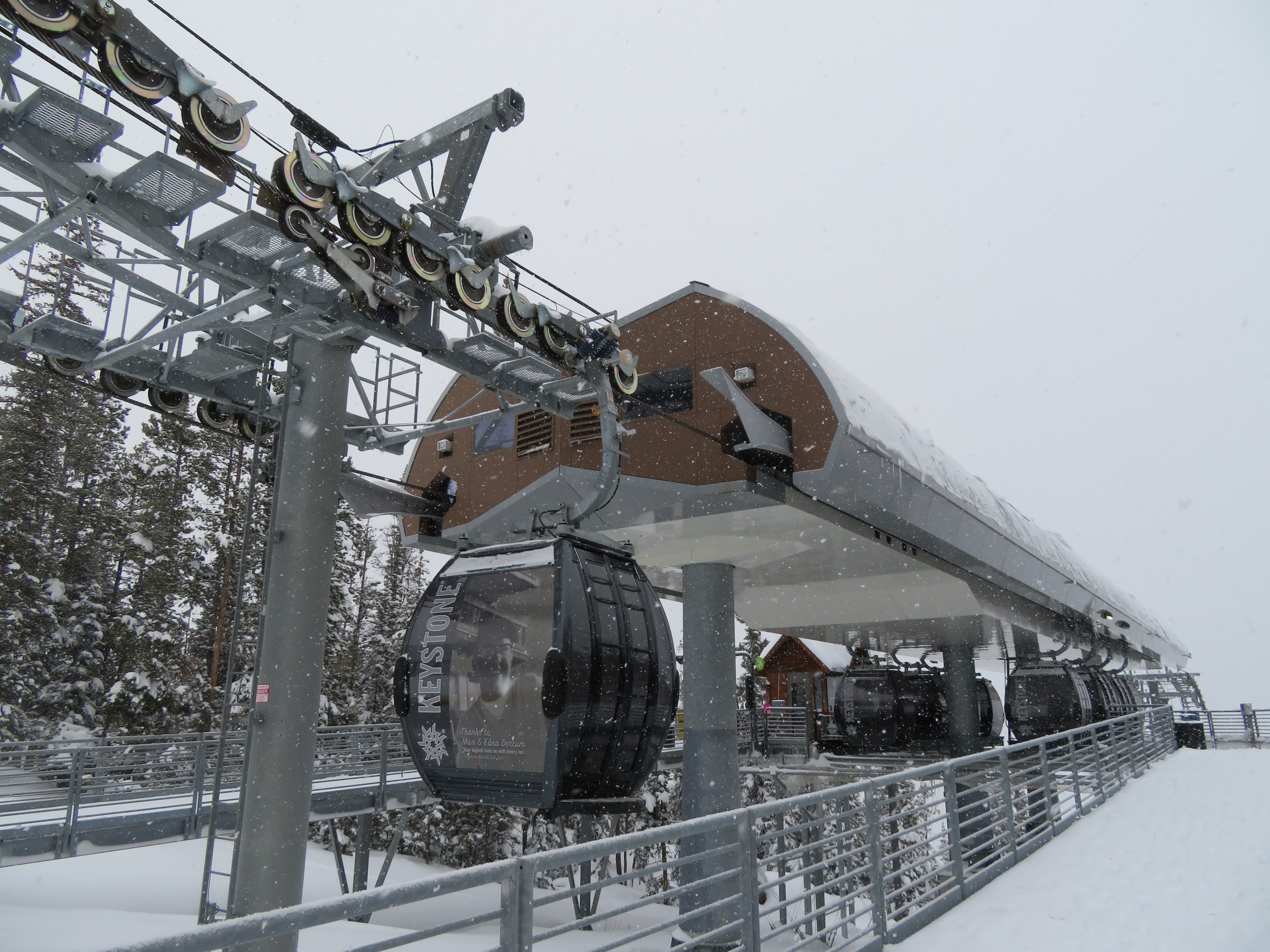
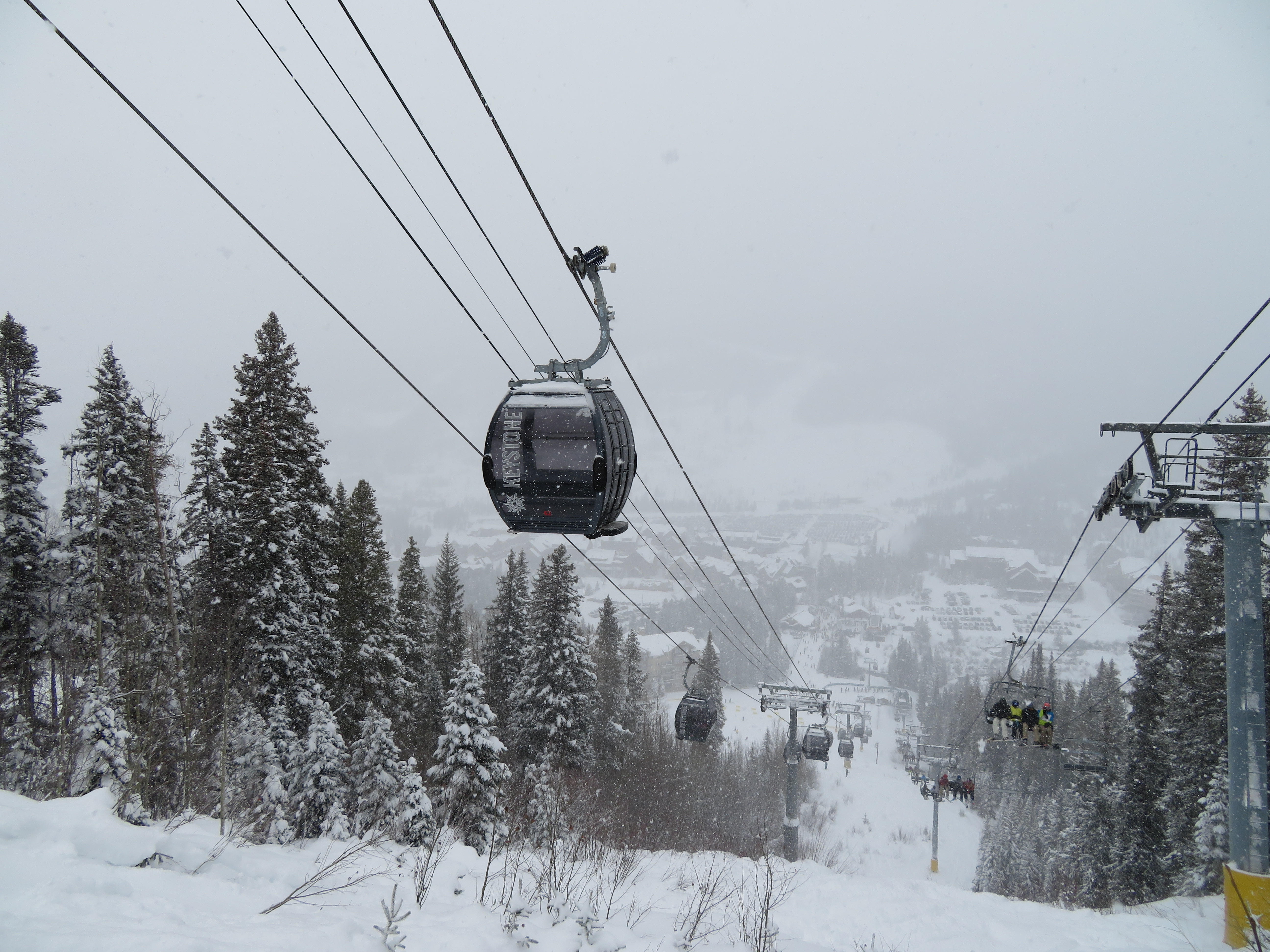
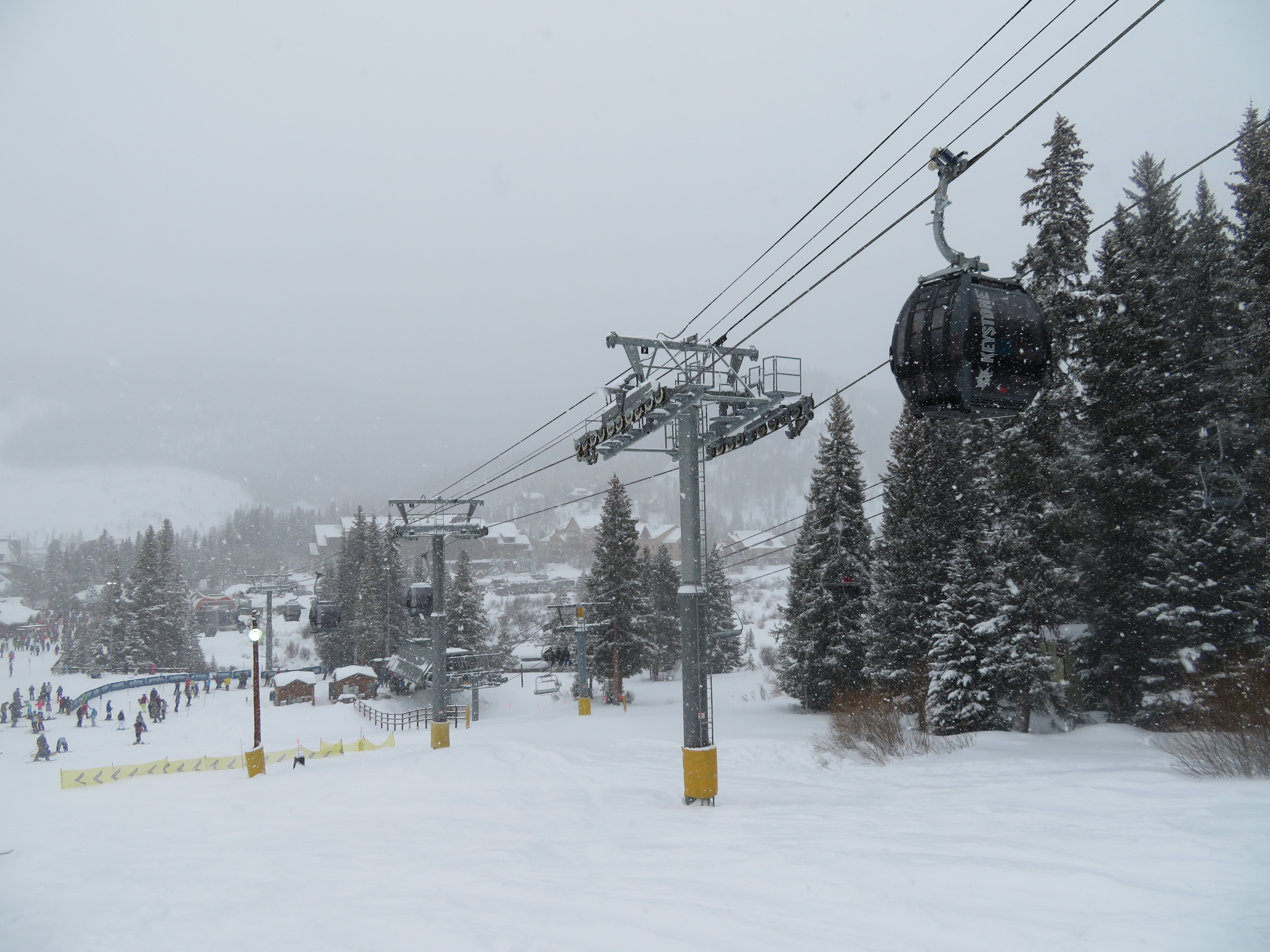
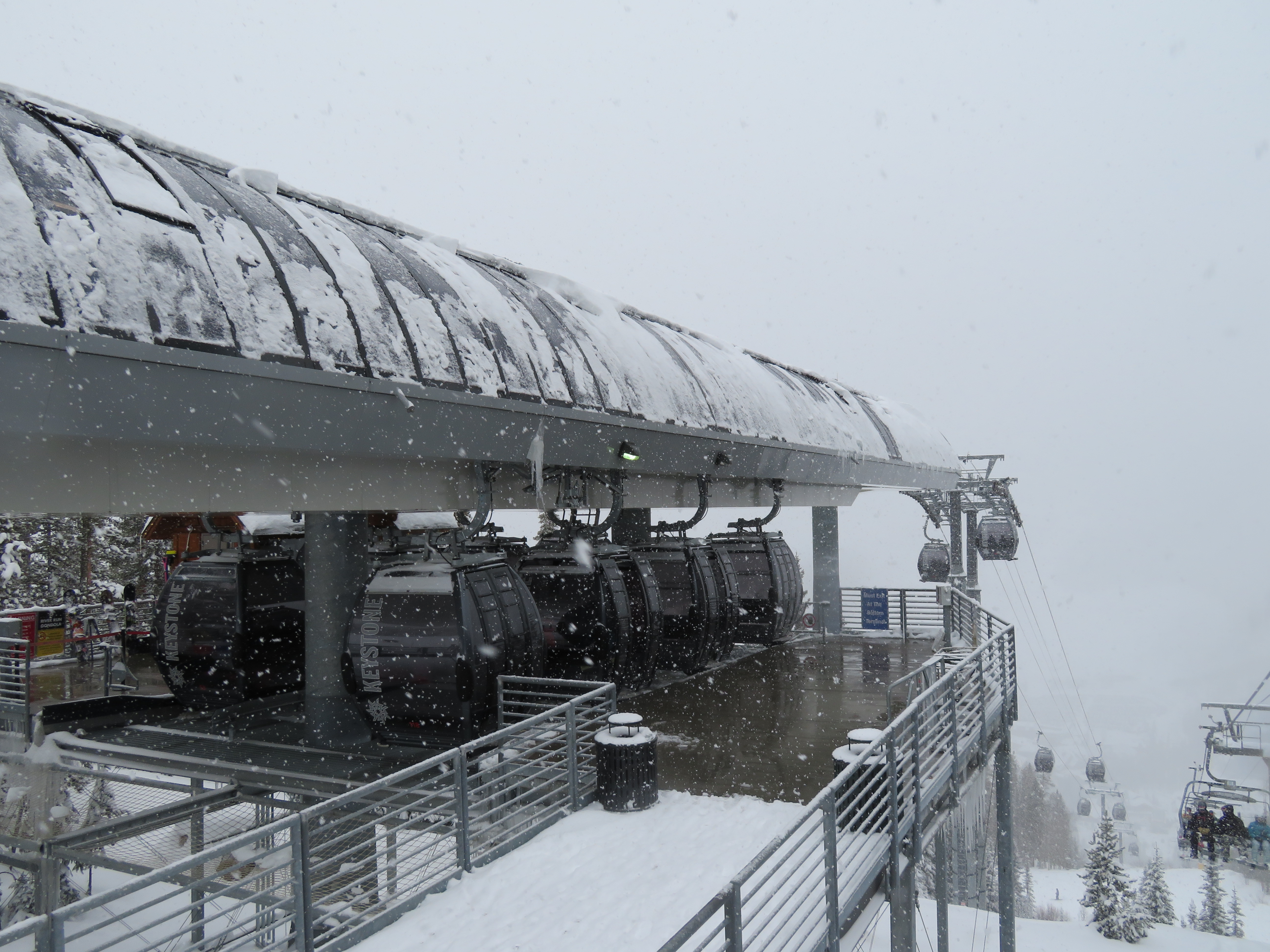
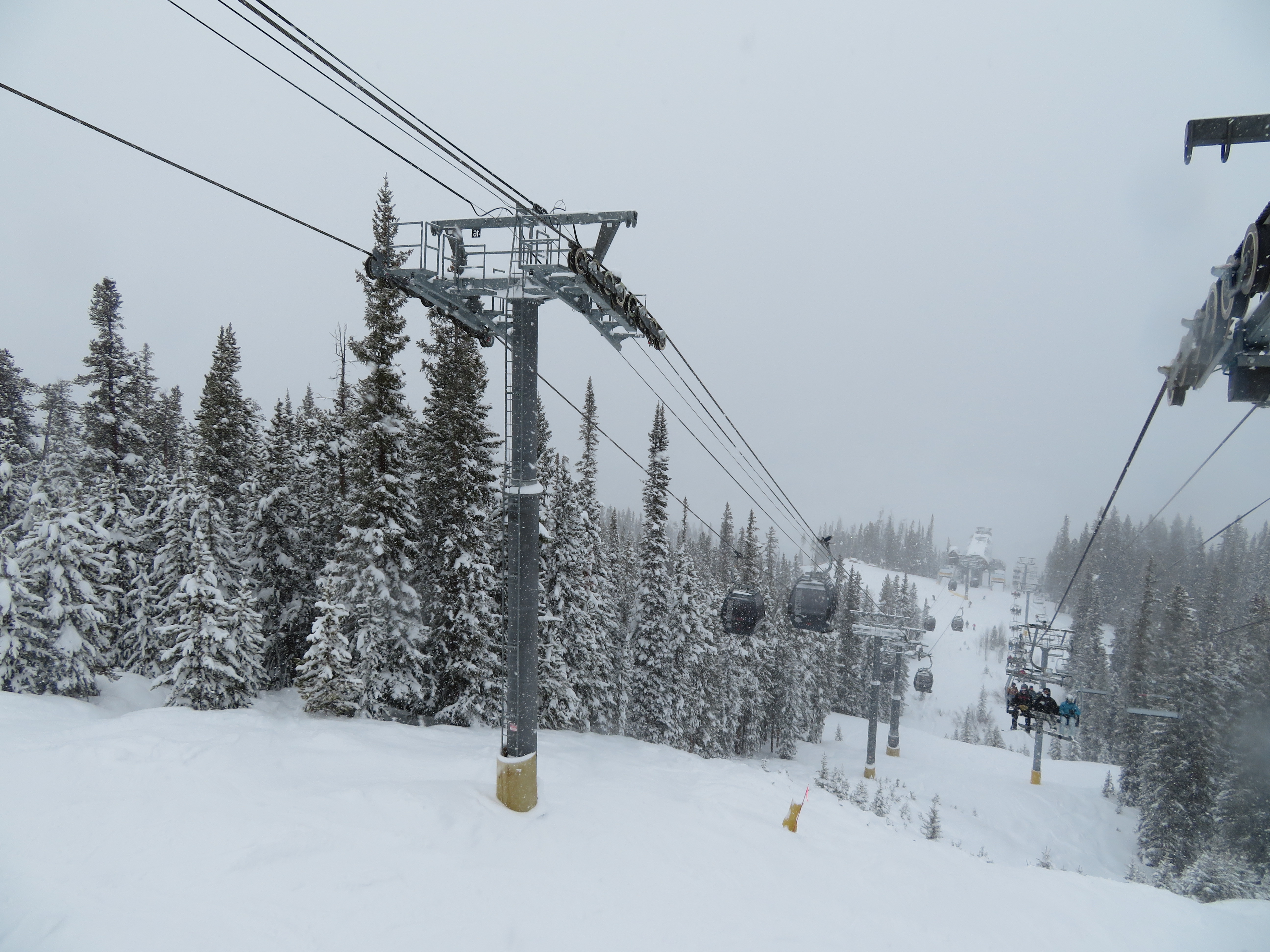
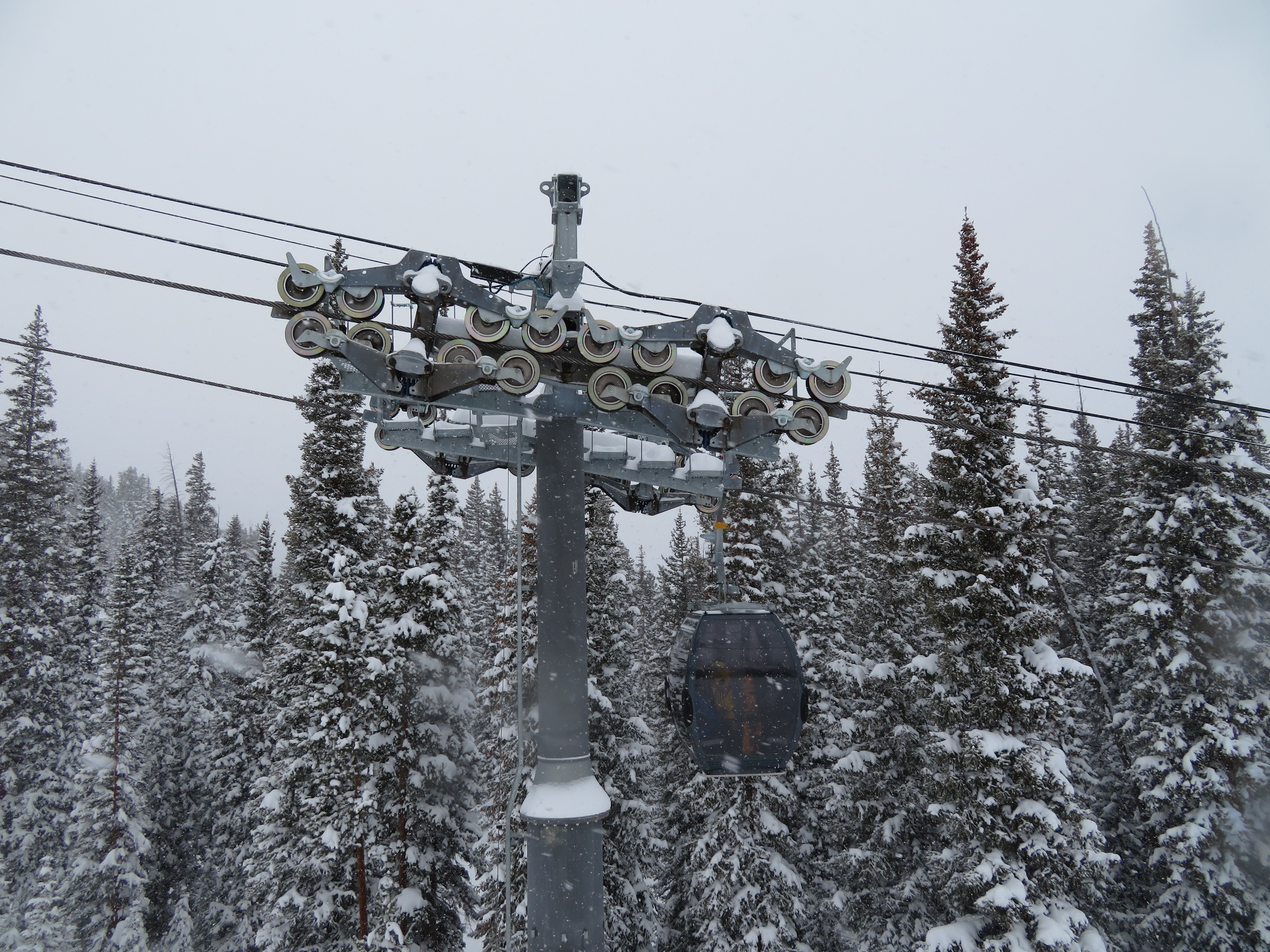
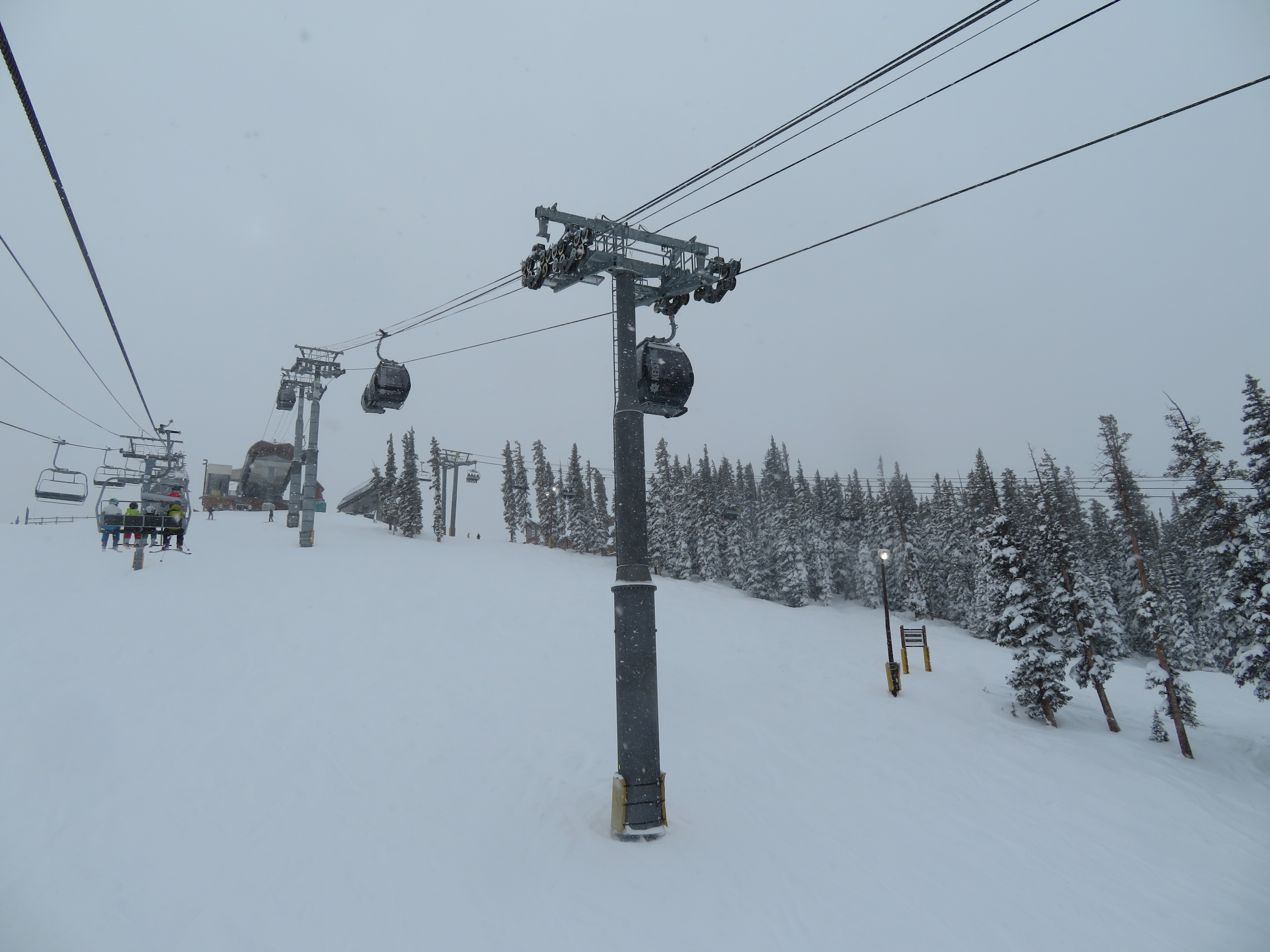
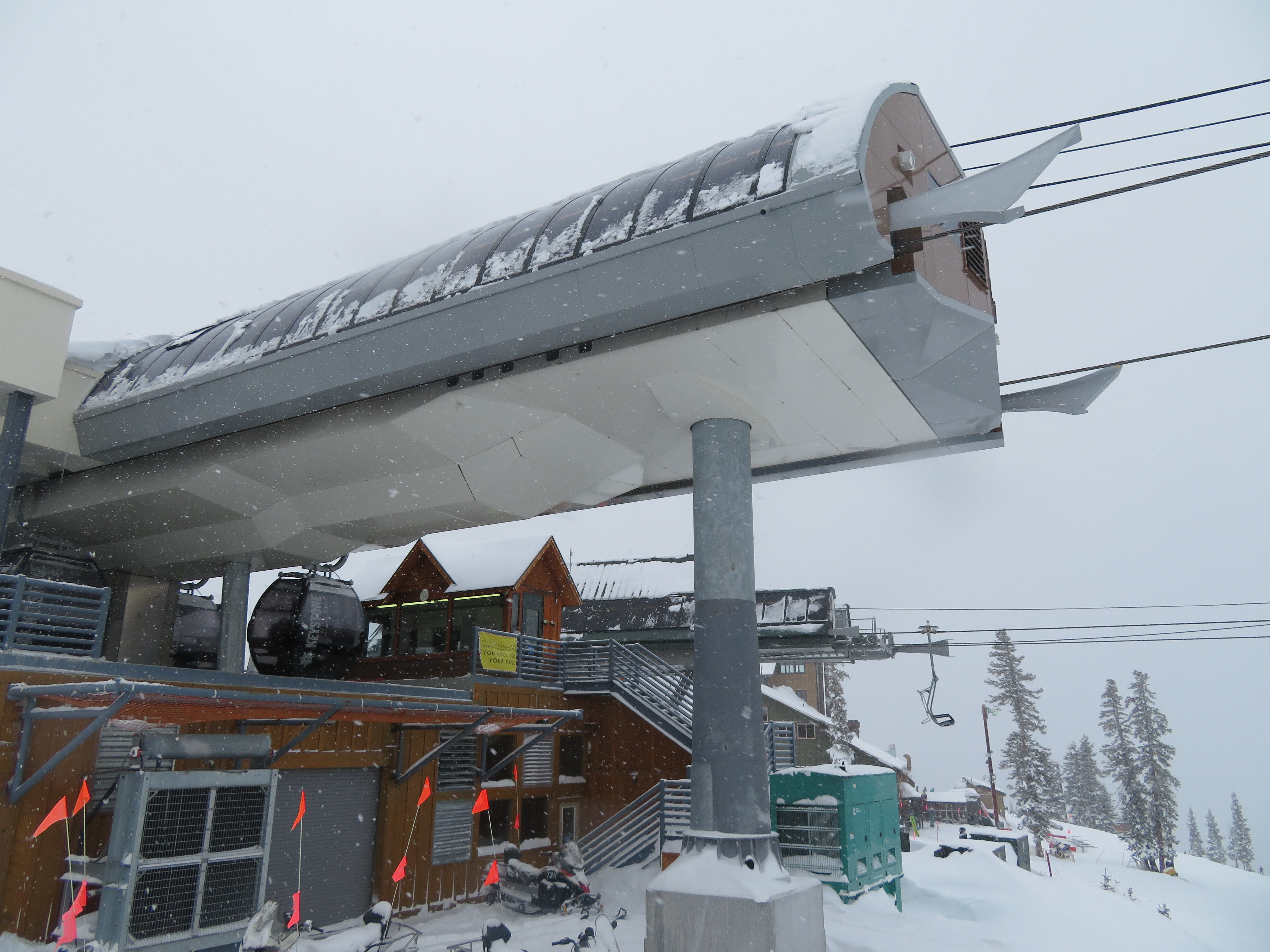
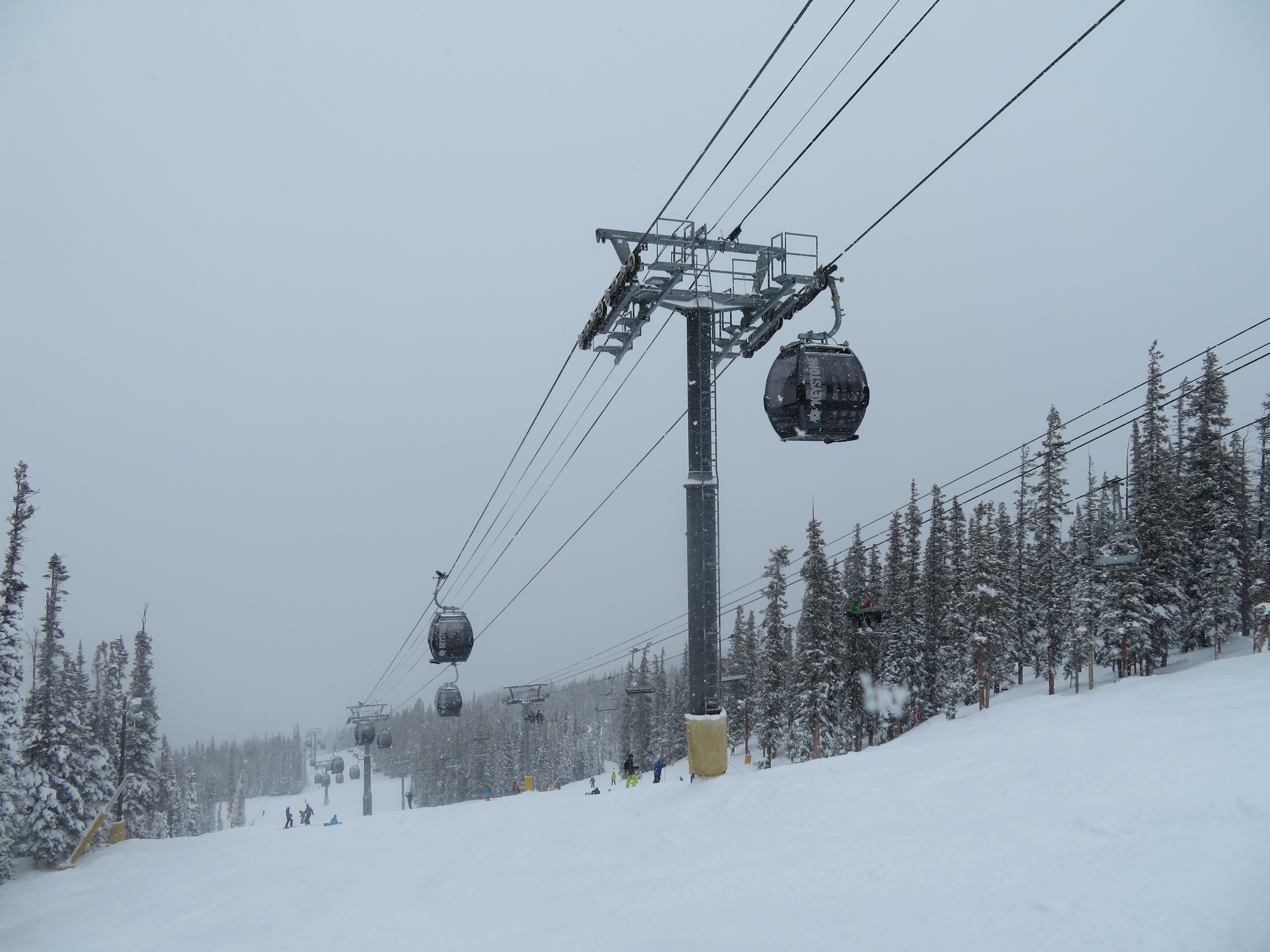
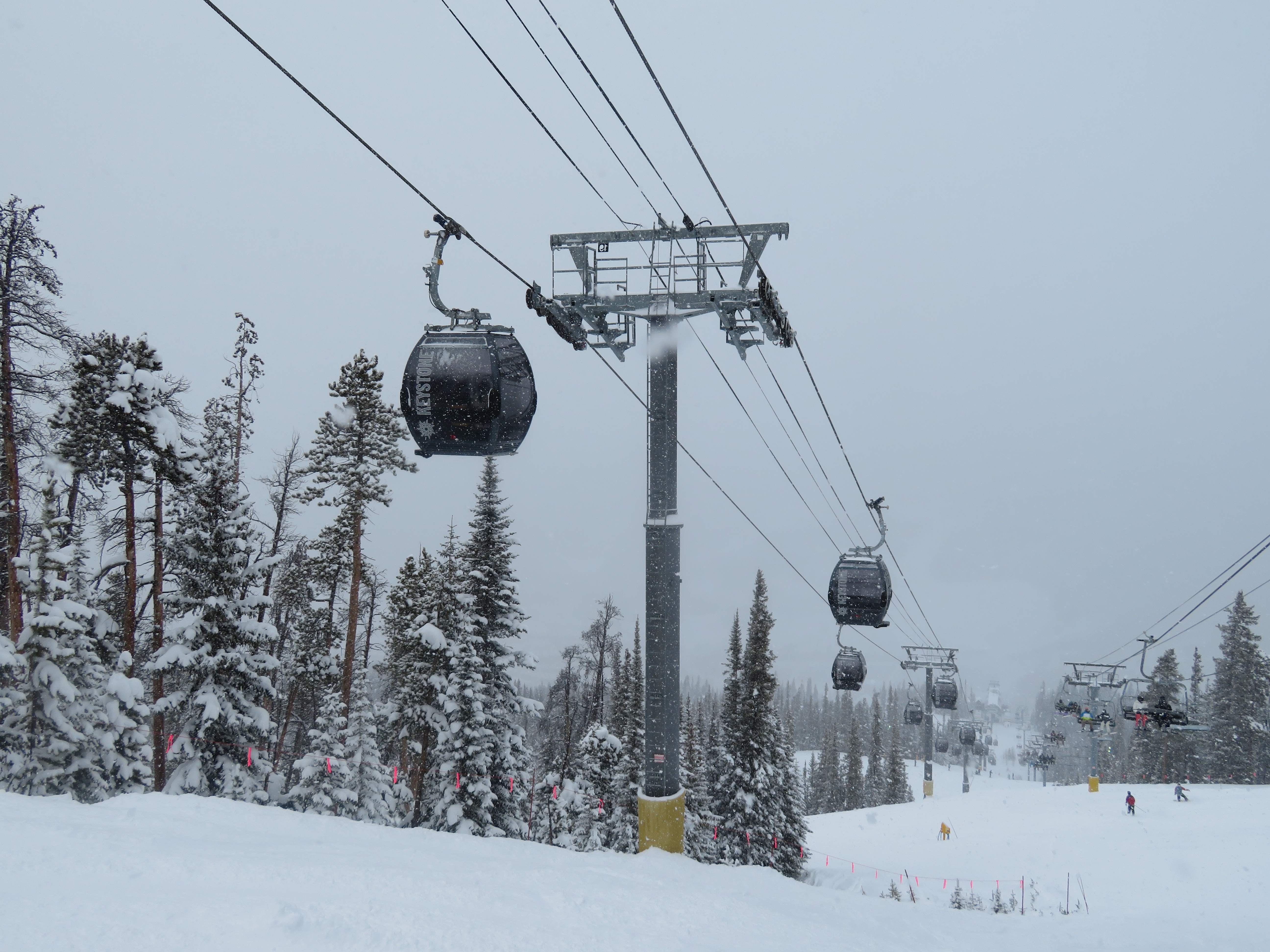
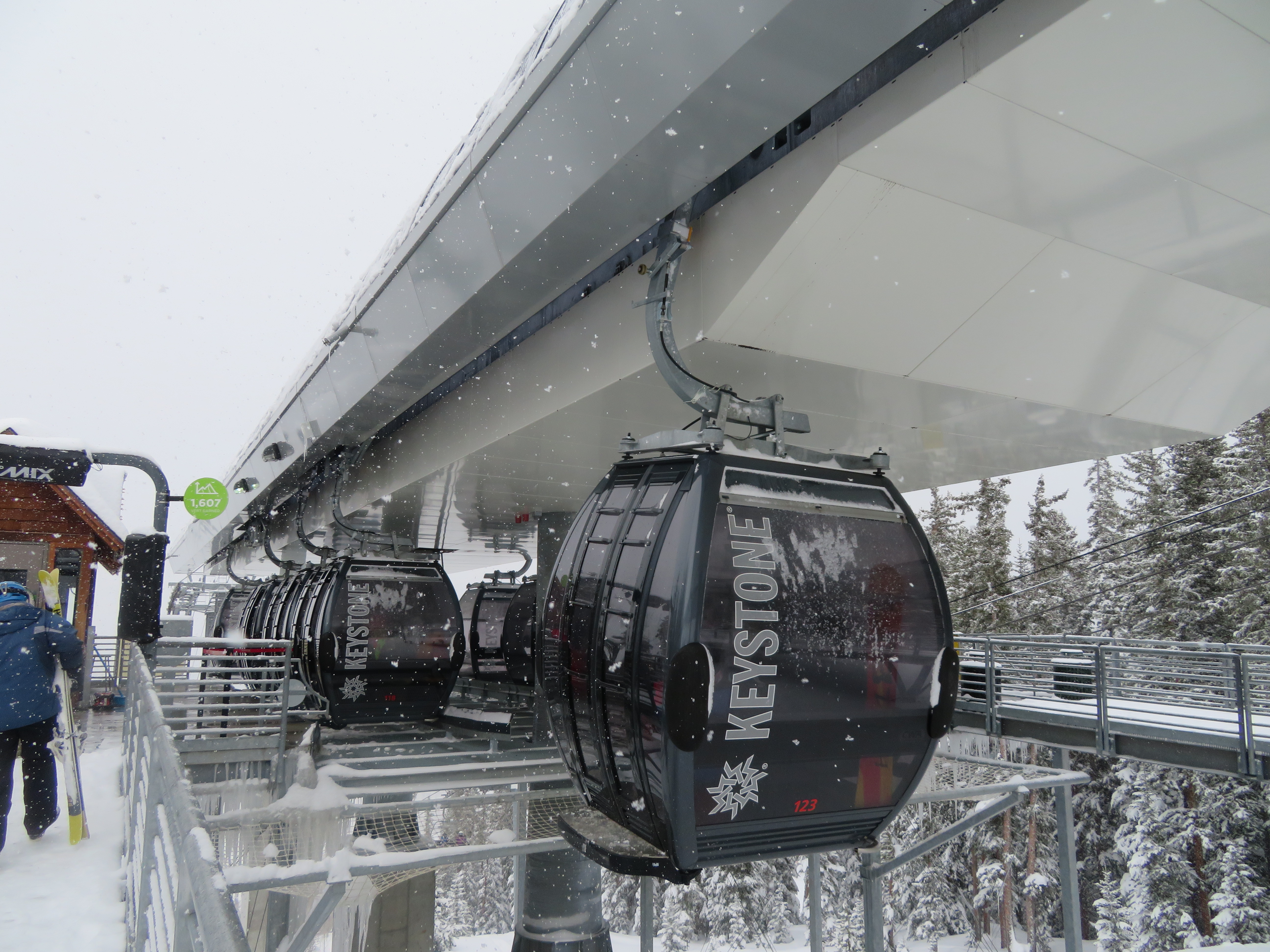
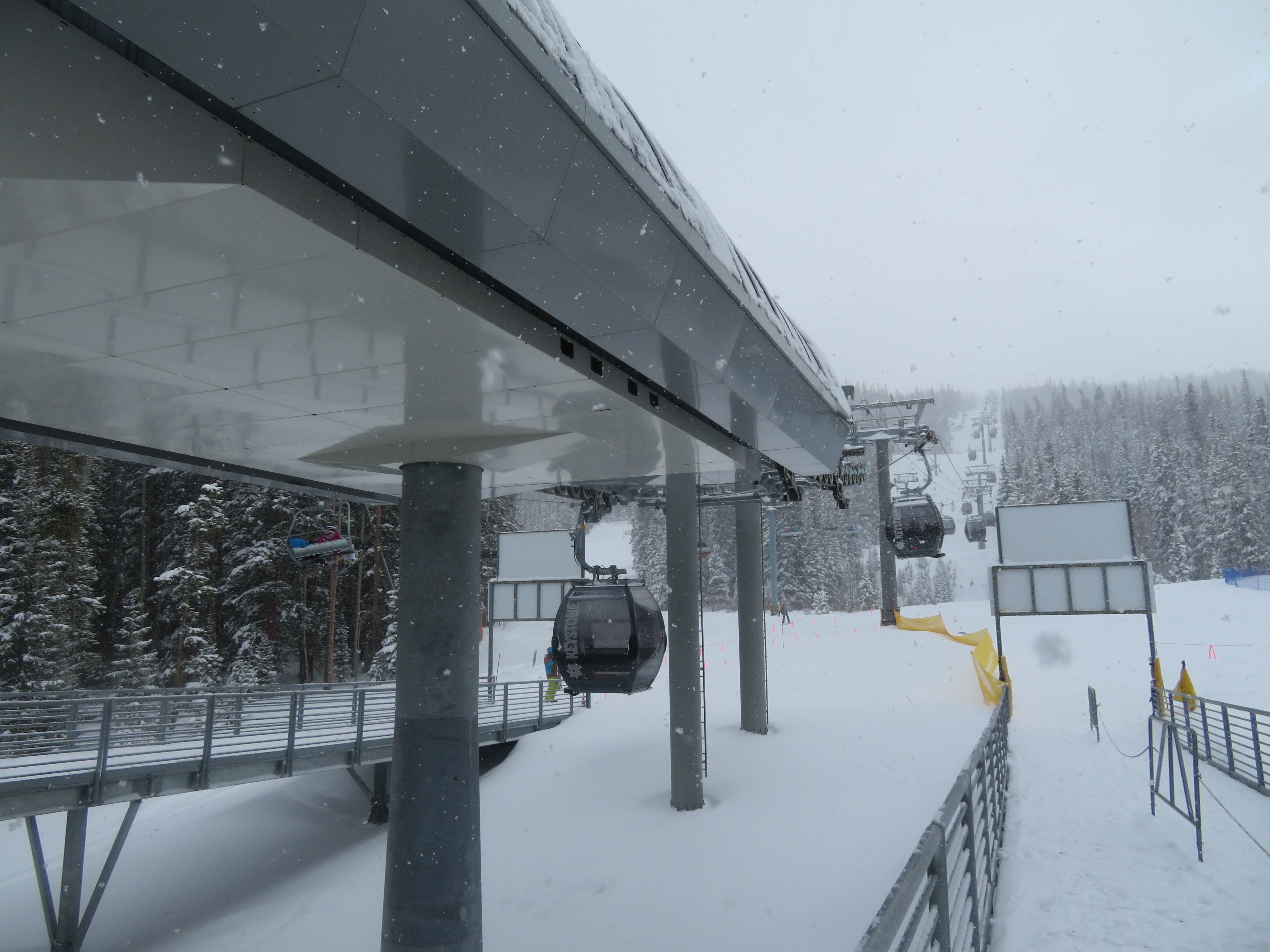
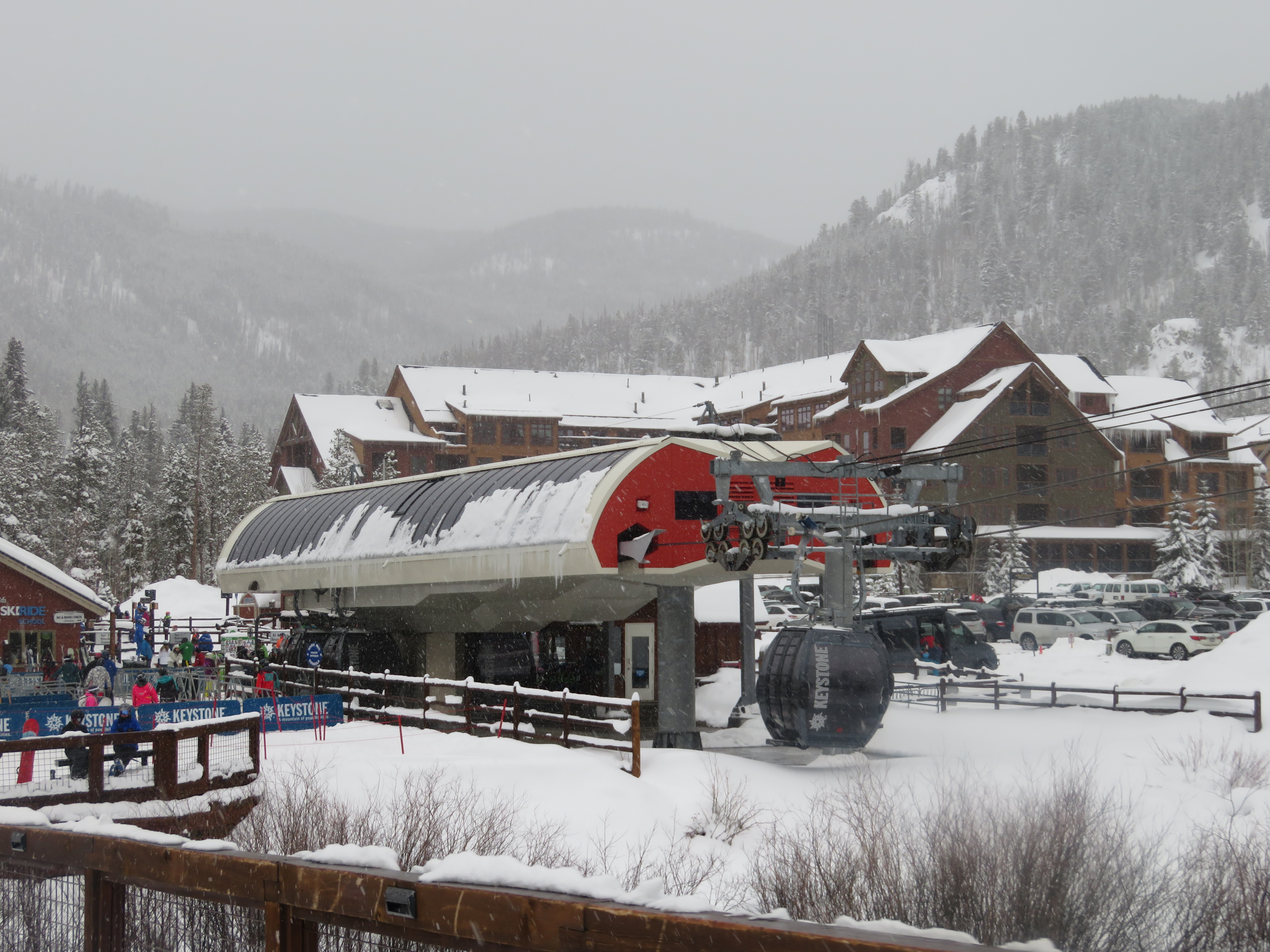
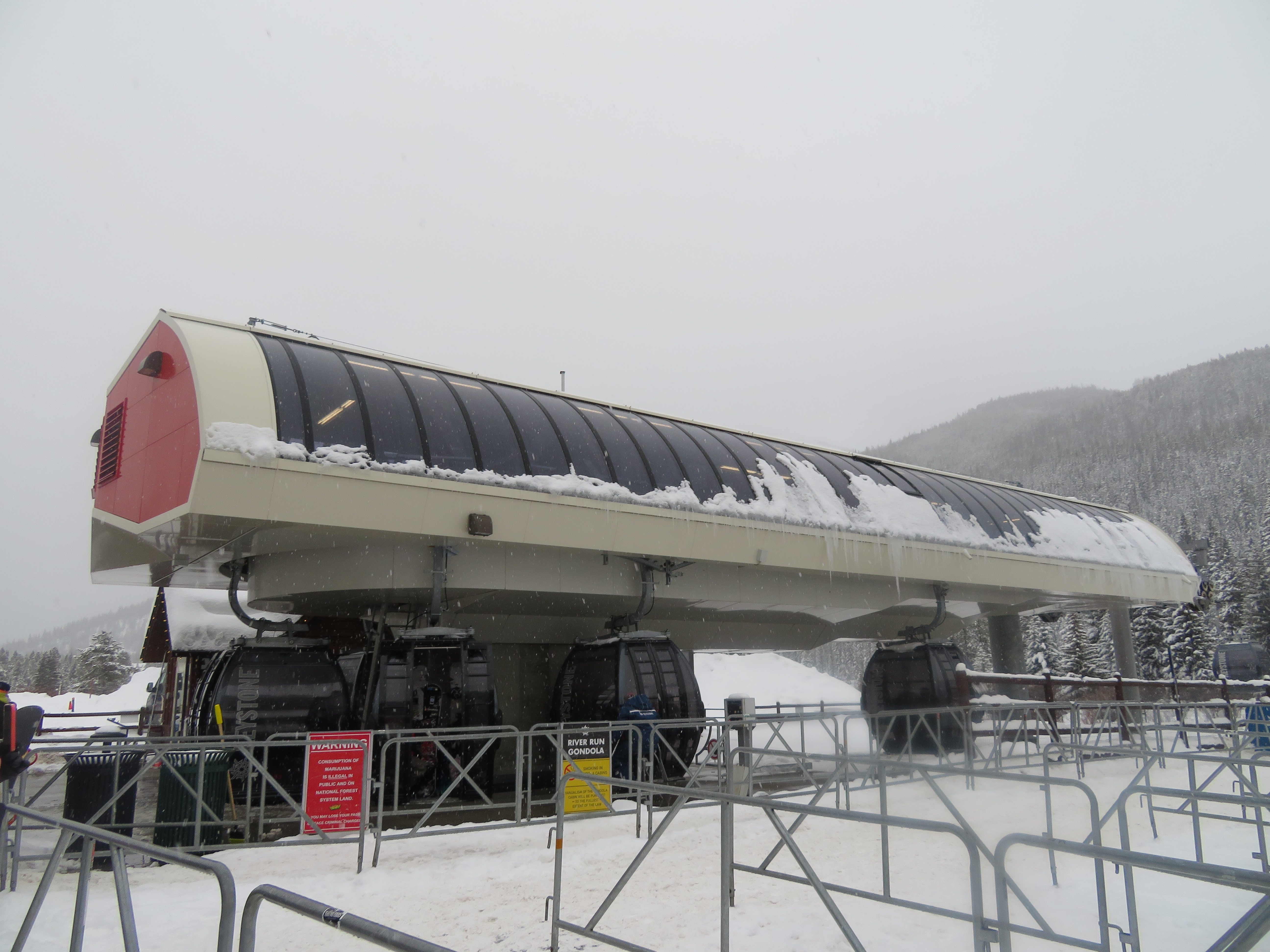
Keystone is the only North American customer to order the Uni-G Vision terminal skin.Lower station with small parking rail.Loading area/turnaround.Extra long station.Combo assemblies on tower 1 over the Snake River.Turnaround up top.End view of the drive station.Top station overview.Mid-station with loading and unloading in both directions.Depression towers 11-12.Mid-downhill side.Breakover towers below the mid.Lower lift line.The old River Run Gondola started next to the Summit Express rather than on the village side of the river.Mid-station loading area.Above the mid-station.Monster combination assemblies.Nearing the summit with tall towers.Uni-G station with vault drive.Upper lift line.Euro-style towers with 6.1 m line gauge.CWA Omega IV cabins.Looking up from the mid-station load.Return terminal from the skier bridge.Loading/maze area.
At the top there is an underground cabin parking facility that is shared with the Outpost gondola directly across from it. It was left over from the previous River Run gondola.
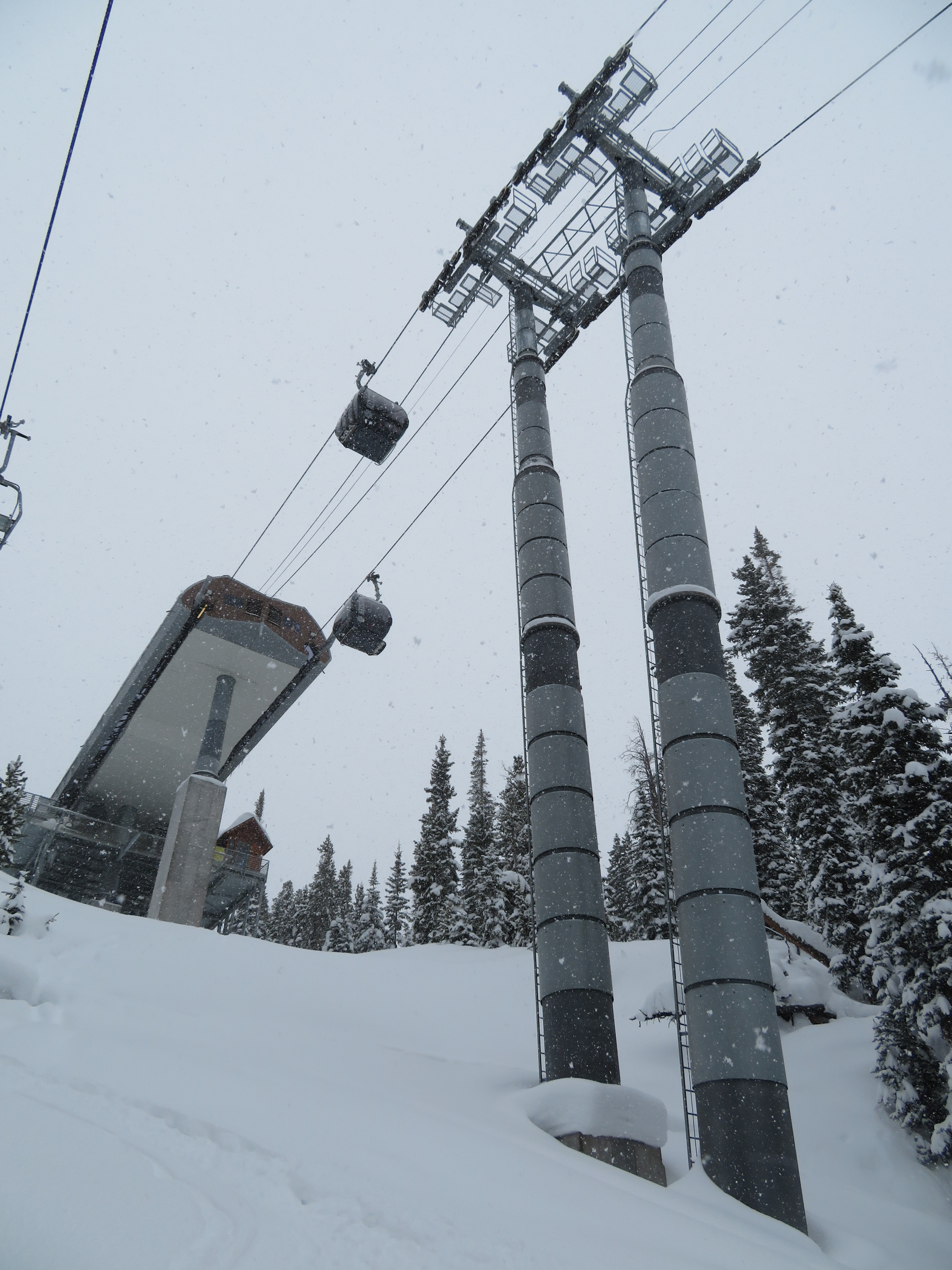
Hopefully I answer your question correctly. The taller the tower is. The wider the tube is. Support towers have to withstand more force. Not just gravity but also tension force. Depress towers withstand less force. Basically larger tubes are near the foundation. Smaller tubes are higher up to the crossarm.
Don’t know if you solved this mystery or not, but I don’t think it is, look at the photos, the sun shields are being held up by something else. I think the little tubes are for either construction platform or a device to prevent people from climbing the tower. I could be completely wrong.
Brody (and previous commentors): I answered the question several comments above. The tubes welded to the tower tube are for temporary platforms used during construction. The installation crew uses them to stand on while torquing the midstage bolts.
I’m guessing for any broken cabin that wouldn’t be able to make it back to the top. A severely broken grip would be an obvious reason not to send it up. Even if the rollers are bad enough where it wont make it through the terminals.
The “mini-combo” has an rope position sensor in it. The Colorado Tramway Safety Board requires RPD sensors in installations with a line speed of 600FPM or greater.
Err ya? I mean all towers regardless of type have CPS sensors on the sheave assemblies. So not sure the point? Not hating or anything, just curious of your post.
Sorry, my previous comment is indeed unclear. I’ll try, and probably fail, to put together the missing pieces of the puzzle.
Donald mentioned that these were retrofitted circa 2014. These are Doppelmayr’s new RPD sensor design to replace the over-rope design- I tried to explain what they were for. The reason they were retrofitted is because of fewer issues with the Agamatic grips. Indeed all towers have RPD sensors, the mini-combo just visually sticks out a lot more.
The point about Colorado is irrelevant and should’ve been omitted.
I disagree. Summit provides redundancy if the gondola goes down, and if they were to both go down you’d only have two out of base options (with both being from the other base area). It could turn into a nightmare for them.
The current River Run Gondola isn’t that old to begin with. I also don’t see the problem with the Gondola as is, especially because Summit is right next to it for lapping purposes. Summit isn’t super old either.
Up until about the mid-2000s, Keystone’s lifts were all painted entirely in dark green, including towers and terminals. Beginning around 2005 and ending in 2007, the lifts all received a repainting, which saw the terminals get repainted beige on almost everything, as well as the towers on all lifts get repainted silver. This was how things were when the gondola was built.
Then, beginning in 2011 and ending in 2014, Keystone began repainting all of the detachable and fixed grip lift terminals to a bright green.
I believe so. The standard UNI-G has windows on the end of each terminal. While on the UNI-G Vision there are metal exteriors with now windows on the ends. Like on the River Run Gondola. Which I believe is the only one out there.
Why? I’m sure they’re more concerned with whether their maintenance gets done. If the paint isn’t peeling there’s no reason to change it just for looks.
No. The D-Line was a new product when it debuted, while the Viper or Vision (whatever it was) was a different skin over the standard Uni-G equipment. Not really a replacement, as the Uni-G is still being produced.
I have a question about those grips that I’ve never seen answered. Does anyone know who designed them? Was it Yan or a licensed design from someone else? Was it used on any other lifts? And how did they function? The Squaw Valley one was a Giovanolla grip right?
Not sure who made them but they were problematic. That and the Teller lift disaster led to the gondola’s replacement. I’ll post a close up of the Keystone grips below. They don’t look like Giovanolas to me (those have 4 rollers), I suppose they could be a Yan design, though they look different than the later marshmallow grips. Maybe someone can identify the manufacturer:
There were giovanola(?) grips on the squaw gondola.There was a picture of it in a news roundup video. I first thought they were double marshmallow grips.
Lift Engineering took inspiration from Von Rolls VR-101 & VR-104 grips while designing their own. To answer your question, this grip was intended to function most similarly to the 104.



 Lift Blog
At the top there is an underground cabin parking facility that is shared with the Outpost gondola directly across from it. It was left over from the previous River Run gondola.
LikeLike
Does anyone know what the small tubes attached to the big tubes are? They seem to be on a lot of towers for larger Doppelmayr lifts.

LikeLike
Hopefully I answer your question correctly. The taller the tower is. The wider the tube is. Support towers have to withstand more force. Not just gravity but also tension force. Depress towers withstand less force. Basically larger tubes are near the foundation. Smaller tubes are higher up to the crossarm.
LikeLike
I’m talking about these…

Thinking something to do with lining up the splice tower sections during construction?
LikeLike
From what I believe is that those little holes are for is the ladder
LikeLike
Yes and no. They’re for temporary platforms used during construction, so that the guys have someplace to stand while torquing the stage bolts.
LikeLiked by 1 person
Could be for holding the padding at the base of the towers as some towers have padding.
LikeLike
I think its something to mount these white things (I think they are to prevent sun damage) on the bottom of some towers. https://skiliftblog.files.wordpress.com/2017/12/img_6461.jpg Wildcat express btw.
LikeLiked by 1 person
Don’t know if you solved this mystery or not, but I don’t think it is, look at the photos, the sun shields are being held up by something else. I think the little tubes are for either construction platform or a device to prevent people from climbing the tower. I could be completely wrong.
LikeLike
Brody (and previous commentors): I answered the question several comments above. The tubes welded to the tower tube are for temporary platforms used during construction. The installation crew uses them to stand on while torquing the midstage bolts.
LikeLike
I wonder why that parking rail is at the bottom, since there is such an extensive facility at the top.
LikeLike
I’m guessing for any broken cabin that wouldn’t be able to make it back to the top. A severely broken grip would be an obvious reason not to send it up. Even if the rollers are bad enough where it wont make it through the terminals.
LikeLike
Is this the only lift in the US with this terminal design?
LikeLike
Yes.
LikeLike
It’s too bad. I really like the way the viper/vision skin looks.
LikeLike
They added those pincher sheaves to the depression towers around 2014. You can see them in my video of the Summit Express from 2015:
LikeLike
The “mini-combo” has an rope position sensor in it. The Colorado Tramway Safety Board requires RPD sensors in installations with a line speed of 600FPM or greater.
LikeLike
Err ya? I mean all towers regardless of type have CPS sensors on the sheave assemblies. So not sure the point? Not hating or anything, just curious of your post.
LikeLike
Sorry, my previous comment is indeed unclear. I’ll try, and probably fail, to put together the missing pieces of the puzzle.
Donald mentioned that these were retrofitted circa 2014. These are Doppelmayr’s new RPD sensor design to replace the over-rope design- I tried to explain what they were for. The reason they were retrofitted is because of fewer issues with the Agamatic grips. Indeed all towers have RPD sensors, the mini-combo just visually sticks out a lot more.
The point about Colorado is irrelevant and should’ve been omitted.
LikeLike
Why is there so many communication lines? Usually there is one or 2.
LikeLike
Perhaps it has to do with the Gondola carrying utility lines for the Summit House?
LikeLike
Fiber for the summit buildings.
LikeLike
Why is this lift in the stats as a Doppelmayr CTEC Gondola? Are there CTEC parts on this lift?
LikeLike
The company was called Doppelmayr CTEC from 2002 to 2010.
LikeLike
They should replace this and summit with a high speed 6/10 combo.
LikeLike
Summit and River Run combine to have a theoretical hourly capacity of 5000. No 6/10 combo would even come close to that and just create longer lines.
LikeLiked by 1 person
I disagree. Summit provides redundancy if the gondola goes down, and if they were to both go down you’d only have two out of base options (with both being from the other base area). It could turn into a nightmare for them.
LikeLike
The current River Run Gondola isn’t that old to begin with. I also don’t see the problem with the Gondola as is, especially because Summit is right next to it for lapping purposes. Summit isn’t super old either.
LikeLike
Summit express is vital when River Run goes down. They should stay two separate lifts.
LikeLike
Why did this get painted tan and orange when everything else at Keystone is green?
LikeLike
Up until about the mid-2000s, Keystone’s lifts were all painted entirely in dark green, including towers and terminals. Beginning around 2005 and ending in 2007, the lifts all received a repainting, which saw the terminals get repainted beige on almost everything, as well as the towers on all lifts get repainted silver. This was how things were when the gondola was built.
Then, beginning in 2011 and ending in 2014, Keystone began repainting all of the detachable and fixed grip lift terminals to a bright green.
LikeLike
Is the only difference between the UNI-G Vision and the standard UNI-G appearance?
LikeLike
I believe so. The standard UNI-G has windows on the end of each terminal. While on the UNI-G Vision there are metal exteriors with now windows on the ends. Like on the River Run Gondola. Which I believe is the only one out there.
LikeLike
No windows on the ends
LikeLike
Anyone know why the River Run Gondola was closed for three days of maintenance in the middle of ski season?
LikeLike
Keystone should really consider repainting the terminals forest green to match the Summit Express and Montezuma Express adjacent to it.
LikeLike
I like the bright red at the bottom, although the top and mid station should be painted green
LikeLike
Why? I’m sure they’re more concerned with whether their maintenance gets done. If the paint isn’t peeling there’s no reason to change it just for looks.
LikeLike
I like the UNI-G Vision!
LikeLike
Did D-Line basically replace the UNI-G vision model terminal?
LikeLike
I believe so.
LikeLike
No. The D-Line was a new product when it debuted, while the Viper or Vision (whatever it was) was a different skin over the standard Uni-G equipment. Not really a replacement, as the Uni-G is still being produced.
LikeLike
Correct me if I’m wrong, but I believe that this is one of the only lifts in the U.S that has a completely straight mid station that isn’t split.
LikeLike
Nope, Sweetwater gondola in Jackson Hole.
LikeLike
Some good photos of he short-lived Yan gondola here:
LikeLiked by 1 person
When was that gondola built? it looked very cutting-edge for the time.
LikeLiked by 1 person
Built 1984. Replaced by VonRoll in 1986.
LikeLike
I have a question about those grips that I’ve never seen answered. Does anyone know who designed them? Was it Yan or a licensed design from someone else? Was it used on any other lifts? And how did they function? The Squaw Valley one was a Giovanolla grip right?
LikeLike
Not sure who made them but they were problematic. That and the Teller lift disaster led to the gondola’s replacement. I’ll post a close up of the Keystone grips below. They don’t look like Giovanolas to me (those have 4 rollers), I suppose they could be a Yan design, though they look different than the later marshmallow grips. Maybe someone can identify the manufacturer:
Giovanola grip for reference:
LikeLike
There were giovanola(?) grips on the squaw gondola.There was a picture of it in a news roundup video. I first thought they were double marshmallow grips.
LikeLiked by 1 person
Lift Engineering took inspiration from Von Rolls VR-101 & VR-104 grips while designing their own. To answer your question, this grip was intended to function most similarly to the 104.
LikeLiked by 1 person
That looks like a death trap!
LikeLike
You can also see the old Montezuma and Erickson lifts!
LikeLike