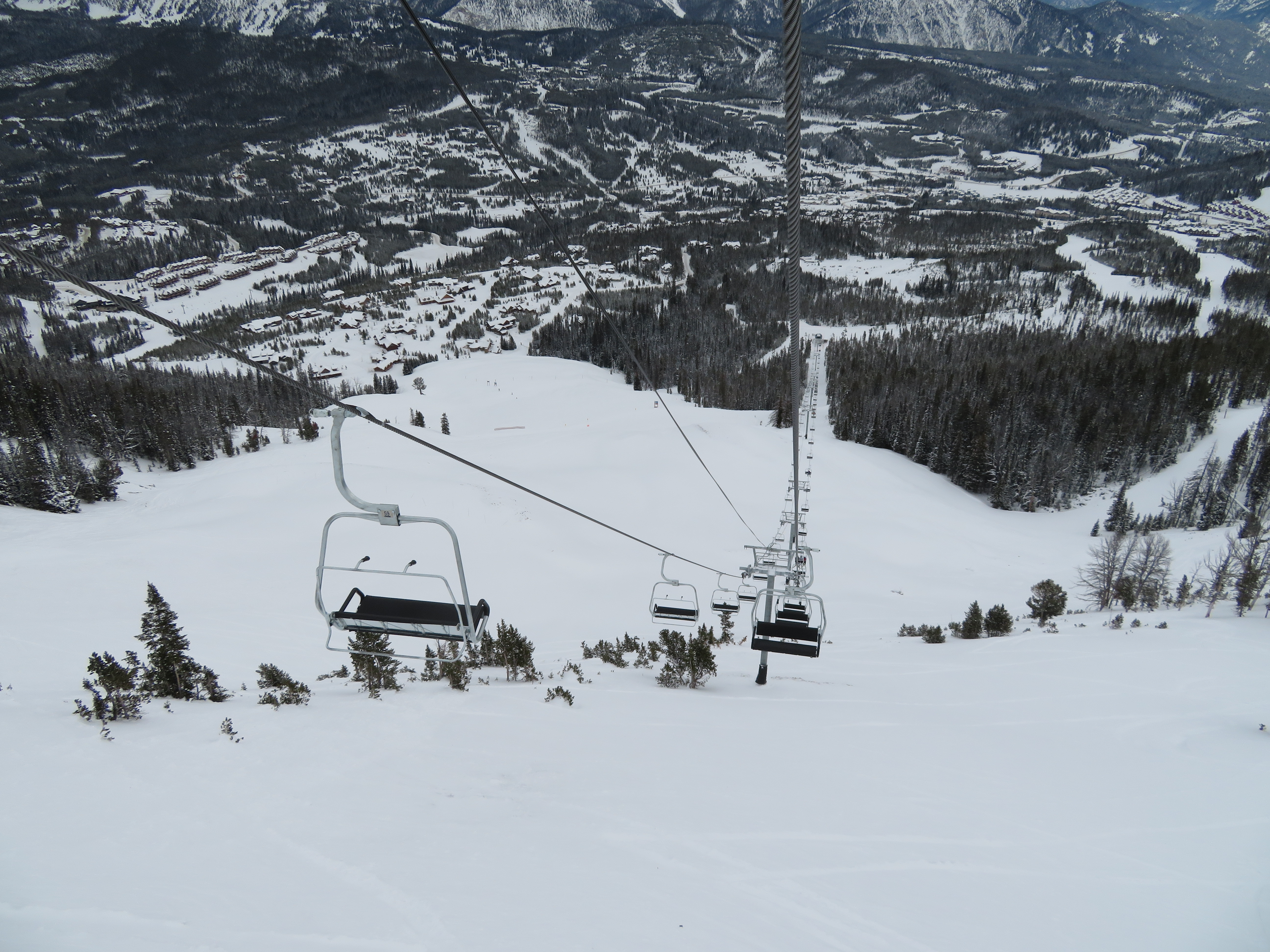
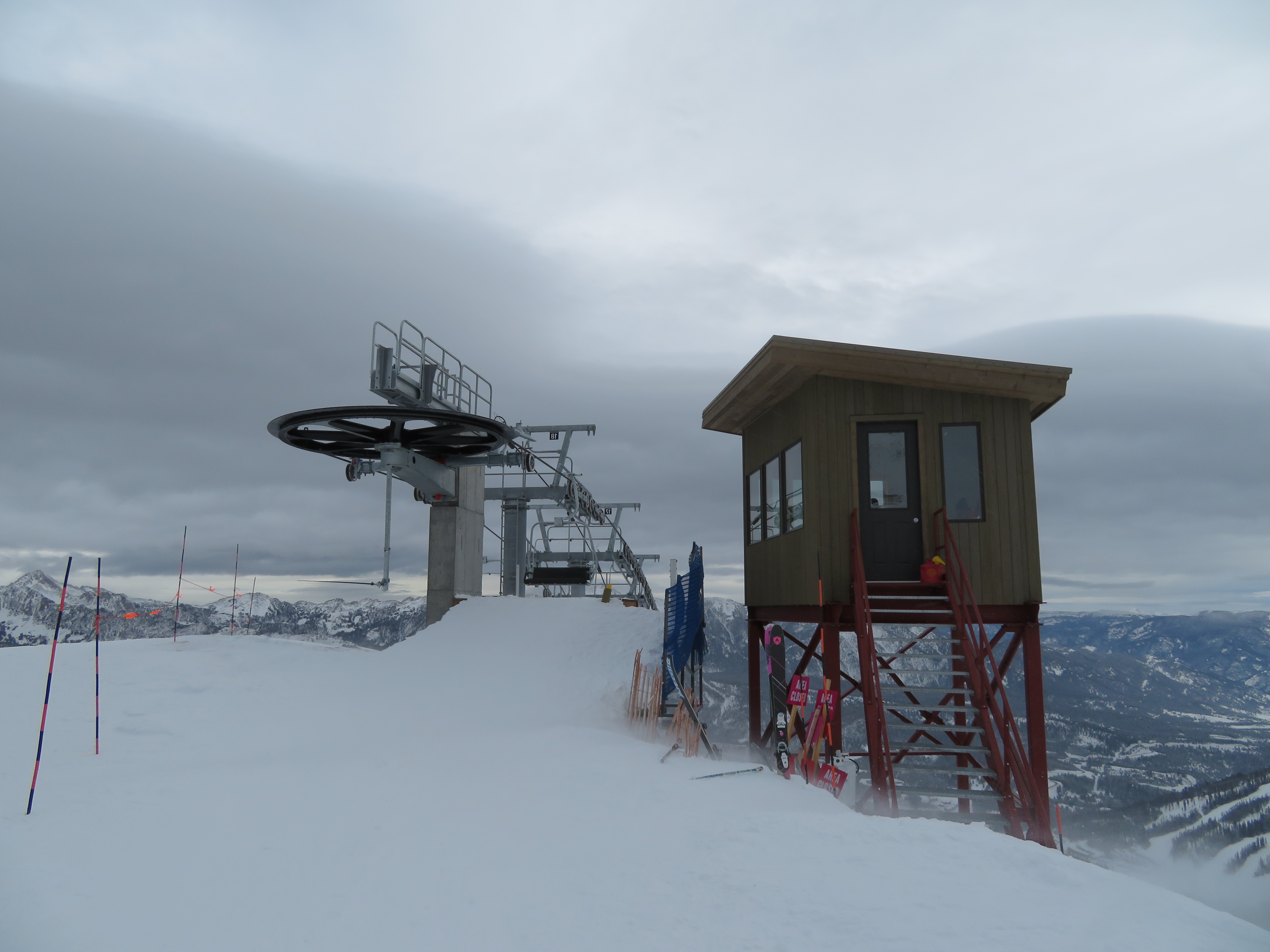
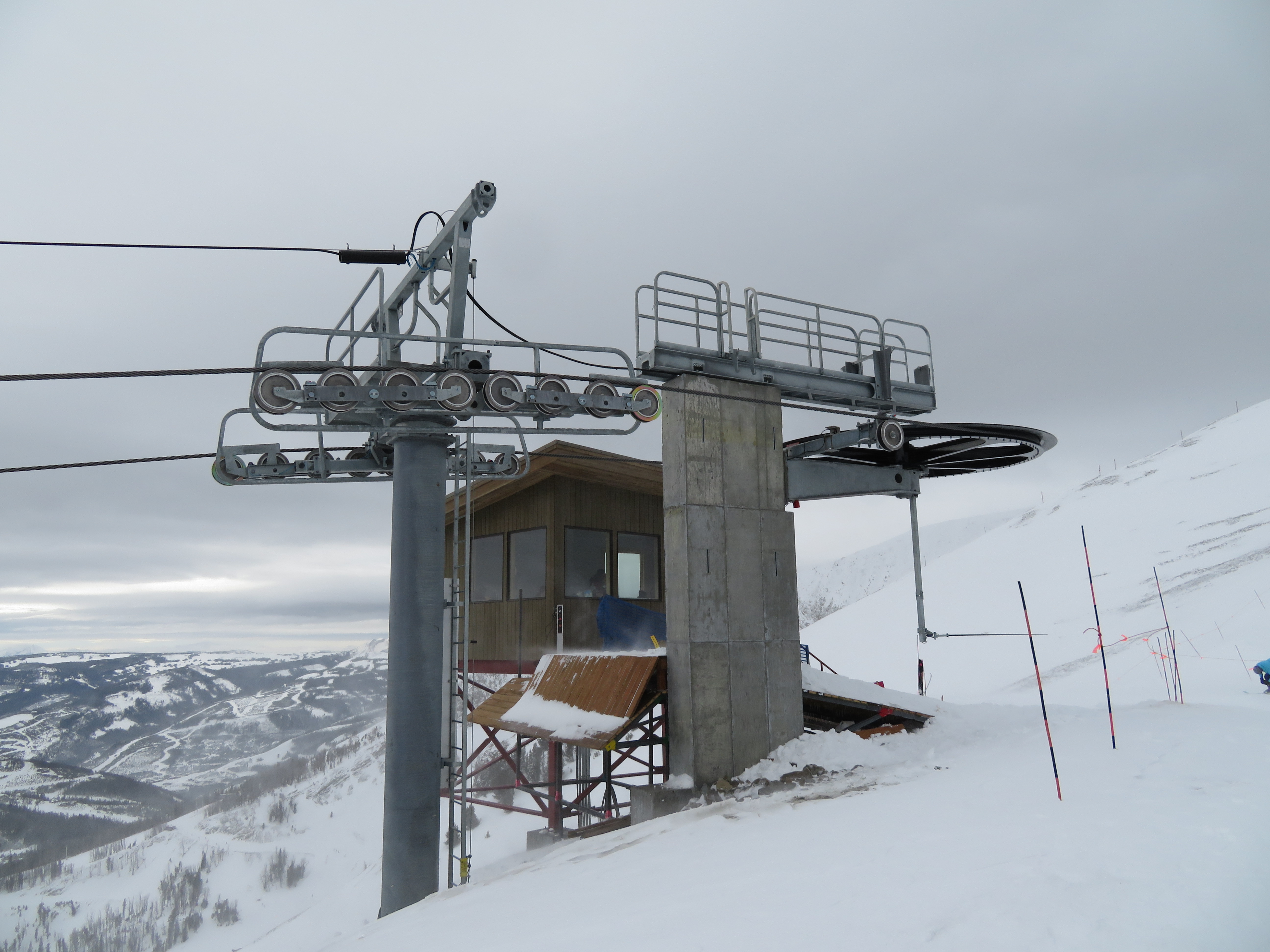
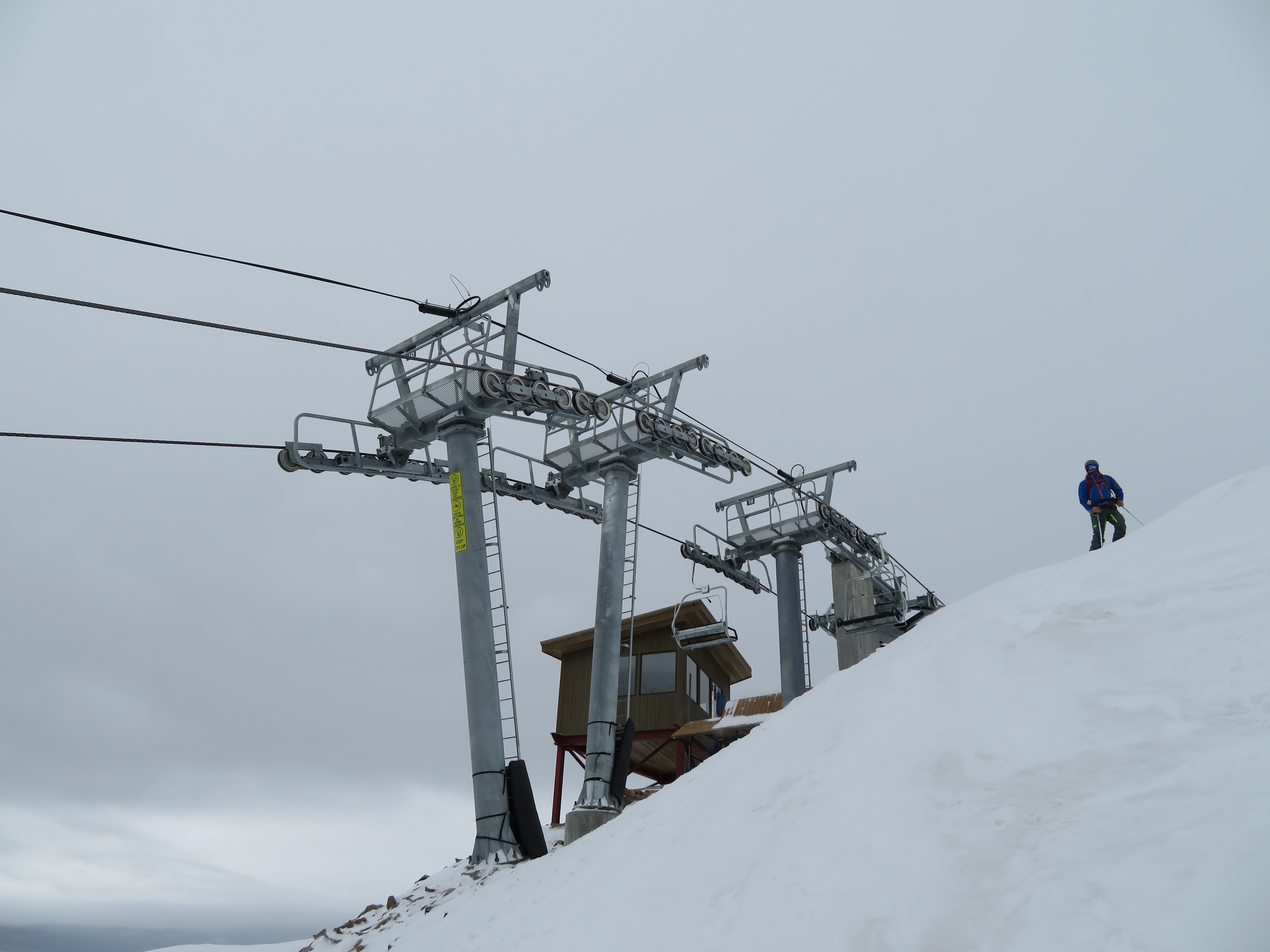
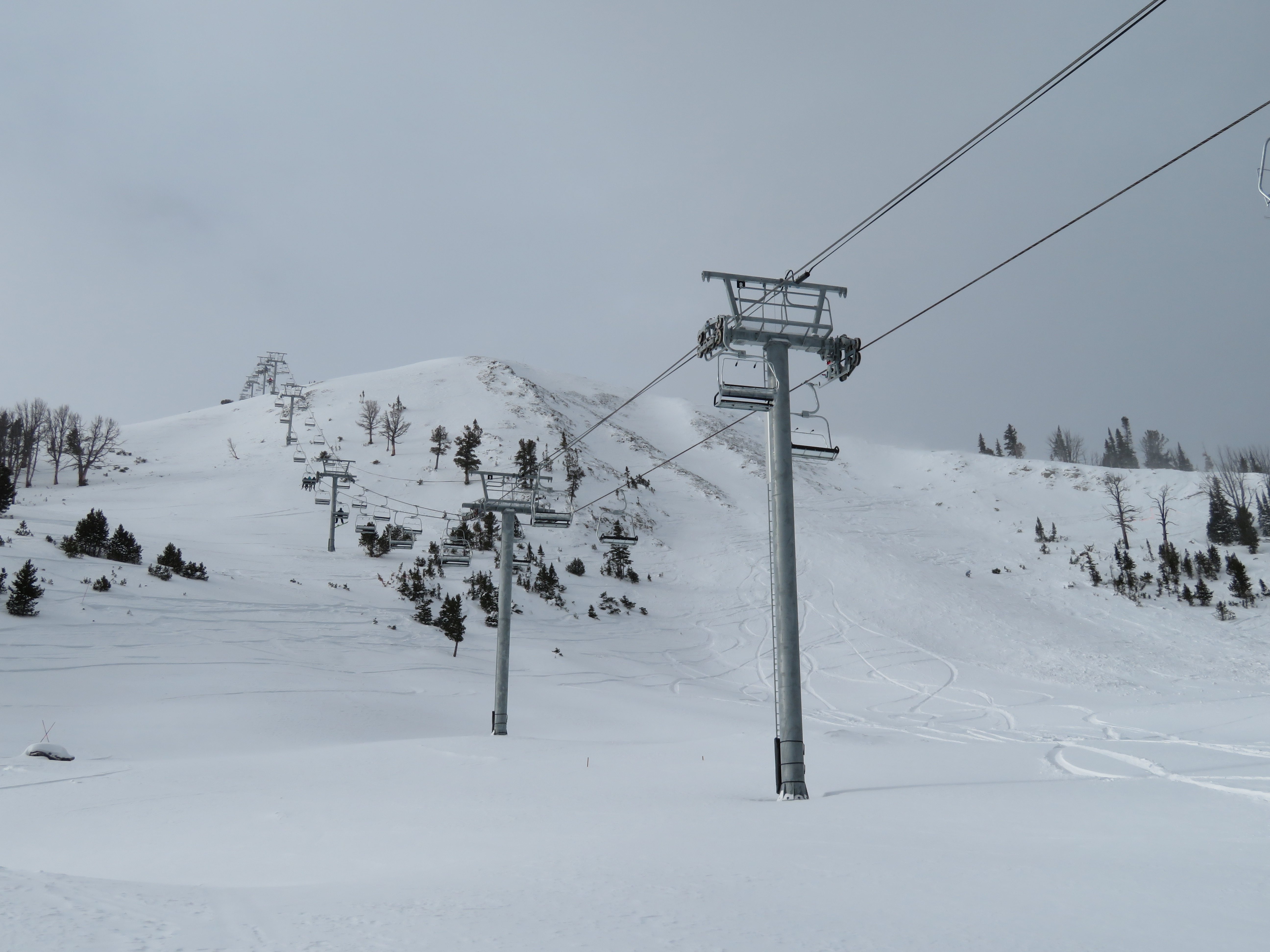
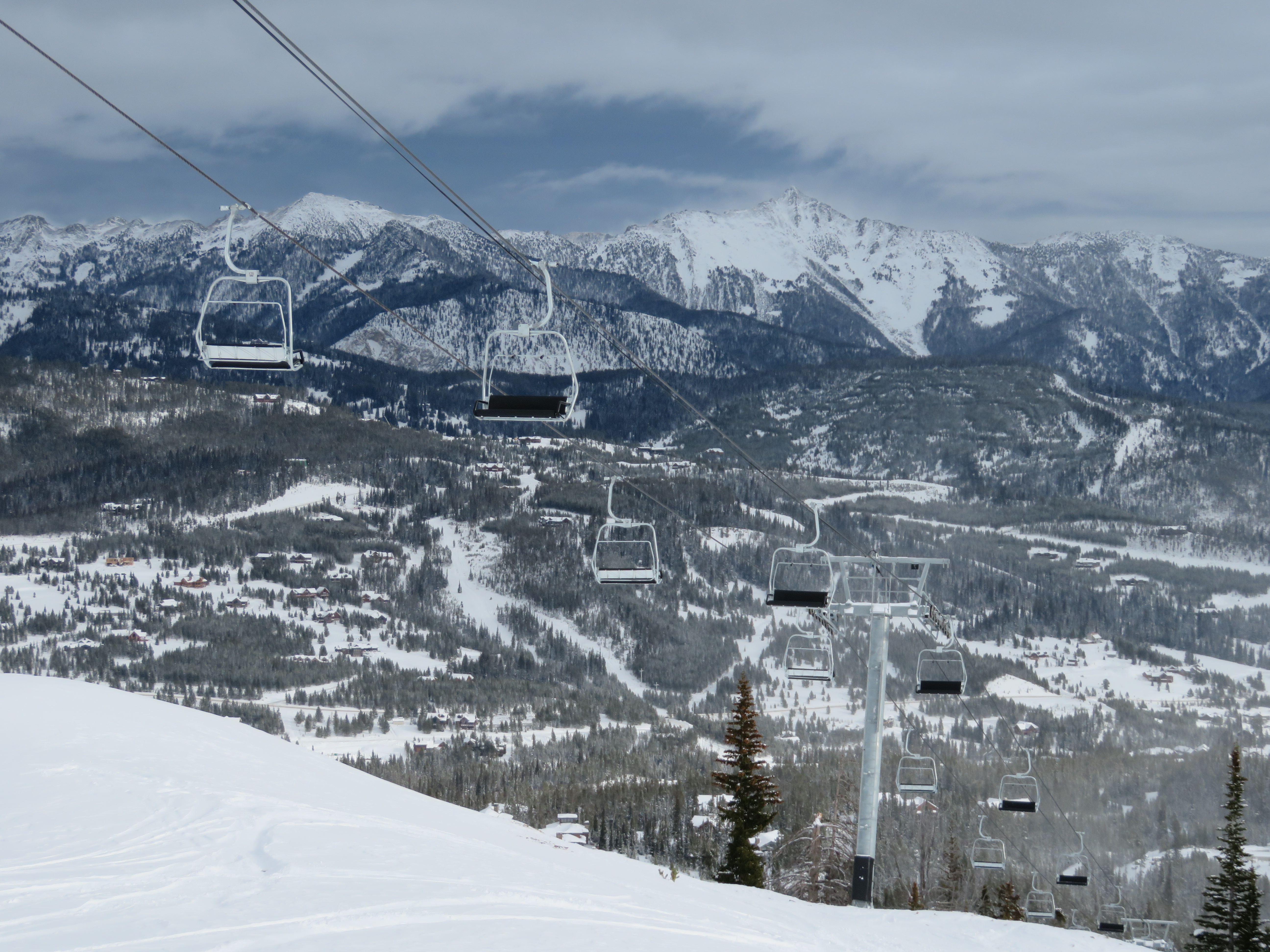
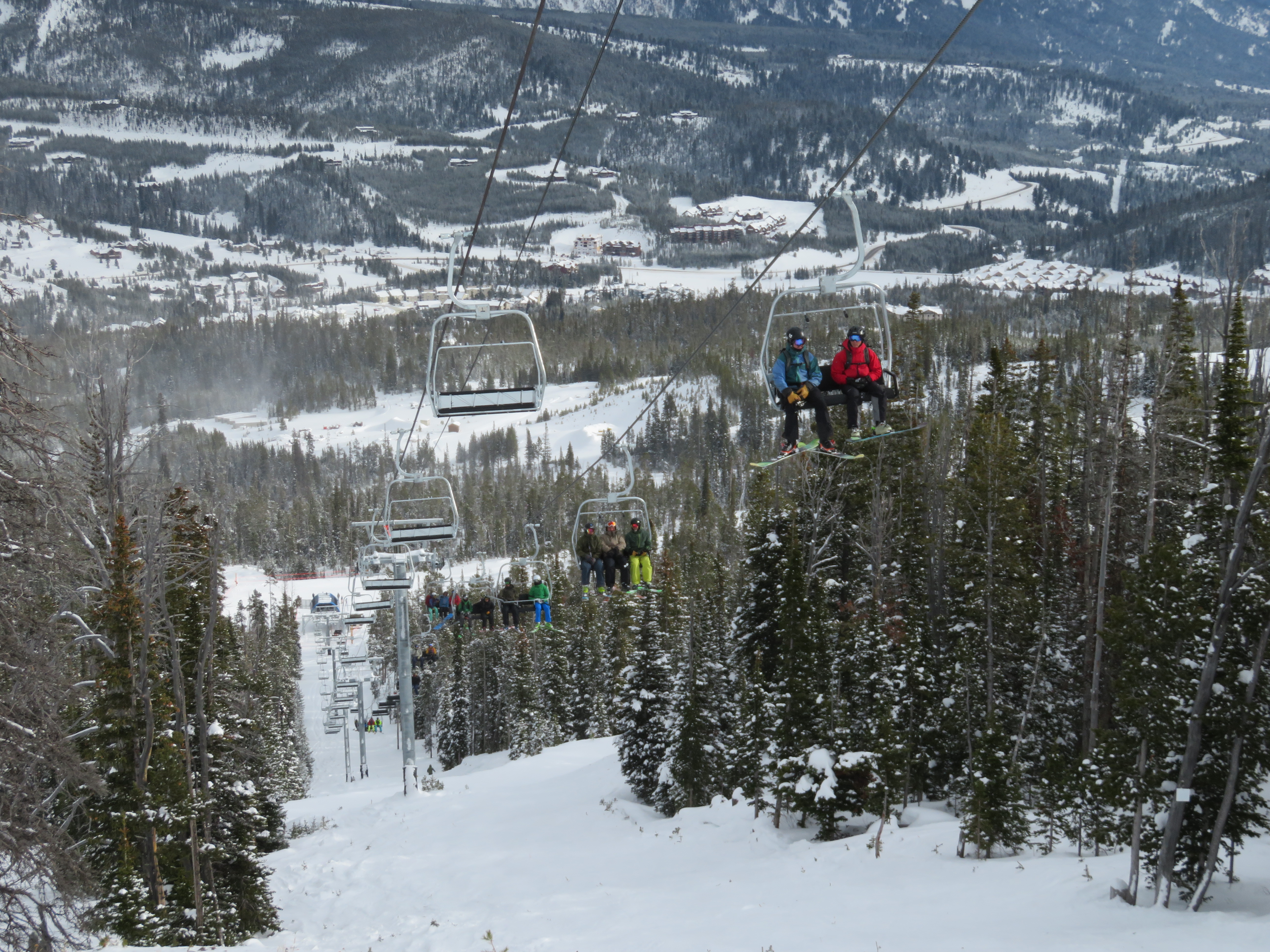
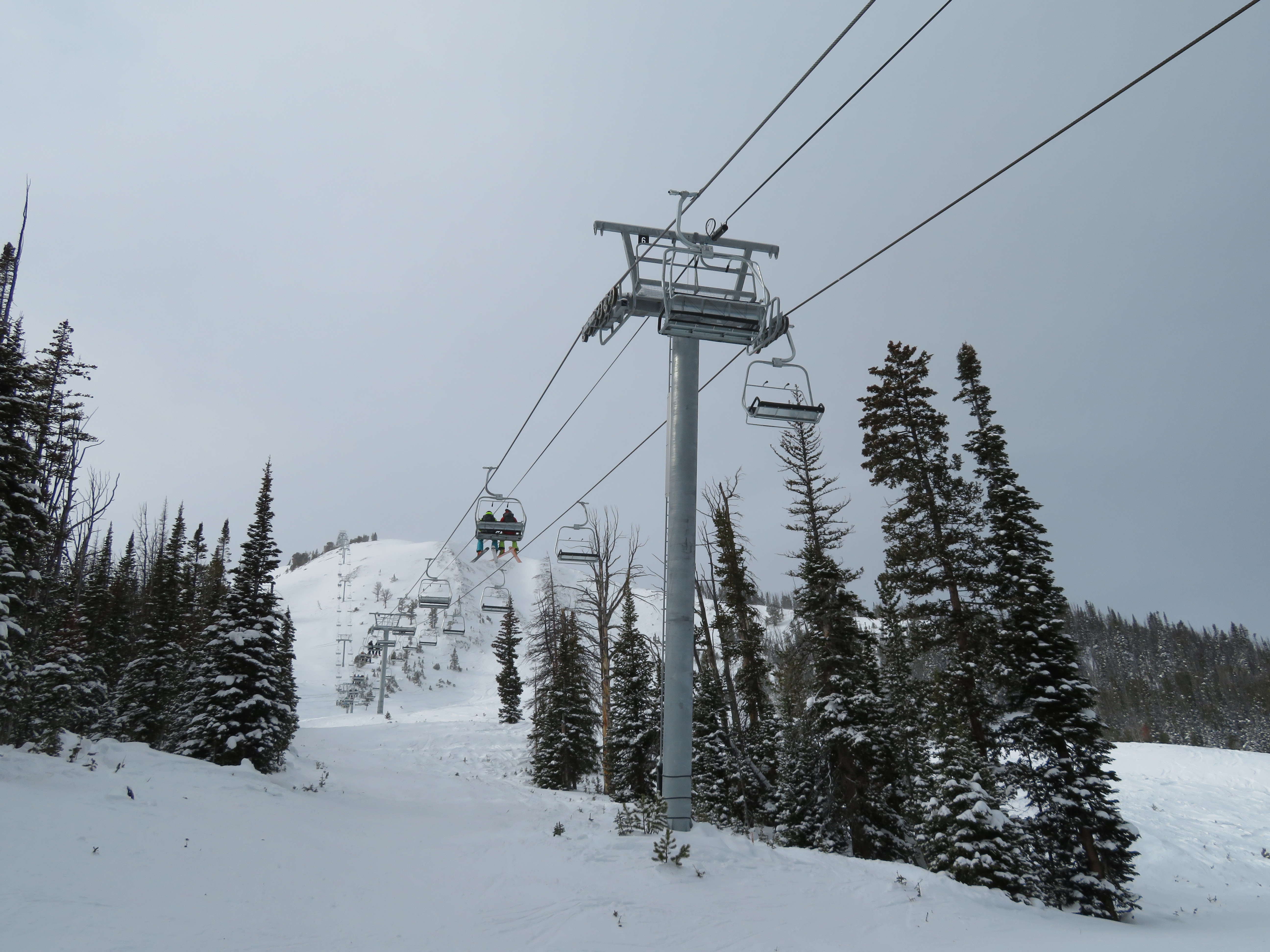
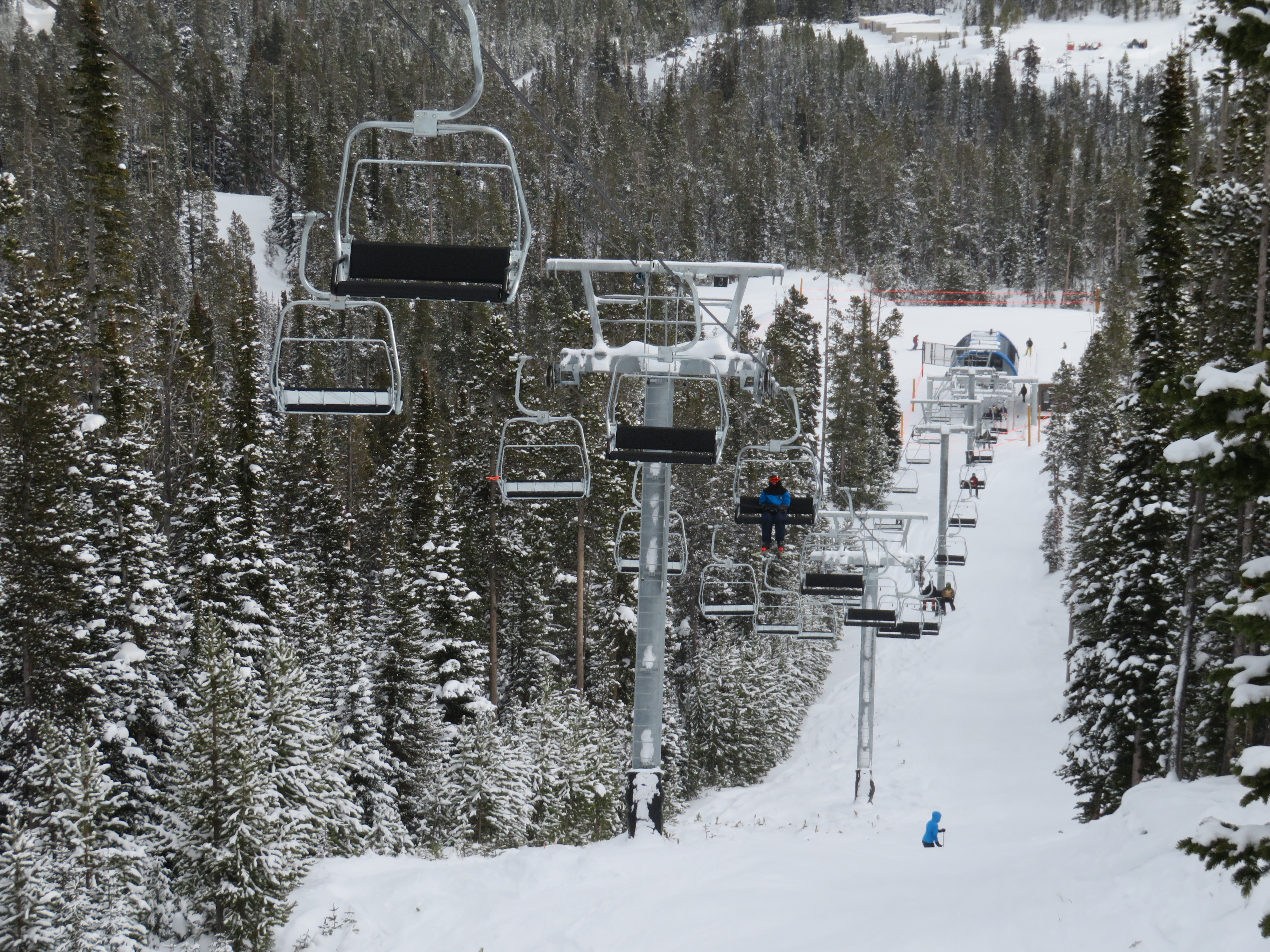
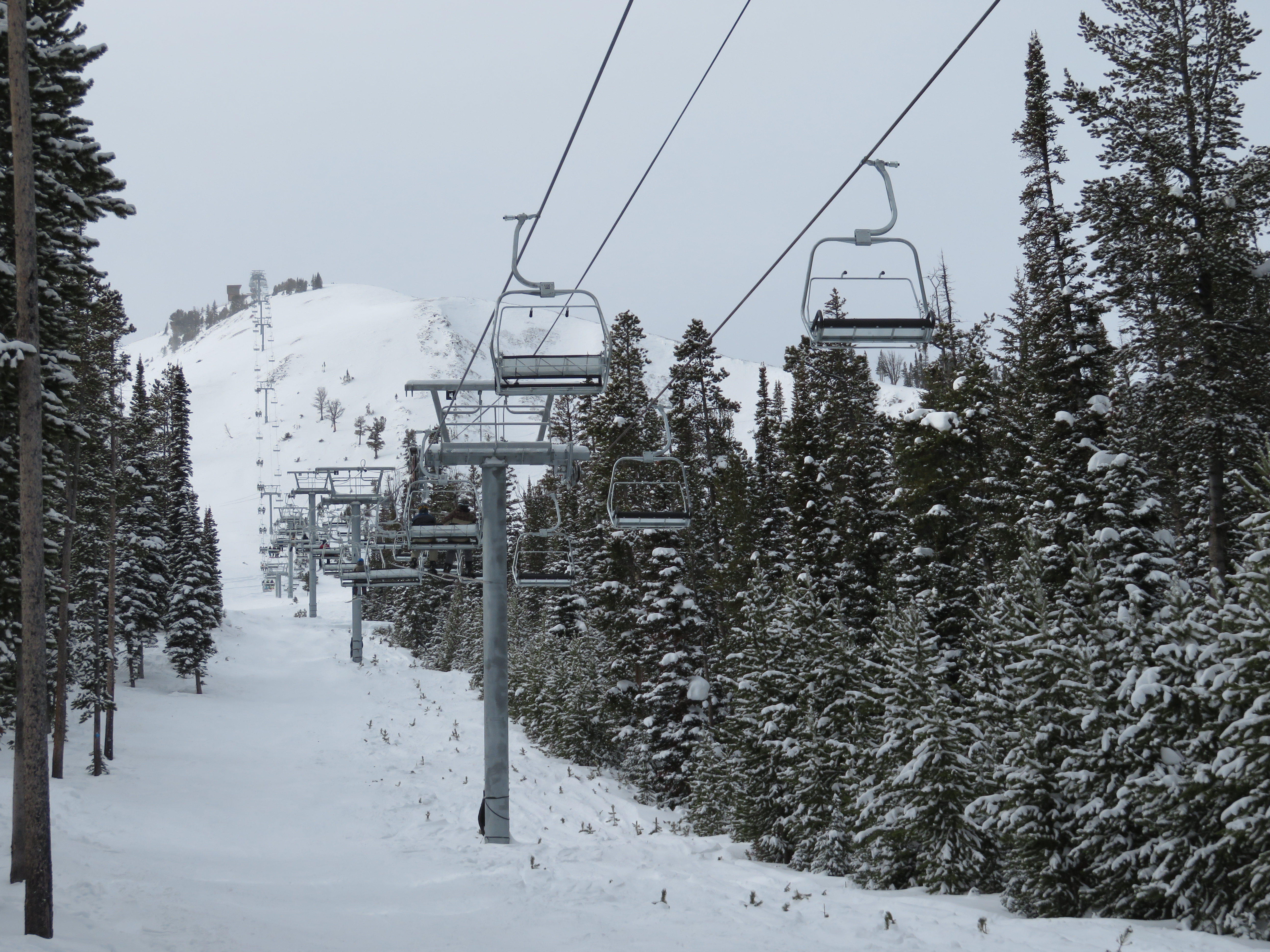
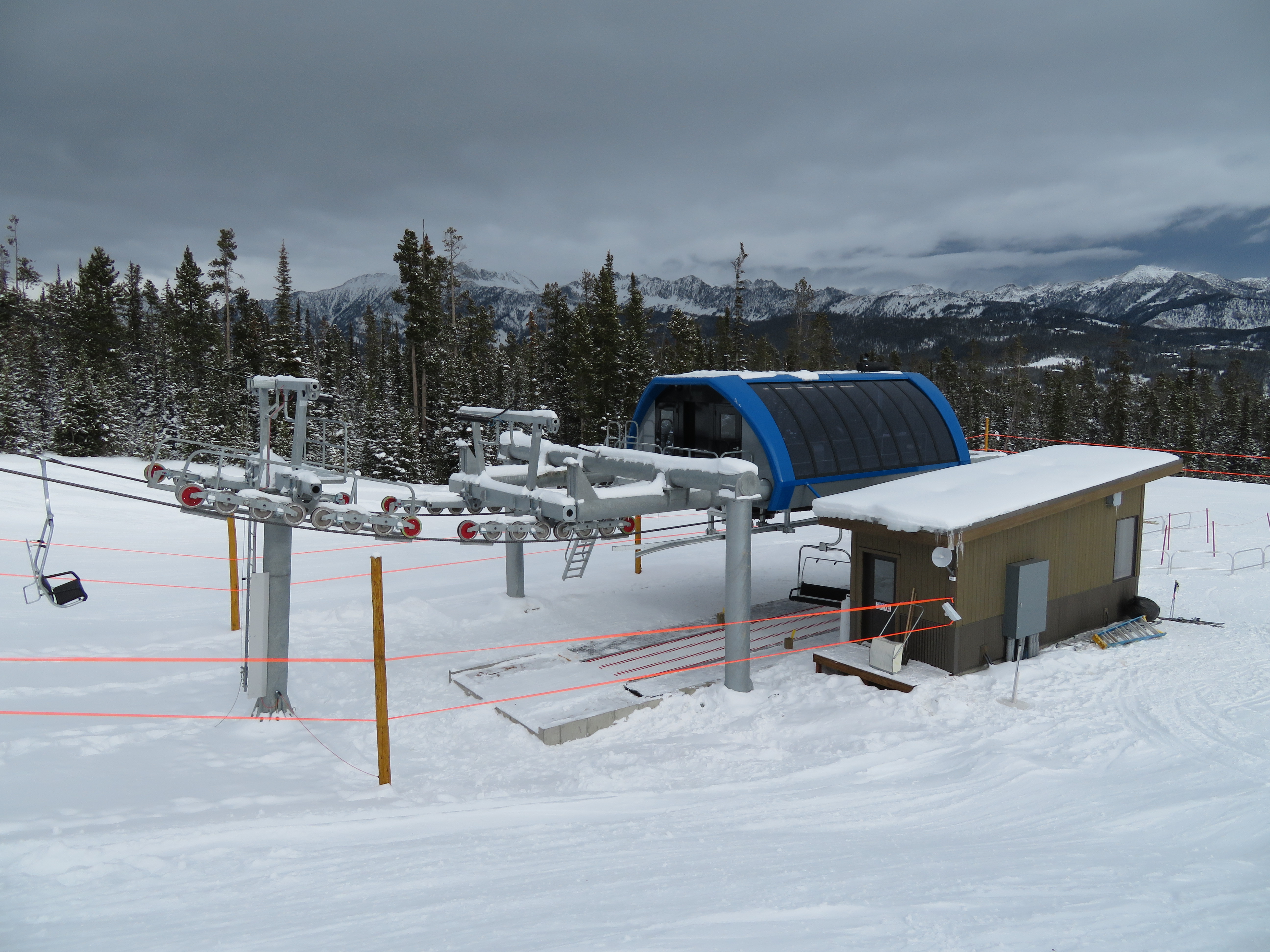
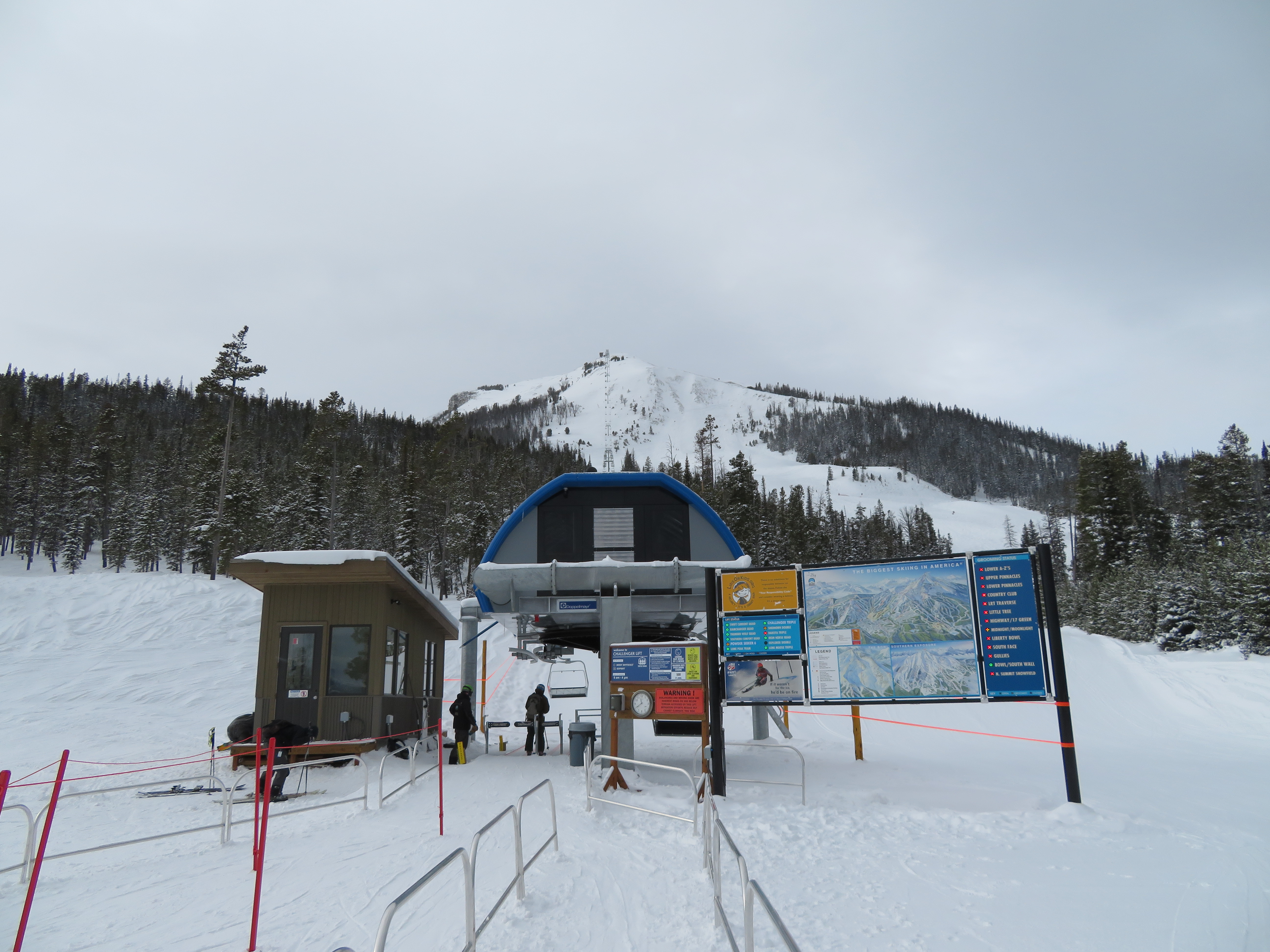
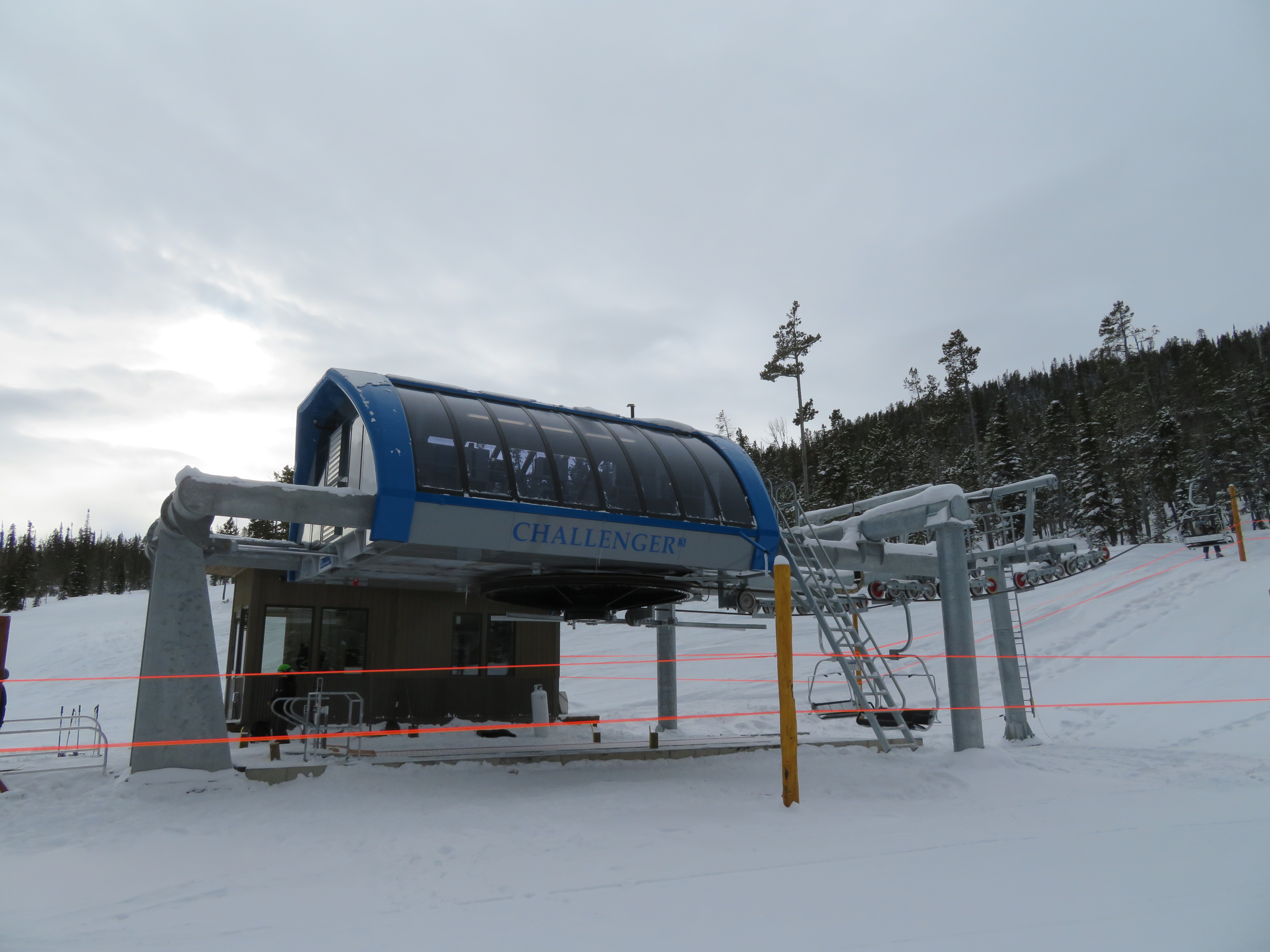
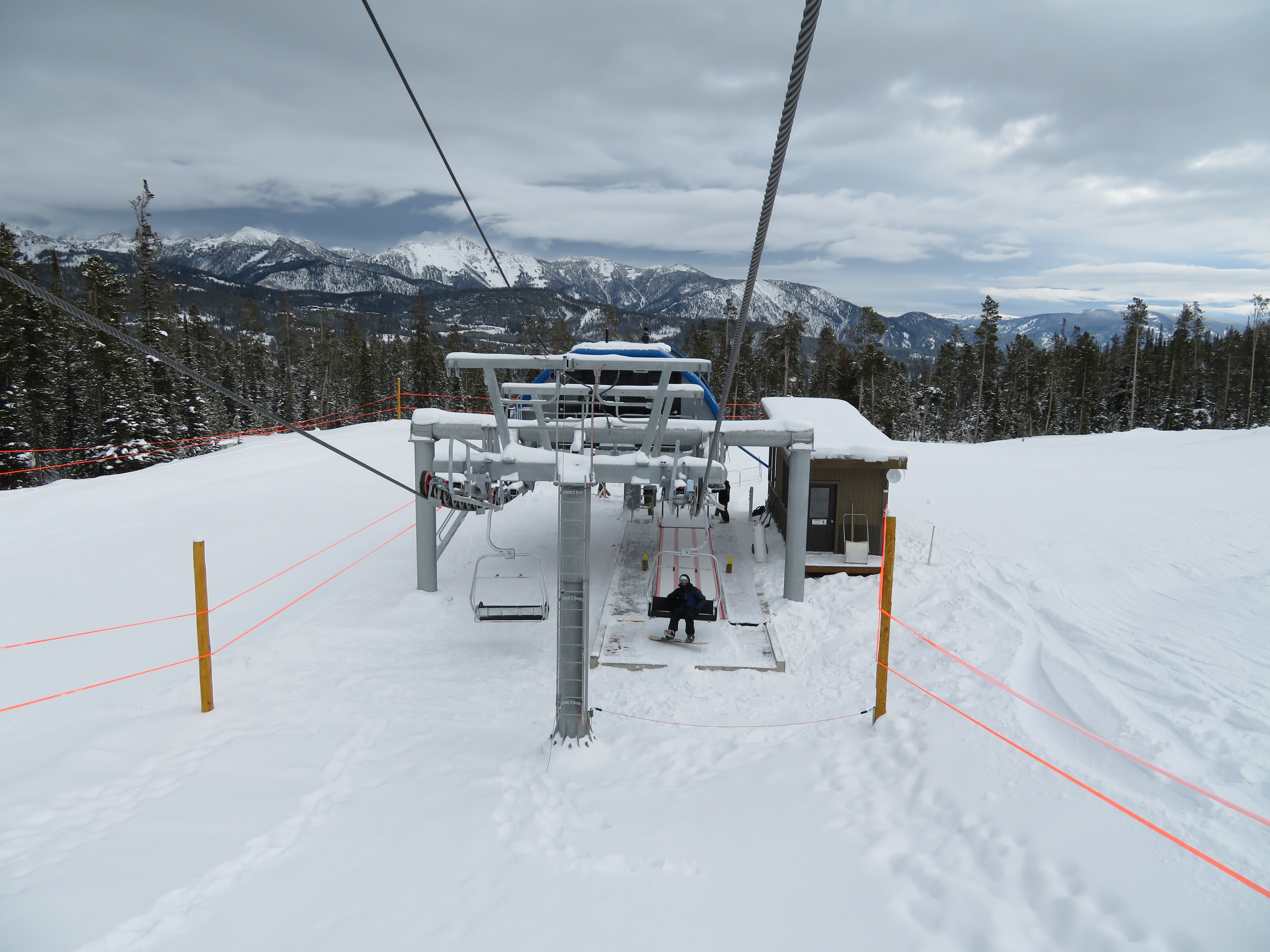
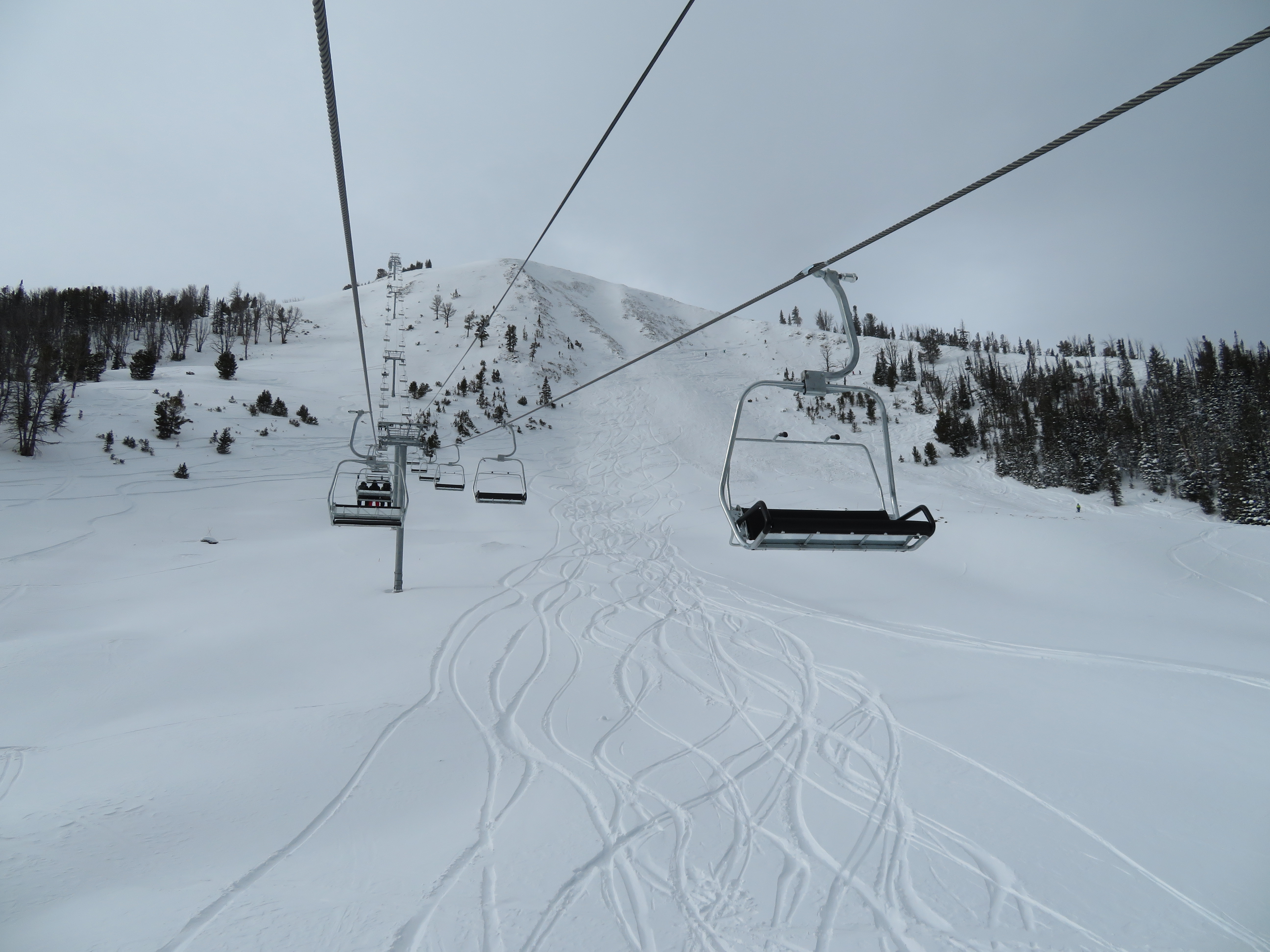
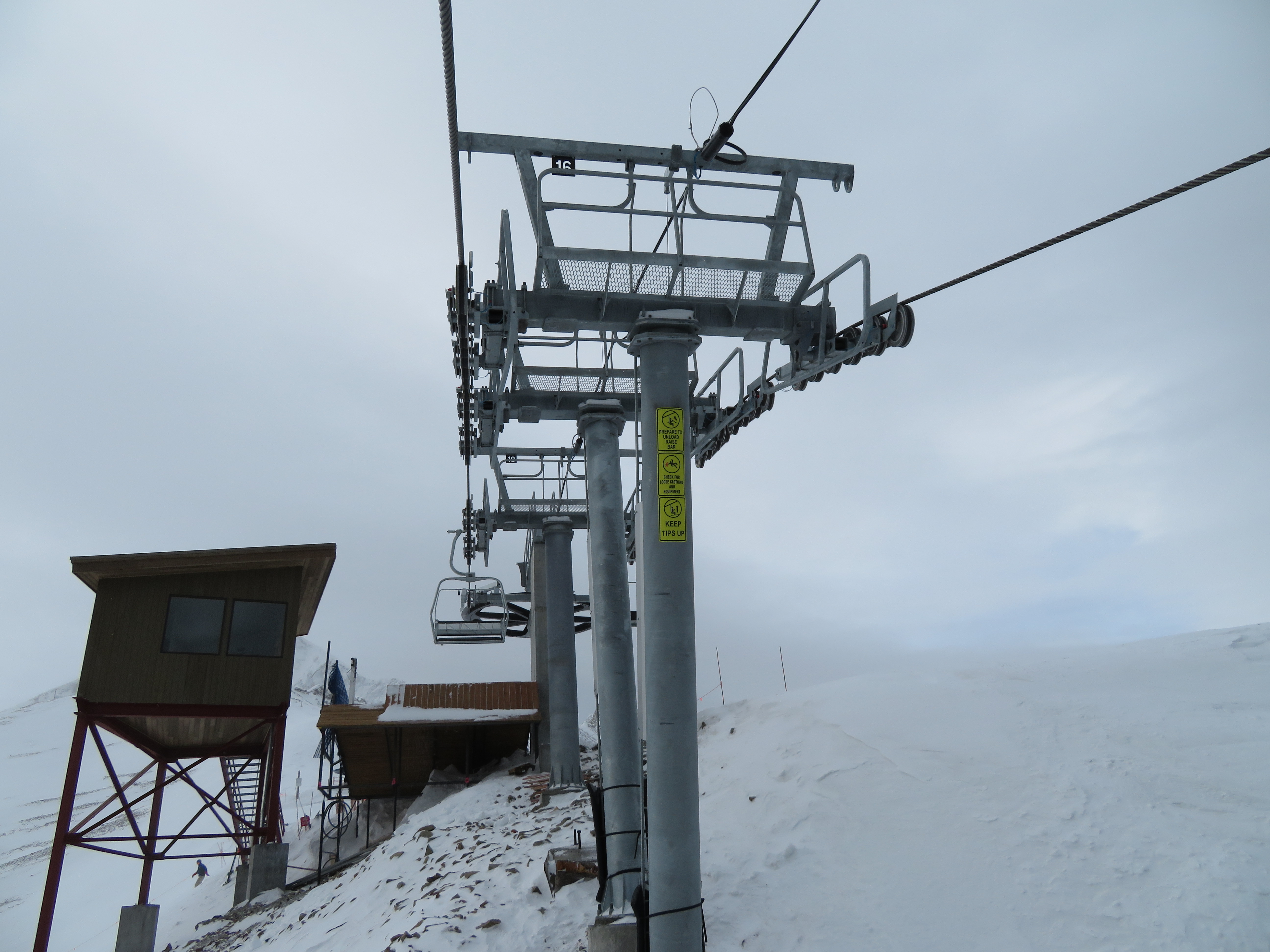
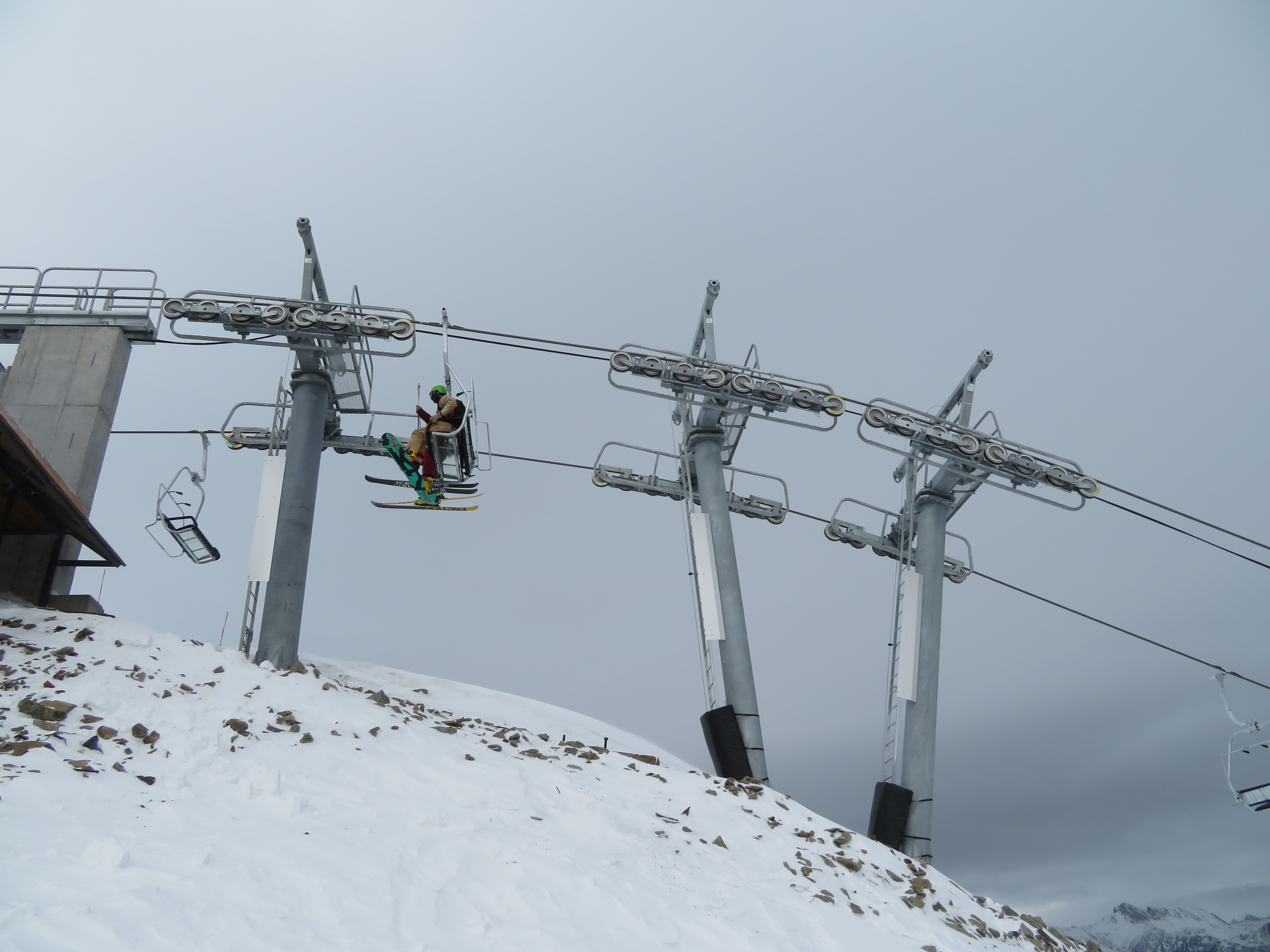
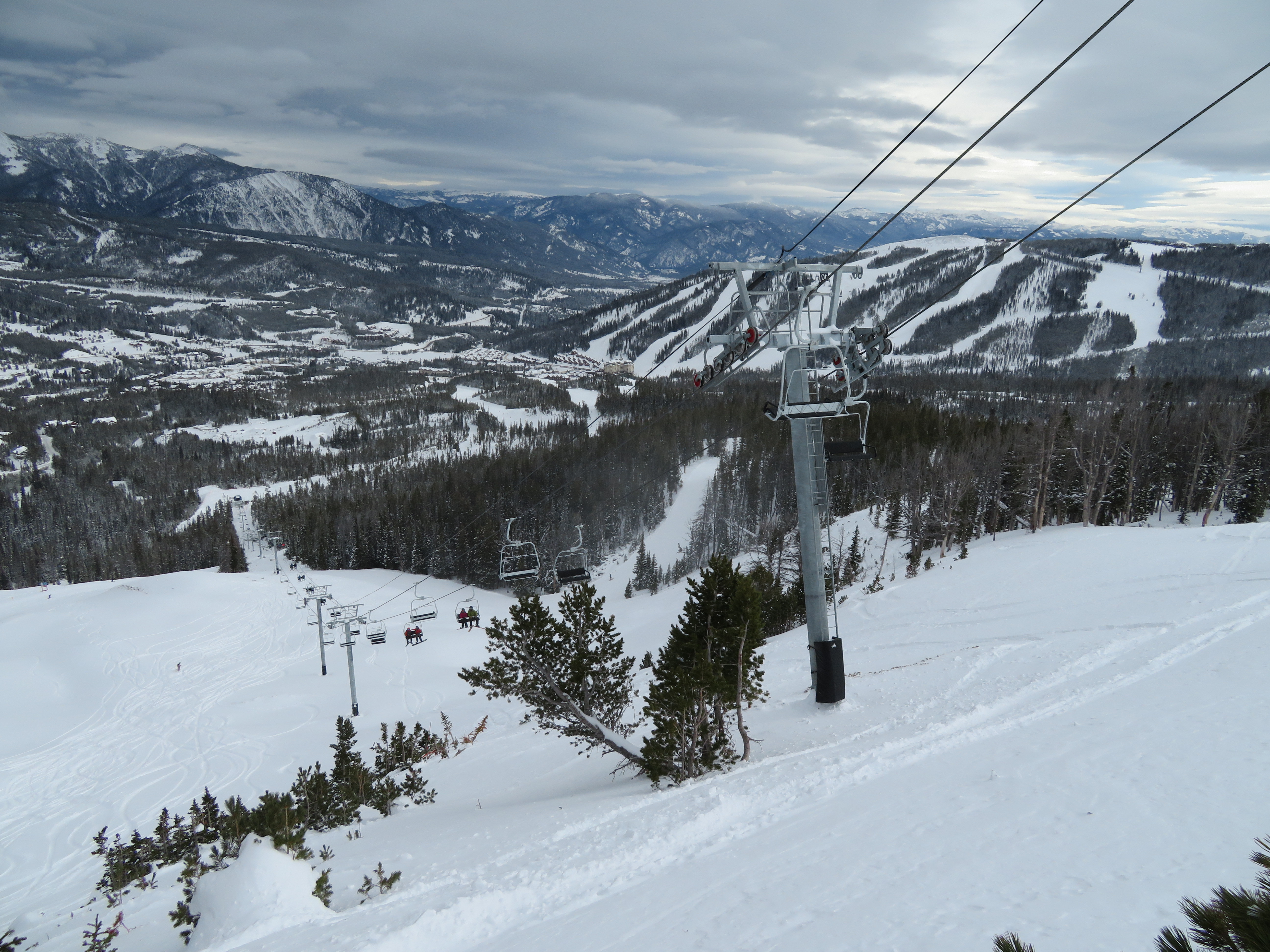
View down the lift line from the steepest span.Top station with new operator house and concrete mast.Tower 18 up top.The breakover from below.View of the upper half of the line.Doppelmayr EJ-model chairs with seat pads.Lower lift line.Middle part of the line.Another view of the lower lift line.Lift line overview.The lower terminal is a Doppelmayr Tristar with drive, tension, and a loading carpet.Maze area.Motor room view.Looking back at the load area.Riding up on a powder day.Note the small extensions on the break over towers.Towers 16-18.Depression/combo tower 10.
It’s a strictly experts only lift. I don’t think even a snowcat could get up to the top of Challenger/Headwaters. Making this lift a detachable would do two things: attract skiers who are not advanced enough to ski the terrain Challenger has to offer, and it would also be a maintenance nightmare considering that the only other way to the top of the Headwaters chair. Imagine having to take a cat up to Headwaters, then ride Headwaters (a very exposed, cold, and slow lift despite its short length) to fix a minor problem that would otherwise cripple a detachable lift.
It just doesn’t make sense to install a detachable here considering the terrain it serves and the simplicity required at the top to ensure reliability.
Even with it being fixed grip they still have issues with beginners getting on it despite signs saying it is for experts only. Imagine if it was a bubble or even a regular high speed quad. I blame that directly on the fact that it starts right near Explorer.
All things considered, they really should have gone detachable here because it is long enough and Big Sky is trying to build a brand around fantastic chairlifts. A quick glance at the trail map and a sign at the base of the lift would show any beginner it is not for them, and they could have fit it at the top like. Little Cloud at Snowbird.
What makes a detach “fantastic”? Why can’t a new, hopefully well engineered and installed CLF also be fantastic? Or a righteous old Poma like the Face at Beaver for that matter? Good mechanics to keep it safe and running and good terrain underneath are far more important to the overall experience. Separately, having spent many winters bumping chairs like Chair 6 at Crystal, neither maps nor slow and/or long doubles do anything to deter beginners. Some folks just aren’t that aware of their surroundings.
Really just comes down to the demand. Austria’s skiing audience is much larger than the average American ski resort’s, and as such means, they need higher capacity lifts in order to reasonably meet this demand. Triple chairs are nice cause they’re cheap and easy to operate, and making a full detachable quad or six becomes impractical and expensive.
I’ve seen a few low capacity quad lifts installed, and there’s definitely a trend here in North America away from double and triple chairs. However, one of the advantages that double and triple chairs have over quad chairs, is that they’re allowed by American standards to spin faster than quad chairs. You can of course install a loading carpet on your quad chair if you want it to spin faster, but that adds cost and expense to a lower utilization lift. Also, most Americans do not care what type of lift they ride, as long as they aren’t having to wait in a long line for a low capacity lift.
Keep in mind that culture is perhaps as, if not more important of a factor as demand. In North America, resorts market themselves as a function of their terrain (both quality and quantity). Infrastructure (including lifts, chalets, hotels) plays a secondary role most of the time. Big Sky seems to have broken from this pattern, but is the only resort in North America so far to do so. In Europe (primarily Austria/Switzerland/France), contrarily, resorts don’t market themselves based on their terrain, but rather the comfort and luxury they can offer their guests. Hence, detachables and bubbles are installed in cases where they wouldn’t seem necessary, entirely to the end of increasing the guest experience at the resort. I’ve seen hilariously short detachable eights that are nowhere near busy enough to justify their construction, but they were built all the same.
Thanks. Note that there were still a fair number of doubles built in Austria in the 90s and at least a few these days. But indeed longer lifts now seem to be detachable quads or up 99% of the time. It just surprises me that on my US trips I can ride brand new tripples while I can barely find one at home, and those few are very dated.
Triples can function as marketing, as it might in Challenger’s case. Functionally they don’t increase capacity, as most triples are ridden by pairs and singles unless the line is yuge, but Big Sky, or anywhere, can claim a dern-near 50% increase in capacity. (Spacing is usually longer.) Locals get a new chair that isn’t worse than the old chair, and Big Sky gets blurbs in blogs for us olds and those terrible PeakRankings videos Unofficial touts as gold.
Woah Woah Woah there, I agree that Unofficial networks is hot garbage, but PeakRankings produce some of the most comprehensible unbiased ski resort reviews out there. You are the first person I’ve seen complain about them
Ha! That was quick. I gots major umbrage and Grade A beef cuts with anyone who says that Monarch is the “worst” place in Colorado, or that Loveland is somehow “worse” than, say, Keystone. If their m.o. is some sort of Ski Magazine-esque pseudoscience, they need a new m.o.. If they actually believe what they say, then they’re pretty much useless. And yes, I know I can just scroll away, but having been stuck on the couch sick or broken a few times these last couple months, typing JUST SHOW ME SKIING GORAMIT into the Great Algorithm in the Sky brings them up, and I’ll admit I give a lotta these sorta folks a shot in those situations.
There’s no such think as an unbiased review. “Breck is better than Cooper” is one person’s opinion. “Breck has more things and Cooper has fewer people” is fact, but neither matters. Attempting to objectively measure ski joints against each other is never truly objective, and never tells you what it feels like to actually be at a given place. If these cats make money so they can ski without having to ruin their backs with real work, then, by God, good on em. They’re still wrong. Loveland, Monarch, and Cooper have a better feel than a place like Vail for me, an angry lifelong skier who hates fancy things like gondolas and Snowbasin terlets and Range Rovers, and no one who happens by with decent editing skills and the privilege of skiing multiple joints each winter is gonna convince me otherwise. Oh, yeah, and. . . . . .they list 18 ski areas in CO and I count somewhere around 30. That’s a problem as well. Rank a state “worst to best”, do the whole dern state. Otherwise, just say “Here’s some nice places in Colorado, and some of them have more fancy things than the places that have fewer fancy things. Order is based on our editorial preference alone. Skiing is fun and you should get after it.”
My $15.02. Apologies for diverting a conversation about a nice lift with rad terrain at Big Sky toward folks not even here to defend themselves.
I agree with @Joe Blake. some of their videos are pretty good, but they don’t know these places, they come for a day, do a ranking and leave the next, for Breck Vs Copper or all these other ski hill vs another ski hill, its a question of preferences. Also agree that state rankings like Colorado they only have like, half of the resorts, Only because a hill is smaller and has minor developement does not mean its bad, every hill is unique in their own way! I would feel better if those ranking were done by people that ski there often and know the mountain well. I feel like some of the criteria is unfair, say lake Louise is in Banff National Park, so they cannot have onsite lodging, yet they give them a bad score because of the park’s rules! Some categories seem a little bit unnecessary like Apres Ski, that is not that important. Sometimes on criteria like accessibility, they give a bad score because a hill is remote, but the best places are not the easiest to get to! I also have some sort of problem for that they only do destination resorts, not all resorts need to be destinations to be good. I still think that a lot of those videos have good content, but sometimes I get a little frustrated at what they come out with. Not trying to create a bad impression, its just my opinion.
The Challenger triple chair is an amazing lift, but this alignment is just way too long for a fixed grip lift. I copied all the data from Peter’s spreadsheet and sorted by ride time. The top 5 were Challenger (8.9 mins), Six Shooter (8.3 mins), Highlands (7.7 mins), White Otter (7.5 mins), and Iron Horse (7.1 mins). Of these, Highlands and White Otter are both real estate lifts so they aren’t relevant to the skier experience, Six Shooter is getting upgraded this summer which will reduce its ride time, and Iron Horse will eventually be a detach as well.
That will leave Challenger, a very new lift for that matter, stranded at the top with a few real estate lifts. It’s kind of crazy how Big Sky has spared no expense on all their other lift upgrades while corner cutting this bad with the Challenger upgrade. They had the perfect opportunity to address this in 2016 by installing a HSQ but completely fumbled.
There are lots of other lifts at Big Sky that’d be more ideal becoming high speed lifts. Challenger’s not one of them, and that’s because of it serving expert terrain only. Lone Moose, Pony Express and Iron Horse are the kinds of lifts that should become detachable because of either the terrain they serve and/or their use as access lifts.
I agree those need it, but Challenger needs it too for its ride time. Difficulty of terrain is irrelevant, advanced skiers don’t want to sit on almost a 9 minute fixed grip lift any more than beginners do. My point is that when they upgraded it in 2016 they should have done it right.
Maybe when they upgrade Headwaters they could relocate this very new triple to become Headwaters and put a standard HSQ on the Challenger alignment. I know that’s probably not gonna happen, but we like to mention far fetched ideas on this site
I agree those need it, but Challenger needs it too for its ride time. Difficulty of terrain is irrelevant, advanced skiers don’t want to sit on almost a 9 minute fixed grip lift any more than beginners do. My point is that when they upgraded it in 2016 they should have done it right.
Maybe when they upgrade Headwaters they could relocate this very new triple to become Headwaters and put a standard HSQ on the Challenger alignment.
I agree those need it, but Challenger needs it too for its ride time. Difficulty of terrain is irrelevant, advanced skiers don’t want to sit on almost a 9 minute fixed grip lift any more than beginners do. My point is that when they upgraded it in 2016 they should have done it right.
Maybe when they upgrade Headwaters they could relocate this very new triple to become Headwaters and put a standard HSQ on the Challenger alignment.
I agree about those projects, but Challenger needs it too for its ride time. Difficulty of terrain is irrelevant, advanced skiers don’t want to sit on almost a 9 minute fixed grip lift any more than beginners do. My point is that when they upgraded it in 2016 they should have done it right.
Maybe when they upgrade Headwaters they could relocate this very new triple to become Headwaters and put a standard HSQ on the Challenger alignment.
One also has to consider that this wasn’t a planned replacement. The decision was made to replace Challenger in 2016 because the double suffered a major mechanical failure.
And this was kinda a late decision to make, so essentially Doppelmayr offered to install a triple replacement for Challenger as a bonus while they were also building the already planned Powder Seeker to replace the Lone Peak triple.
Iron/Pony (of the Big Sky variety, not WP), strikes me as a better P0 upgrade than Challenger. Also Lone Tree.
While expert skiers may not like fixed grips any more than beginners, they are typically better at loading onto them. That means the lift can run faster and experience fewer mis-loads and stops. This makes fixed grips relatively more attractive on exclusively expert terrain.
Ungroomed expert terrain also typically features a way lower skier density than intermediate or beginner terrain. So acre-per-acre, lower-level terrain is more deserving of big, comfy, higher cost detachable equipment. Why commit higher operating costs and maintenance to a trail pod most of your visitors are too intimidated to use? As much as I like Grouse Mountain at Beaver Creek, it feels slightly ridiculous riding an almost-empty lift line at noon on a Saturday.
Lastly, faster ride times can induce higher demand. A Challenger pod served by a high speed quad would probably get “skied-out” more quickly. On a scale of Mary Jane to the Hobacks, I’d imagine Big Sky may be aiming for the latter.
Challenger was a last minute project, but even if it wasn’t, a high speed on this alignment was not ever seriously considered. There are many reasons for this, many of which @Muni mentioned, although we were less concerned about skier density than skier skill. High speed lifts have an expectation from novice guests that they have a groomed way down. Part of the goal was to not make the area look more accessible than it is. We also were not really concerned about the ride time as the new lift already reduced the ride time by 3-5 minutes with the loading carpet, and we have headwaters on the other side which is far shorter if riders are looking for hot laps.
An even bigger issue though is logistics. There was no electricity to the top of challenger until this summer, when we finally ran a small line to replace the propane heater in the op house. To get the infrastructure in place to build a full detachable terminal up there would not have been worth the significant extra time and money. It would have turned this relatively small and simple project into something more in the realm of what we just did for the new tram. It would have also necessitated significant reworking of the ridgeline to accommodate the much larger terminal.
I think overall what we ended up with was an ideal solution to balance the many factors we had to deal with with this project. My only regret is actually not making it smaller. If we had kept it a double we could have run it even faster and reduced the ride time even more. We wouldn’t even really be hurting on capacity as this lift almost never has a line. But the triple is nice as it does help some with wind resistance and those rare busy powder days.
Everett, the insight is much appreciated! I do stand by my prior comment and disagree that there is an expectation for novice/intermediate skiers to have a way down from a high-speed lift, as detachable lifts ranging from KT-22 to Mahogany Ridge are advanced/expert only. However, the logistics component is valid, and there is a point where the capital costs just aren’t worth it. I had figured there would be more room at the top if the upper-most entrance to Midnight/Moonlight was used for the lift (forcing all skiers to enter the trails by going left and traversing back under the lift instead of immediately u-turning right when unloading Challenger), but you obviously know better than I do!
The Tristar terminal design has a longer tension carriage which makes it better for longer alignments. The Tristar is less compact than the Alpenstar and takes up more space due to the longer carriage design. There are also two variants of the Tristar, one having a longer motor room such as this lift, which is most likely to accommodate a larger motor.

 Lift Blog
Why did this lift not go detachable?
LikeLike
It’s a strictly experts only lift. I don’t think even a snowcat could get up to the top of Challenger/Headwaters. Making this lift a detachable would do two things: attract skiers who are not advanced enough to ski the terrain Challenger has to offer, and it would also be a maintenance nightmare considering that the only other way to the top of the Headwaters chair. Imagine having to take a cat up to Headwaters, then ride Headwaters (a very exposed, cold, and slow lift despite its short length) to fix a minor problem that would otherwise cripple a detachable lift.
It just doesn’t make sense to install a detachable here considering the terrain it serves and the simplicity required at the top to ensure reliability.
LikeLike
Even with it being fixed grip they still have issues with beginners getting on it despite signs saying it is for experts only. Imagine if it was a bubble or even a regular high speed quad. I blame that directly on the fact that it starts right near Explorer.
LikeLike
There’s not really much space up at the top for a detachable terminal, unless they did a 90 degree unload (like Little Cloud).
LikeLike
Didn’t need to. One lap and your legs are on fire, you want all nine minutes going back up haha
LikeLiked by 2 people
All things considered, they really should have gone detachable here because it is long enough and Big Sky is trying to build a brand around fantastic chairlifts. A quick glance at the trail map and a sign at the base of the lift would show any beginner it is not for them, and they could have fit it at the top like. Little Cloud at Snowbird.
LikeLiked by 1 person
What makes a detach “fantastic”? Why can’t a new, hopefully well engineered and installed CLF also be fantastic? Or a righteous old Poma like the Face at Beaver for that matter? Good mechanics to keep it safe and running and good terrain underneath are far more important to the overall experience. Separately, having spent many winters bumping chairs like Chair 6 at Crystal, neither maps nor slow and/or long doubles do anything to deter beginners. Some folks just aren’t that aware of their surroundings.
LikeLike
I spent a fair amount of time turning beginners away from old chair 6 back in the day. When were you there?
LikeLike
How does a detachable attract beginners?
LikeLike
I wouldn’t know. It could be from people not consulting a trail map.
LikeLike
Easier load/unload.
LikeLiked by 3 people
They are easier to load and unload and get you up quick (some people don’t have the patience required to ride a “slow chair”) ;)
LikeLike
Btw, why do American resorts still build tripple chairs? I don’t know of one in Austria that isn’t at least 30 years old.
LikeLike
It depends on what the resort feels is the needed capacity.
LikeLike
Really just comes down to the demand. Austria’s skiing audience is much larger than the average American ski resort’s, and as such means, they need higher capacity lifts in order to reasonably meet this demand. Triple chairs are nice cause they’re cheap and easy to operate, and making a full detachable quad or six becomes impractical and expensive.
LikeLike
I’ve seen a few low capacity quad lifts installed, and there’s definitely a trend here in North America away from double and triple chairs. However, one of the advantages that double and triple chairs have over quad chairs, is that they’re allowed by American standards to spin faster than quad chairs. You can of course install a loading carpet on your quad chair if you want it to spin faster, but that adds cost and expense to a lower utilization lift. Also, most Americans do not care what type of lift they ride, as long as they aren’t having to wait in a long line for a low capacity lift.
LikeLike
Keep in mind that culture is perhaps as, if not more important of a factor as demand. In North America, resorts market themselves as a function of their terrain (both quality and quantity). Infrastructure (including lifts, chalets, hotels) plays a secondary role most of the time. Big Sky seems to have broken from this pattern, but is the only resort in North America so far to do so. In Europe (primarily Austria/Switzerland/France), contrarily, resorts don’t market themselves based on their terrain, but rather the comfort and luxury they can offer their guests. Hence, detachables and bubbles are installed in cases where they wouldn’t seem necessary, entirely to the end of increasing the guest experience at the resort. I’ve seen hilariously short detachable eights that are nowhere near busy enough to justify their construction, but they were built all the same.
LikeLike
“function of their terrain”. As it should be. If I want a fancy restaurant Ill stay in town :)
LikeLike
Thanks. Note that there were still a fair number of doubles built in Austria in the 90s and at least a few these days. But indeed longer lifts now seem to be detachable quads or up 99% of the time. It just surprises me that on my US trips I can ride brand new tripples while I can barely find one at home, and those few are very dated.
LikeLike
Triples can function as marketing, as it might in Challenger’s case. Functionally they don’t increase capacity, as most triples are ridden by pairs and singles unless the line is yuge, but Big Sky, or anywhere, can claim a dern-near 50% increase in capacity. (Spacing is usually longer.) Locals get a new chair that isn’t worse than the old chair, and Big Sky gets blurbs in blogs for us olds and those terrible PeakRankings videos Unofficial touts as gold.
LikeLike
Woah Woah Woah there, I agree that Unofficial networks is hot garbage, but PeakRankings produce some of the most comprehensible unbiased ski resort reviews out there. You are the first person I’ve seen complain about them
LikeLike
Ha! That was quick. I gots major umbrage and Grade A beef cuts with anyone who says that Monarch is the “worst” place in Colorado, or that Loveland is somehow “worse” than, say, Keystone. If their m.o. is some sort of Ski Magazine-esque pseudoscience, they need a new m.o.. If they actually believe what they say, then they’re pretty much useless. And yes, I know I can just scroll away, but having been stuck on the couch sick or broken a few times these last couple months, typing JUST SHOW ME SKIING GORAMIT into the Great Algorithm in the Sky brings them up, and I’ll admit I give a lotta these sorta folks a shot in those situations.
There’s no such think as an unbiased review. “Breck is better than Cooper” is one person’s opinion. “Breck has more things and Cooper has fewer people” is fact, but neither matters. Attempting to objectively measure ski joints against each other is never truly objective, and never tells you what it feels like to actually be at a given place. If these cats make money so they can ski without having to ruin their backs with real work, then, by God, good on em. They’re still wrong. Loveland, Monarch, and Cooper have a better feel than a place like Vail for me, an angry lifelong skier who hates fancy things like gondolas and Snowbasin terlets and Range Rovers, and no one who happens by with decent editing skills and the privilege of skiing multiple joints each winter is gonna convince me otherwise. Oh, yeah, and. . . . . .they list 18 ski areas in CO and I count somewhere around 30. That’s a problem as well. Rank a state “worst to best”, do the whole dern state. Otherwise, just say “Here’s some nice places in Colorado, and some of them have more fancy things than the places that have fewer fancy things. Order is based on our editorial preference alone. Skiing is fun and you should get after it.”
My $15.02. Apologies for diverting a conversation about a nice lift with rad terrain at Big Sky toward folks not even here to defend themselves.
LikeLiked by 2 people
I agree with @Joe Blake. some of their videos are pretty good, but they don’t know these places, they come for a day, do a ranking and leave the next, for Breck Vs Copper or all these other ski hill vs another ski hill, its a question of preferences. Also agree that state rankings like Colorado they only have like, half of the resorts, Only because a hill is smaller and has minor developement does not mean its bad, every hill is unique in their own way! I would feel better if those ranking were done by people that ski there often and know the mountain well. I feel like some of the criteria is unfair, say lake Louise is in Banff National Park, so they cannot have onsite lodging, yet they give them a bad score because of the park’s rules! Some categories seem a little bit unnecessary like Apres Ski, that is not that important. Sometimes on criteria like accessibility, they give a bad score because a hill is remote, but the best places are not the easiest to get to! I also have some sort of problem for that they only do destination resorts, not all resorts need to be destinations to be good. I still think that a lot of those videos have good content, but sometimes I get a little frustrated at what they come out with. Not trying to create a bad impression, its just my opinion.
LikeLike
Plus, some of PeakRankings’ videos are outdated. (Snowbasin’s review, for instance, clearly shows that it was made before DeMoisy was added.)
LikeLike
The Challenger triple chair is an amazing lift, but this alignment is just way too long for a fixed grip lift. I copied all the data from Peter’s spreadsheet and sorted by ride time. The top 5 were Challenger (8.9 mins), Six Shooter (8.3 mins), Highlands (7.7 mins), White Otter (7.5 mins), and Iron Horse (7.1 mins). Of these, Highlands and White Otter are both real estate lifts so they aren’t relevant to the skier experience, Six Shooter is getting upgraded this summer which will reduce its ride time, and Iron Horse will eventually be a detach as well.
That will leave Challenger, a very new lift for that matter, stranded at the top with a few real estate lifts. It’s kind of crazy how Big Sky has spared no expense on all their other lift upgrades while corner cutting this bad with the Challenger upgrade. They had the perfect opportunity to address this in 2016 by installing a HSQ but completely fumbled.
LikeLike
There are lots of other lifts at Big Sky that’d be more ideal becoming high speed lifts. Challenger’s not one of them, and that’s because of it serving expert terrain only. Lone Moose, Pony Express and Iron Horse are the kinds of lifts that should become detachable because of either the terrain they serve and/or their use as access lifts.
LikeLike
I agree those need it, but Challenger needs it too for its ride time. Difficulty of terrain is irrelevant, advanced skiers don’t want to sit on almost a 9 minute fixed grip lift any more than beginners do. My point is that when they upgraded it in 2016 they should have done it right.
Maybe when they upgrade Headwaters they could relocate this very new triple to become Headwaters and put a standard HSQ on the Challenger alignment. I know that’s probably not gonna happen, but we like to mention far fetched ideas on this site
LikeLike
I agree those need it, but Challenger needs it too for its ride time. Difficulty of terrain is irrelevant, advanced skiers don’t want to sit on almost a 9 minute fixed grip lift any more than beginners do. My point is that when they upgraded it in 2016 they should have done it right.
Maybe when they upgrade Headwaters they could relocate this very new triple to become Headwaters and put a standard HSQ on the Challenger alignment.
LikeLike
I agree those need it, but Challenger needs it too for its ride time. Difficulty of terrain is irrelevant, advanced skiers don’t want to sit on almost a 9 minute fixed grip lift any more than beginners do. My point is that when they upgraded it in 2016 they should have done it right.
Maybe when they upgrade Headwaters they could relocate this very new triple to become Headwaters and put a standard HSQ on the Challenger alignment.
LikeLike
I agree about those projects, but Challenger needs it too for its ride time. Difficulty of terrain is irrelevant, advanced skiers don’t want to sit on almost a 9 minute fixed grip lift any more than beginners do. My point is that when they upgraded it in 2016 they should have done it right.
Maybe when they upgrade Headwaters they could relocate this very new triple to become Headwaters and put a standard HSQ on the Challenger alignment.
LikeLike
One also has to consider that this wasn’t a planned replacement. The decision was made to replace Challenger in 2016 because the double suffered a major mechanical failure.
https://liftblog.com/2016/02/07/news-roundup-rope-evac-at-big-sky/
And this was kinda a late decision to make, so essentially Doppelmayr offered to install a triple replacement for Challenger as a bonus while they were also building the already planned Powder Seeker to replace the Lone Peak triple.
LikeLike
Iron/Pony (of the Big Sky variety, not WP), strikes me as a better P0 upgrade than Challenger. Also Lone Tree.
While expert skiers may not like fixed grips any more than beginners, they are typically better at loading onto them. That means the lift can run faster and experience fewer mis-loads and stops. This makes fixed grips relatively more attractive on exclusively expert terrain.
Ungroomed expert terrain also typically features a way lower skier density than intermediate or beginner terrain. So acre-per-acre, lower-level terrain is more deserving of big, comfy, higher cost detachable equipment. Why commit higher operating costs and maintenance to a trail pod most of your visitors are too intimidated to use? As much as I like Grouse Mountain at Beaver Creek, it feels slightly ridiculous riding an almost-empty lift line at noon on a Saturday.
Lastly, faster ride times can induce higher demand. A Challenger pod served by a high speed quad would probably get “skied-out” more quickly. On a scale of Mary Jane to the Hobacks, I’d imagine Big Sky may be aiming for the latter.
LikeLike
Challenger was a last minute project, but even if it wasn’t, a high speed on this alignment was not ever seriously considered. There are many reasons for this, many of which @Muni mentioned, although we were less concerned about skier density than skier skill. High speed lifts have an expectation from novice guests that they have a groomed way down. Part of the goal was to not make the area look more accessible than it is. We also were not really concerned about the ride time as the new lift already reduced the ride time by 3-5 minutes with the loading carpet, and we have headwaters on the other side which is far shorter if riders are looking for hot laps.
An even bigger issue though is logistics. There was no electricity to the top of challenger until this summer, when we finally ran a small line to replace the propane heater in the op house. To get the infrastructure in place to build a full detachable terminal up there would not have been worth the significant extra time and money. It would have turned this relatively small and simple project into something more in the realm of what we just did for the new tram. It would have also necessitated significant reworking of the ridgeline to accommodate the much larger terminal.
I think overall what we ended up with was an ideal solution to balance the many factors we had to deal with with this project. My only regret is actually not making it smaller. If we had kept it a double we could have run it even faster and reduced the ride time even more. We wouldn’t even really be hurting on capacity as this lift almost never has a line. But the triple is nice as it does help some with wind resistance and those rare busy powder days.
LikeLiked by 4 people
Fixed grips are fine for longer alignments if they are experts-only lifts.
LikeLike
Everett, the insight is much appreciated! I do stand by my prior comment and disagree that there is an expectation for novice/intermediate skiers to have a way down from a high-speed lift, as detachable lifts ranging from KT-22 to Mahogany Ridge are advanced/expert only. However, the logistics component is valid, and there is a point where the capital costs just aren’t worth it. I had figured there would be more room at the top if the upper-most entrance to Midnight/Moonlight was used for the lift (forcing all skiers to enter the trails by going left and traversing back under the lift instead of immediately u-turning right when unloading Challenger), but you obviously know better than I do!
LikeLike
How does a resort choose between TriStar or AlpenStar?
LikeLike
The Tristar terminal design has a longer tension carriage which makes it better for longer alignments. The Tristar is less compact than the Alpenstar and takes up more space due to the longer carriage design. There are also two variants of the Tristar, one having a longer motor room such as this lift, which is most likely to accommodate a larger motor.
LikeLike