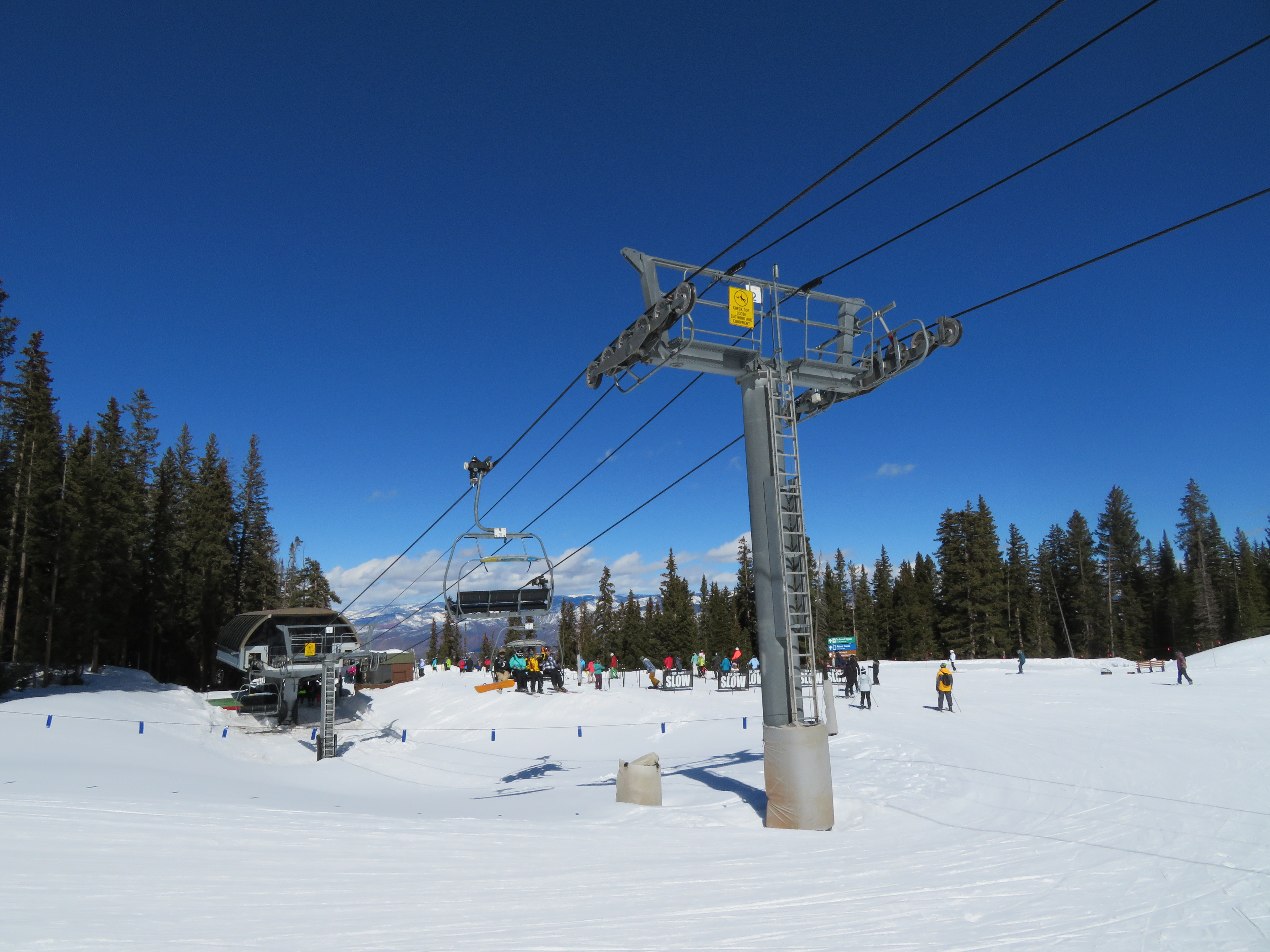
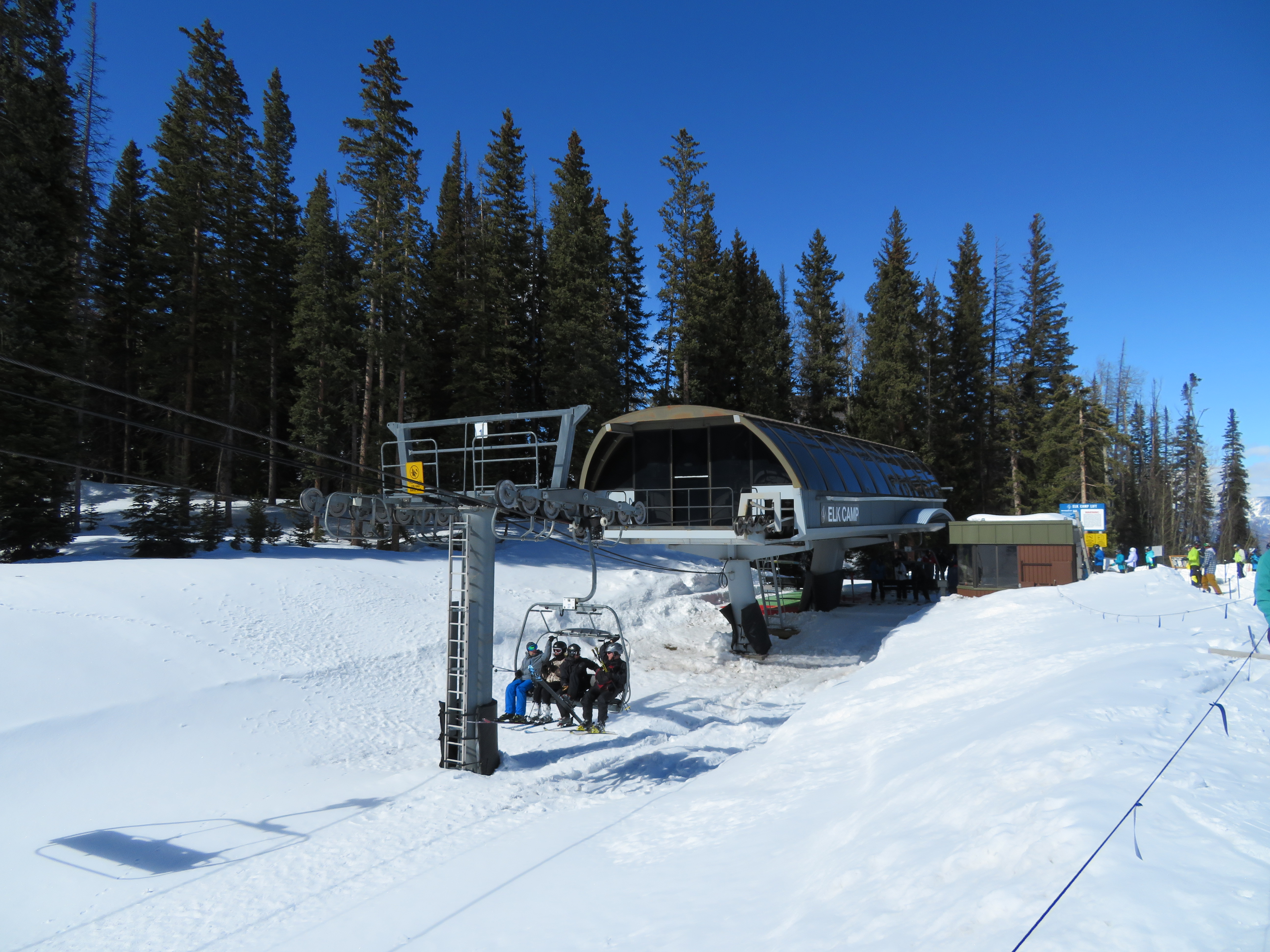
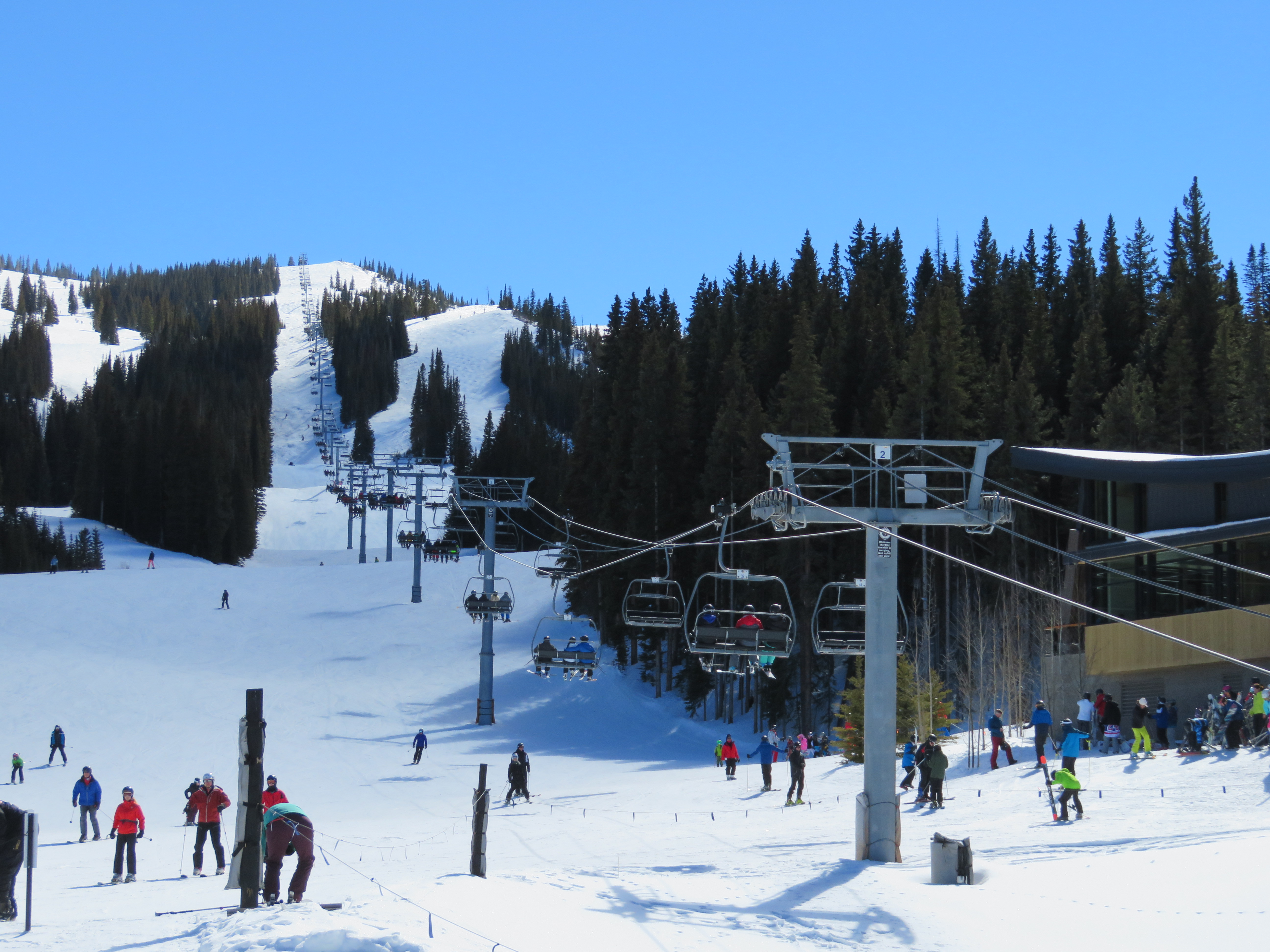
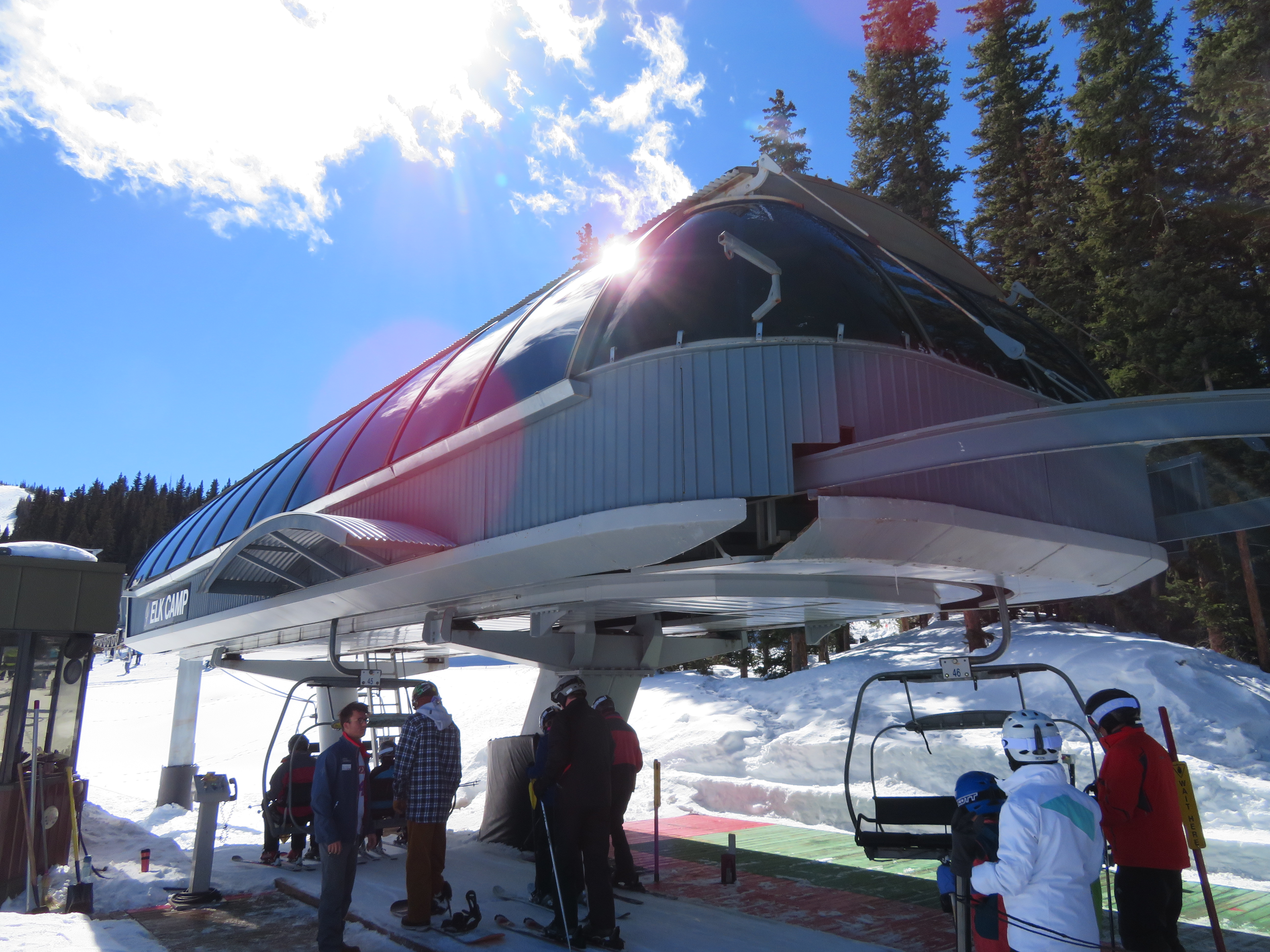
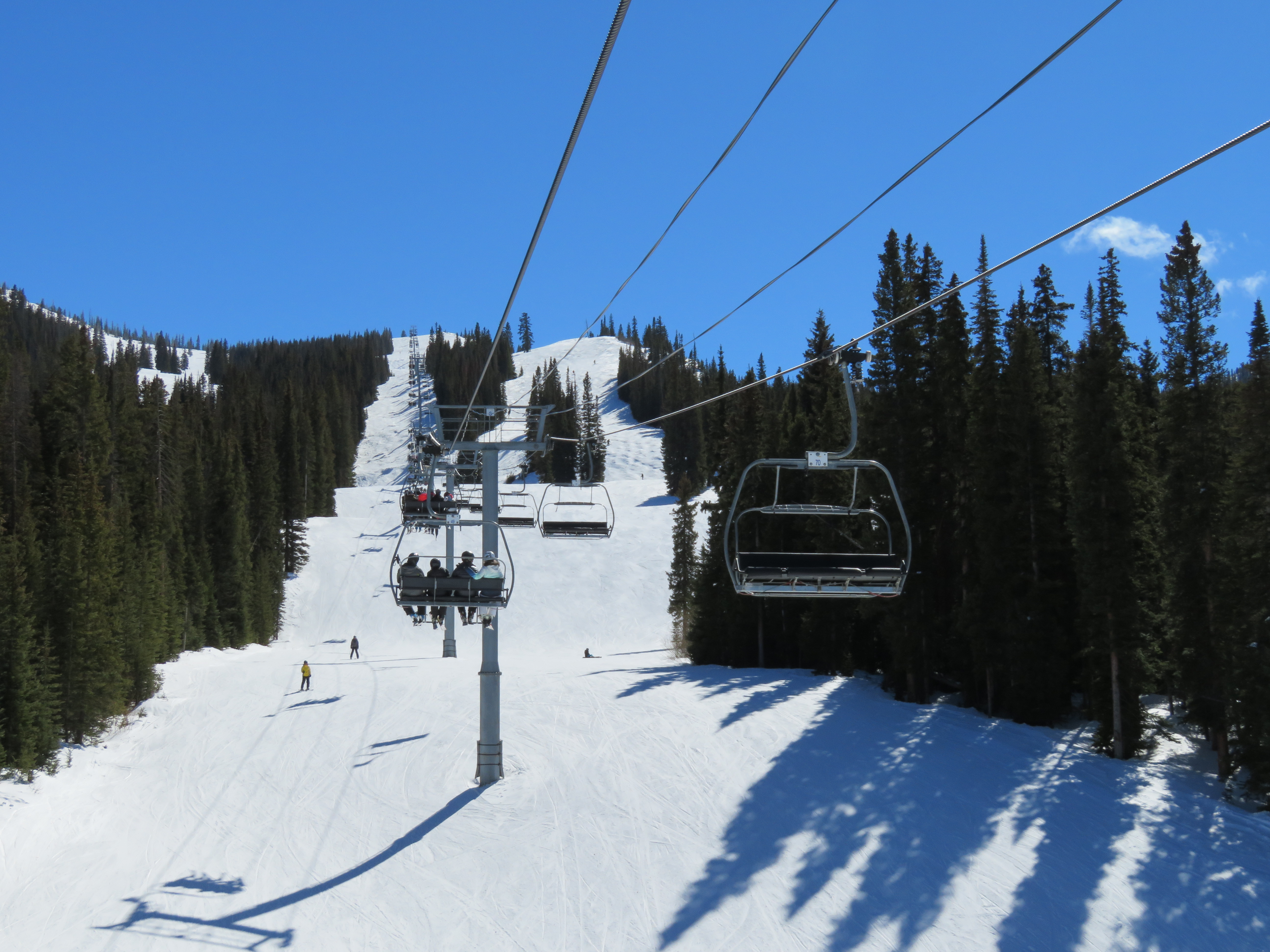
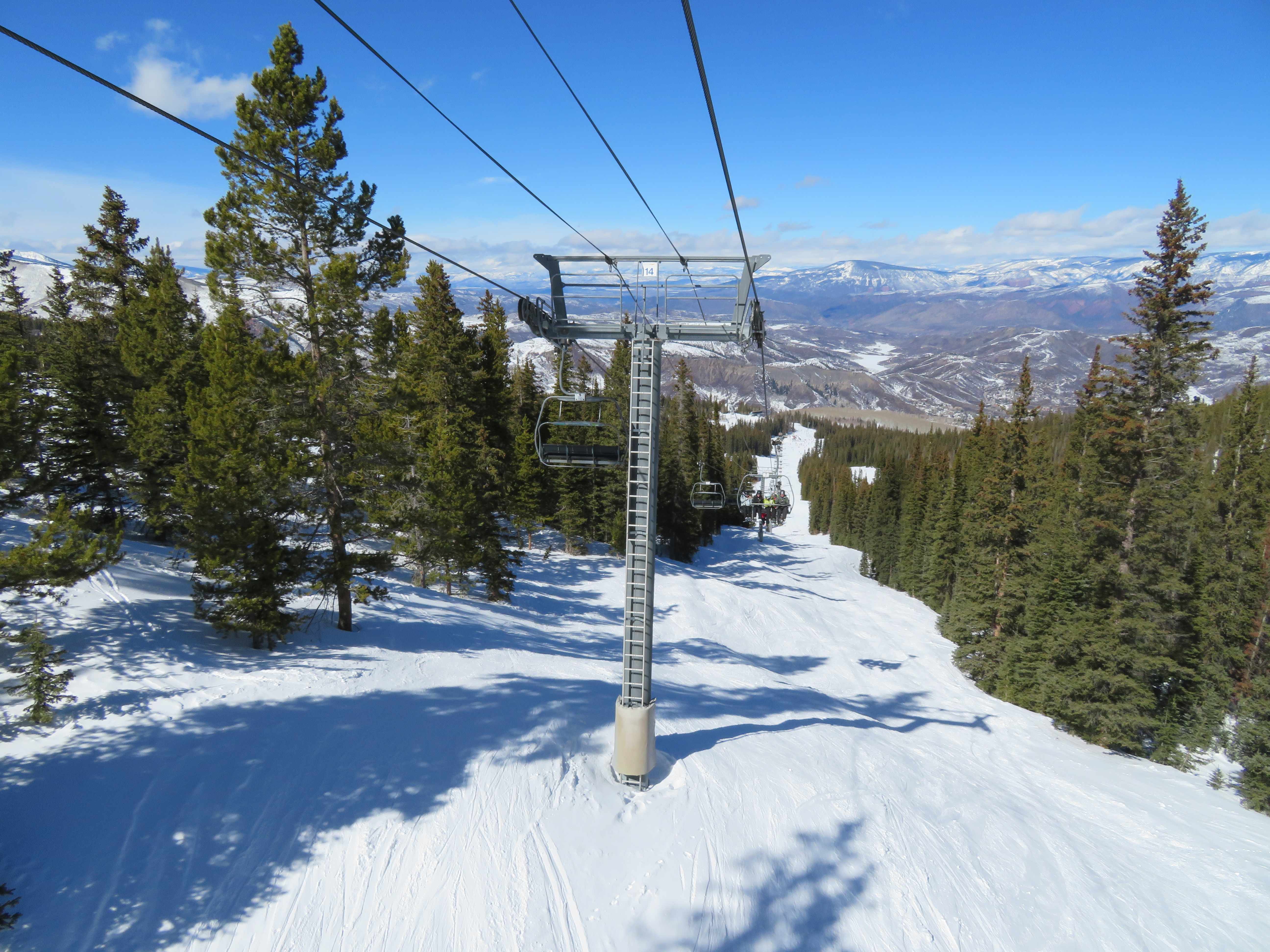
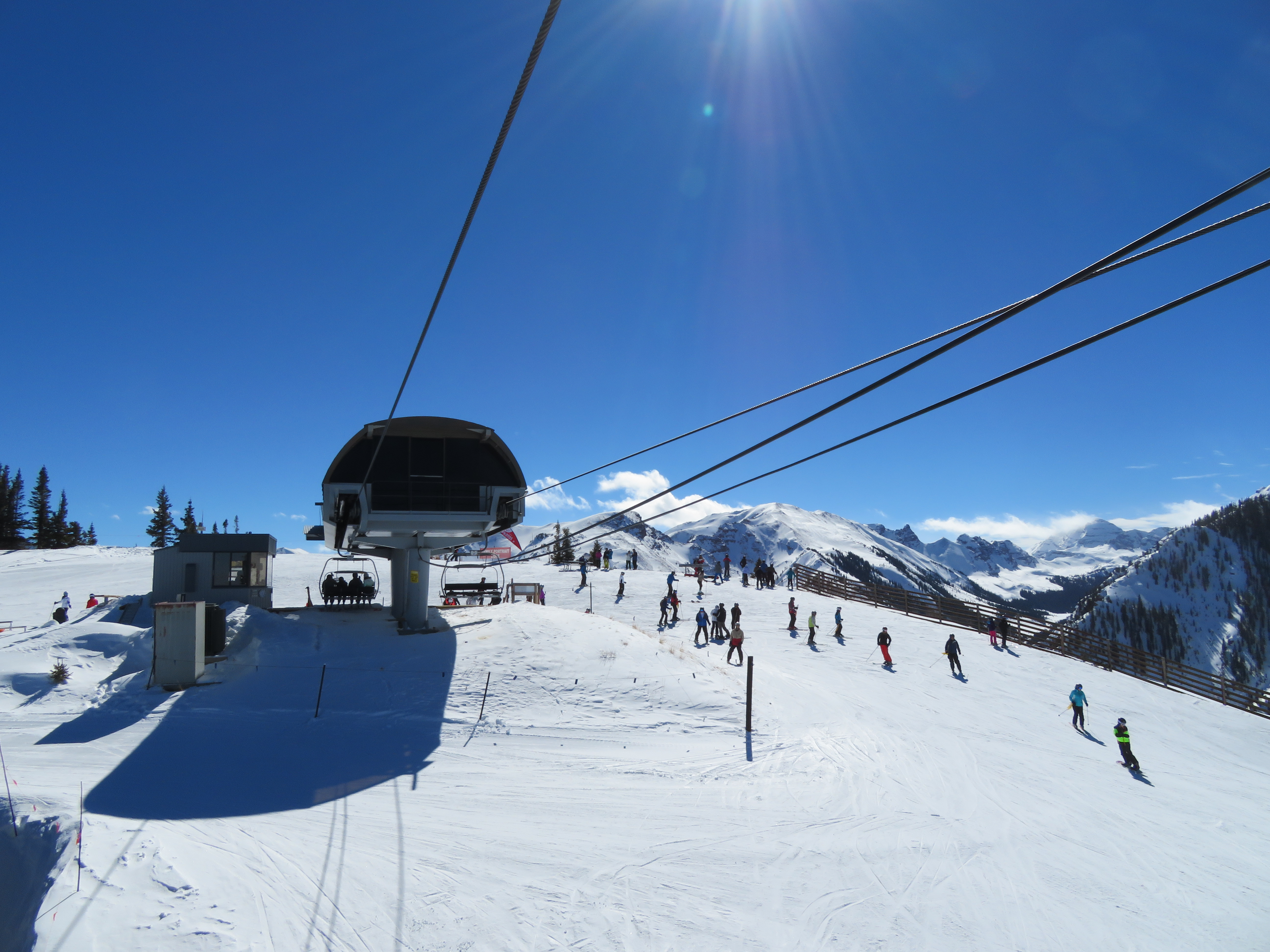
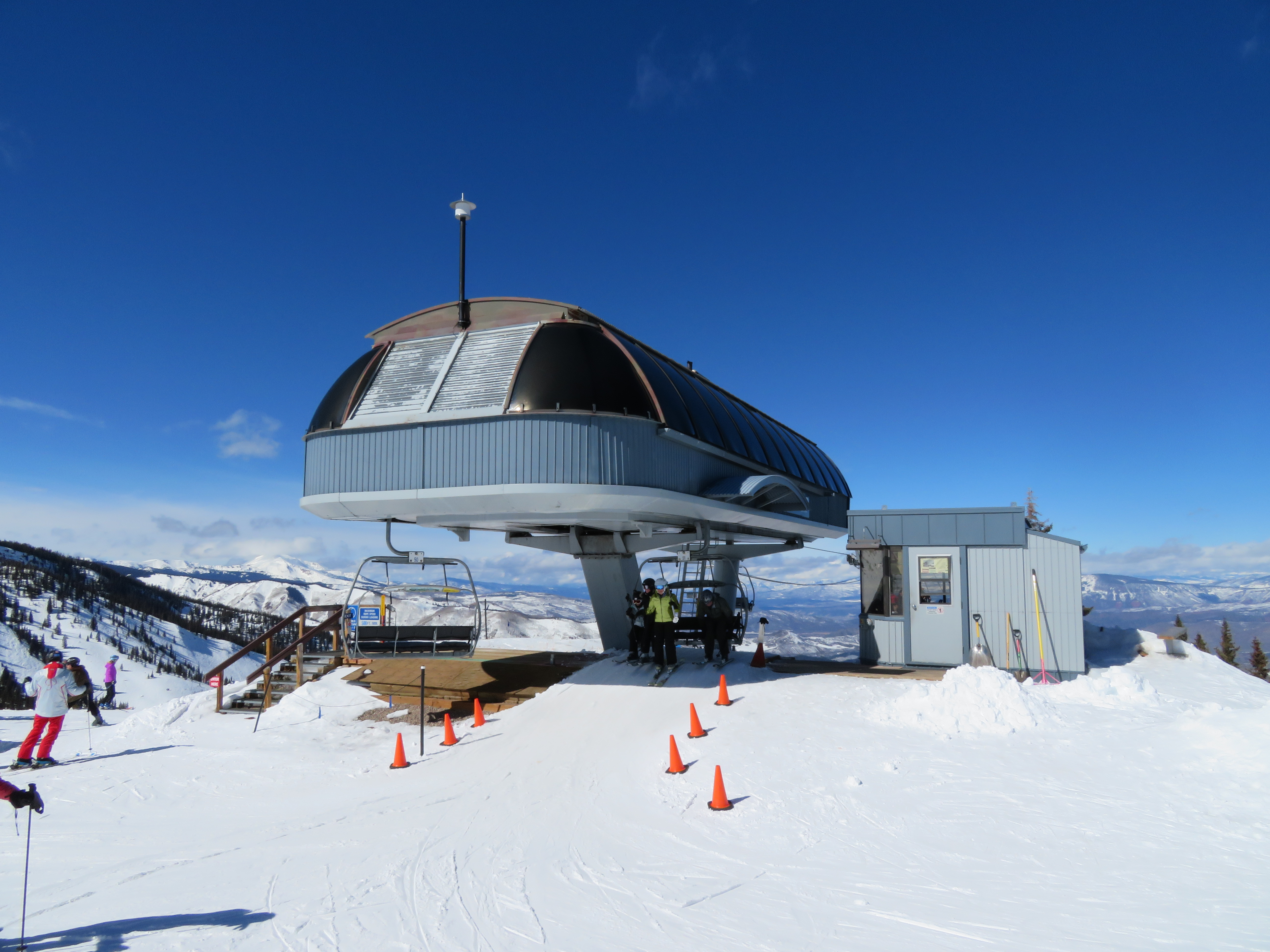
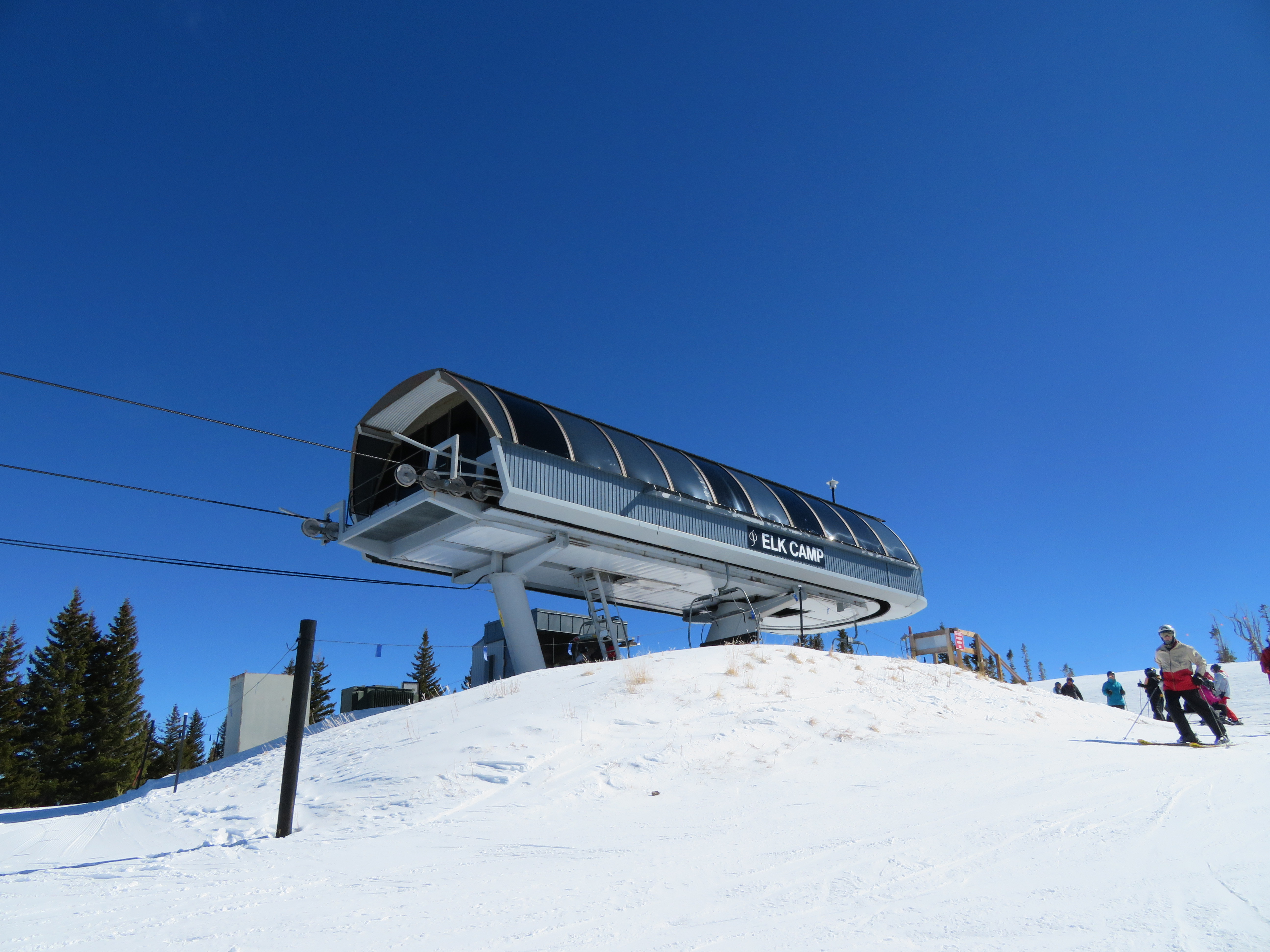
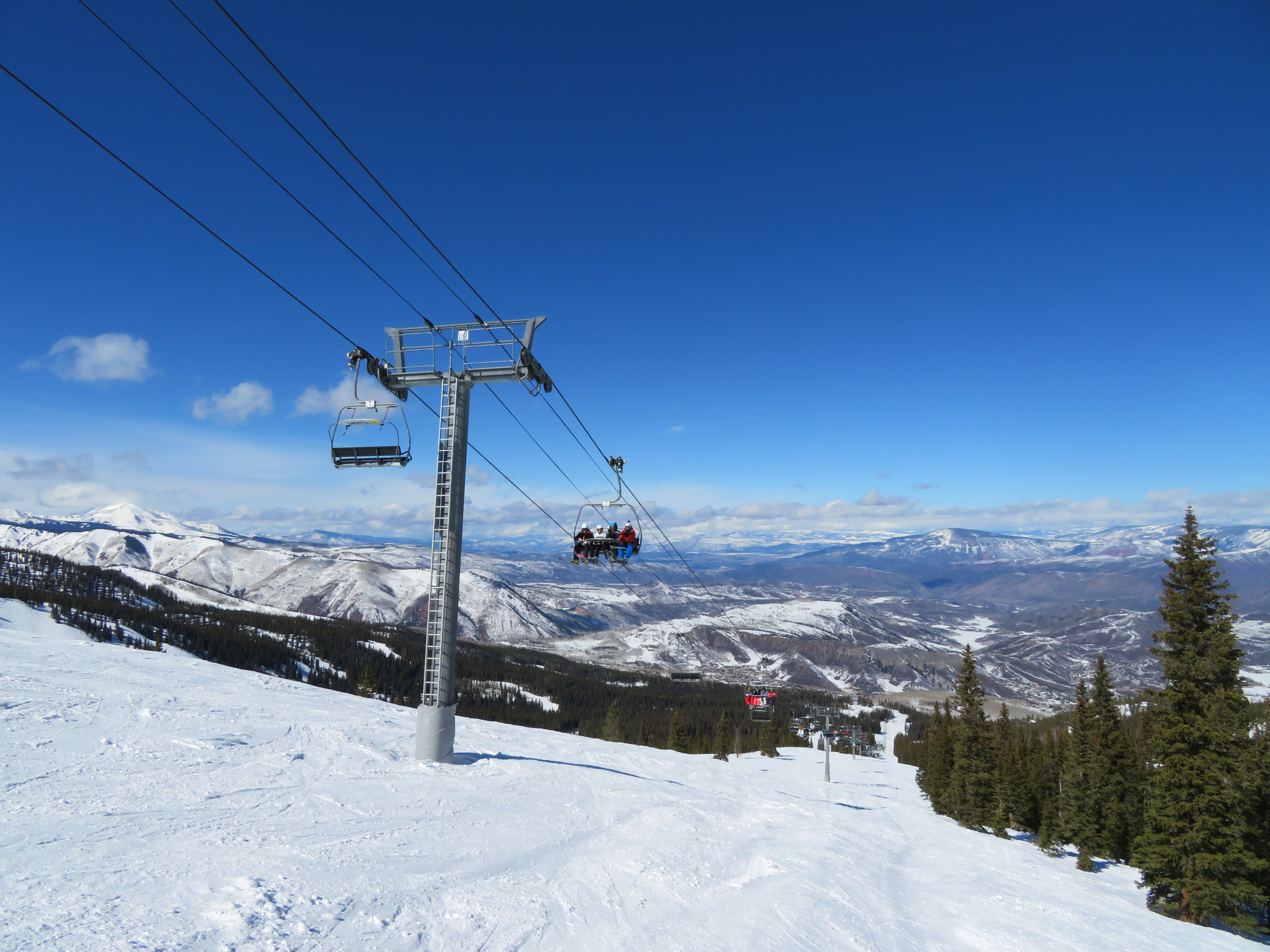
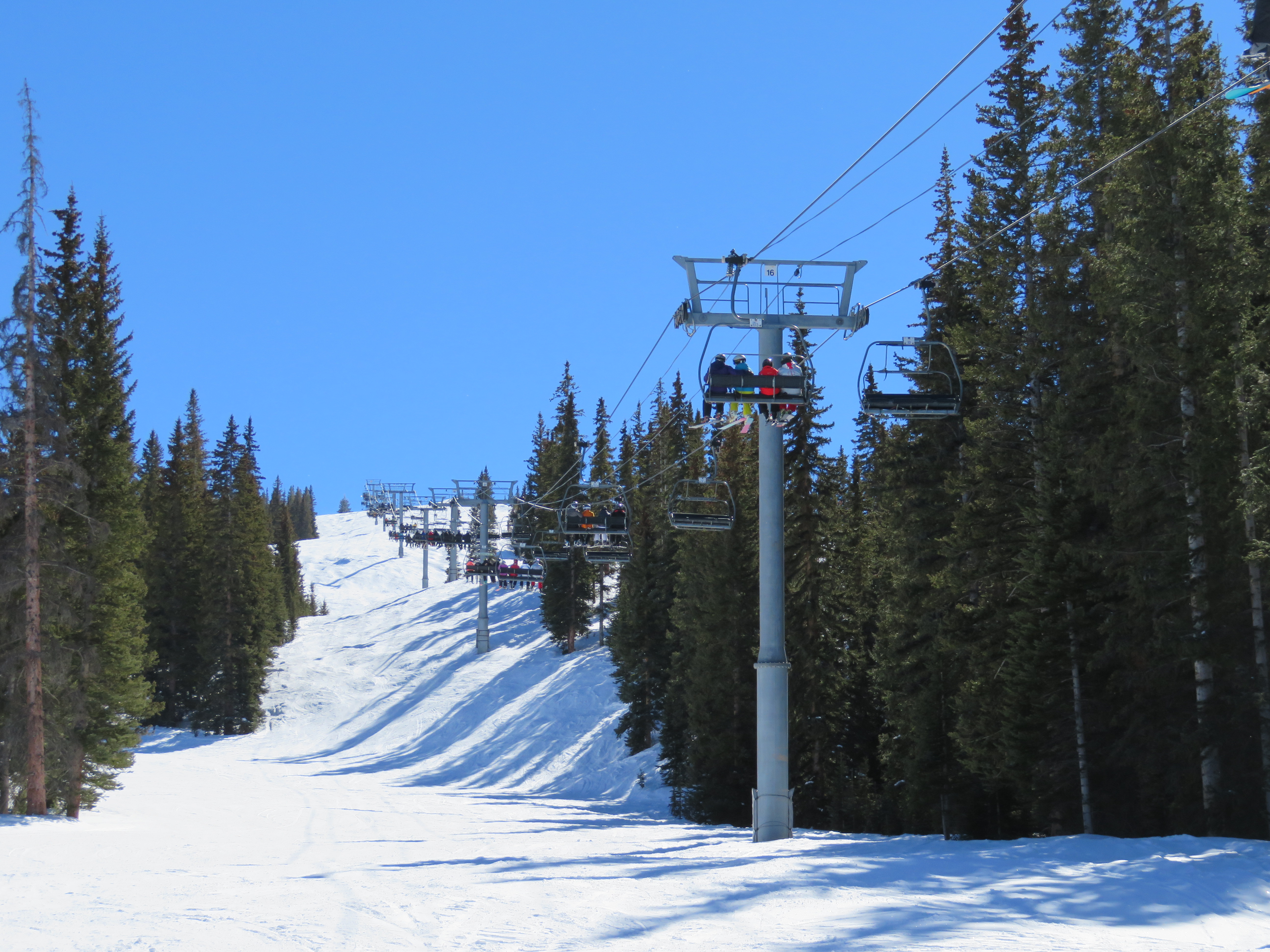
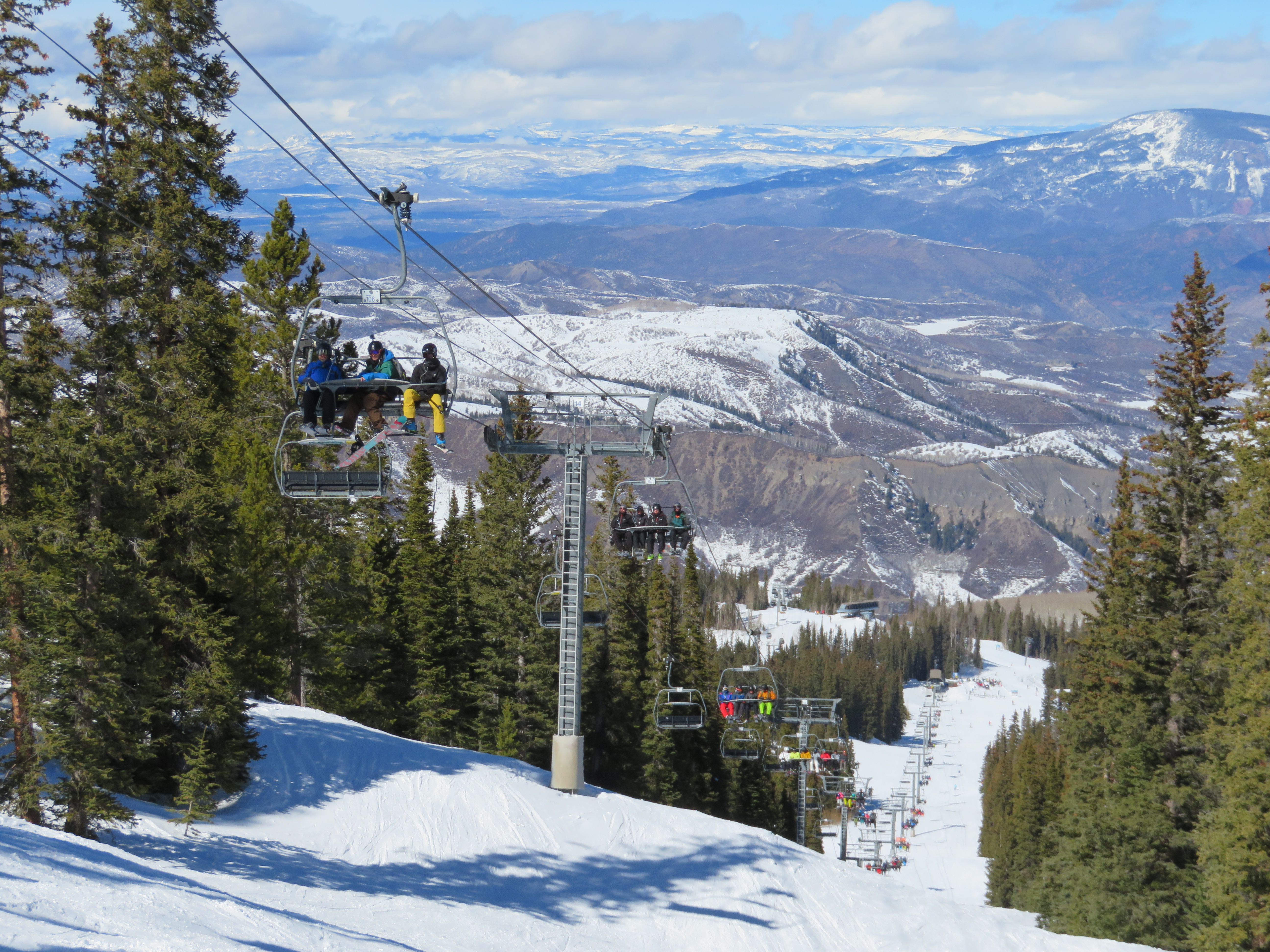
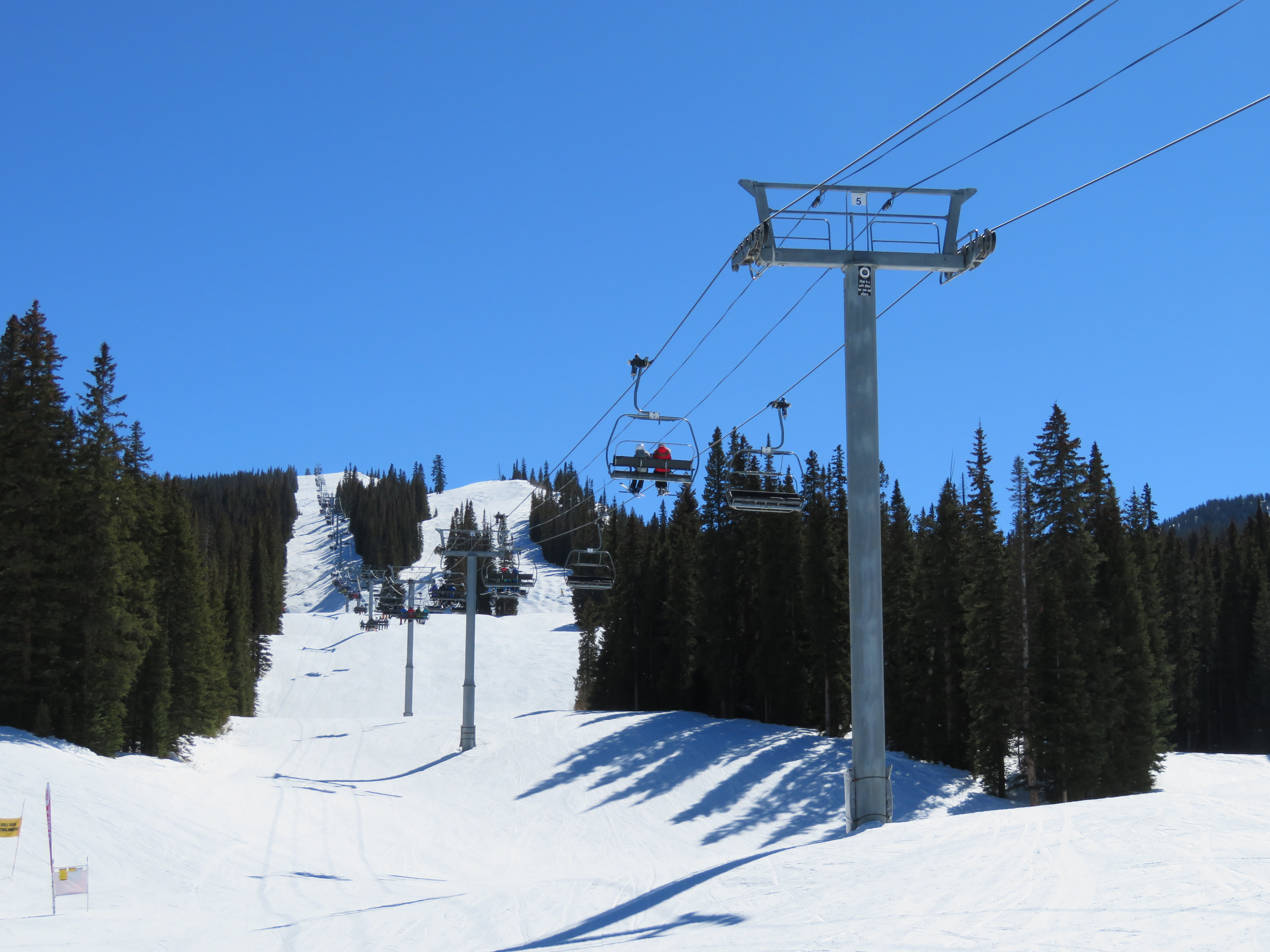
Tower 2.Poma Competition terminal.View up the lift line.Return station at Elk Camp.Riding up.View back down the line.Arriving up top with quite the view.Unloading ramp and drive terminal.The breakover.Drive terminal underskin.Down line view.Upper lift line.Lower lift line.View up at tower 5.
Elk Camp was originally built with 95 carriers and had an uphill capacity of 1,600. About 10-12 years ago they increased the number of carriers to 120 and the uphill capacity was increased to 1,800.
They rarely run this lift at 1,000 fpm and instead, routinely run it at 900 fpm. When it originally opened it would regularly run at 1,100 fpm.
If I were the Snowmass mountain manager the lifts would run at full speed. Unfortunately, I’m not. Most of the detachable lifts at Snowmass are routinely operated at 850 to 950 fpm. It drives me crazy! On busy days they’ll up the speed to 1,000 fpm on Alpine Springs, High Alpine, and Elk Camp. From my pesky questioning I’ve concluded that Snowmass gives drive operators some latitude as to how fast they operate the lift with guidance from lift maintenance and of course, weather conditions.
It’s been explained that Snowmass management believes that by slowing the line speed they reduce the number of stops and slowdowns. I don’t entirely agree. From my viewpoint when you give people more time to load, they’re not as attentive, pay less attention, and thus it results in more loading problems.
What blows my mind is that most of the detachable lifts at Snowmass already have a longer interval between chairs – Sam’s Knob (routinely operates at 850 fpm!), Sheer Bliss, Big Burn, High Alpine, Elk Camp, and Two Creeks (only 850-900 fpm) – so why do you need to give people even more time?
Overall, I don’t understand SkiCo since they don’t slow the detachable lifts down at their other mountains. Highlands operates Exhibition, Cloud Nine, and Loge Peak at 1,000 to 1,100 fpm. Buttermilk also operates their lifts at full speed. Same with Aspen Mountain.
Eric- I’ve personally seen dropping line speeds have a positive effect. We routinely run the American Flyer at 900- 925 fpm on Saturdays with crowds, and the lift does stop less. Overall the lift ride takes less time at that speed than if we were to run it at full (1000 FPM) with stops every so many chairs.
Pbropetch- on a six-pack with a 6.75-second loading interval, like American Flyer, I can understand where you may experience less slows and stops. What I’d like to understand is the root of the problem. Is it the speed at which the chairs move through the station or the amount of time between them?
When you slow American Flyer to 900 fpm you increase the interval 3/4 a second to 7.5 seconds. Many of the detachable lifts at Snowmass already have an interval longer than 7.5 seconds when operating at full speed.
Maintenance might simply not want to run the lifts fast and put more wear and tear on them. Stratton’s still relatively new Snow Bowl Express regularly runs its top speed (1000 fpm) with a tight 6 second interval. They have 3 CTEC 6 packs which have longer intervals at their top speeds (1050-1100), yet they never reach them and always run slower than Snow Bowl. I’m not sure if they give their operators any say in what speed to run at. At Whiteface, management does not know or care about speed, so the lifties will set the speed as slow or as fast as they feel like.
Collin/Donald- as a longtime mechanic I don’t see any cost savings from running the lift slower. They’re engineered to run full speed- parts, components, structures, all of that- so running them slower isn’t going to help with anything that way. I could see a small lengthening in the life of a sheave liner, maybe- but when I compare what my coworker changes on E-lift (1100 FPM) to what I would change on the Flyer (900-1000, same sheaves) and adjust his totals for the fact the his lift is one-third the length of mine, we changed the same percentage.
A lot of the detachable here in Austria run as slow as 3.5 m/s (about 690 fpm) in the low season. The prime reason seems to be to save on the electrical bill. The same lifts tends to run at their design speed when it is crowded, which usually works out fine with the loading conveyors helping with the skier placement.
Is ASC the kind to do relocations? I think it’s more likely that parts from the lift get used as spares for the other Poma detachables of this vintage within the ASC group (Ruthie’s, Exhibition, Loge Peak, Summit Express, Two Creeks, Sam’s Knob).
It’ll be a soft removal, meaning a relocation and not the scrapyard. I don’t know where it’s going. There were some interested parties that toured both Elk Camp and Alpine Springs, and there has been talk of relocating within the ASC fleet.
This lift is 30 years old with high operating hours. I’ll be shocked to see it relocated within the ASC mountains. Historically they install new detachable chairs, not used. I expected it may be used for parts since similar models still operate on all four mountains.
@Eric G for a quick second I thought the ASC you were referring to was “American Skiing Company”, haha.
Ski Cooper and possibly Powderhorn could potentially be a great new customer for buying Elk Camp, as the owner of Cooper has mentioned on social media numerous times that it is something they would like in the future. Despite a new master plan announced (for Cooper), I am still optimistic they want a HSQ instead. (The alternative being a long fixed grip quad that services their frontside.)
Powderhorn could also be a good candidate as well, as their West End double is long, old, and in need of an upgrade soon. That being said though, I think the owners of Powderhorn are probably looking for a brand new replacement rather than a used model, so I’m not entirely sure. It is an option though.
It’s definitely 30 yrs old. Was this lift used for summer ops? I’ve long thought that this and Alpine Springs were candidates for relocation elsewhere in the broader Alterra universe, as a refurbished lift seems off-brand for SkiCo and I’m not sure where it would be used anyway (maybe to replace West Buttermilk lift?). Wouldn’t be surprised if one of these two end up being the replacement for North Ridge at Sugarbush North/Mt Ellen. That line needs a high-speed lift but no way they’ll spend $12-14M on a new machine for that mountain.
Alterra does not own ASC…it’s the other way around. These lifts are not assets that are readily available to be deployed to other Alterra owned mountains.
Yes I am aware of the nature of the relationship. It is precisely b/c of SkiCo’s equity ownership stake in Alterra that I think the latter would have first dibs on any refurb lift if SkiCo itself didn’t want it.
@Mike B, yes, Elk Camp is one of the primary summer lifts. West Buttermilk is an Omega era lift, much newer than Elk Camp, and not a candidate for replacement at this time
@grotonranger – the issue with North Ridge isn’t its vintage. It’s that it’s a franken-lift due to a variety of unusual situations including relocations (by a competitor to the OEM) and multiple lightning strikes. It is highly unlikely Alterra ever invests in a new machine for a mountain that’s open 3 month out of the year, so any refurb candidates in the Alterra/SkiCo universe would be possibilities IMO.
It’s part of a theme park called The Lost Forest that runs in the summertime. They do day camps up there, so I’m guessing that’s where the name comes from.
It’s likely that the name came well before they developed anything like that… most likely a place elk hunters used to camp, or something along those lines


 Lift Blog
With eight second intervals at 1,000 fpm, I think the capacity is closer to 2,400 pph than 1,600.
LikeLike
Elk Camp was originally built with 95 carriers and had an uphill capacity of 1,600. About 10-12 years ago they increased the number of carriers to 120 and the uphill capacity was increased to 1,800.
They rarely run this lift at 1,000 fpm and instead, routinely run it at 900 fpm. When it originally opened it would regularly run at 1,100 fpm.
LikeLiked by 1 person
A lift of Elk Camp’s length should be run at close to 1,000 fpm if possible. But I’m guessing the 900 fpm speed is about saving money.
LikeLike
If I were the Snowmass mountain manager the lifts would run at full speed. Unfortunately, I’m not. Most of the detachable lifts at Snowmass are routinely operated at 850 to 950 fpm. It drives me crazy! On busy days they’ll up the speed to 1,000 fpm on Alpine Springs, High Alpine, and Elk Camp. From my pesky questioning I’ve concluded that Snowmass gives drive operators some latitude as to how fast they operate the lift with guidance from lift maintenance and of course, weather conditions.
It’s been explained that Snowmass management believes that by slowing the line speed they reduce the number of stops and slowdowns. I don’t entirely agree. From my viewpoint when you give people more time to load, they’re not as attentive, pay less attention, and thus it results in more loading problems.
What blows my mind is that most of the detachable lifts at Snowmass already have a longer interval between chairs – Sam’s Knob (routinely operates at 850 fpm!), Sheer Bliss, Big Burn, High Alpine, Elk Camp, and Two Creeks (only 850-900 fpm) – so why do you need to give people even more time?
Overall, I don’t understand SkiCo since they don’t slow the detachable lifts down at their other mountains. Highlands operates Exhibition, Cloud Nine, and Loge Peak at 1,000 to 1,100 fpm. Buttermilk also operates their lifts at full speed. Same with Aspen Mountain.
LikeLike
Eric- I’ve personally seen dropping line speeds have a positive effect. We routinely run the American Flyer at 900- 925 fpm on Saturdays with crowds, and the lift does stop less. Overall the lift ride takes less time at that speed than if we were to run it at full (1000 FPM) with stops every so many chairs.
LikeLike
Pbropetch- on a six-pack with a 6.75-second loading interval, like American Flyer, I can understand where you may experience less slows and stops. What I’d like to understand is the root of the problem. Is it the speed at which the chairs move through the station or the amount of time between them?
When you slow American Flyer to 900 fpm you increase the interval 3/4 a second to 7.5 seconds. Many of the detachable lifts at Snowmass already have an interval longer than 7.5 seconds when operating at full speed.
LikeLike
Maintenance might simply not want to run the lifts fast and put more wear and tear on them. Stratton’s still relatively new Snow Bowl Express regularly runs its top speed (1000 fpm) with a tight 6 second interval. They have 3 CTEC 6 packs which have longer intervals at their top speeds (1050-1100), yet they never reach them and always run slower than Snow Bowl. I’m not sure if they give their operators any say in what speed to run at. At Whiteface, management does not know or care about speed, so the lifties will set the speed as slow or as fast as they feel like.
LikeLike
Collin/Donald- as a longtime mechanic I don’t see any cost savings from running the lift slower. They’re engineered to run full speed- parts, components, structures, all of that- so running them slower isn’t going to help with anything that way. I could see a small lengthening in the life of a sheave liner, maybe- but when I compare what my coworker changes on E-lift (1100 FPM) to what I would change on the Flyer (900-1000, same sheaves) and adjust his totals for the fact the his lift is one-third the length of mine, we changed the same percentage.
LikeLike
A lot of the detachable here in Austria run as slow as 3.5 m/s (about 690 fpm) in the low season. The prime reason seems to be to save on the electrical bill. The same lifts tends to run at their design speed when it is crowded, which usually works out fine with the loading conveyors helping with the skier placement.
LikeLike
It’s about fewer stops, not cost savings
LikeLike
And not all stops are due to mis-loads
LikeLike
this lift has 120 chairs
LikeLike
I think that some chairs got their grips replaced. Some grips have orange or blue springs.
LikeLike
some red or white too
LikeLike
Replacement springs only, not full grips (unless AO has more info).
LikeLike
I was mistaken. My counterparts had fun with paint.
LikeLike
I think Aspen is replacing this loft over the summer
LikeLike
Will the lift be saved or scrapped? Looks like a good candidate for refurbishment for a smaller area
LikeLike
Is this really feasible? Removal, relocation, and refurbishment is costly and doesn’t seem logical.
LikeLike
Both LPOA and Doppelmayr have done recent detach relocates such as lifts from Big Sky, and more already in the works on the install list
LikeLike
Is ASC the kind to do relocations? I think it’s more likely that parts from the lift get used as spares for the other Poma detachables of this vintage within the ASC group (Ruthie’s, Exhibition, Loge Peak, Summit Express, Two Creeks, Sam’s Knob).
LikeLike
I agree considering they have similar detachables still in operation-Sam’s Knob, Alpine Springs, Exhibition, Summit, Loge, and Ruthies.
LikeLike
at 35,000 hrs I’m betting some parts may be saved but it’s the scrapyard for the rest.
LikeLike
It’ll be a soft removal, meaning a relocation and not the scrapyard. I don’t know where it’s going. There were some interested parties that toured both Elk Camp and Alpine Springs, and there has been talk of relocating within the ASC fleet.
LikeLike
This lift is 30 years old with high operating hours. I’ll be shocked to see it relocated within the ASC mountains. Historically they install new detachable chairs, not used. I expected it may be used for parts since similar models still operate on all four mountains.
LikeLike
@Eric G for a quick second I thought the ASC you were referring to was “American Skiing Company”, haha.
Ski Cooper and possibly Powderhorn could potentially be a great new customer for buying Elk Camp, as the owner of Cooper has mentioned on social media numerous times that it is something they would like in the future. Despite a new master plan announced (for Cooper), I am still optimistic they want a HSQ instead. (The alternative being a long fixed grip quad that services their frontside.)
Powderhorn could also be a good candidate as well, as their West End double is long, old, and in need of an upgrade soon. That being said though, I think the owners of Powderhorn are probably looking for a brand new replacement rather than a used model, so I’m not entirely sure. It is an option though.
LikeLike
It’s definitely 30 yrs old. Was this lift used for summer ops? I’ve long thought that this and Alpine Springs were candidates for relocation elsewhere in the broader Alterra universe, as a refurbished lift seems off-brand for SkiCo and I’m not sure where it would be used anyway (maybe to replace West Buttermilk lift?). Wouldn’t be surprised if one of these two end up being the replacement for North Ridge at Sugarbush North/Mt Ellen. That line needs a high-speed lift but no way they’ll spend $12-14M on a new machine for that mountain.
LikeLike
Alterra does not own ASC…it’s the other way around. These lifts are not assets that are readily available to be deployed to other Alterra owned mountains.
LikeLiked by 1 person
Yes I am aware of the nature of the relationship. It is precisely b/c of SkiCo’s equity ownership stake in Alterra that I think the latter would have first dibs on any refurb lift if SkiCo itself didn’t want it.
LikeLike
Mike B., where is the wisdom in replacing North Ridge, a 30 year old HSQ, with another 30 year old HSQ?
LikeLiked by 1 person
@Mike B, yes, Elk Camp is one of the primary summer lifts. West Buttermilk is an Omega era lift, much newer than Elk Camp, and not a candidate for replacement at this time
LikeLike
@grotonranger – the issue with North Ridge isn’t its vintage. It’s that it’s a franken-lift due to a variety of unusual situations including relocations (by a competitor to the OEM) and multiple lightning strikes. It is highly unlikely Alterra ever invests in a new machine for a mountain that’s open 3 month out of the year, so any refurb candidates in the Alterra/SkiCo universe would be possibilities IMO.
LikeLike
Just saw a flatbed with probably half of the chairs headed out of the valley. Will be curious to see it it is reinstalled somewhere.
LikeLike
It is headed to another Colorado resort
LikeLike
But am curious.. where is the camp?
LikeLike
It’s part of a theme park called The Lost Forest that runs in the summertime. They do day camps up there, so I’m guessing that’s where the name comes from.
LikeLike
It’s likely that the name came well before they developed anything like that… most likely a place elk hunters used to camp, or something along those lines
LikeLiked by 1 person
It’s named Elk Camp because the area where the lift and runs are was an old elk calving ground and they were frequently spotted in the area.
LikeLiked by 1 person