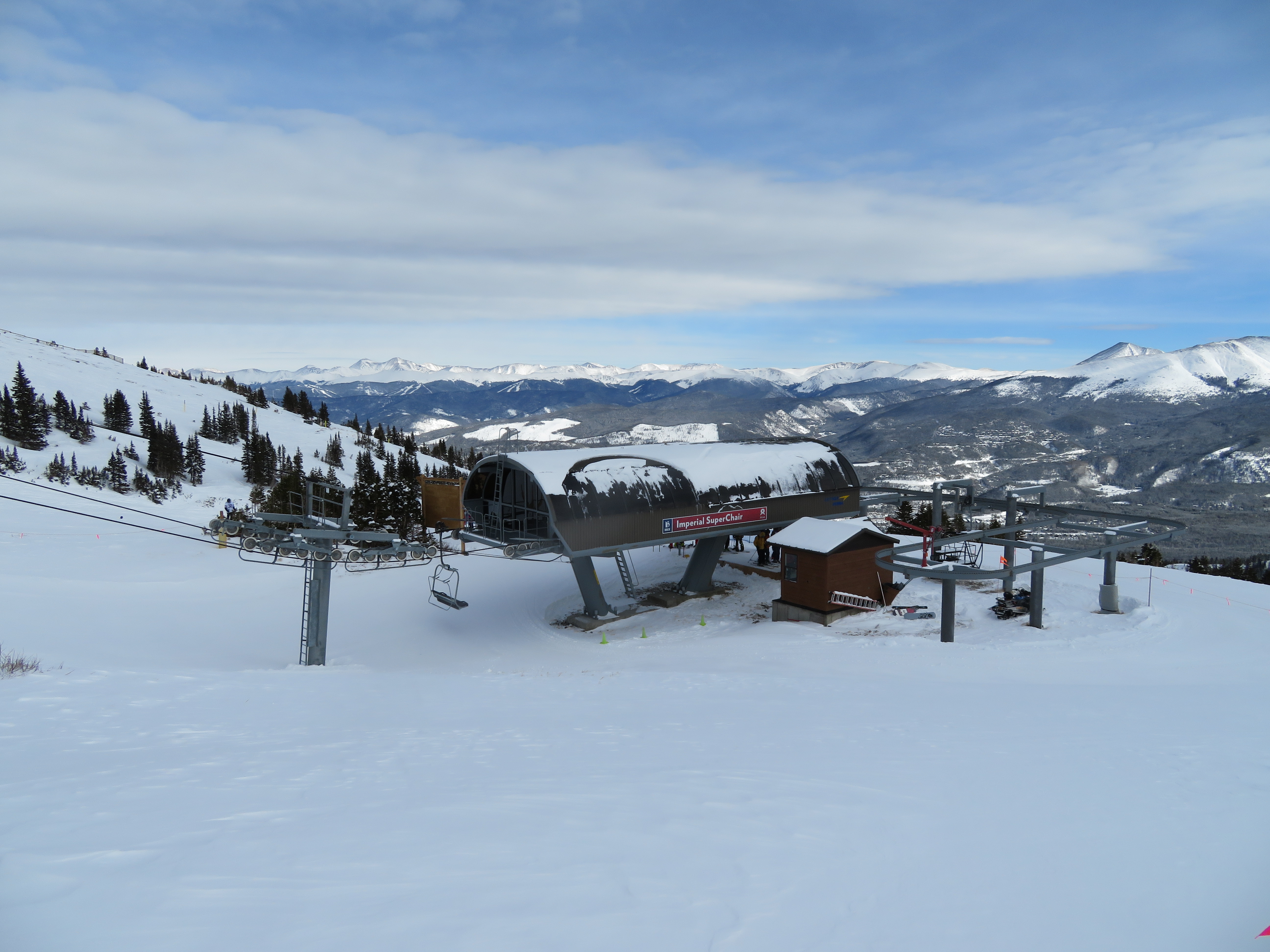
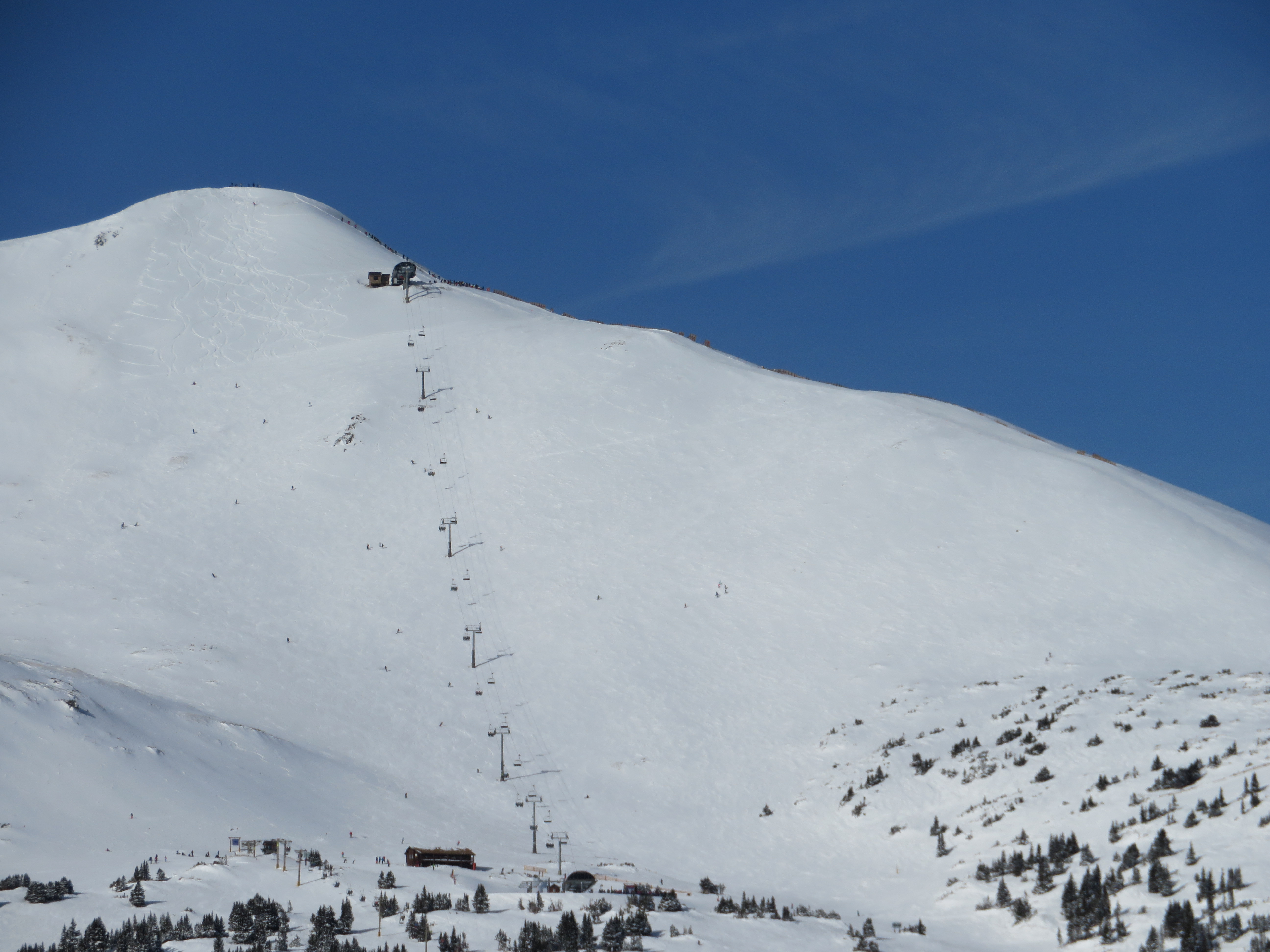
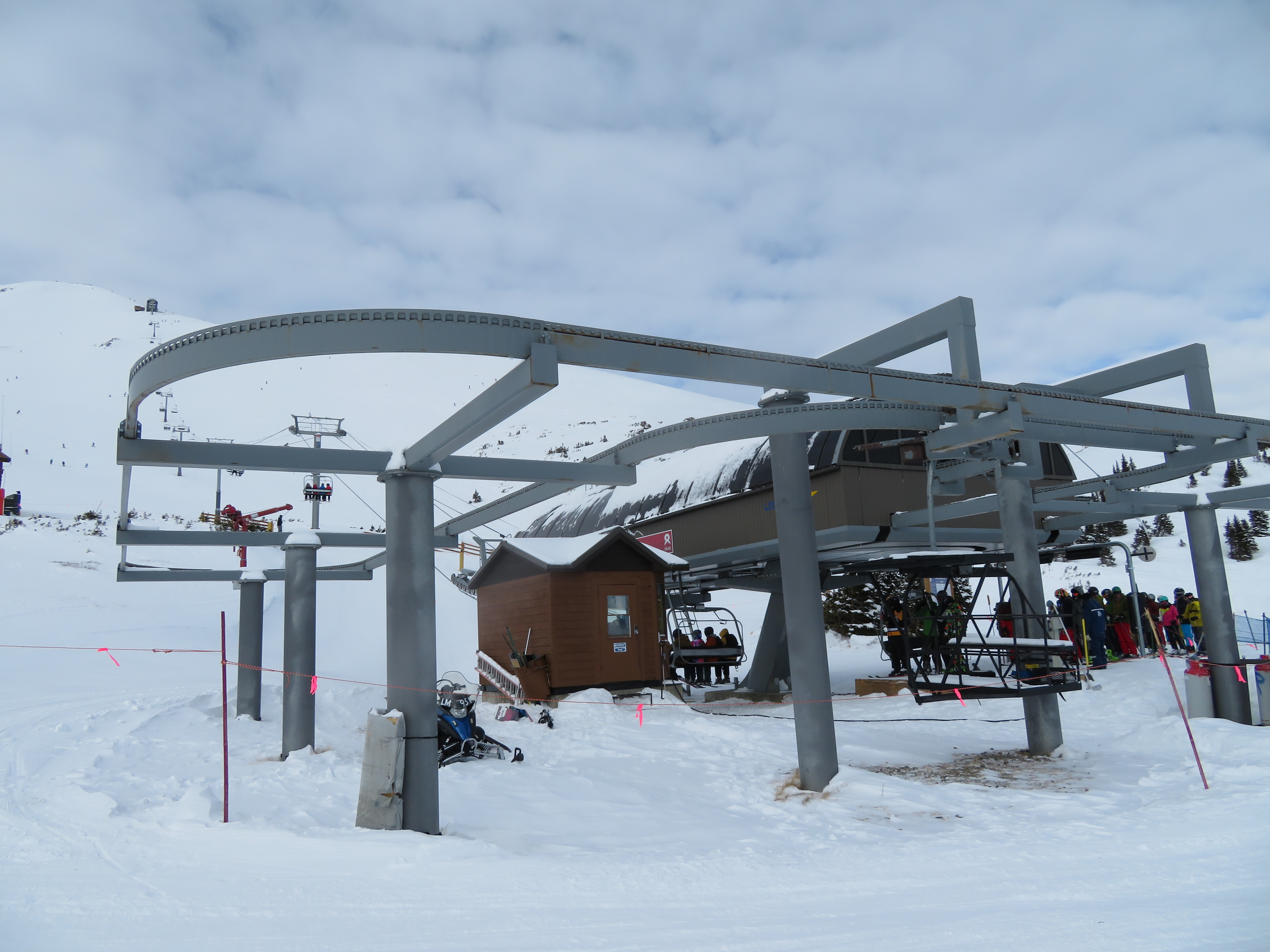
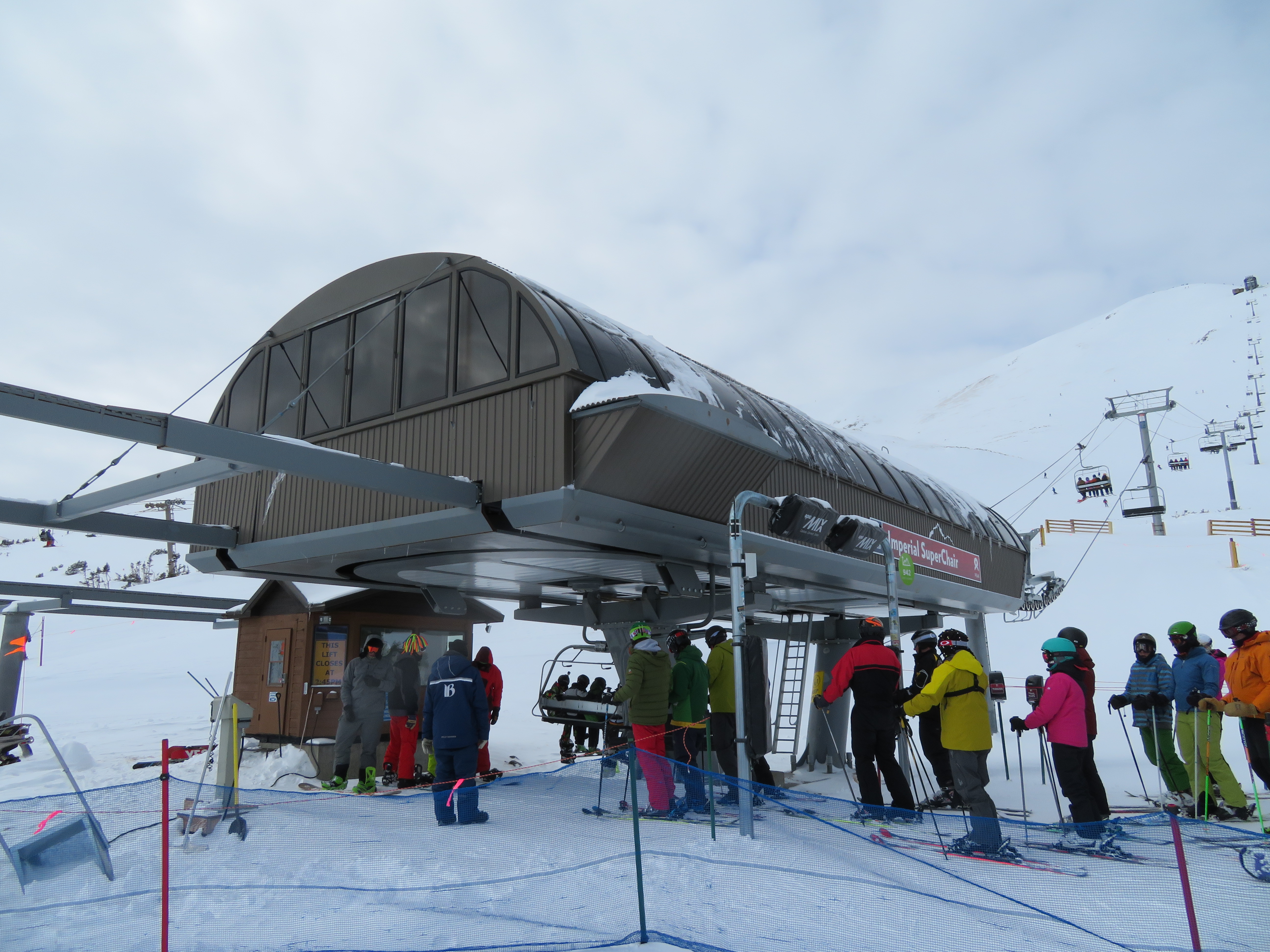
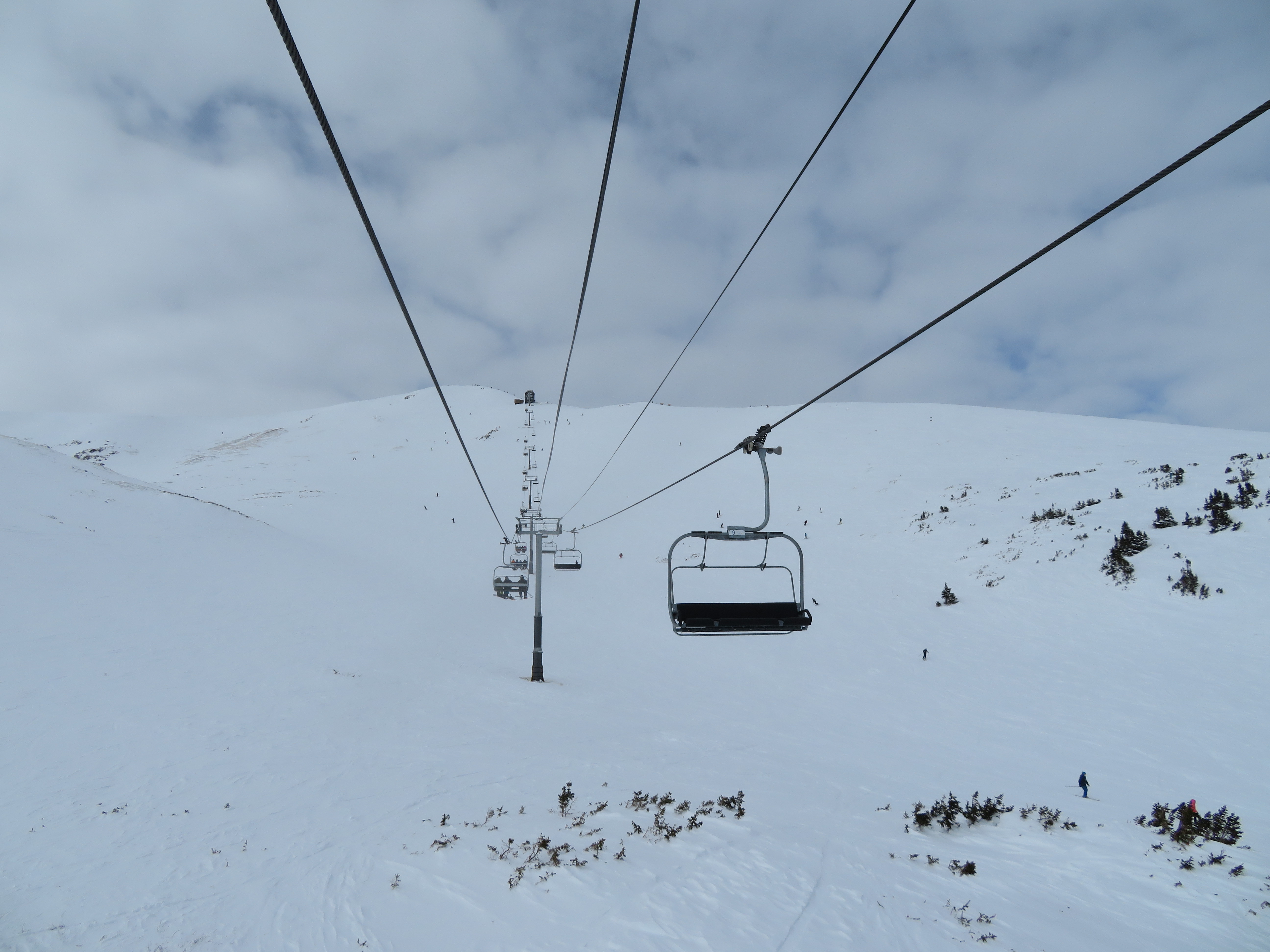
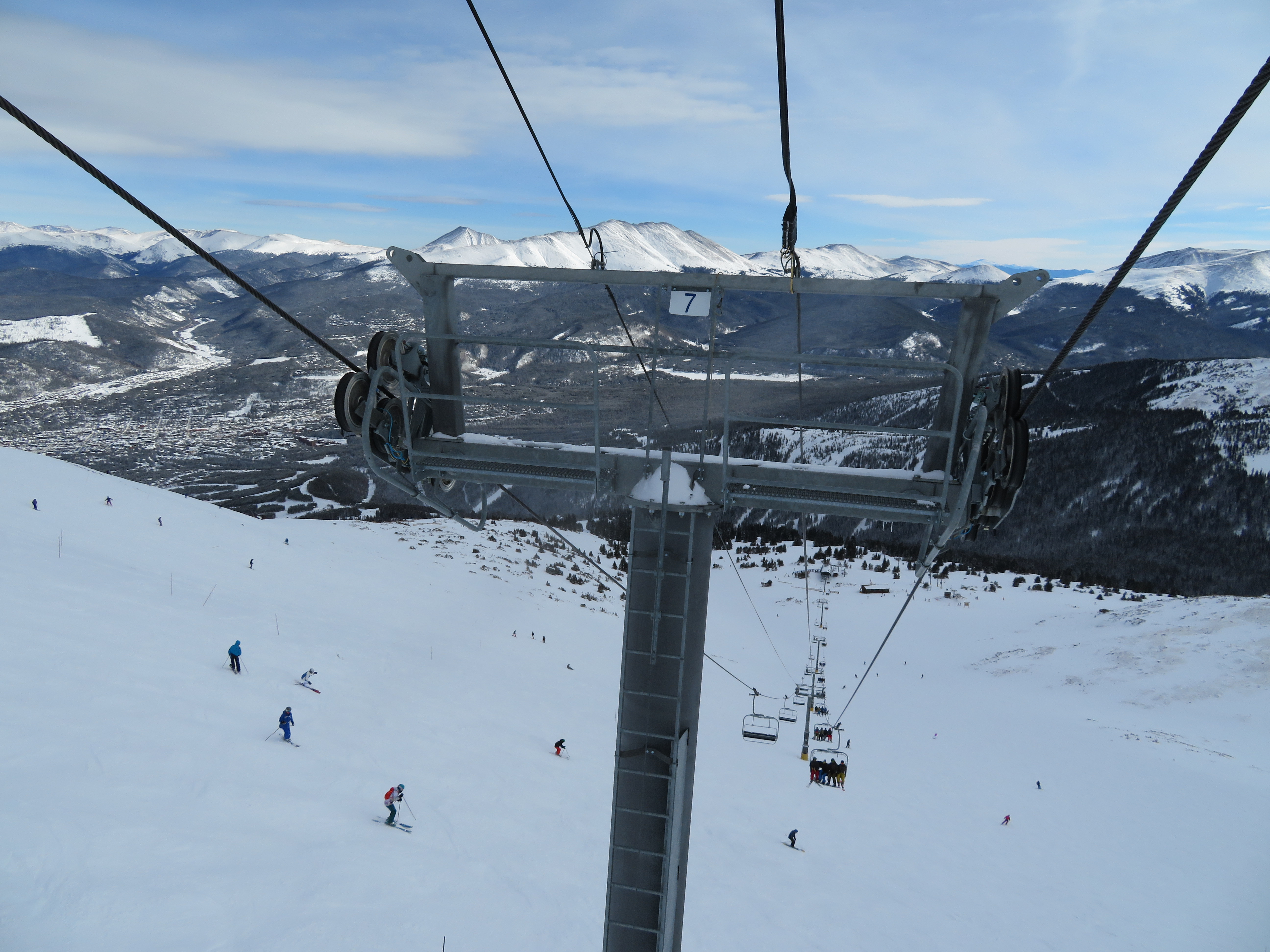
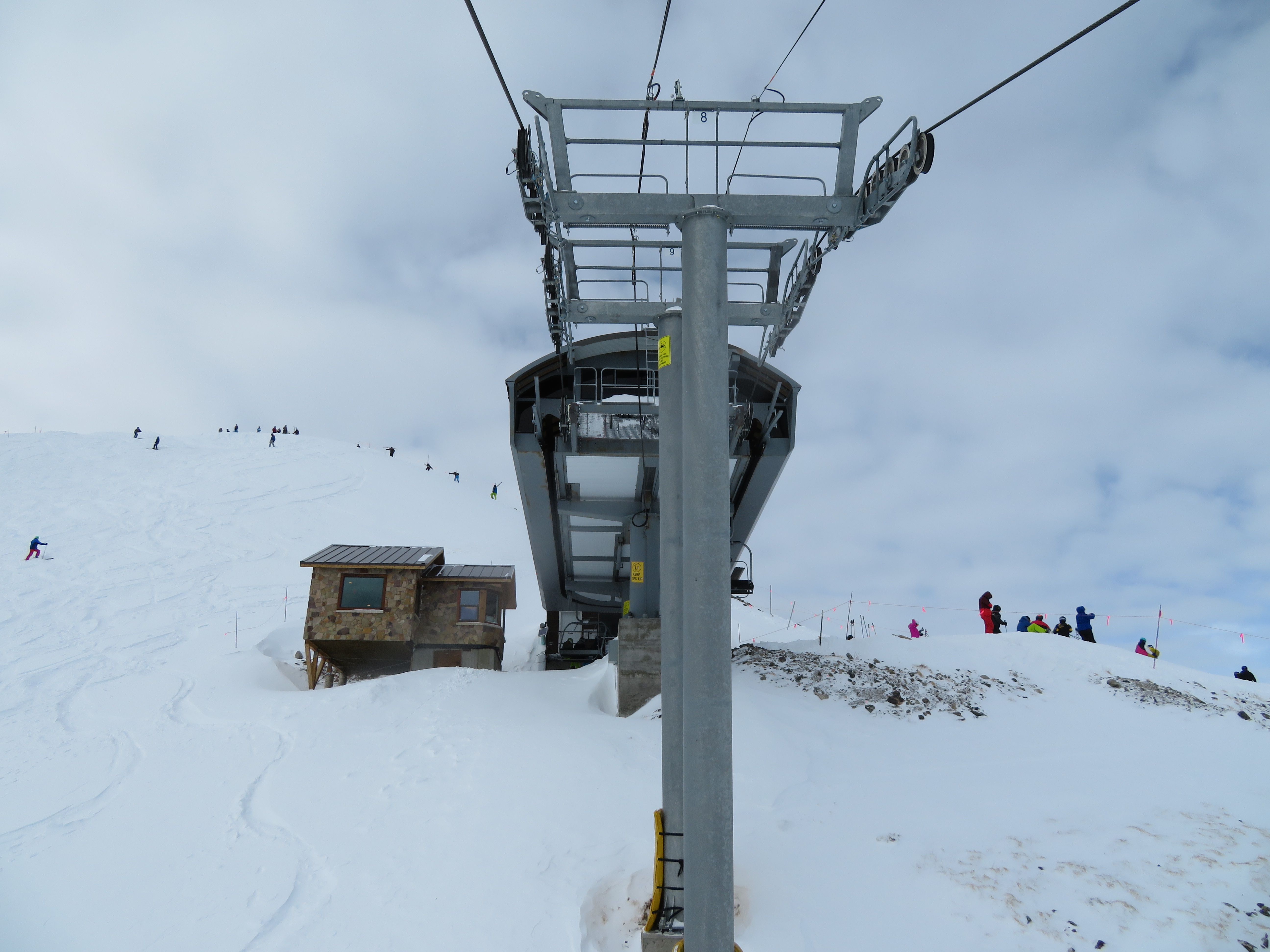
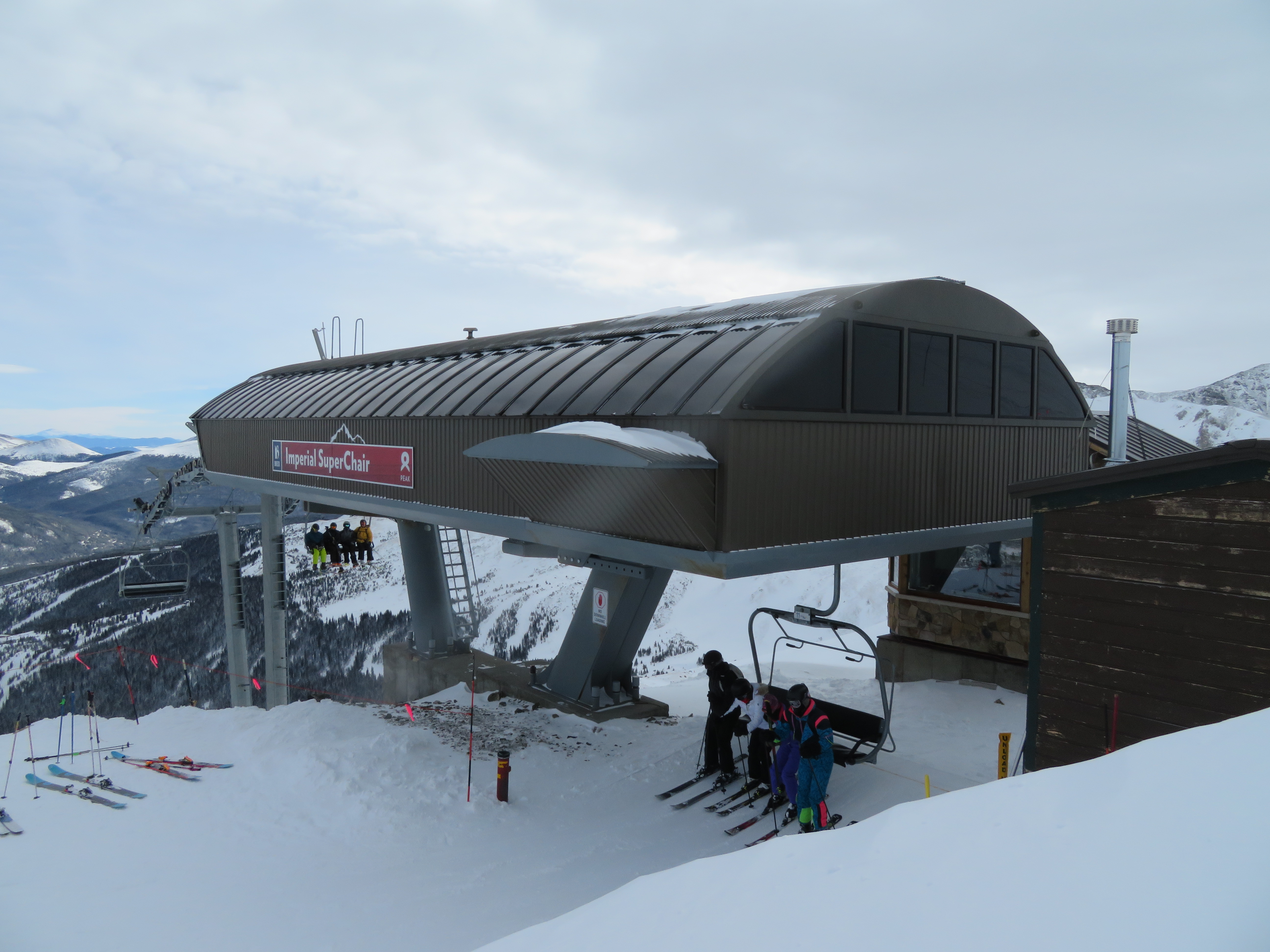
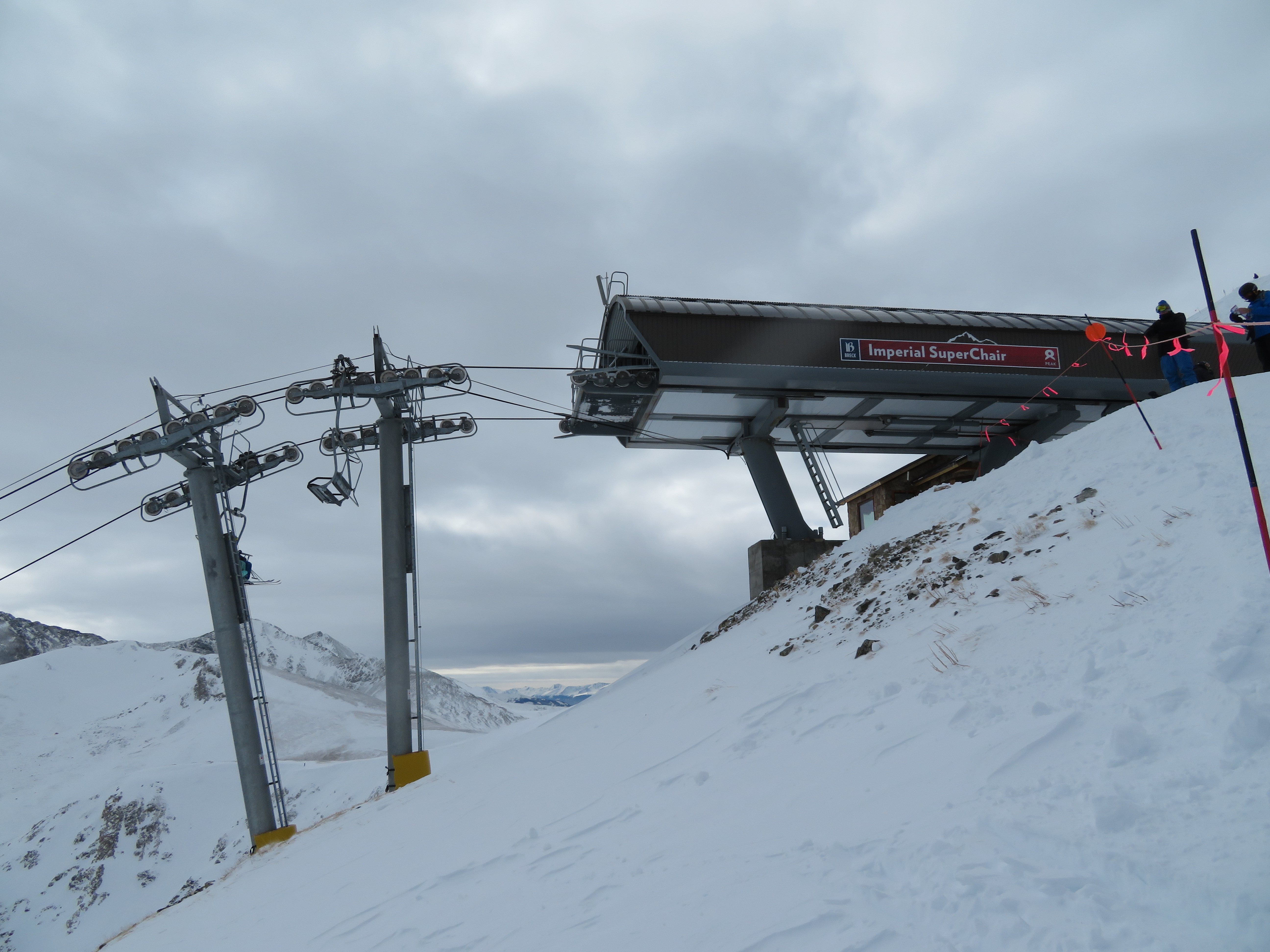
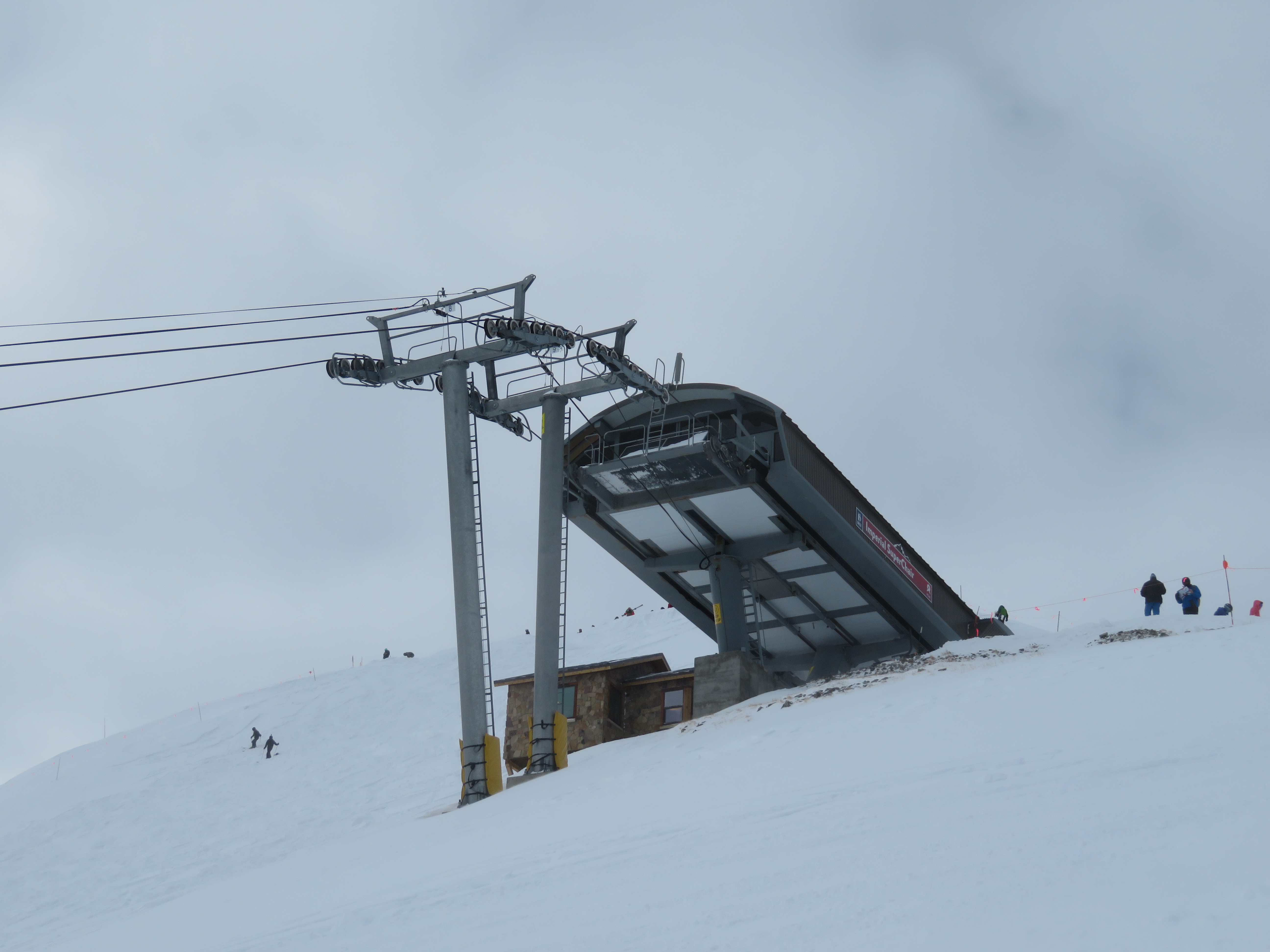
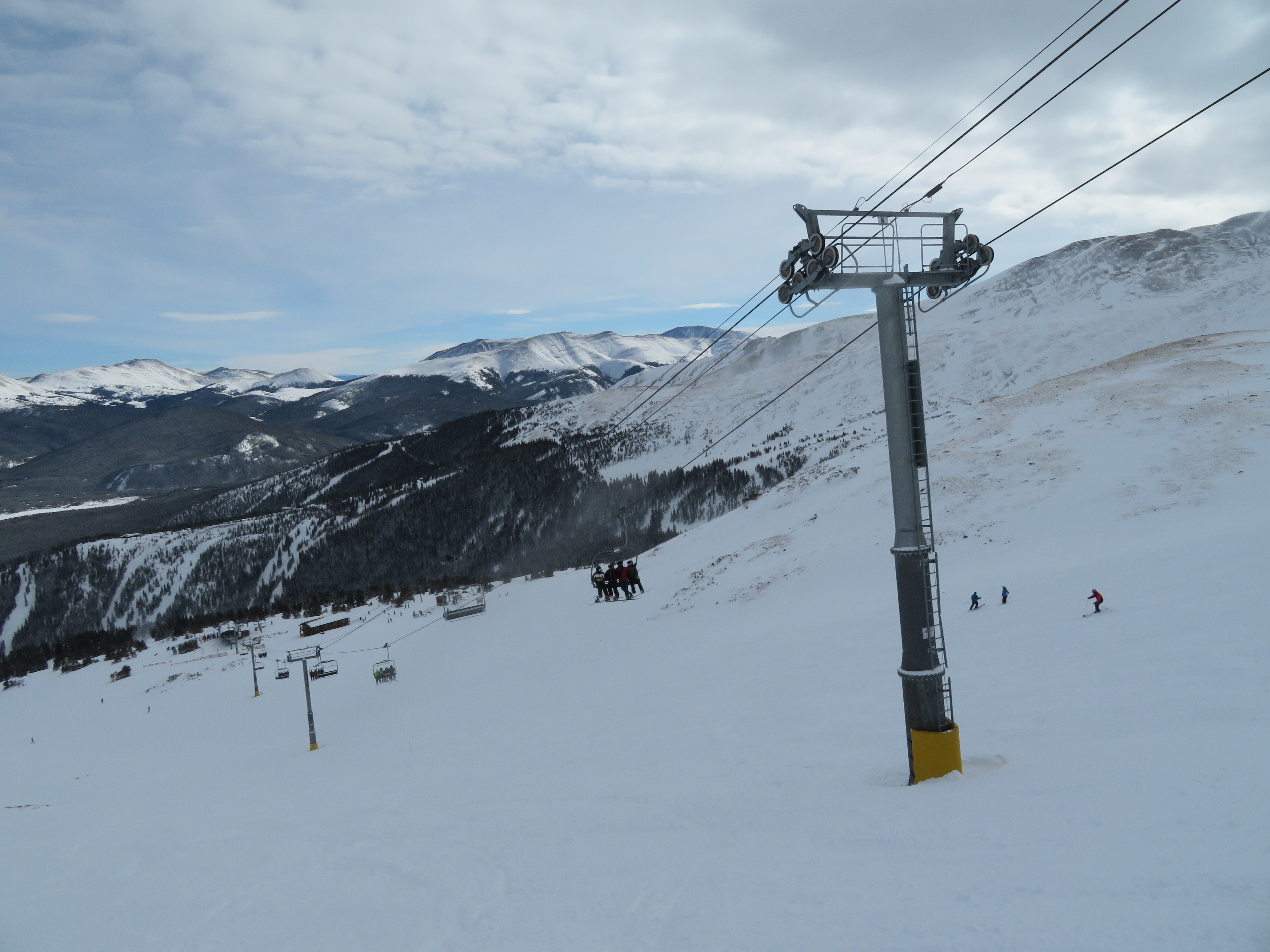
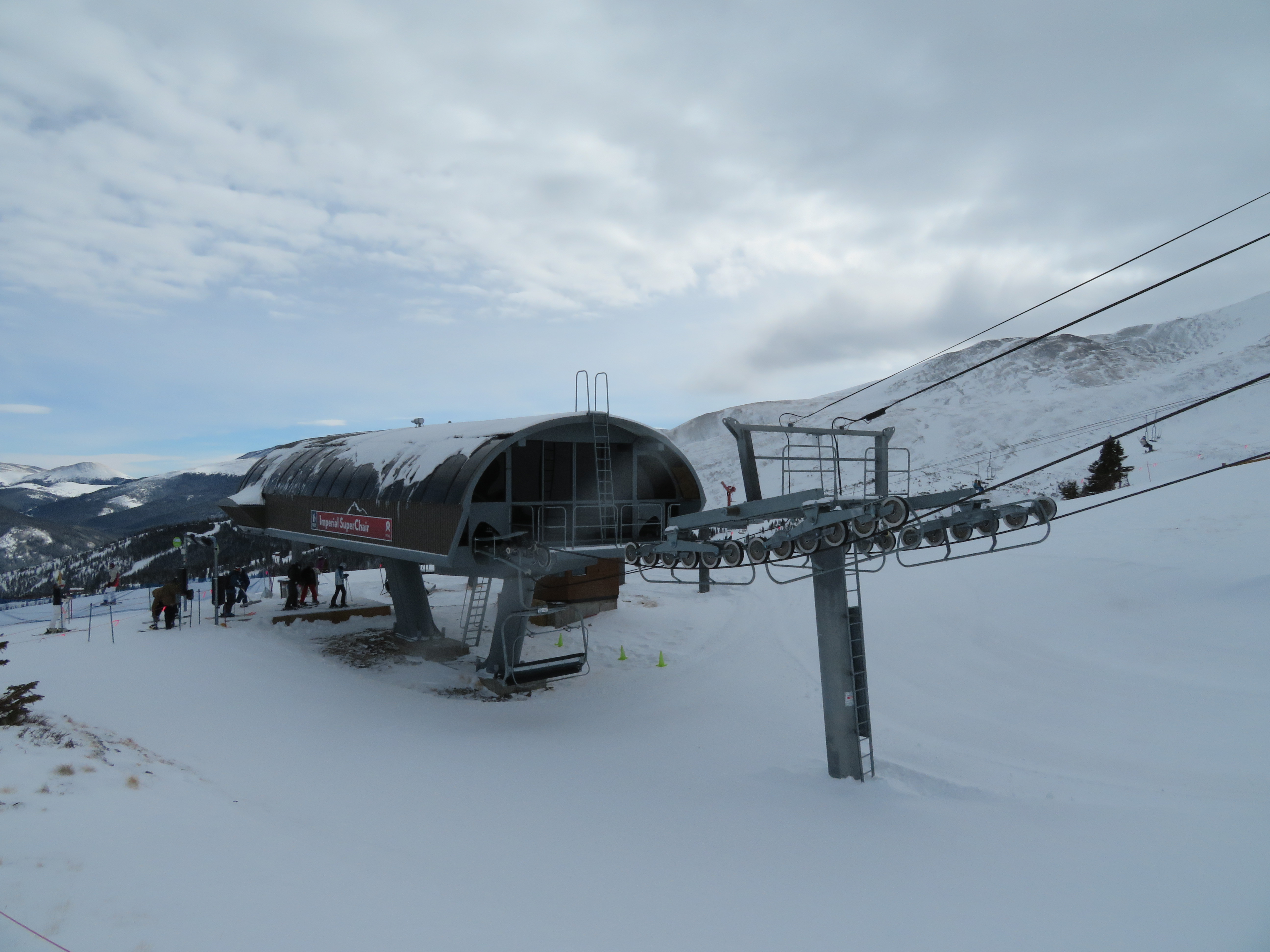
This is a bottom drive lift with parking for all chairs.Lift line overview from Peak 9.Chair parking rail.90-degree loading.Riding up the line.Nearly every tower on this lift is in three tube sections with combo assemblies for wind tolerance.Arriving at the top.90-degree unloading.Top station and breakover.Poma Omega quad terminal.View down the line.Combo towers.Lower terminal.
42 thoughts on “Imperial SuperChair – Breckenridge, CO”
Donald M. ReifFebruary 28, 2019 / 9:36 pm
The first year of operation, Imperial only had 15 chairs. They added more in the second year. I think it can be upped further to 45 chairs if demand ever gets to that point, but they probably will stick to 30 chairs to control the flow of people offloading onto the narrow ridge.
The one thing I won’t get is the fact the lift name is inconsistent. It’s named Imperial SuperChair on the lift terminals, but the trail map (and the original logo before the red signs were posted over them) label it as the Imperial Express SuperChair. Quicksilver has a similar issue, where the signs above the loading areas use the old Quicksilver Super6 name, while the lift terminals have Quicksilver SuperChair branding.
Wind slats started popping up on high speed quads around the late 90s, but (outside of a few rare exceptions) Leitner-poma has never made any chairlifts with slats. They just don’t design them that way.
It’s for reasons like that that the Kensho SuperChair was built as a six pack even though a quad would probably have sufficed capacity-wise: because six-pack chairs are heavier and that offers a little bit more in the way of wind resistance.
This is one of the few lifts that requires a fixed grip or other non-detachable lift to access. Others include the Wenatchee Express at Mission Ridge, and the Jupiter Express at Stevens Pass
Random thought but I imagine that the three section splice towers were engineered that way to make it possible to fly them in with a helicopter. At that elevation, the regular tube lengths would probably be too heavy to fly.
Also, must have been a pretty crazy top terminal build. Imagine getting concrete, heavy terminal parts, and a crane all the way up there!
This is actually accurate. I’m an LPoA Install Tech (not on this project, but for two others in the county in recent years), and at 12k feet the air is simply too thin for the helicopter to generate enough lift. Lifting capacity normally is around 4000lbs at 10,000ft factoring in a 150% safety margin. A typical 4-bolt 40’ tower section weighs right around 3800lbs. The terminal components were flown in using a heavy lift chinook vs the usual blackhawk for the line. Also a fun fact, the line experiences such thermal fluxes from one side facing the sun and the other in the shade that alignment warps up to a few inches in the spring! Needless to say, lift maintenance works very hard on this lift.
The mid to lower lift line towers are designed to be in an avalanche path. The bottoms of the vulnerable towers are beefed up 8 bolts for that reason. Don’t quote me on it, but if I remember correctly a few of those lower tubes are full of concrete to prevent them from collapsing from avalanche loading from the uphill side. They flew concrete into the top terminal with a K-max and a Bell 212. It took both helicopters nearly two days to fly partial loads to that elevation. A chinook was used several times on this project. First to fly an excavator to the top in two pieces, then to fly the line and top terminal.
We saw that from across the ridge. Lots of helicopters buzzing about for days. We got a heads-up from someone (probably Michael) that they were lifting the excavator up there, so of course we had to watch.
As of April 21 2024 Imperial only has 30 chairs. It could definitely use some more chairs though, the lift is pretty low capacity and the line can get long.
That’s a necessary tradeoff considering how tight the space at the upper terminal is. You’re offloading on the side of a narrow ridge. Compared to say, the Kensho SuperChair…
…you don’t want the unload area on Imperial to get too congested between those taking in the view, those preparing to start downhill, and those who are going to hike the last 150 vertical feet to the true summit of the peak.
Here’s a shot of the breakover on North America’s highest chairlift, taken from the summit of nearby Crystal Peak (13.86K). You can see the Dillon Reservoir in the background.
Diesel Machinery Power is usually calculated at sea level. As your elevation increases, the machinery starts to derate because the air is thinner (i.e. a Generator rated for 1000 kW at Sea Level might only be able to produce 750 kW at 8,000 ft).
With respect to lifts, the manufacturer will procure a diesel generator that is large enough to power the lift even at that altitude. So in an alternate universe where Breckenridge is actually in Vermont at 3,000 ft, the diesel generator could be much smaller than what it is in Colorado.
So to answer your question, elevation doesn’t necessarily mean it’s less reliable, but the backup needs to be large enough in the first place to do its job.
A couple weeks late on the post. Avalanche control isn’t a perfect science, but I think Breck’s ski patrol got a little more than they expected with this one, especially with six chair already open to the public while it occurred.
The fall line on the eastern side of the imperial bowl has always seen avalanche runout towards the bottom of the “Nut Trail” or whatever it’s called now. This is why every tower on the Imperial starts with an eight bolt foundation/tower segment.
Lifts with five combi towers in a row are pretty rare. There’s only a handful of other lifts that are like this, such as the Game Creek Express and Expo (in all three cases, it’s due to the profile of the hill they’re climbing).
Engines, whether gasoline or diesel, deal with high altitude by the addition of either superchargers (driven off the engine) or turbochargers (powered by the engine’s exhaust gases). Piston aircraft engines lean toward supercharging. Backup diesels for ski lifts are most likely turbocharged. In both cases, air is forced into an engine’s intake tract rather than being drawn in by natural aspiration, or vacuum, on a piston’s intake stroke.




The first year of operation, Imperial only had 15 chairs. They added more in the second year. I think it can be upped further to 45 chairs if demand ever gets to that point, but they probably will stick to 30 chairs to control the flow of people offloading onto the narrow ridge.
LikeLike
Interesting fact, this is the only one of Breckenridge’s superchairs to be shorter than one mile in length.
LikeLike
The one thing I won’t get is the fact the lift name is inconsistent. It’s named Imperial SuperChair on the lift terminals, but the trail map (and the original logo before the red signs were posted over them) label it as the Imperial Express SuperChair. Quicksilver has a similar issue, where the signs above the loading areas use the old Quicksilver Super6 name, while the lift terminals have Quicksilver SuperChair branding.
LikeLike
Not anymore. The new Rips Ride and Five lifts have joined imperial in that category.
LikeLike
Why is this not an LPA lift?
LikeLike
It was built several years before the LPA terminals and grips became available.
LikeLike
Oh right, for some reason I thought this was built in 2011
LikeLike
LikeLike
I’ve heard this is One of the fastest lifts, but Peter said it is only 1000 fpm. What is true?
LikeLike
Was this built before wind slats on detachable chairs were common? It seems like it could benefit from them.
LikeLike
Wind slats started popping up on high speed quads around the late 90s, but (outside of a few rare exceptions) Leitner-poma has never made any chairlifts with slats. They just don’t design them that way.
LikeLike
It’s for reasons like that that the Kensho SuperChair was built as a six pack even though a quad would probably have sufficed capacity-wise: because six-pack chairs are heavier and that offers a little bit more in the way of wind resistance.
LikeLike
There’s actually some Leitner Poma lifts in New Zealand that not only have slatted backrests, but also have slatted seat bottoms.
Pictures of them
https://rodoaf.remontees-mecaniques.net/nz/mthutt/tsd6sum/47ok.JPG
https://rodoaf.remontees-mecaniques.net/nz/mthutt/tsd6sum/52ok.JPG
https://rodoaf.remontees-mecaniques.net/nz/mthutt/tsd6sum/54ok.JPG
LikeLike
Slats on the seat?
LikeLike
This is one of the few lifts that requires a fixed grip or other non-detachable lift to access. Others include the Wenatchee Express at Mission Ridge, and the Jupiter Express at Stevens Pass
LikeLike
Honestly I wish they expanded Wenatchee Express down the the lodge, having to ride up the slow chair 1 or long chair 4 is annoying.
LikeLike
The Kensho SuperChair also is on that list, as the primary way of reaching it is by taking the Zendo Chair.
LikeLike
That does not count anymore because of the catrack from Freedom Superchair
LikeLike
Add the new Haig One Express at Castle to the list.
LikeLike
Random thought but I imagine that the three section splice towers were engineered that way to make it possible to fly them in with a helicopter. At that elevation, the regular tube lengths would probably be too heavy to fly.
Also, must have been a pretty crazy top terminal build. Imagine getting concrete, heavy terminal parts, and a crane all the way up there!
LikeLike
This is actually accurate. I’m an LPoA Install Tech (not on this project, but for two others in the county in recent years), and at 12k feet the air is simply too thin for the helicopter to generate enough lift. Lifting capacity normally is around 4000lbs at 10,000ft factoring in a 150% safety margin. A typical 4-bolt 40’ tower section weighs right around 3800lbs. The terminal components were flown in using a heavy lift chinook vs the usual blackhawk for the line. Also a fun fact, the line experiences such thermal fluxes from one side facing the sun and the other in the shade that alignment warps up to a few inches in the spring! Needless to say, lift maintenance works very hard on this lift.
LikeLiked by 2 people
The mid to lower lift line towers are designed to be in an avalanche path. The bottoms of the vulnerable towers are beefed up 8 bolts for that reason. Don’t quote me on it, but if I remember correctly a few of those lower tubes are full of concrete to prevent them from collapsing from avalanche loading from the uphill side. They flew concrete into the top terminal with a K-max and a Bell 212. It took both helicopters nearly two days to fly partial loads to that elevation. A chinook was used several times on this project. First to fly an excavator to the top in two pieces, then to fly the line and top terminal.
LikeLike
We saw that from across the ridge. Lots of helicopters buzzing about for days. We got a heads-up from someone (probably Michael) that they were lifting the excavator up there, so of course we had to watch.
LikeLike
I looked it up and it appears to be the world’s highest chairlift. The highest lift is a gondola.
LikeLiked by 1 person
Yes, that’s right. In second place is Gobba di Rollin in Switzerland with a height of 3899 m.
LikeLike
Gulmarg Gondola
LikeLike
That’s true. I forgot about India.
LikeLike
There are 35 chairs now and the arrive every 12 seconds. So about 1200 people per hour and a 3.5 minute ride.
LikeLike
As of April 21 2024 Imperial only has 30 chairs. It could definitely use some more chairs though, the lift is pretty low capacity and the line can get long.
LikeLike
That’s a necessary tradeoff considering how tight the space at the upper terminal is. You’re offloading on the side of a narrow ridge. Compared to say, the Kensho SuperChair…
https://liftblog.com/wp-content/uploads/2017/01/img_3349.jpg
…you don’t want the unload area on Imperial to get too congested between those taking in the view, those preparing to start downhill, and those who are going to hike the last 150 vertical feet to the true summit of the peak.
LikeLike
Yeah. It can already get congested in the unload area with 30 chairs.
LikeLike
Here’s a shot of the breakover on North America’s highest chairlift, taken from the summit of nearby Crystal Peak (13.86K). You can see the Dillon Reservoir in the background.
https://dismalwilderness.com/wp-content/uploads/assets/imperial-breakover.JPG
LikeLike
oops, meant to post inline
https://dismalwilderness.com/wp-content/uploads/assets/imperial-breakover.JPG
LikeLike
Nice perspective! 😎
LikeLiked by 1 person
How would the high elevation affect the diesel backup? Would that make it harder to run/start in an emergency?
LikeLike
Diesel Machinery Power is usually calculated at sea level. As your elevation increases, the machinery starts to derate because the air is thinner (i.e. a Generator rated for 1000 kW at Sea Level might only be able to produce 750 kW at 8,000 ft).
With respect to lifts, the manufacturer will procure a diesel generator that is large enough to power the lift even at that altitude. So in an alternate universe where Breckenridge is actually in Vermont at 3,000 ft, the diesel generator could be much smaller than what it is in Colorado.
So to answer your question, elevation doesn’t necessarily mean it’s less reliable, but the backup needs to be large enough in the first place to do its job.
LikeLiked by 2 people
A couple weeks late on the post. Avalanche control isn’t a perfect science, but I think Breck’s ski patrol got a little more than they expected with this one, especially with six chair already open to the public while it occurred.
The fall line on the eastern side of the imperial bowl has always seen avalanche runout towards the bottom of the “Nut Trail” or whatever it’s called now. This is why every tower on the Imperial starts with an eight bolt foundation/tower segment.
https://www.instagram.com/abcavalanchas/reel/DEjVdcVoHbe/
https://www.summitdaily.com/news/breckenridge-ski-resort-opens-imperial-chairlift-on-peak-8-following-large-controlled-avalanche-caught-on-video/
LikeLike
That work carrier in pic 3 is supposed to be on Beaver Run!
LikeLike
Lifts with five combi towers in a row are pretty rare. There’s only a handful of other lifts that are like this, such as the Game Creek Express and Expo (in all three cases, it’s due to the profile of the hill they’re climbing).
LikeLike
Engines, whether gasoline or diesel, deal with high altitude by the addition of either superchargers (driven off the engine) or turbochargers (powered by the engine’s exhaust gases). Piston aircraft engines lean toward supercharging. Backup diesels for ski lifts are most likely turbocharged. In both cases, air is forced into an engine’s intake tract rather than being drawn in by natural aspiration, or vacuum, on a piston’s intake stroke.
LikeLike
This cable car is the highest chairlift in the world. Without a doubt. It’s a shame that this superlative is not mentioned anywhere.
LikeLike