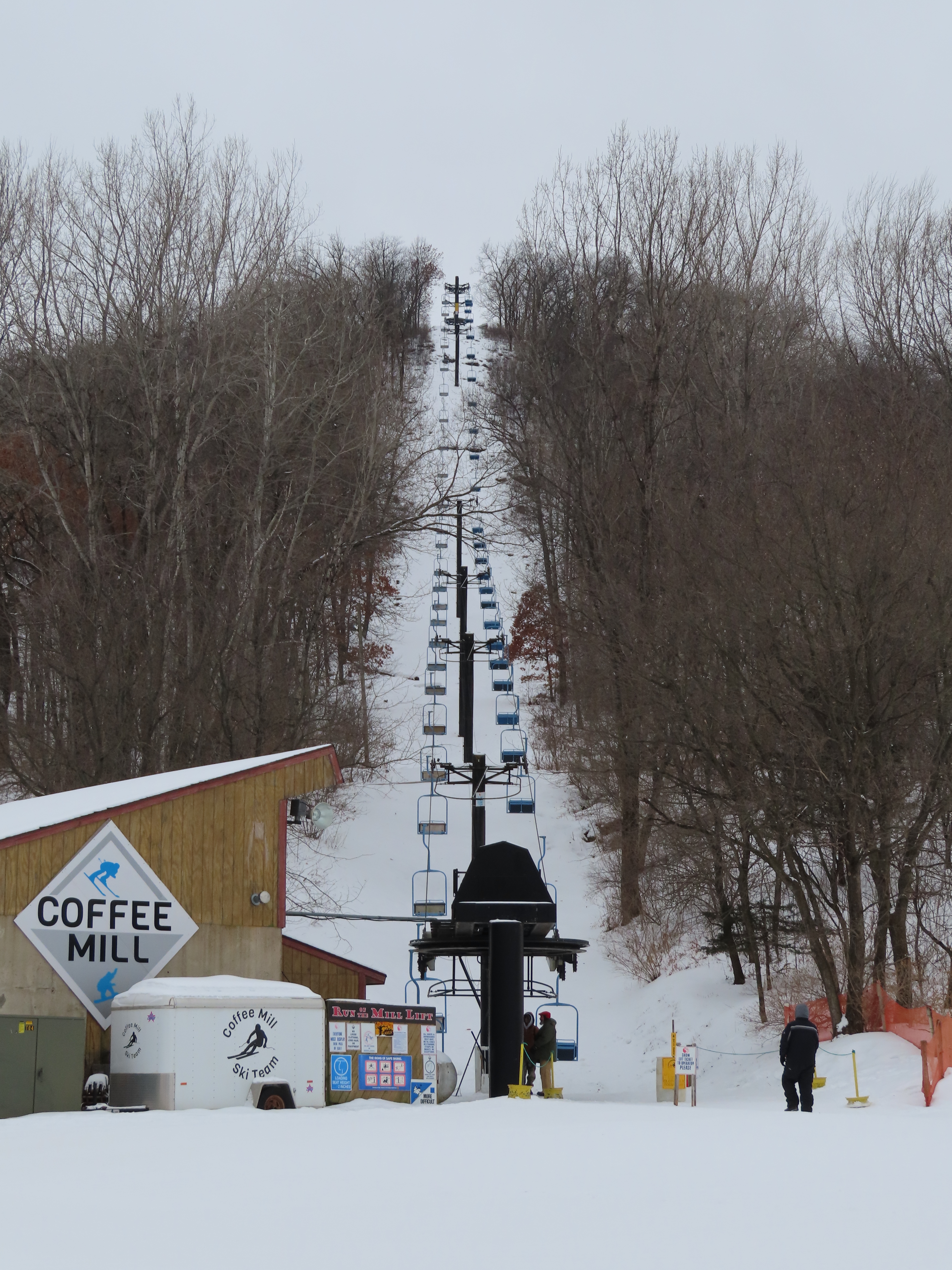
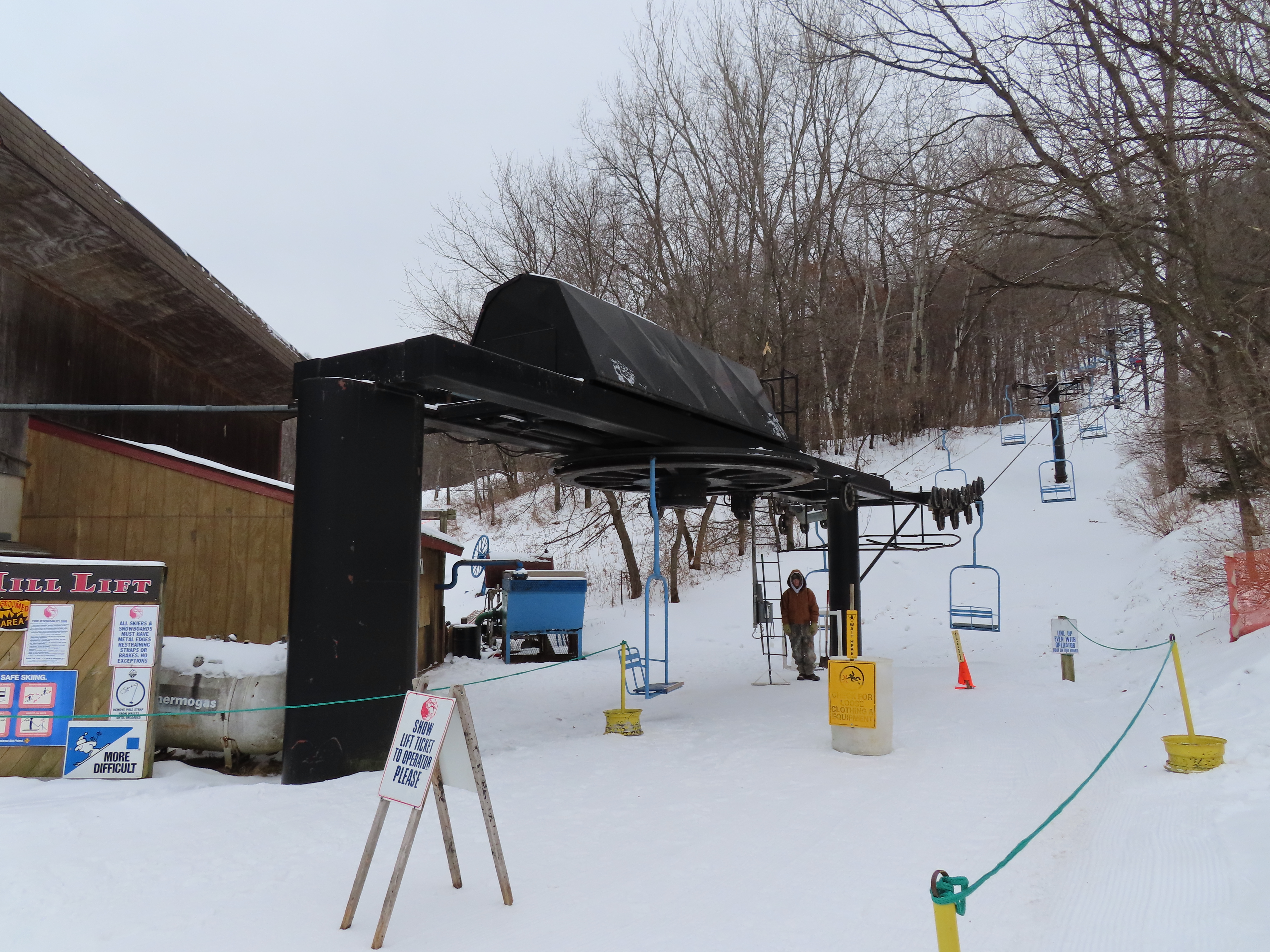
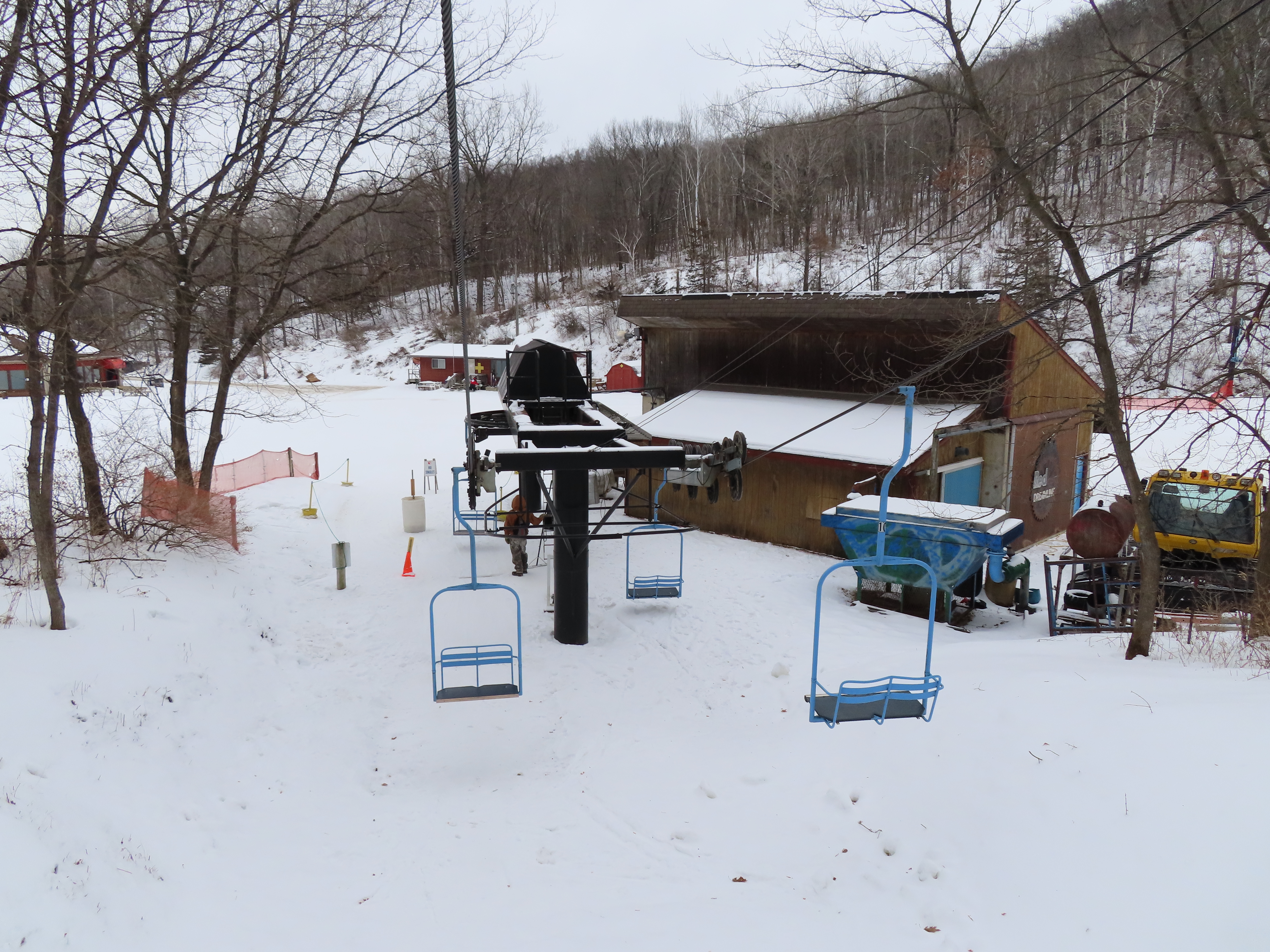
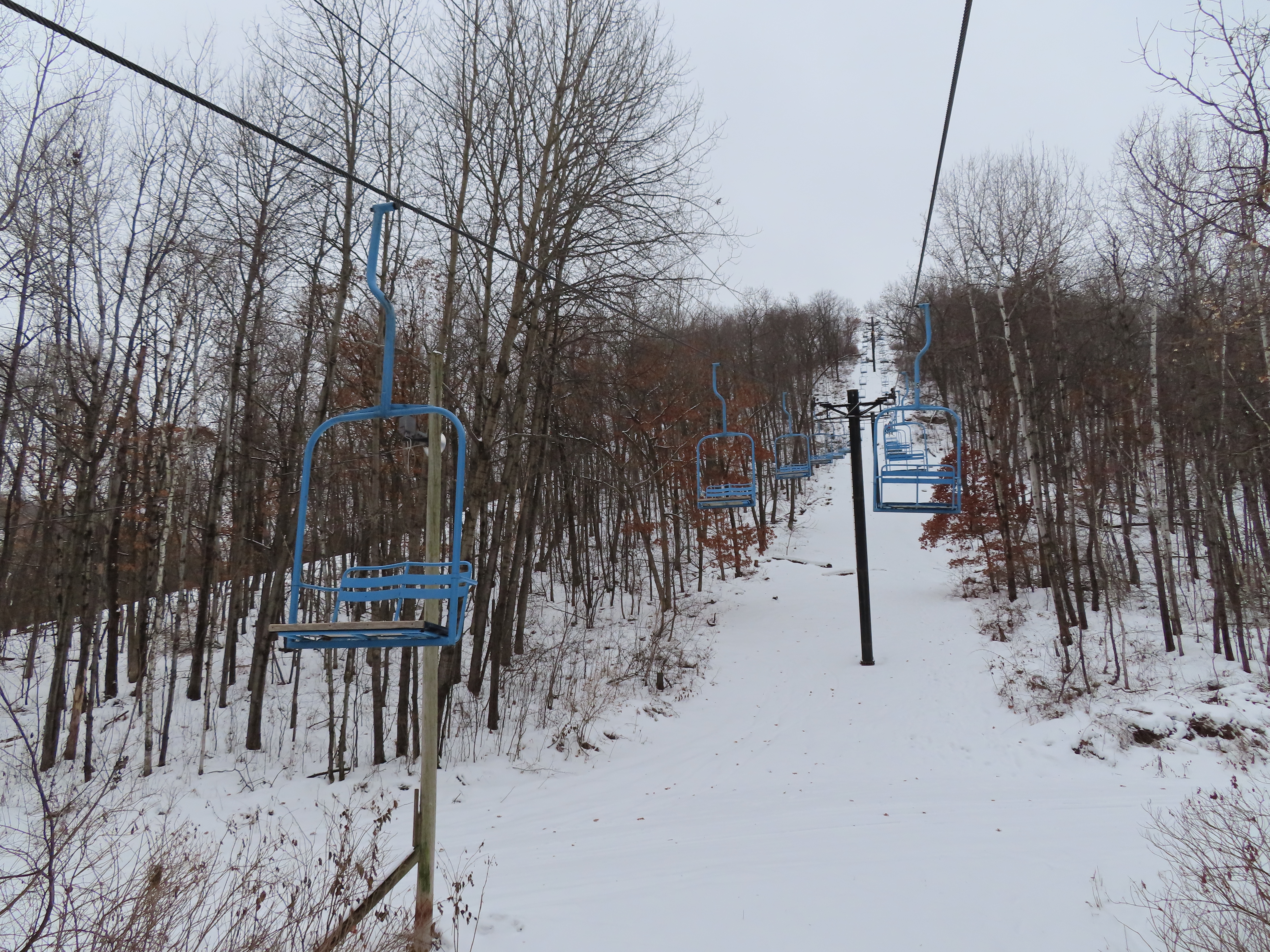
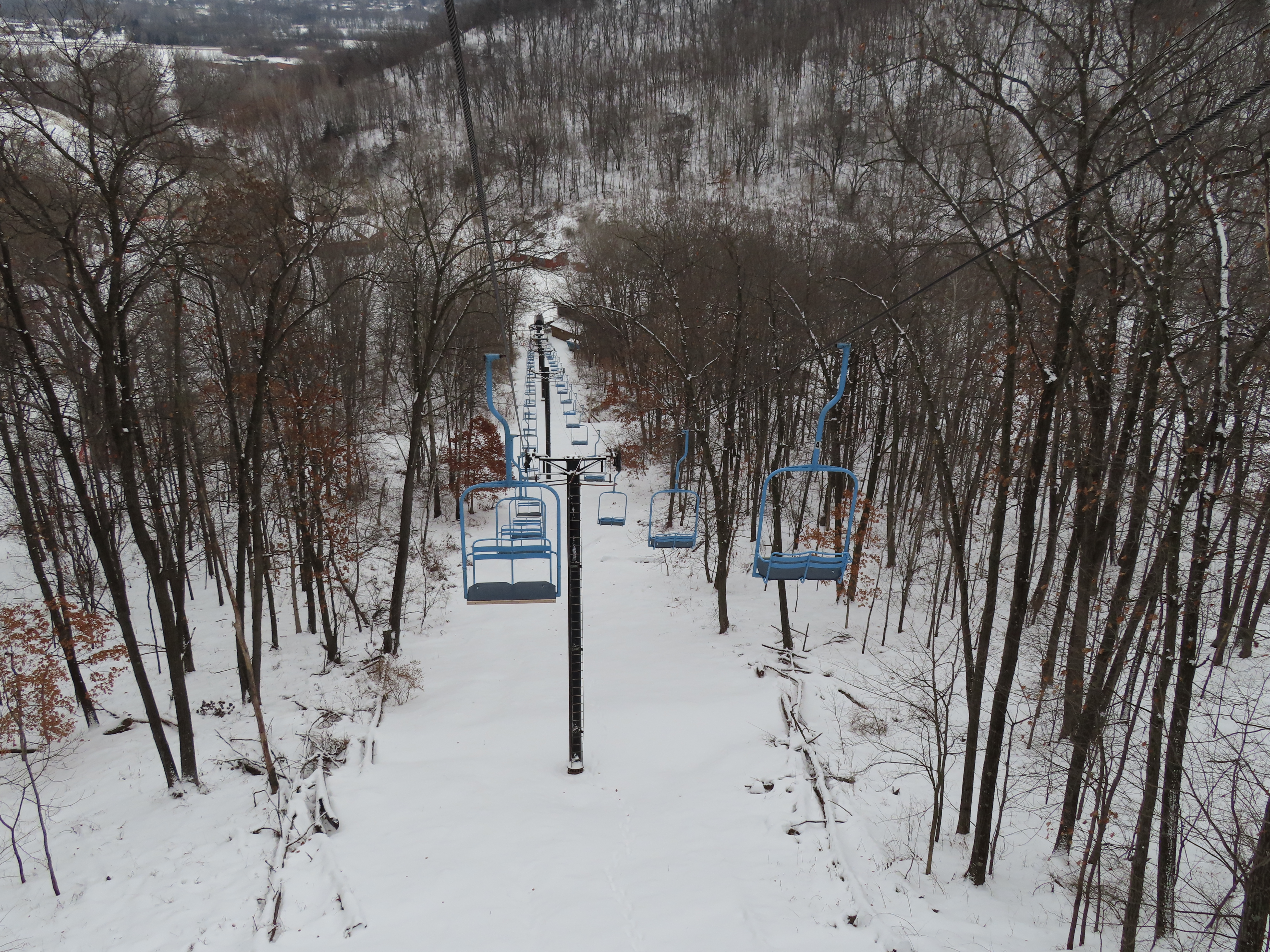
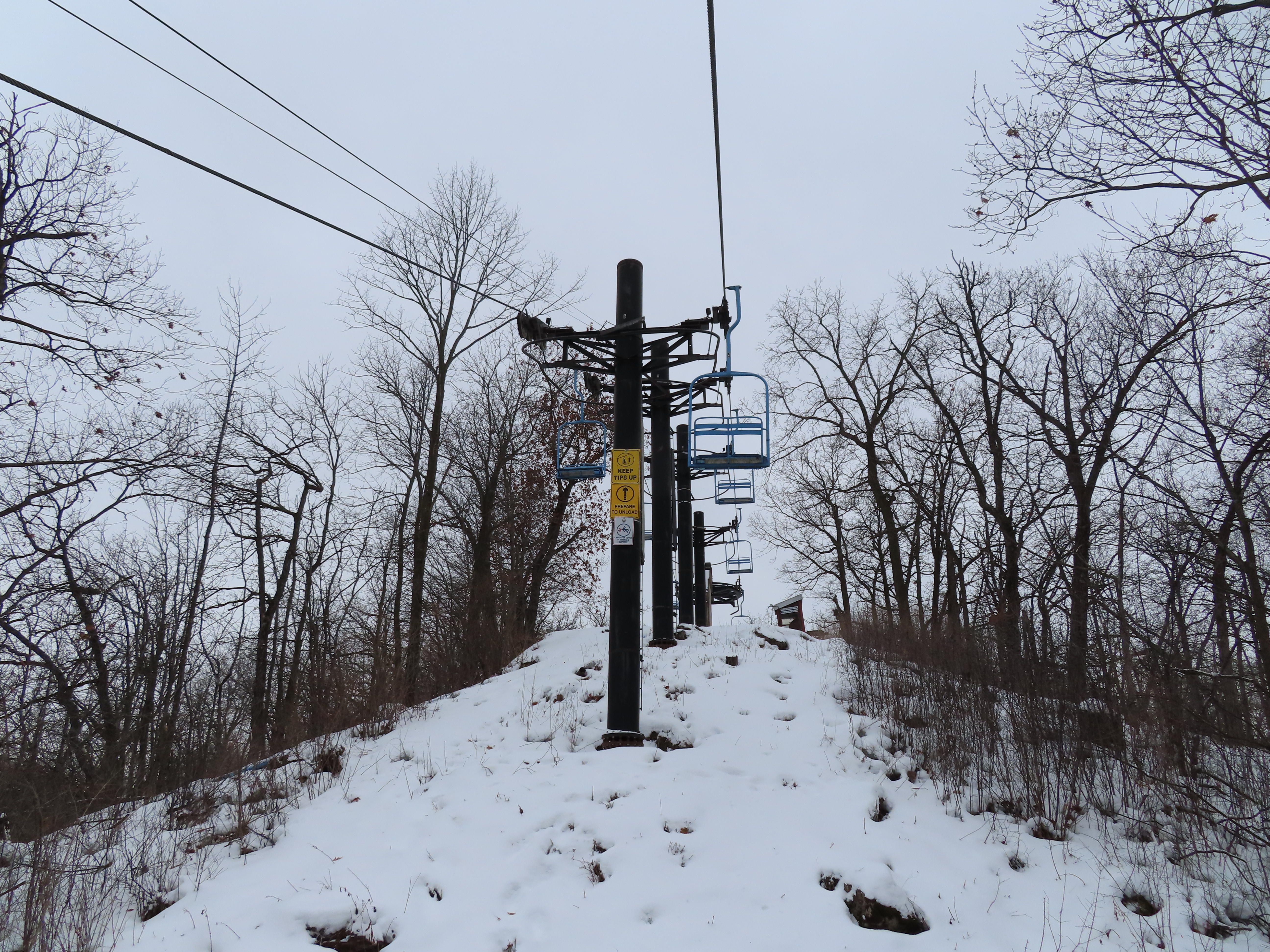
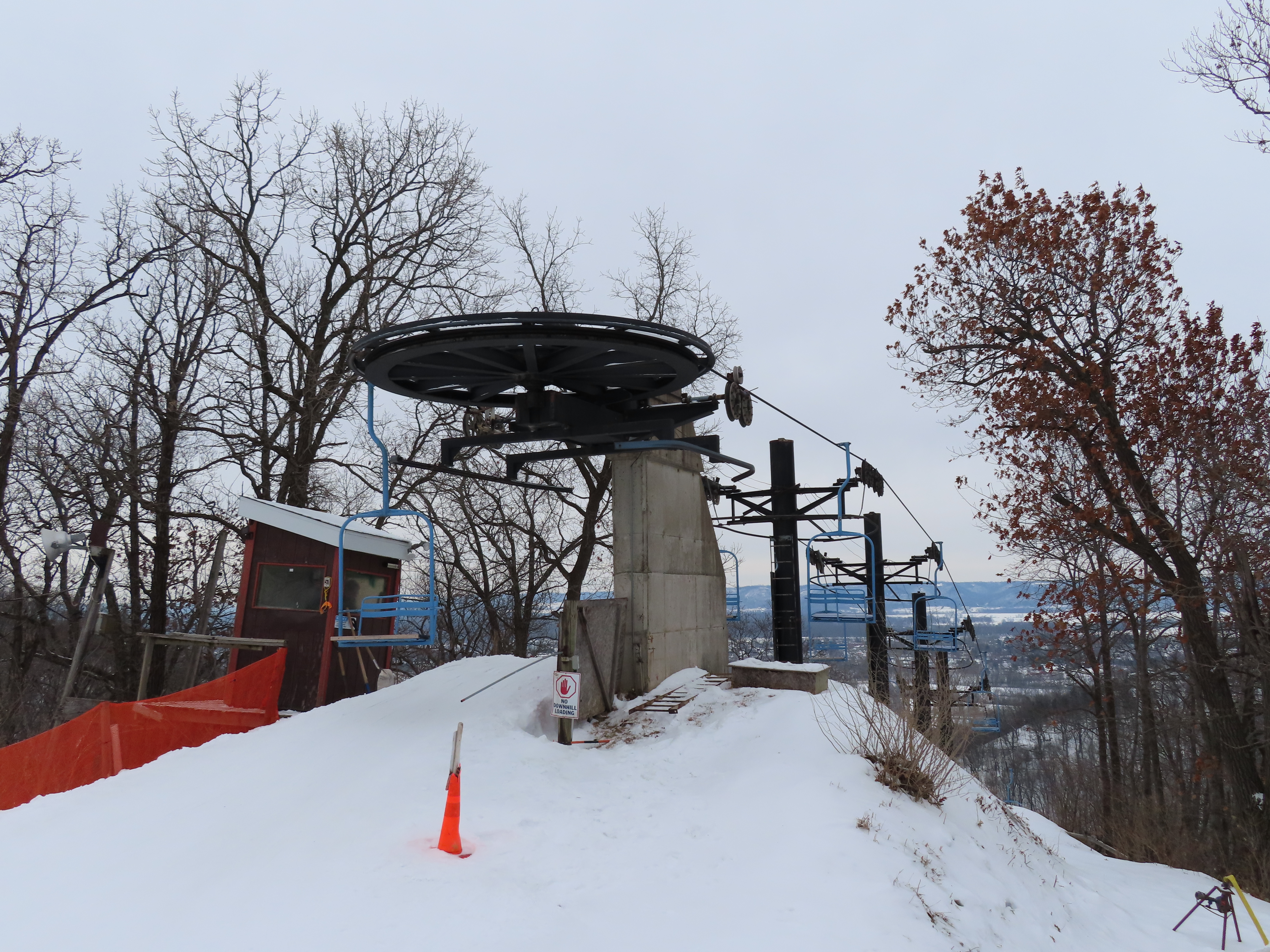
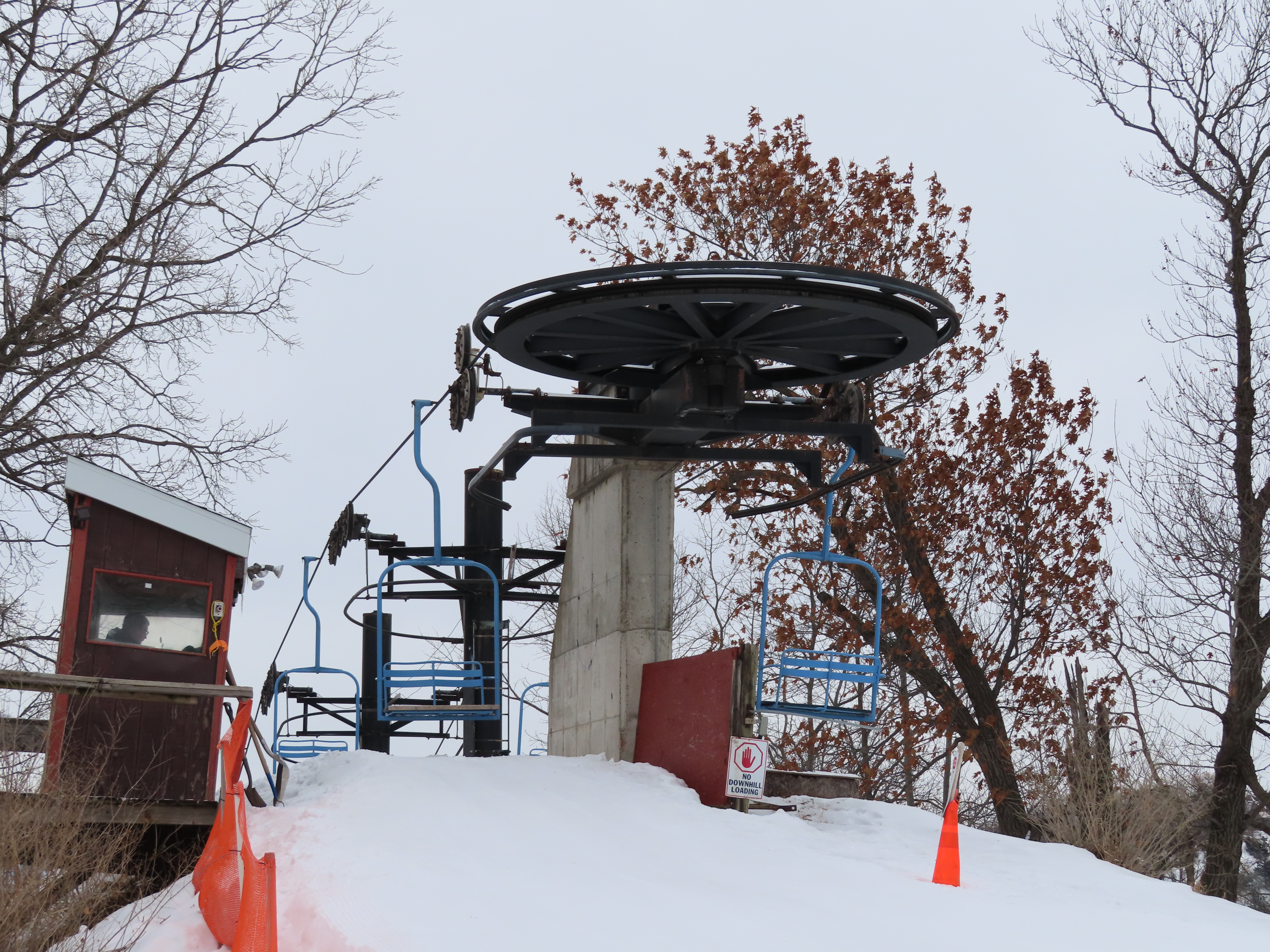
This Riblet double was initially planned as a triple and likely replaced a T-Bar in 1985.Late model Riblet drive station.Leaving the bottom terminal.Riding up the lift line.Bail-style chair.View back down the line.This is one of the bigger Riblet breakovers in the midwest.The top bullwheel.Rare concrete support for a Riblet bullwheel.Unloading area.The steep part of the line.
The top terminal structure looks very similar to Hunzinger, Hjorth, and American Cableways (maybe even Cosmos). There was most likely a previous lift on this alignment.
This lift replaced an American Cableways double which itself came from Barn Mountain MI in 1978. The lift went to Frost Fire, and it was scrapped in 2018.
This lift reuses old foundations which is not unusual but the way they are reused seemed unusual. There is a 3 foot long lower tower section which is comprised of a non-riblet bolt pattern into the foundation (looks like Hall but could be another manufacturer) The other end of the lower tower section has a standard Riblet bolt pattern which matches the upper tower’s base. However, these two sections are not flush with each other with a gap of maybe 3 inches between. Presumably, Riblet choose to not reuse the existing towers, cut 90% of the existing towers off, welded a Riblet fitting to the truncated tower and left a gap between tower sections. All of those decisions seem odd but maybe someone in the know has more context.
Riblet commonly used the upper/lower tower approach when building new with the lower tower embedded in the concrete so the approach at Coffee Mill allowed Riblet to use standard gear above the lower tower. Example: https://skiliftblog.files.wordpress.com/2020/12/img_0459.jpg Still seems odd.
You’re probably correct that Riblet made an adaptor section out of the old lift’s towers. As for the gap between the upper and lower sections, that’s present on all Riblet towers that used that construction method. Typically there’s a clamp/wrap of sheet metal that covers the gap and seals out snow and water. You can see it in the photo you used for an example. Coffee Mill may have removed (or not installed at all) the ones on their towers.




 Lift Blog
you should post pics of ski resorts in Michigan like boyne mountain or nubs nob with all older style quad and triple riblets I believe
LikeLike
https://liftblog.com/nubs-nob-mi/
https://liftblog.com/boyne-mountain-mi/
LikeLike
Actual Lift name is Run of the Mill.
This is the 3rd chair lift in this location. No t-bar lifts have been at this ski area.
LikeLiked by 1 person
3rd chairlift? what do you mean
LikeLike
The top terminal structure looks very similar to Hunzinger, Hjorth, and American Cableways (maybe even Cosmos). There was most likely a previous lift on this alignment.
LikeLike
This lift replaced an American Cableways double which itself came from Barn Mountain MI in 1978. The lift went to Frost Fire, and it was scrapped in 2018.
LikeLike
I believe it is still standing, though it has not spun in a long time.
LikeLike
Why does it say years of operation end at 1989?
LikeLiked by 1 person
This lift reuses old foundations which is not unusual but the way they are reused seemed unusual. There is a 3 foot long lower tower section which is comprised of a non-riblet bolt pattern into the foundation (looks like Hall but could be another manufacturer) The other end of the lower tower section has a standard Riblet bolt pattern which matches the upper tower’s base. However, these two sections are not flush with each other with a gap of maybe 3 inches between. Presumably, Riblet choose to not reuse the existing towers, cut 90% of the existing towers off, welded a Riblet fitting to the truncated tower and left a gap between tower sections. All of those decisions seem odd but maybe someone in the know has more context.
Riblet commonly used the upper/lower tower approach when building new with the lower tower embedded in the concrete so the approach at Coffee Mill allowed Riblet to use standard gear above the lower tower. Example: https://skiliftblog.files.wordpress.com/2020/12/img_0459.jpg Still seems odd.
LikeLike
You’re probably correct that Riblet made an adaptor section out of the old lift’s towers. As for the gap between the upper and lower sections, that’s present on all Riblet towers that used that construction method. Typically there’s a clamp/wrap of sheet metal that covers the gap and seals out snow and water. You can see it in the photo you used for an example. Coffee Mill may have removed (or not installed at all) the ones on their towers.
LikeLike
Two photos of the Stadeli chairlift during installation. Have no idea if it went anywhere after it was removed.
LikeLike
Here’s a photo that shows the chairs on the Stadeli double that once ran here:
LikeLike
I believe that this was relocated to Hardscrabble, Wisconsin in 1986.
LikeLike
I believe that the original chairlift that ran this alignment (1979-1985) was relocated to Hardscrabble Wisconsin in 1986ish.
More photos on the Mt Hardscrabble Facebook page:
https://www.facebook.com/groups/53479021732
LikeLike
I believe that the American Cableways lift (1979-1985) was relocated to Hardscrabble Wisconsin in 1986ish.
Here’s a link to photos of it at Hardscrabble:
https://www.facebook.com/photo/?fbid=10206587712277424&set=g.53479021732
LikeLike