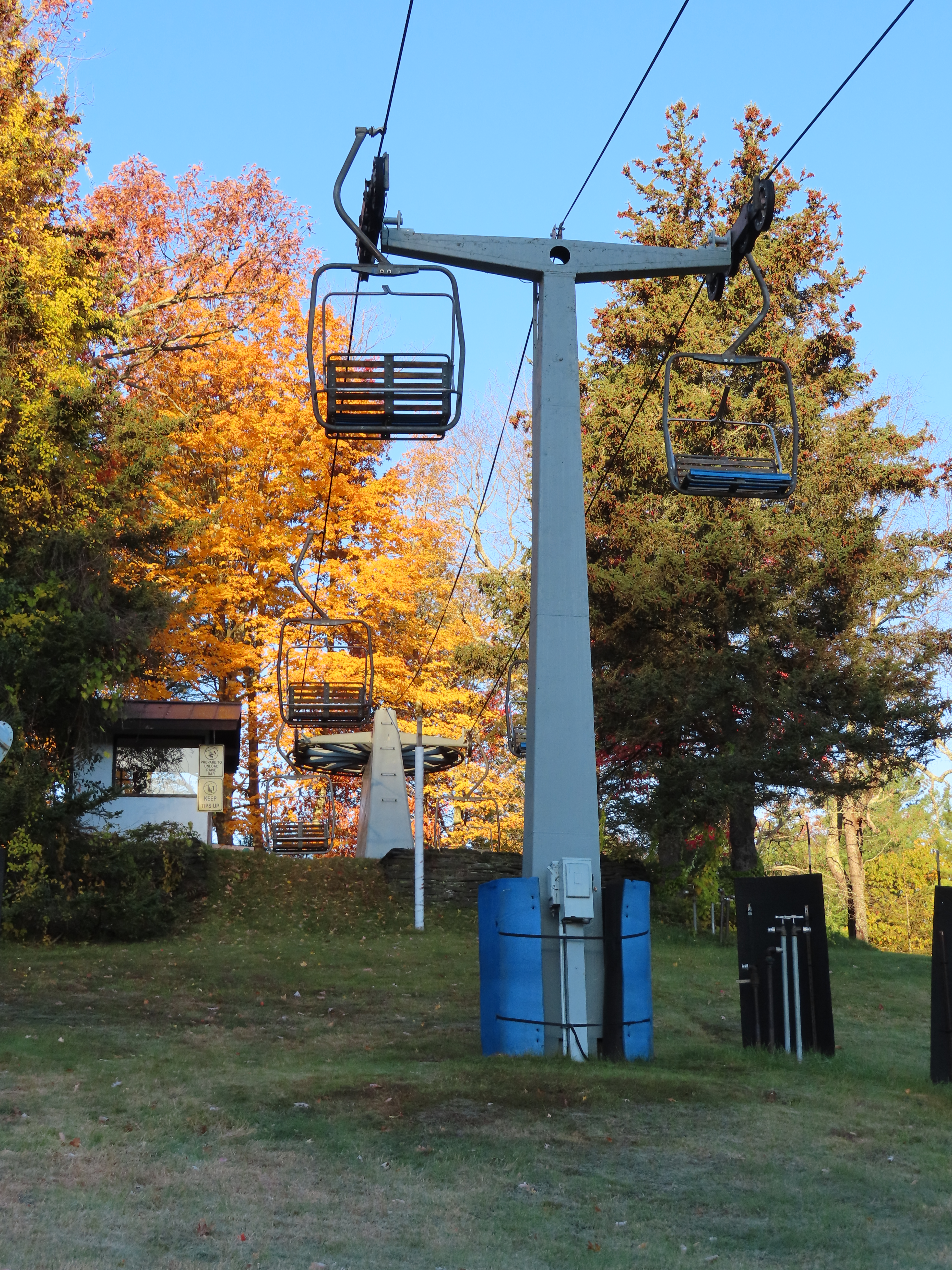
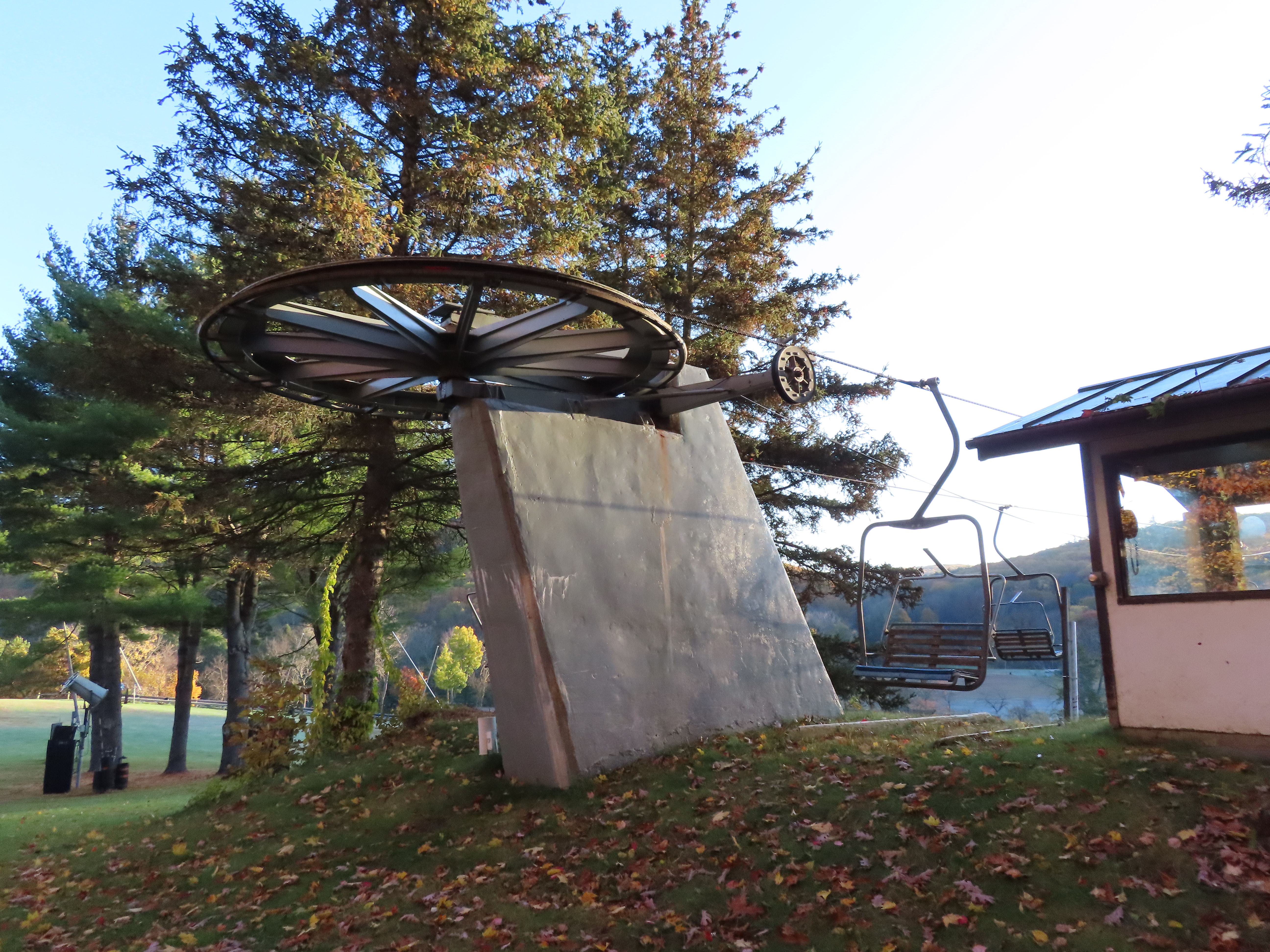
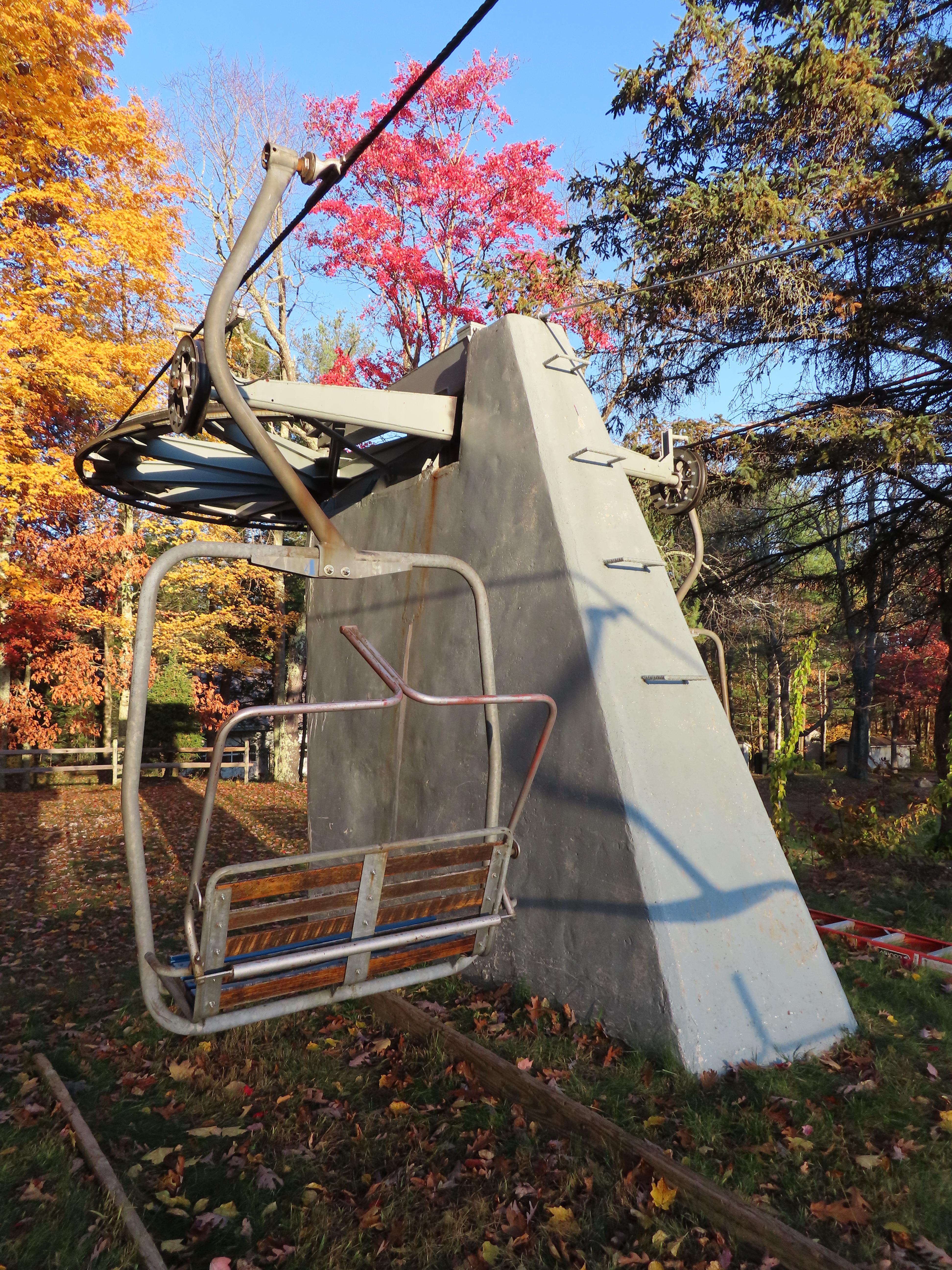
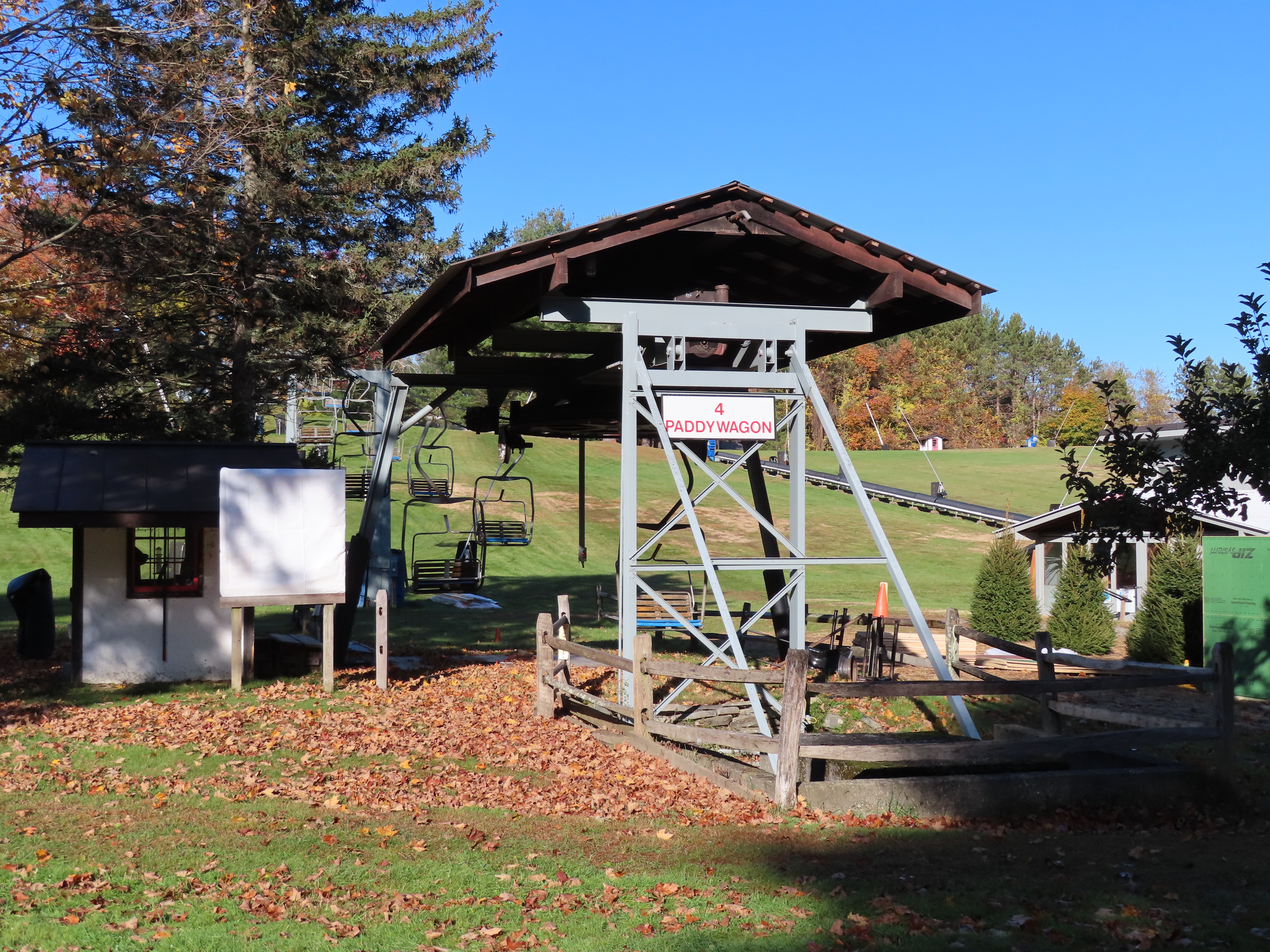
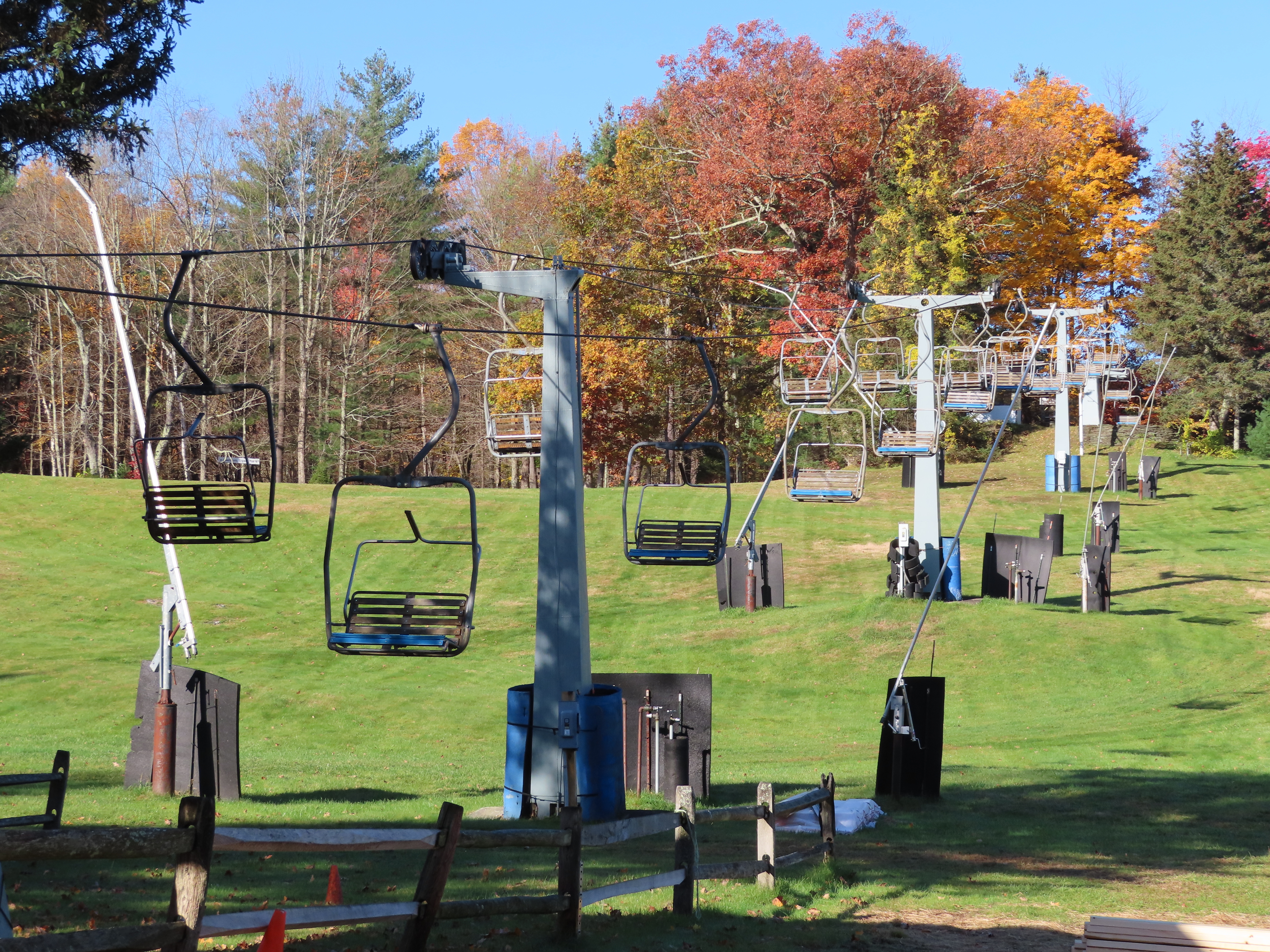
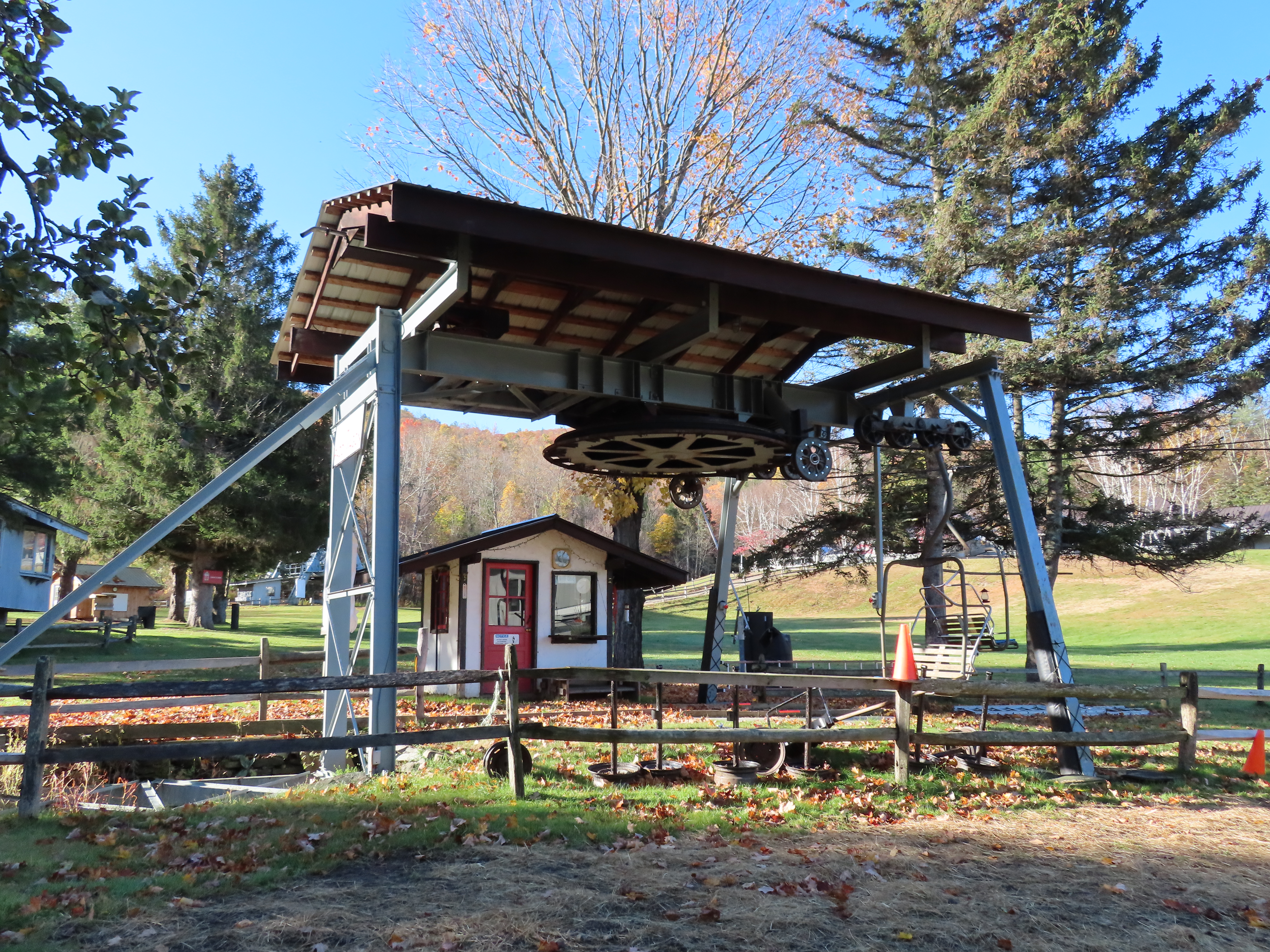
This is the last remaining of three Carlevaro-Savio lifts at Ski Butternut.The top station with s concrete support structure.Chair 1.Loading area.Lift line with a half tower.The drive station.
This lift had a very interesting bottom terminal, and the only one like it that I’ve seen was on the removed Scooter double next door. Scooter was a relocated Poma double with Borvig chairs and this lift was a new Carlevaro-Savio install, so part of me thinks that another company retrofitted both lifts with this model of drive-tension terminal at some point as it’s unlikely that a new install and relocation from different and mostly unrelated manufacturers would have nearly identical terminals.
What makes the bottom terminal so interesting is that its tension system is not a typical tension carriage connected to the counterweight by cables. Rather, I believe that tensioning was accomplished by having the downhill terminal mast as well as the integrated portal tower attached via hinges to both the horizontal motor platform and their respective foundations. The counterweight (the large concrete block in the pit downhill of the terminal) would have been cantilevered off of the downhill terminal mast. When the line was heavily loaded, the terminal would pivot uphill, and when the line was less loaded, the counterweight would make the terminal pivot back downhill.
It has been a long time since I last rode this lift, but I vaguely recall seeing the counterweight move around when chairs were loaded, so that block of concrete probably wasn’t a fixed foundation. Additionally, several photos on Newenglandskihistory.com and Remontees-mecaniques.net show what appear to be hinges connecting the downhill mast and integrated portal tower to the motor platform. Also, here’s a picture of the Scooter double’s bottom terminal when the lift was closed: https://www.newenglandskihistory.com/lifts/viewliftimage.php?photoid=1277 Notice how the terminal is visibly angled downhill, meaning the terminal masts were likely hinged.
I imagine that this style of tensioning was only useful for very short lifts like this one where not much bullwheel travel is required, which explains why we don’t see it very frequently. If anyone knows who may have built the bottom terminal or any other lifts that have this type of tensioning, I would be very interested to see them.



This lift had a very interesting bottom terminal, and the only one like it that I’ve seen was on the removed Scooter double next door. Scooter was a relocated Poma double with Borvig chairs and this lift was a new Carlevaro-Savio install, so part of me thinks that another company retrofitted both lifts with this model of drive-tension terminal at some point as it’s unlikely that a new install and relocation from different and mostly unrelated manufacturers would have nearly identical terminals.
What makes the bottom terminal so interesting is that its tension system is not a typical tension carriage connected to the counterweight by cables. Rather, I believe that tensioning was accomplished by having the downhill terminal mast as well as the integrated portal tower attached via hinges to both the horizontal motor platform and their respective foundations. The counterweight (the large concrete block in the pit downhill of the terminal) would have been cantilevered off of the downhill terminal mast. When the line was heavily loaded, the terminal would pivot uphill, and when the line was less loaded, the counterweight would make the terminal pivot back downhill.
It has been a long time since I last rode this lift, but I vaguely recall seeing the counterweight move around when chairs were loaded, so that block of concrete probably wasn’t a fixed foundation. Additionally, several photos on Newenglandskihistory.com and Remontees-mecaniques.net show what appear to be hinges connecting the downhill mast and integrated portal tower to the motor platform. Also, here’s a picture of the Scooter double’s bottom terminal when the lift was closed: https://www.newenglandskihistory.com/lifts/viewliftimage.php?photoid=1277 Notice how the terminal is visibly angled downhill, meaning the terminal masts were likely hinged.
I imagine that this style of tensioning was only useful for very short lifts like this one where not much bullwheel travel is required, which explains why we don’t see it very frequently. If anyone knows who may have built the bottom terminal or any other lifts that have this type of tensioning, I would be very interested to see them.
LikeLiked by 3 people
That’s a long comment
LikeLike