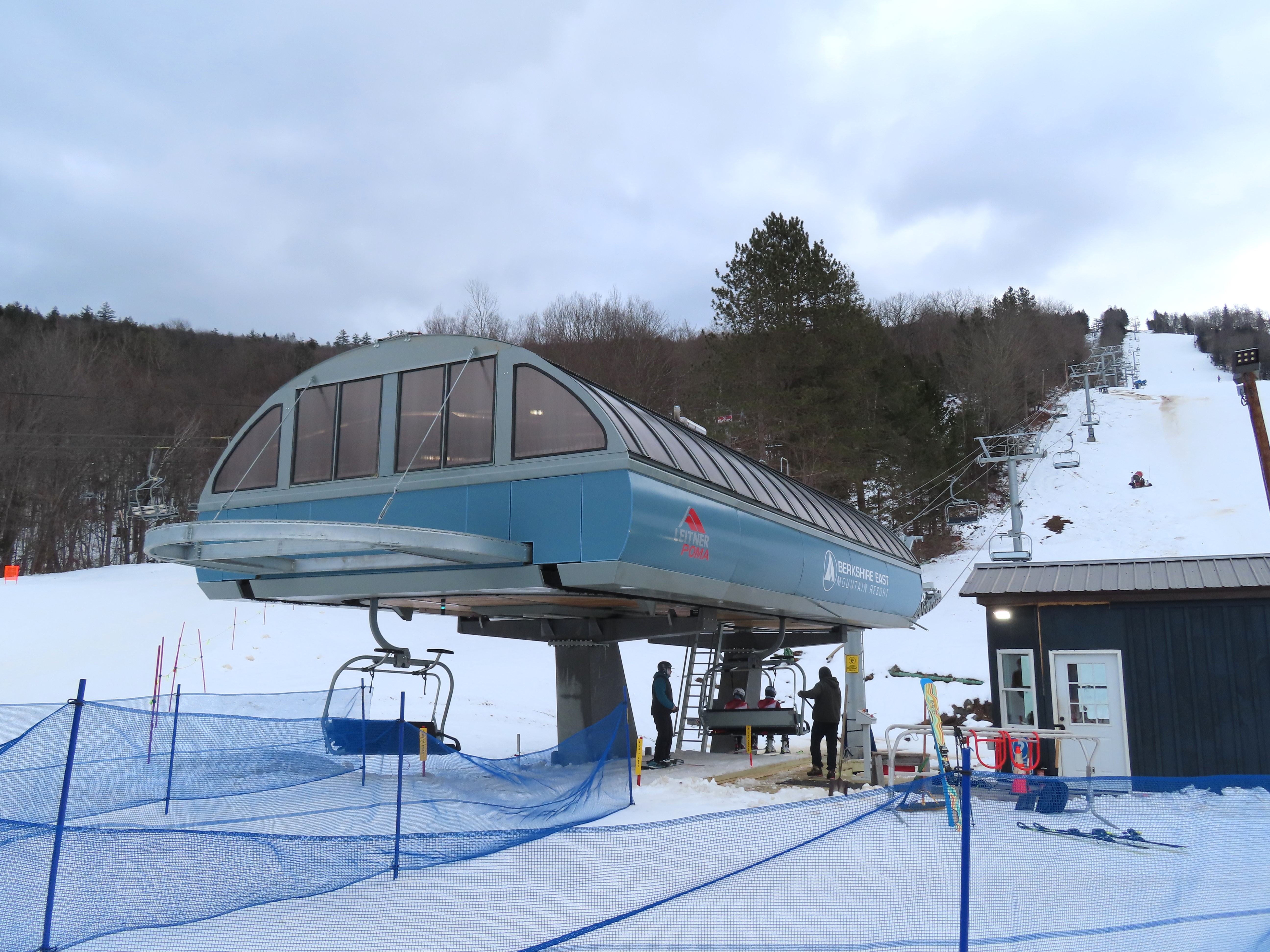
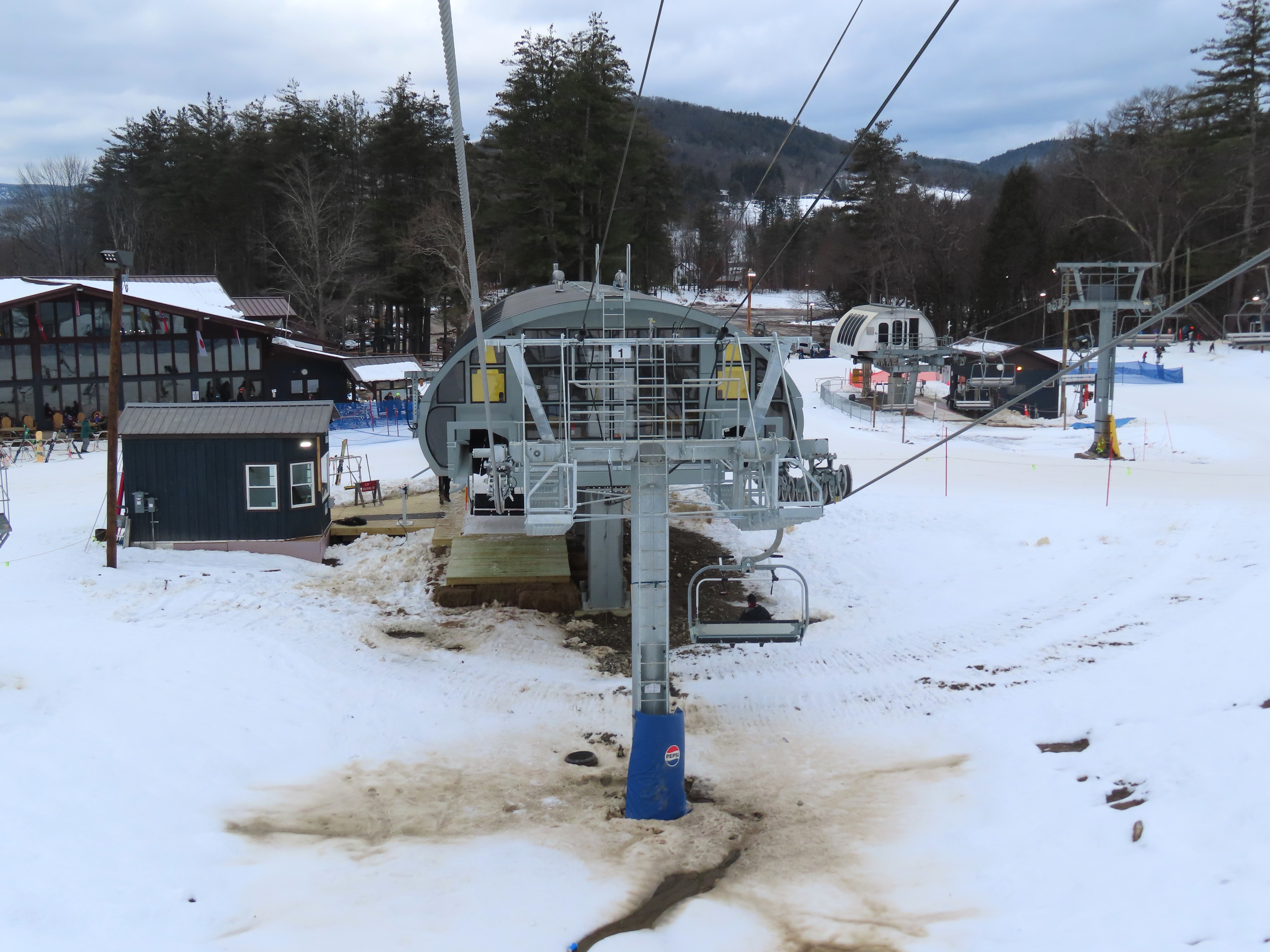
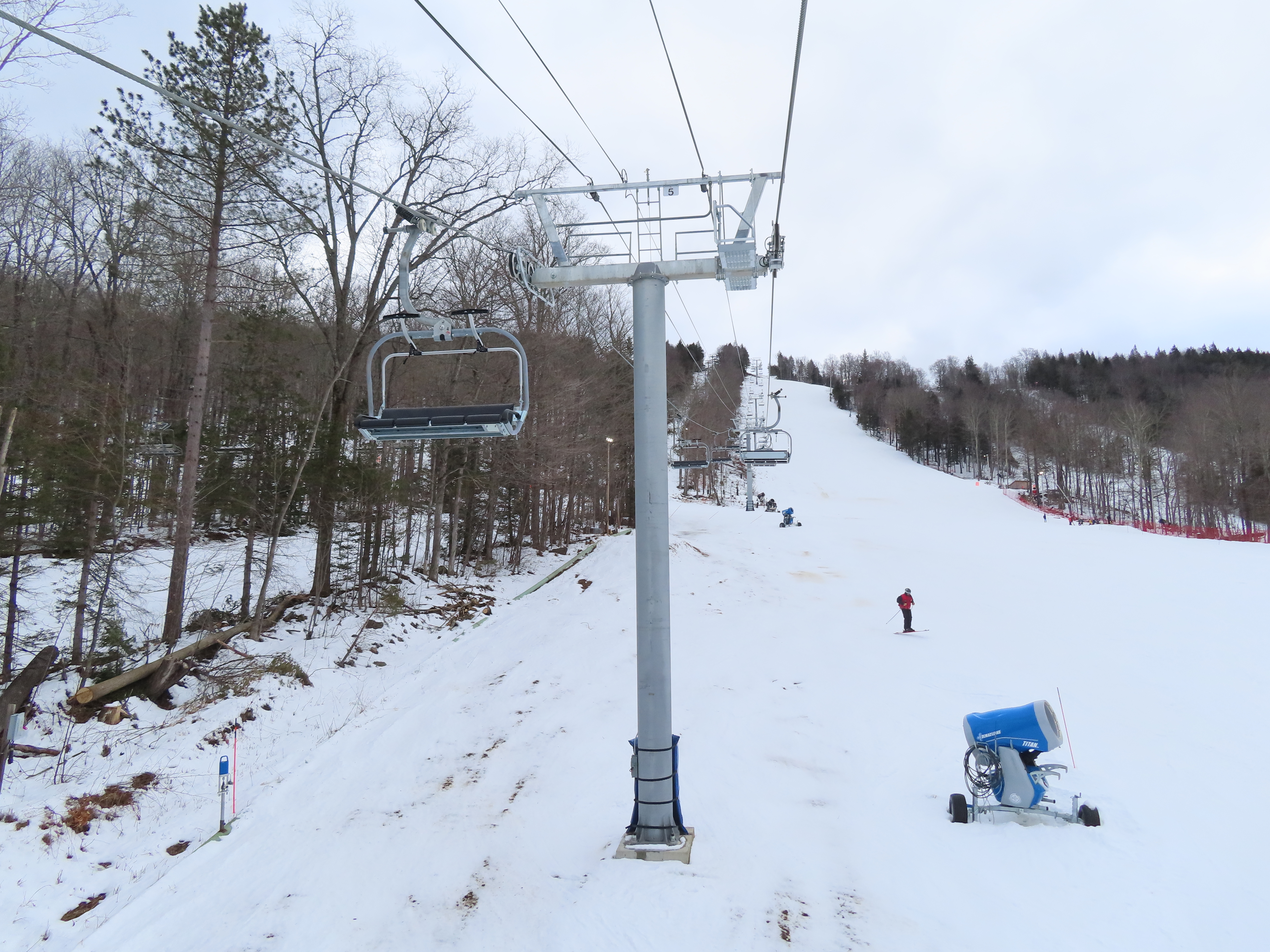
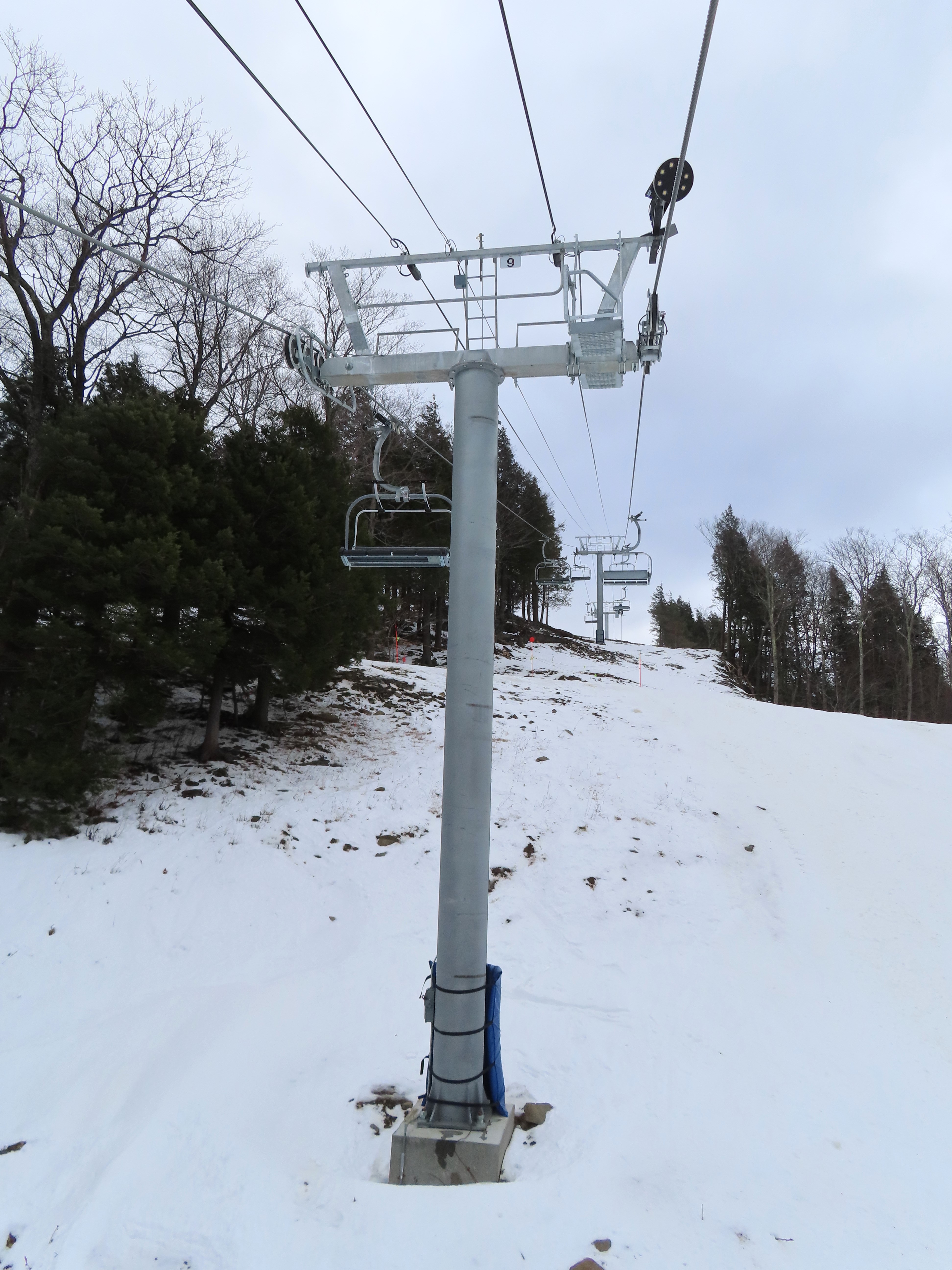
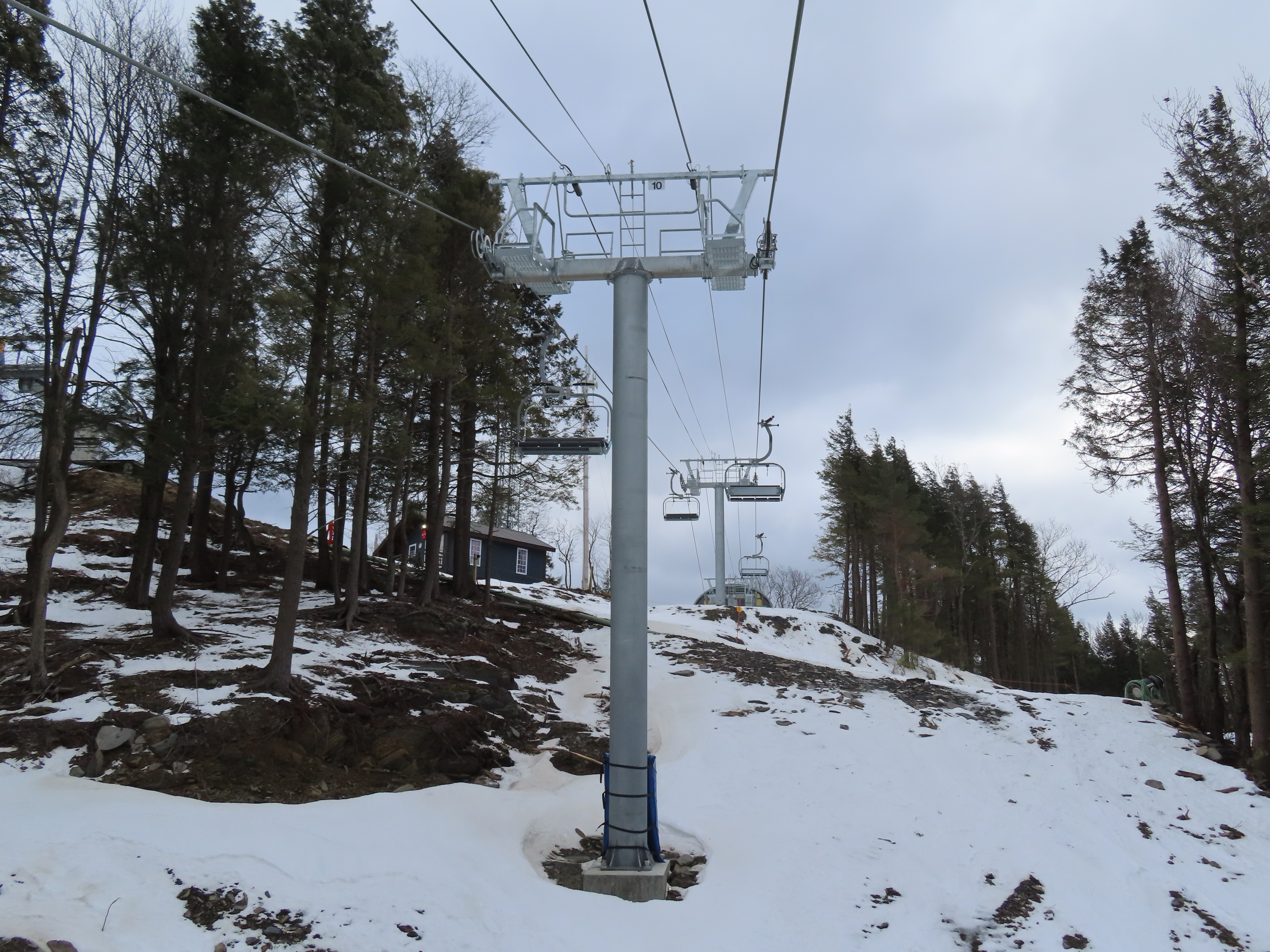
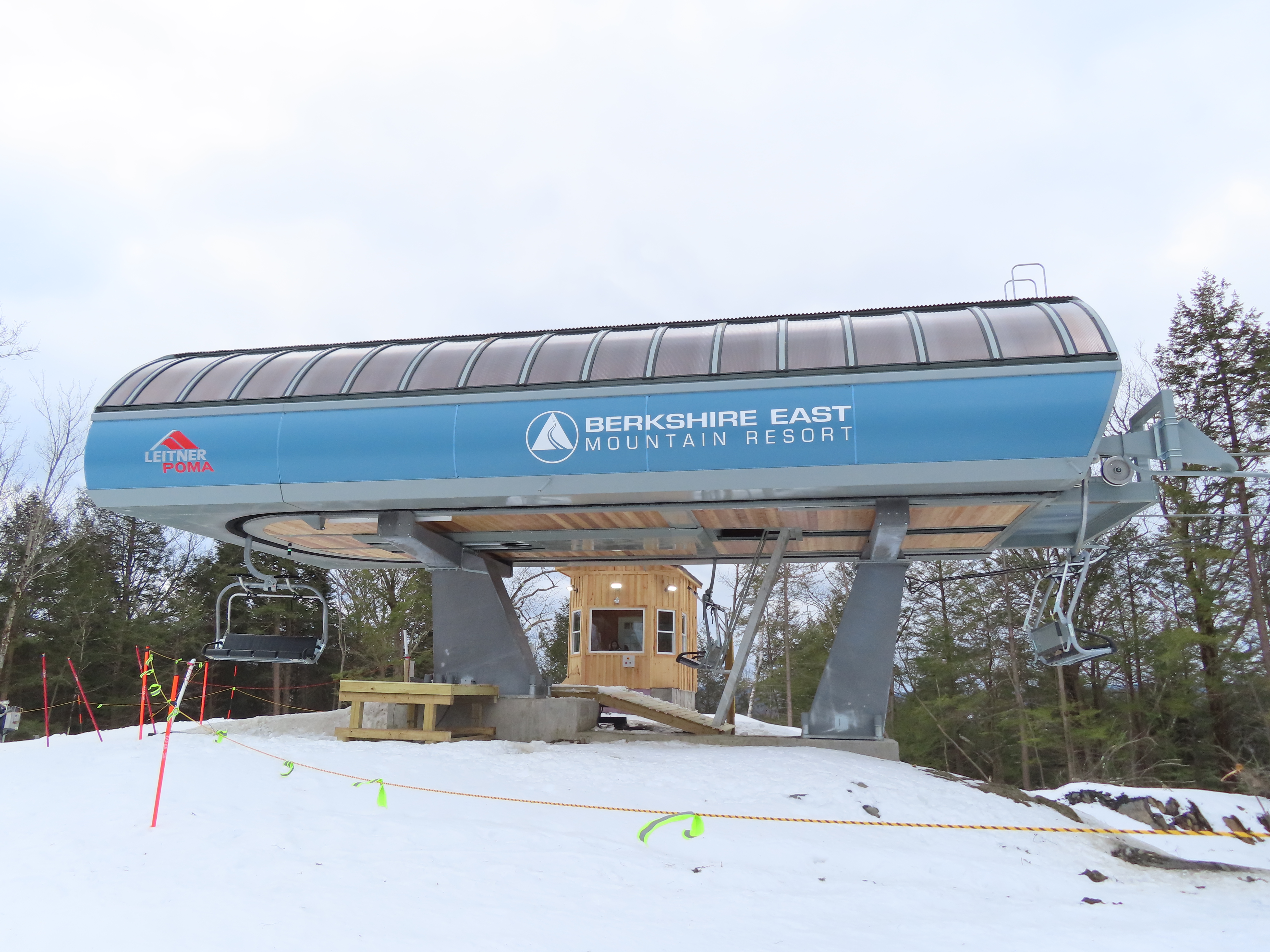
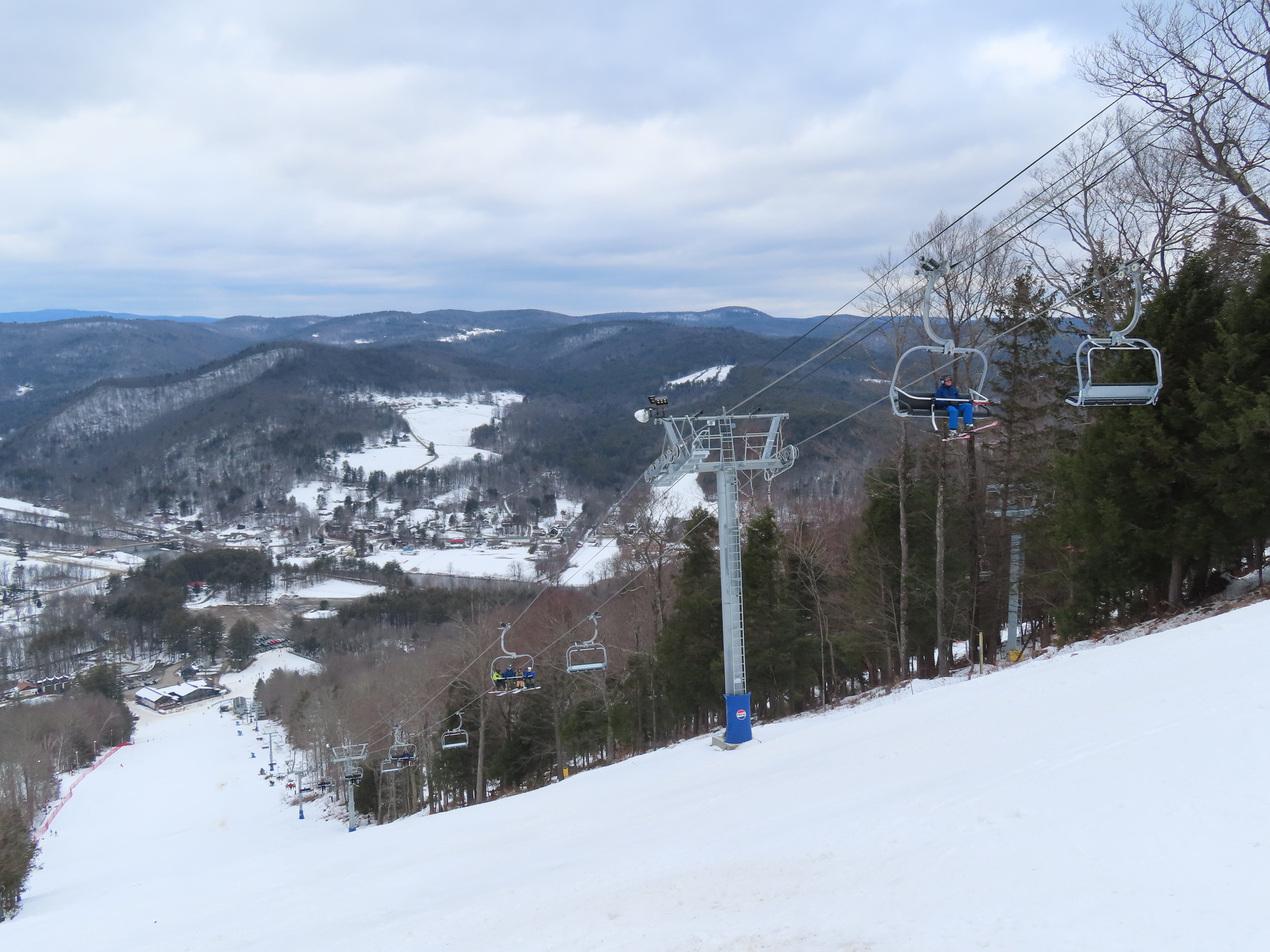
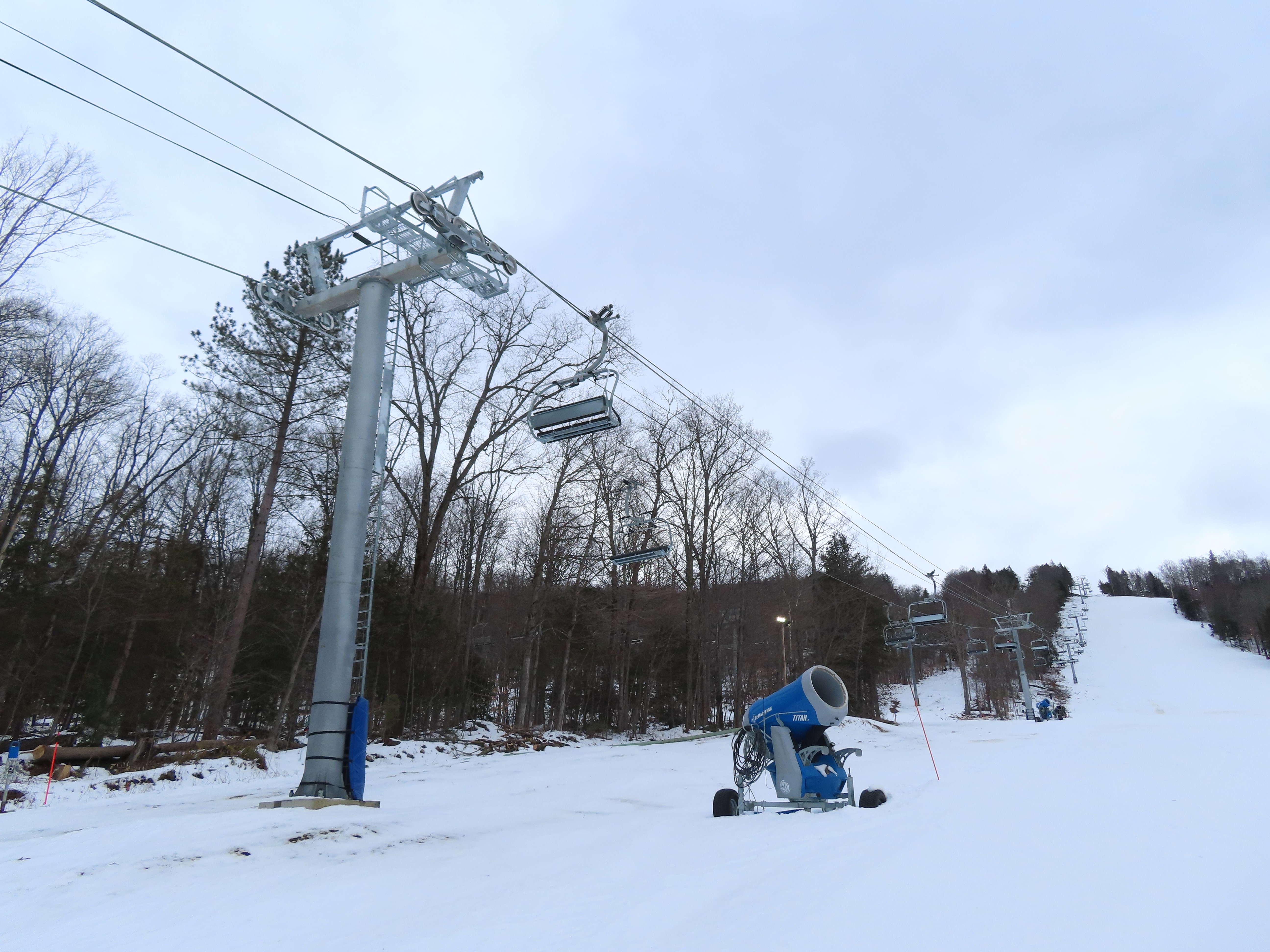
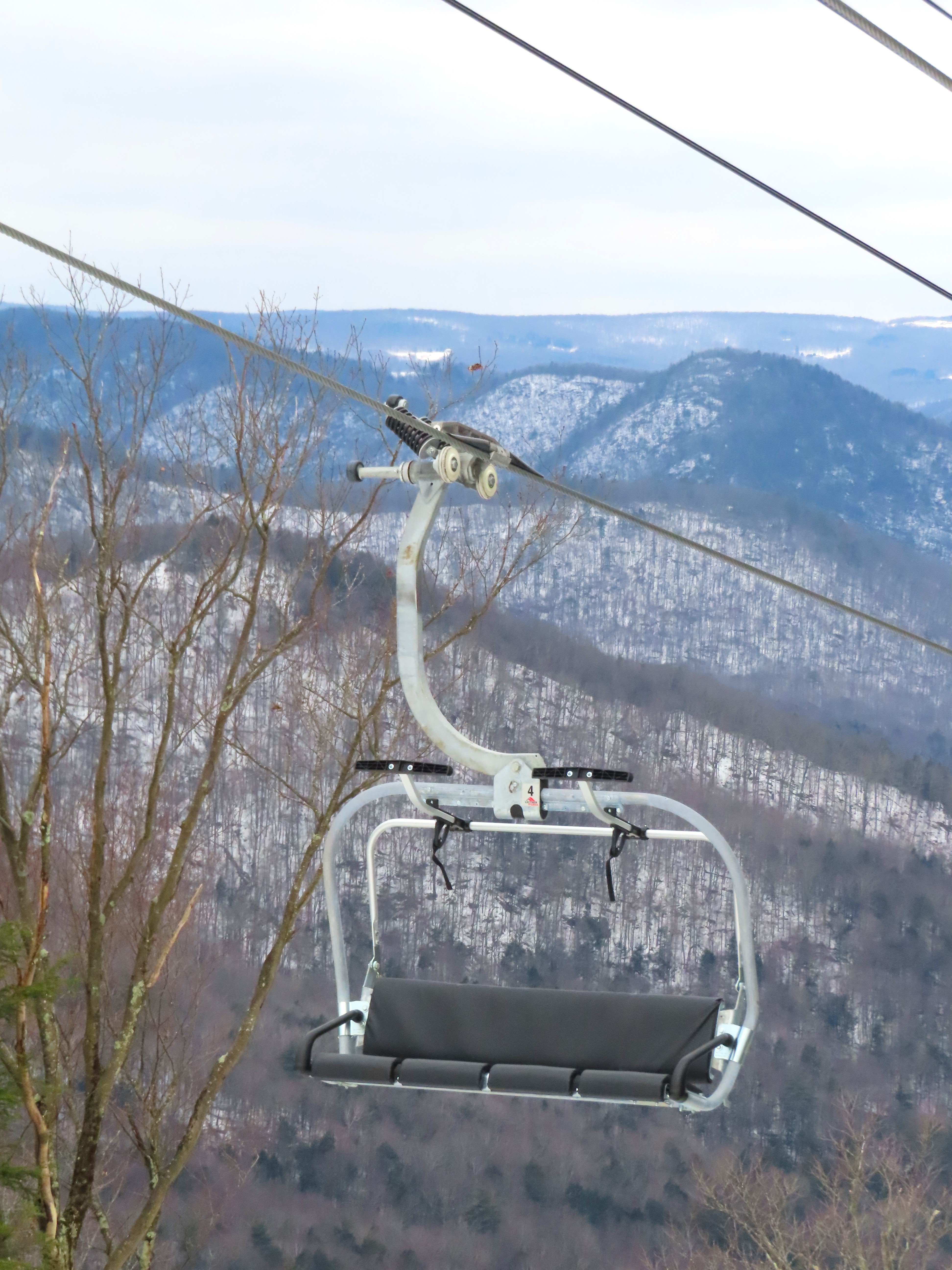
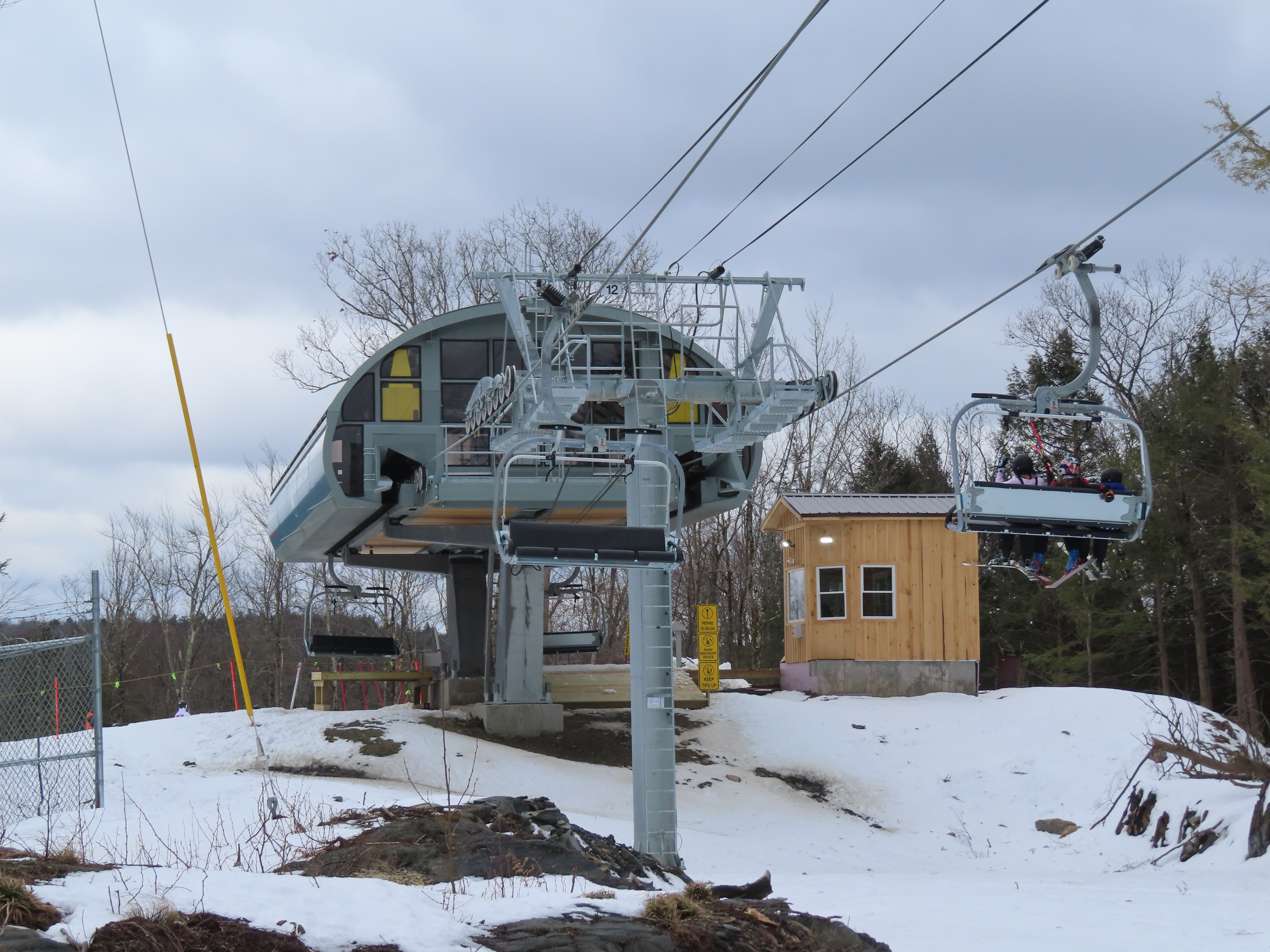
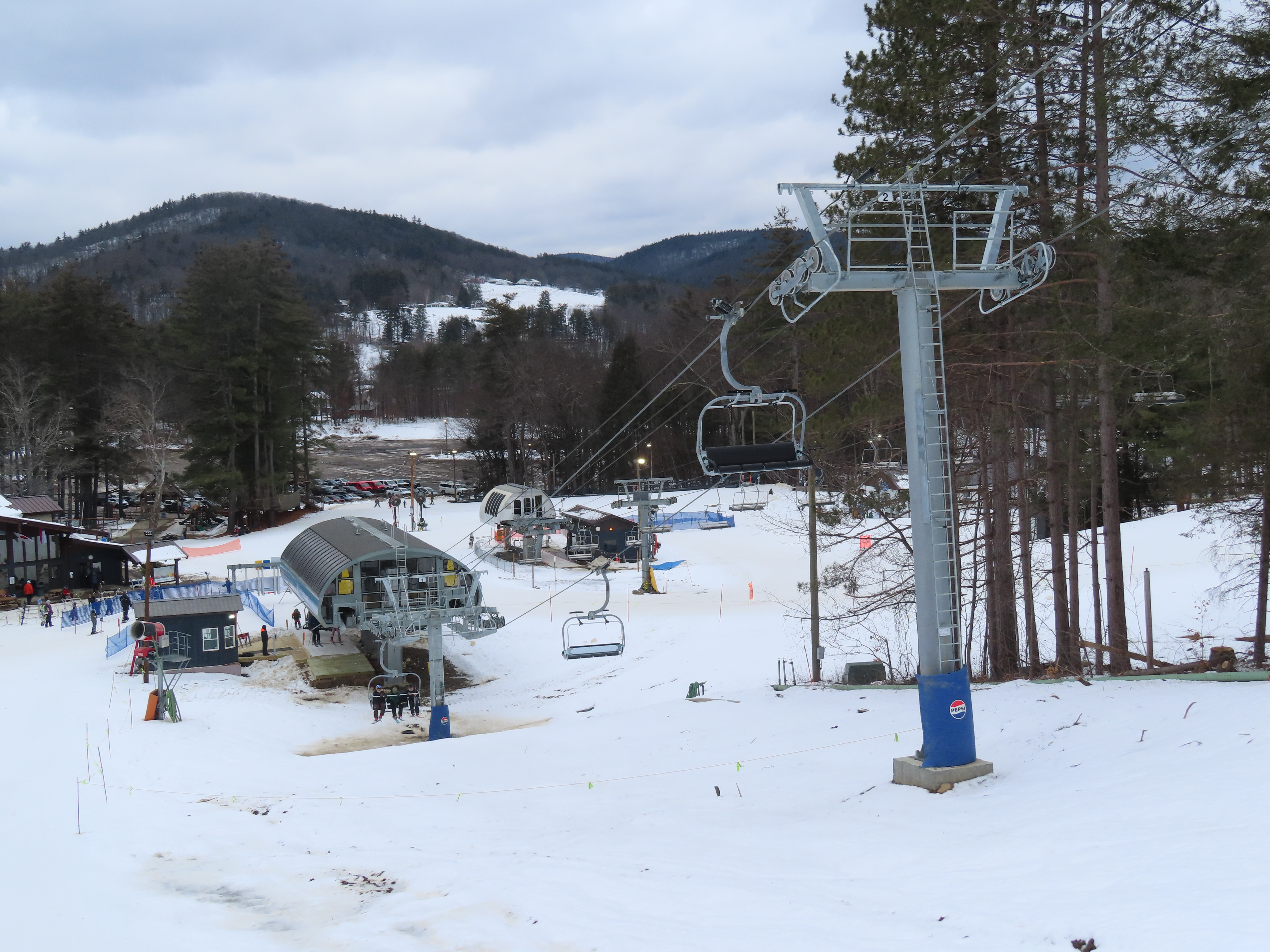
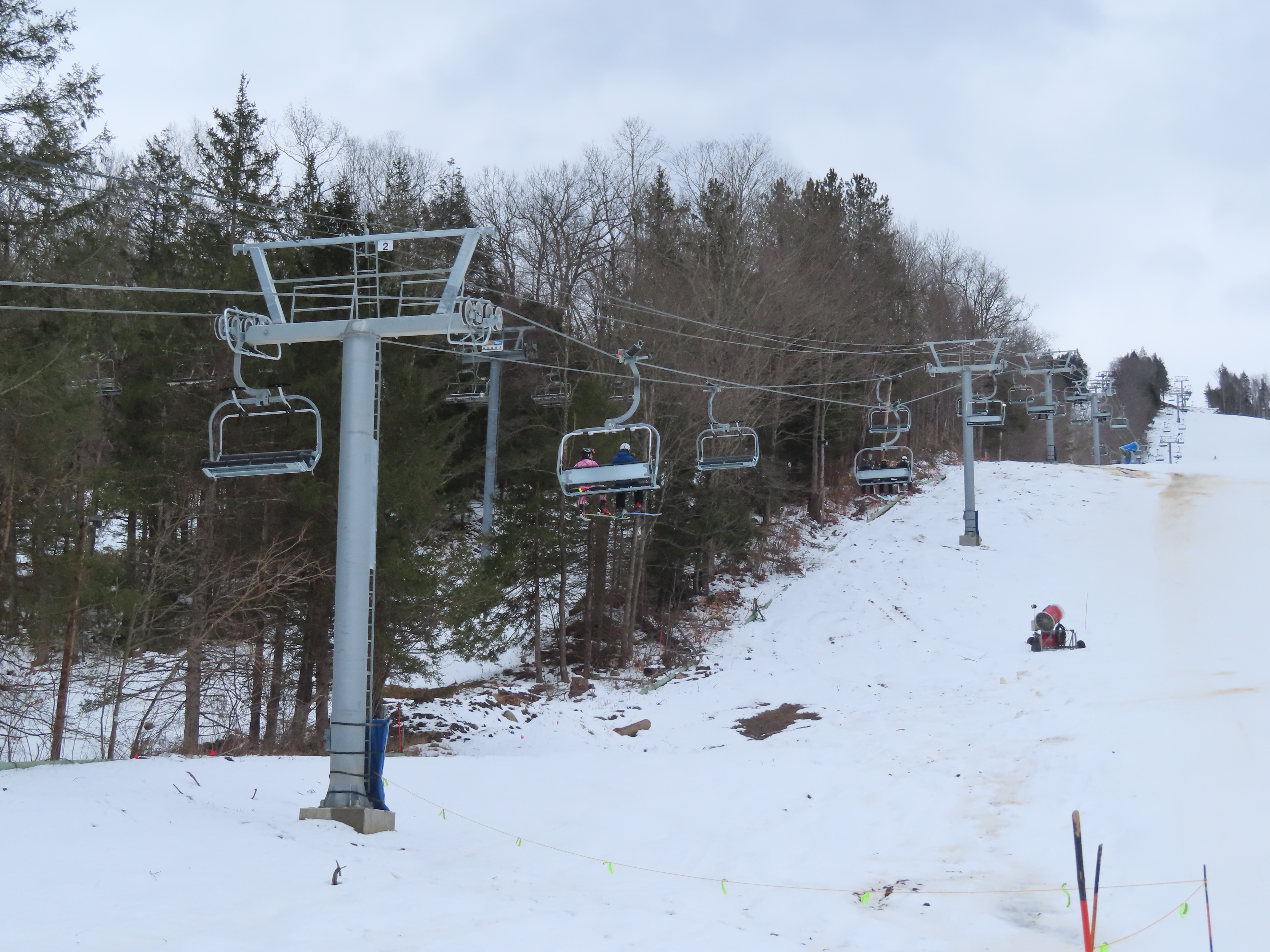
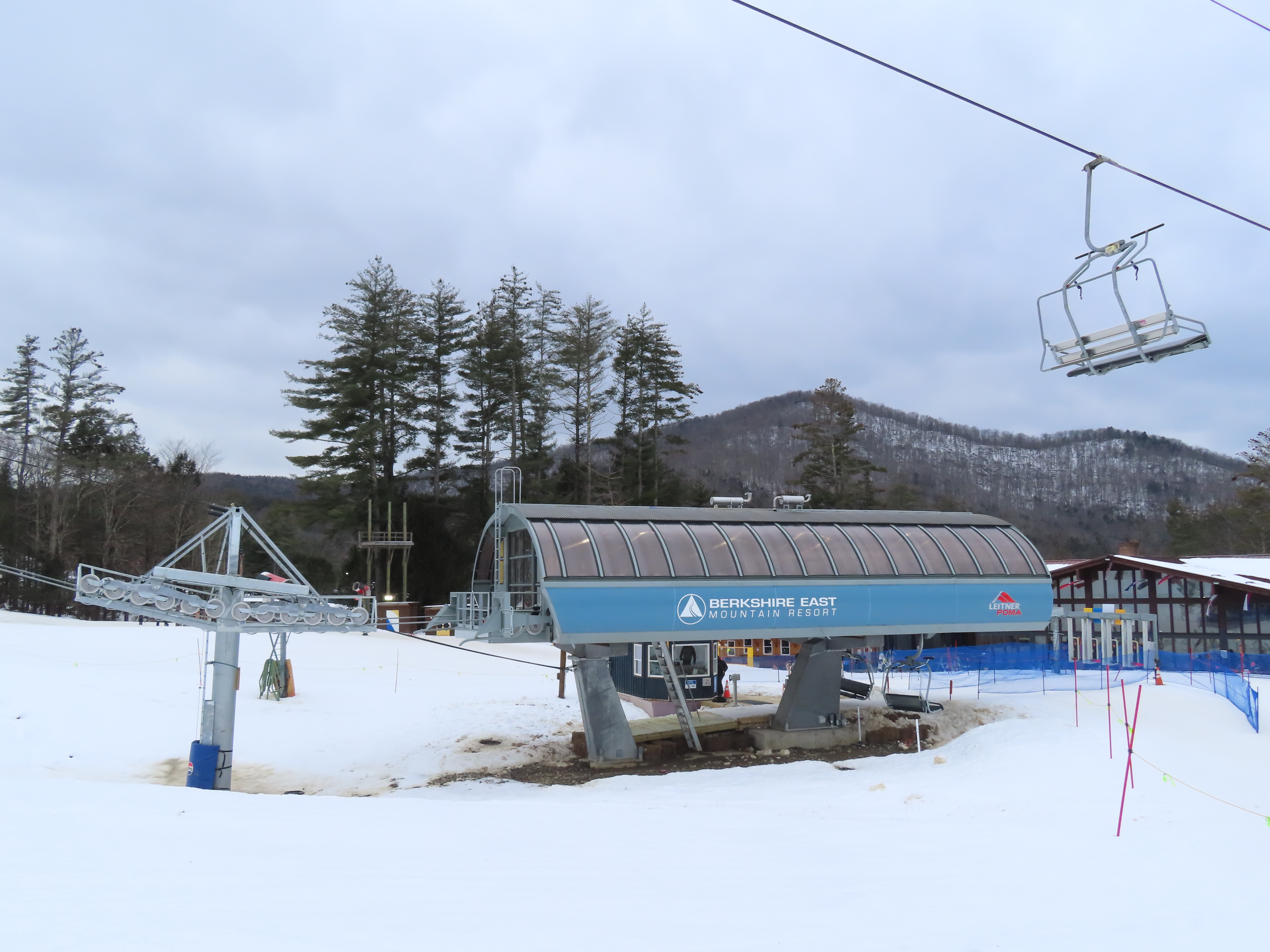
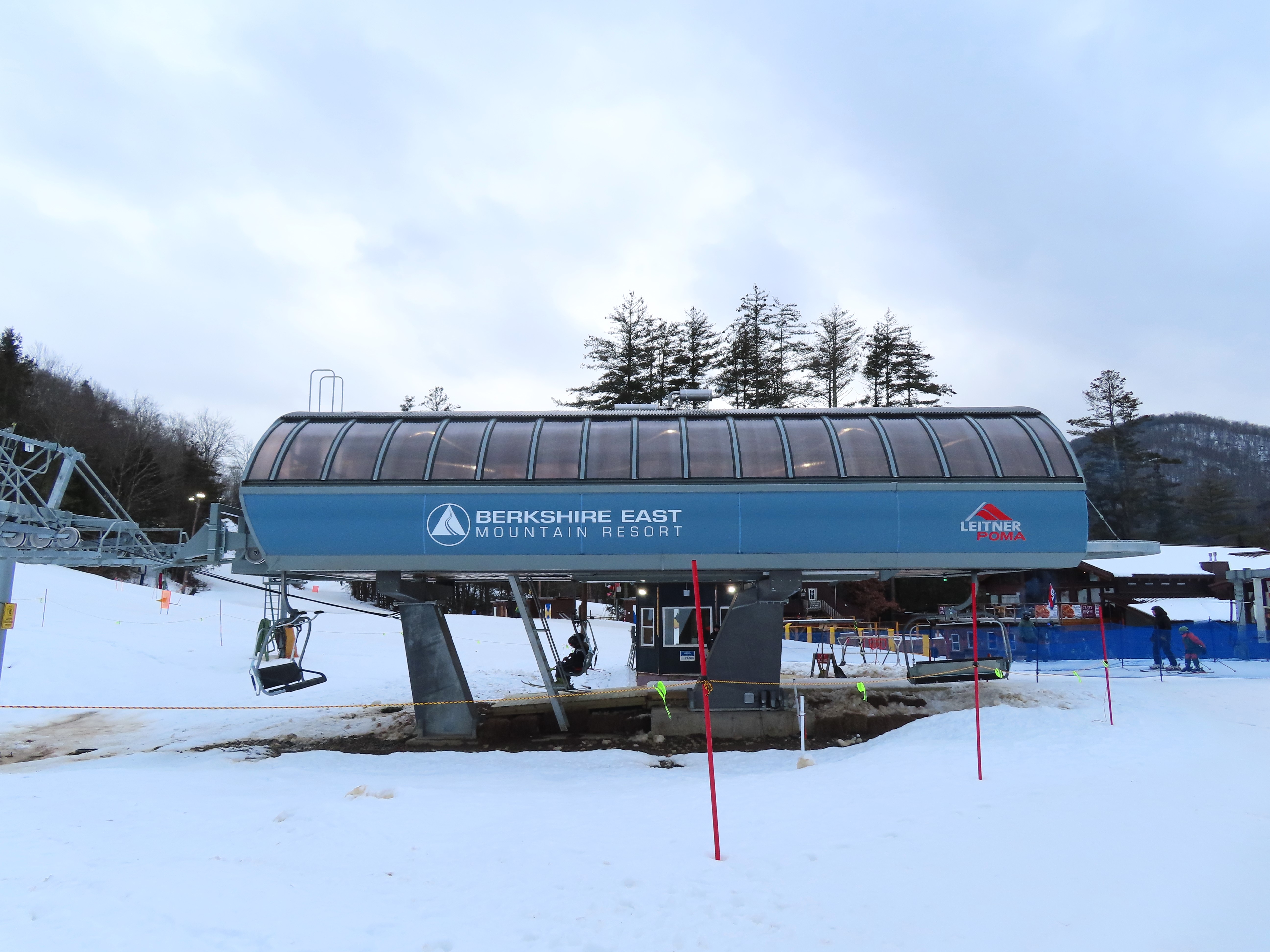
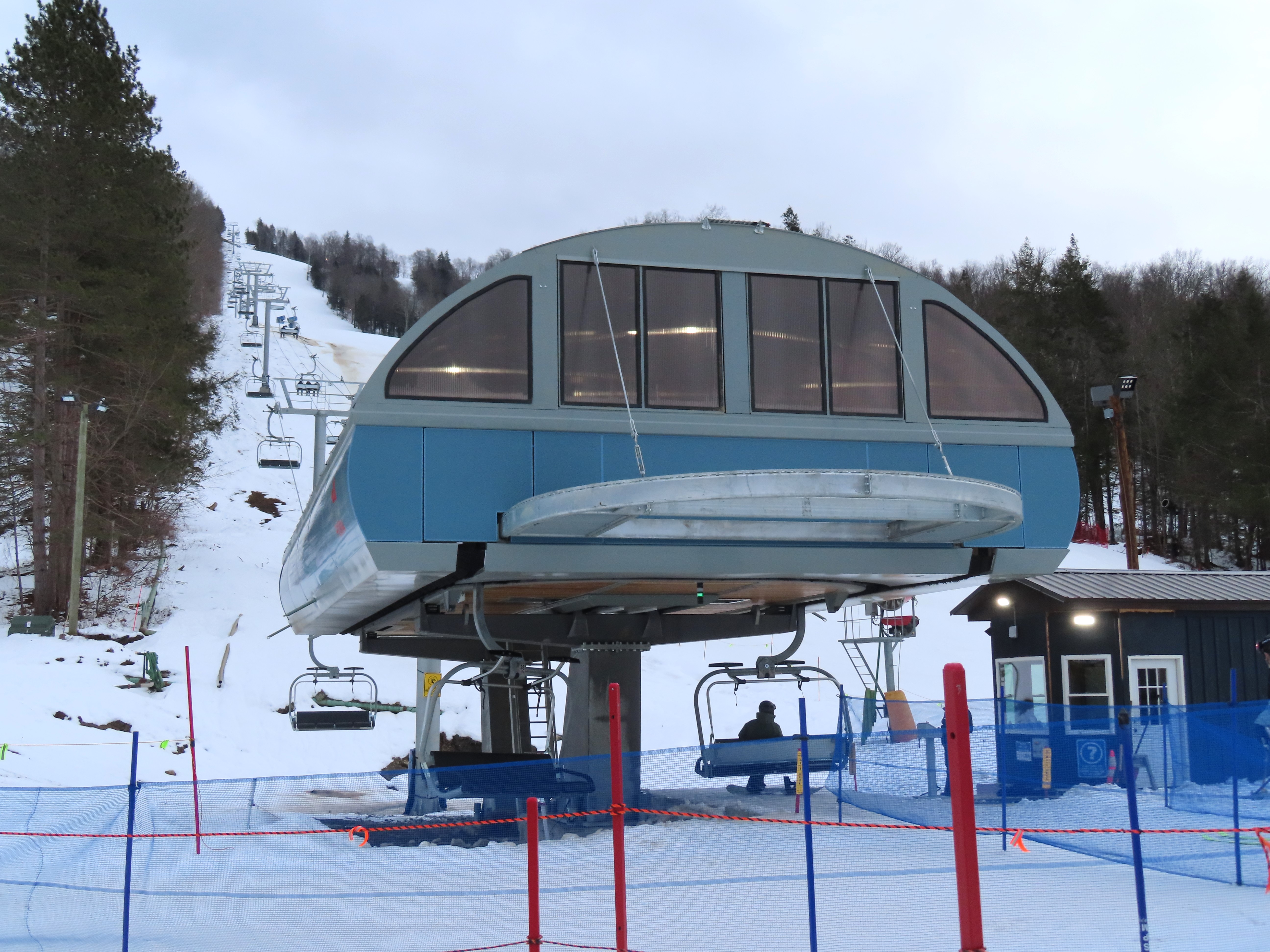
This is the first detachable lift at Berkshire East and runs approximately in the alignment of a former T-Bar.The bottom station sits in front of the main lodge near a parallel Skytrac quad.Leitner-Poma tower head and LPA chair.Riding up the middle section of the lift line.Upper lift line.Tower 9 with LED night lighting.Breakover towers 10 through 12.Unloading area on the summit.The lift briefly travels down on approach to the top terminal.LPA return station.View from the top.Steepest section of the lift line.Combo assemblies on tower 6.Upper half of the line.View down at tower 4.Chair 4.The top terminal and tower 12.Base area overview.View up at tower 2.Side view of the bottom station and tower 1.Like all lifts at Berkshire East, the T-Bar Express is a bottom drive.Loading area and lift line.
Some of the biggest funitel and monocable ropeways (especially fixed grips) are bottom drive.
There can be a noticeable difference in haul rope dynamics for a top vs. bottom drive (depending on the topographic profile, length of the largest span, and tension) but the tractive effort from the drive bull wheel against the haul rope is no less efficient under engineered tension.
Wouldn’t the higher tension required for bottom-drive lifts mean a bit more friction in the system? That’s the explanation I’ve seen mentioned, but I’m definitely not an expert. Maybe this is also something that was more pronounced in older lifts.
From my understanding, it’s somewhere near that .. but the gap has closed with better gearboxes, better hydraulic tension systems, and the general improvement of prime mover motors.
And those better components deal with the 5-10% efficiency loss so easily, there’s almost always a bigger and more relevant factor that determines top vs bottom drive. 5ish percent of pure friction calculated “efficiency” doesn’t translate to a 5% decrease in energy cost either. That 5% might be spread out amongst slightly worse wear and tear on a number of components, shouldering the entire loss with something like .3% per part. So the end actual energy use difference is a fraction of a percent.
If a lift costs $5k/season more to run cuz it’s bottom drive, but it lets you have a more reliable setup near an electrical source, the uptime is gonna bring you more than that $5k. Or the cost to electrify a remote summit.
The naming here is really to the next level. For sure the most creative I’ve seen! Props to the Berkshire East team for creating such a clever play on words here. Simple, pure genius.








 Lift Blog
Is there a specific benefit to having a top drive vs bottom drive? Or is it just where electric connections and whatnot are easier?
LikeLike
Ease of access to an electrical service is a big cost consideration. As for the operability, it’s sixes either way, even on big lift profiles.
LikeLike
I thought I read once that top drives are more efficient? but obviously access to electrical is the big one.
LikeLike
Some of the biggest funitel and monocable ropeways (especially fixed grips) are bottom drive.
There can be a noticeable difference in haul rope dynamics for a top vs. bottom drive (depending on the topographic profile, length of the largest span, and tension) but the tractive effort from the drive bull wheel against the haul rope is no less efficient under engineered tension.
LikeLike
Wouldn’t the higher tension required for bottom-drive lifts mean a bit more friction in the system? That’s the explanation I’ve seen mentioned, but I’m definitely not an expert. Maybe this is also something that was more pronounced in older lifts.
LikeLike
Top drives are about 10% more efficient, according to a mechanic at Loon.
LikeLike
From my understanding, it’s somewhere near that .. but the gap has closed with better gearboxes, better hydraulic tension systems, and the general improvement of prime mover motors.
And those better components deal with the 5-10% efficiency loss so easily, there’s almost always a bigger and more relevant factor that determines top vs bottom drive. 5ish percent of pure friction calculated “efficiency” doesn’t translate to a 5% decrease in energy cost either. That 5% might be spread out amongst slightly worse wear and tear on a number of components, shouldering the entire loss with something like .3% per part. So the end actual energy use difference is a fraction of a percent.
If a lift costs $5k/season more to run cuz it’s bottom drive, but it lets you have a more reliable setup near an electrical source, the uptime is gonna bring you more than that $5k. Or the cost to electrify a remote summit.
LikeLiked by 1 person
The naming here is really to the next level. For sure the most creative I’ve seen! Props to the Berkshire East team for creating such a clever play on words here. Simple, pure genius.
LikeLike
What play on words?
LikeLike
This along with the Mountaineer at Attitash are the first two high speed quads on the east coast to feature the European LPA quad chairs
LikeLike
I wonder how many people take Summit now that this is here.
LikeLike