
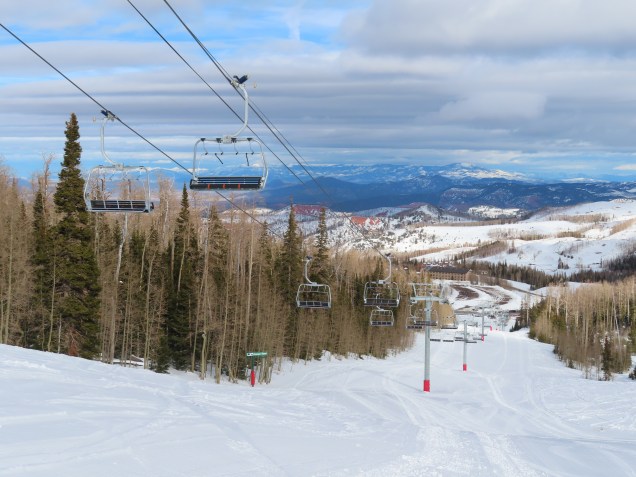
Southern Utah’s Brian Head Resort would quadruple in size under a sprawling vision detailed today by the Forest Service. The complex expansion would encompass 1,651 acres of the Dixie National Forest along with thousands of acres of private land owned by Brian Head Resort and third party developer Aspen Meadows. The expanded ski area would also include lands owned by the State of Utah and Brian Head Town. All told, the vision could see 26 new lifts, more than 382 acres of new cut trails, 19 miles of new snowmaking lines, 15 miles of new roads and four new on-mountain restaurants. Brian Head’s Comfortable Carrying Capacity would more than triple from 4,330 guests today to 13,250. The resort says the project would accommodate a growing demand for outdoor recreation in Utah, enhance learning progression, provide connectivity between base portals and improve the overall guest experience.

Brian Head was acquired in 2019 by Mountain Capital Partners, the fast-growing collective of 13 ski areas in the Western United States and South America helmed by James Coleman. Coleman’s ambitious plan for Brian Head is not completely new as adjacent developer Aspen Meadows proposed eight of the lifts on 850 acres of private land back in 2023. Many of the lifts proposed on public land were included in Brian Head’s 2023 Master Development Plan.

Of the 26 lifts now proposed, ten would be located entirely on Forest Service land, four would straddle private and USFS lands and 12 would occupy entirely private land. Within the existing ski area, Roulette would be replaced with a high speed quad and extended to load lower on the mountain. All other existing lifts would remain. A surface tow is proposed near the existing Alpen Glow triple to serve four new trails. Higher up on the mountain, three new lifts are planned on 11,310′ foot Brian Head Peak. These would include a 4,340′ detachable quad called Dragon’s Back and a 1,400 foot jig-back tram called Peak.

In the Sid’s Peak to East Ridge expansion pod, Brian Head aims to manage hazard trees and vegetation in areas impacted by the 2017 Brian Head Fire. Five lifts in this pod would service some of Brian Head’s most advanced terrain. The longest, dubbed Summit, would be a detachable quad spanning 7,425 feet. Four other lifts in this zone would be fixed grip triples extending between 999 and 3,120 feet.

A third pod called Navajo Ridge to Dry Lakes would include four lifts ranging from surface tow to detachable quad. These installations would run near the existing Navajo Express and stretch between 558 and 4,887 feet. They would operate on public land within the Dixie National Forest and require a Special Use Permit boundary adjustment.

Finally is the Aspen Meadows to Highway 143 pod with a substantial new day skier portal called Art Village. This pod, located on private land, would include an eight passenger pulse gondola linking to Brian Head’s existing Navajo base. From Art Village, skiers could connect to numerous lifts including four conveyors, six fixed triples and a detachable quad called Long Meadows. The Forest Service notes construction on this pod could begin before or concurrent with projects on public land as it is not subject to the EIS.

If this expansion was constructed as envisioned, it would create a unique opportunity to ski 360 degrees around a huge area in either direction along numerous different aspects. “Certain new lifts and associated ski runs would play an integral role in creating a circuit of resort skiing around a base village currently unparalleled in North America,” the plan exclaims.


The Forest Service notes portions of the proposal on public and adjacent land will undergo its most stringent level of environmental review – an Environmental Impact Statement (EIS). Even with today’s potentially favorable regulatory climate, the review is expected to take at least three years.

At a high level, Mountain Capital Partners has shown an incredible fortitude for acquiring ski areas and dreaming up big plans. Just last week, MCP announced its intent to become the controlling shareholder of four more ski areas in Chile, bringing its total mountain count to 17. Since 2015, the company has invested more than $125 million in improvements across its growing portfolio, including new detachable lifts at Nordic Valley and Arizona Snowbowl. Last year, the company debuted a modest new Skytrac at Arizona Snowbowl and this year MCP plans new lifts at Purgatory and Sipapu, both of which are fixed grip and contain parts from older lifts. Despite its success, Mountain Capital Partners’ ambition has not always been met with realized capital projects. A similarly massive expansion plan for Nordic Valley involving public land announced in 2018 went nowhere with the Forest Service.
At Brian Head, three public open houses are planned during the initial scoping period to solicit public feedback. They are:
- Tuesday, July 29, 2025 — Brian Head Lodge, 314 W Hunter Ridge Dr, Brian Head, UT
- Wednesday, July 30, 2025 — Parowan City Office, 35 E 100 N, Parowan, UT
- Thursday, July 31, 2025 — Southern Utah University, Brian Head Room (Sharwan Smith Center), Cedar City, UT
All three will run from 6:00 to 8:00 pm.
 Lift Blog
this BrianHead advertisement is complete nonsense. That is not an area where this will happen, and if it does it’s not because of the skiing that’s for certain. This is the same old pitch we’ve always had for the last 75 years of RESORT developers. This is the pinnacle of greed and nonsense. Go to a roulette wheel, your returns will be better astonishingly.
LikeLike
Aspen Meadows is already under construction. This entire development plan was designed to be spread over 20-30 years as well.
Will all of this happen? Probably not, but a good chunk certainly will.
LikeLike
26 new lifts some of which are very long, most of which are fantasy.
LikeLike
Yeah, I see this one as pretty pipe-dreamy, maybe even bordering on a fantasy map. No doubt it would be a really unique experience if built out, but the terrain isn’t exactly spectacular and seems to be more geared toward real estate, which makes it hard to imagine playing out as designed.
LikeLike
Does this remind anyone of Deer Valley? What is all the resort development in Utah.
LikeLiked by 1 person
More people than ever want to ski. Also, as some regions are started to see less reliable snowfall, more are shelling out to visit UT. Hence the major developments: more people=more $$
LikeLike
It just seems like there is little environmental regulations for all of this and an insane urge to develop lodging and villages, which seems a bit much.
LikeLiked by 1 person
Regarding the actual environmental impact of this plan, much of the proposed expansion is national forest land that burned down in a fire 10 years ago, proper trail maintenance and tree planting can actually go a long way towards restoring this habitat. Alta is a great example of this approach, look at pictures of the place in the early 1900s when the whole thing was strip-mined bare, it took skiers planting trees to make it the terrain it is today. There’s also a recent storm skiing podcast interviewing SE group talking about how they balance ski area development with open space and trail development working around sensitive areas like aspen groves, I’d recommend giving it a listen!
This is tangential to your point, but the Vertical Integration of American ski areas is what forces them to yoke any and all resort infrastructure improvements to real estate sales. Compare that to the European approach where the ski area is tasked with running the lifts, grooming / snowmaking, and maybe a handful of food / rental options. The vast VAST majority of operations like lodging, rentals, ski school, on-mountain dining, etc… are run by dozens of private entities ranging from local farmers running on-mountain lodges to ski schools teaching local kids for cheap.
That is the nature of European ski areas of where the ski area grew organically out of the local town, rather than the town (re: real estate value) only making it after the ski area was built. Yes that cuts off significant revenue streams for the ski lift operator, but it also gets very expensive, labor intensive operations like staffing a lodge or paying for ski school insurance off their plate. That means Ski Area Revenue (tickets and passes) goes to paying for the actual lift / snow operations and the millions of CapEx needed to keep a modern ski area going with the best snowmaking / lifts / grooming / etc…
LikeLiked by 2 people
I think it’s more the case that some American ski operators are really just real estate developers with a ski area thrown in as an amenity. Examples of this go back decades such as diamond peak in nevada. Deer valley is the most prominent example and now it’s become the norm at places like wasatch ranch and now Brianhead. I think it’s indicative of Utah’s light regulatory touch that most of these examples are happening in that state. It’s also instructive that the conditions for a successful real estate development and a ski area aren’t always in alignment but the real estate wins out resulting in strange and subpar ski terrain that serious skiers would typically avoid. You’re correct that in Europe the ski operator is solely focused on the mountain experience. Real estate sales are a complete afterthought in the alps. Alpine ski resort operators just want to cover their costs so that tourists spend loads of money in town.
LikeLiked by 1 person
European ski resorts often receive public subsidies (varying from tax breaks to direct payments) for new infrastructure, which includes expensive snowmaking systems and lifts. This allows their actual CapEx to be a lot lower. American ski resorts rarely receive these subsidies, so many have used real estate to generate the necessary revenue to cover a higher CapEx.
As for insurance, its worth remembering that liability laws in Europe are different such that their insurance costs are typically only 33-50% of what their American ski resorts peers pay.
LikeLike
Agreed. Glad to see that skiing is thriving, but the majority of these massive expansions aren’t skiing-forward. Watching the crazy buildup in the Mayflower expansion area at DV has been sad. The mountainside went from pristine to having a 20-story mega hotel in a matter of months. That isn’t what skiing is about.
As MammothBot89 pointed out, some resorts, like Alta, have a more symbiotic relationship with the land they use—not every resort is Deer Valley-but Alta wasn’t thrown together in a massive, capital-heavy expansion over a couple years, it was thoughtfully built and developed over decades. Really big, really fast isn’t sustainable without selling off real estate to pay for it, it seems.
LikeLike
Yes, surely the conclusion you should be taking away from the article, which explicitly mentioned that Brian Head is going to have to go through the costly, stringent and years-long EIS process, is that there isn’t enough environmental regulation at play here.
LikeLike
I’m just pointing out that no matter the environment process, no ski resort should be expanding in such ways just for selling condos.
LikeLiked by 1 person
I’m sure all of those concerns will be fully evaluated in the extensive EIS process. And I’ll leave it to the market to decide whether a ski resort should be investing in real estate development on private land they own.
LikeLike
The Utah expansions such as deer valley aren’t exactly snowsure. That’s why they’re installing hundreds of snow guns. These expansions are just about selling homesites and condos
LikeLiked by 1 person
Las Vegas/St. George have grown exponentially in recent decades, and ski capacity certainly hasn’t kept up, so there is plenty of demand for the terrain. And the PowerPass has this ski market locked up. It’s a reasonable drive from Phoenix (another major PowerPass market), and there’s also nonstop flights from Phoenix to St. George.
The real estate… harder to say. Certainly much will sell, but it’ll have a lot to do with pricing. I hope they aim for actually building these into villages where ordinary people can afford to live and work (a big market), rather than just second homes for the uber-rich.
MCP is definitely a ski operator first and foremost, and this is about as snow-sure a spot as you can find for US ski expansion (although that snowmaking will be crucial for the financially-important November/December business). And while it’s not Alta/Snowbird or Mammoth… nowhere else is either. It also is definitely NOT Mayflower/Deer Valley. This can be a great addition to the ski universe, and I’m surprised by the level of negativity in this thread.
LikeLike