

Several Doppelmayr construction employees escaped injury in Big Sky today when a crossarm fell from a helicopter and crashed to the ground. The Boeing CH-47 Chinook and its crew, working to assemble towers for Madison 8, were also unharmed. “During construction of the Madison 8 chairlift, a cross arm assembly fell during installation due to a rigging failure,” said a Big Sky Resort spokesperson in a statement. “Fortunately, there were no injuries, and the flight teams were able to resume operations shortly after the incident.” The helicopter is owned and operated by PJ Helicopters of California.
It was not immediately clear whether the mishap would delay opening of Madison 8, set to become the longest eight seat chairlift in the world this winter. Doppelmayr typically manufactures crossarms for its largest D-Line chairlifts in Austria and ships them to the United States via ocean container. “The resort is working with our partners at Doppelmayr to mitigate any construction delays, and both organizations are optimistic that the impacts are minimal,” said Big Sky’s statement.
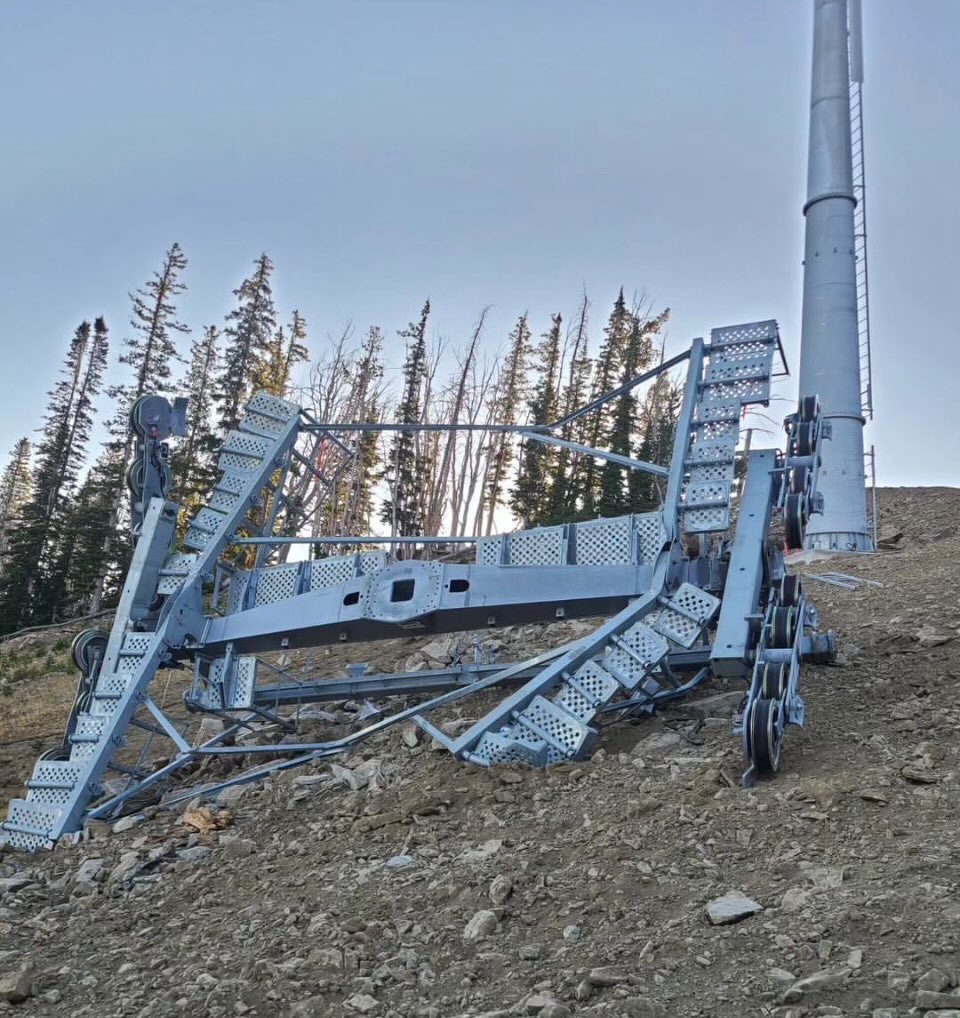
Rigging failures and helicopter incidents, though rare, have happened before during lift installations. In 2022, a helicopter pilot setting a lift at Cypress Mountain, British Columbia, jettisoned a tower in thick fog. The same year, crane rigging failed during installation of one of Snowbird’s new tram cars, destroying it. In both cases, Doppelmayr manufactured new equipment to replace what was dropped.
 Lift Blog
Glad everyone is ok. Definitely not ideal to have something like this go wrong on a project with this tight of a timeline.
Tram was 2 years, Gondola will be 3, SC6 was 2, R8 was done in one summer but it’s far shorter. I thought this project was overly ambitious if nothing went wrong.
LikeLike
Expensive Fail!!
Humor aside, is the crossarm damaged beyond repair? Can it get re-hoisted back into its intended place?
LikeLike
From the video it looks like it got pretty mangled when it hit the ground
LikeLike
It looks trashed. The individual sheaves might be salvageable, but the main crossarm appears to bend as it lands and the rest of it is probably bent beyond usability.
It’s interesting because the sling appears to start coming apart just as the pilot sets the crossarm on the flange on the tower. Very lucky that none of the folks on the ladder were hit..
LikeLike
Very unfortunate indeed. We will have to see if this will cause any major opening delays, it is possible an entirely new crossarm might be fabricated.
LikeLiked by 1 person
i’d imagine a new crossarm will likely have to be manufactured. that’s a very expensive mistake i wouldn’t be surprised if it delays the opening of Madison 8
LikeLike
Agreed, especially if the new crossarm needs to be shipped from Austria. That’s gonna take time.
The bigger picture problem is that without Madison 8, operating the entire former Moonlight terrain is impossible. It is the only lift serving a massive amount of terrain. There also wouldn’t be any lift service for Madison Base or any of the real estate over there. This is such a critical alignment to have any kind of delay, and would be an operational nightmare for Big Sky if the delay extends into ski season.
LikeLike
You bring up a great point. I wonder what Boyne is going to do now. I’d imagine Big Sky might put the project on hold until they can get a whole new tower head but until then all they can really do is finish the terminals and the terminal buildings.
LikeLike
the new cross arm will be fabed in the US and all the other parts also.
there will be no delay on opening the lift…
LikeLiked by 2 people
I don’t think it will be fabricated in the US. The shop in salt lake is mainly for fixed grip lifts no? so i would imagine that it’ll be fabricated in Canada
LikeLike
Aren’t D-Line parts only made in Austria?
LikeLike
Doppelmayr probably made an exception.
LikeLiked by 1 person
I’m glad no-one was hurt. Setting towers isn’t exactly the safest job in lift installation.
LikeLiked by 1 person
Me too, so glad everyone made it out safe. Definitively the most dangerous job on lift installations.
LikeLike
Some helicopter pilots won’t allow the use of nylon slings. They only use steel cables. That is the only way to do it with a chopper.. Nylon slings fail!
LikeLike
Understandable, towerheads are so heavy.
LikeLike
Agree, we had 23 picks with a Blackhawk 3 weeks ago. Used all wire rope slings.
LikeLike
WH2Oshredder- Nylon slings are absolutely up to the task, load-wise. We and many others use them all the time for their excellent weight-to-capacity. We have an assortment that are good to 80,000 pounds, for example. Where they aren’t great is that they’re much easier to damage during use, especially dynamic situations such as this.
Kirk- we still have half a dozen two-legged wire rope bridles from when we used to build lifts in house- we call them ‘helicopter slings’.
LikeLike
Close call for that guy next to the pickup truck
LikeLike
Is it standard procedure to fall to the ground like that when a tower falls? I would have just tried to run away
LikeLike
looks like he was diving below pickup, hoping arm would land on it and pickup would protect him.
LikeLike
My worst nightmare during my career in that business. Glad everyone is ok!
LikeLike
Update from Big Sky: “The resort is working with our partners at Doppelmayr to mitigate any construction delays, and both organizations are optimistic that the impacts are minimal.”
LikeLike
Thanks for the update Peter. I would like to see a Whistler Blackcomb update on Jersey to be completely honest. I haven’t heard/seen anything in a hot minute. Have you?
LikeLike
You can see the top station on the WB website webcams for Blackcomb.
https://player.brownrice.com/embed/whistlerblackcomb
Top station, operator shack and and grading look to be done and haul/comm ropes are on – no chairs (yet). I suspect they are just waiting on their Technical Safety BC inspection.
LikeLike
Theres a chair on the line being used for station setup, making sure the contours are ready and calibrated properly before the full line of grips/ chairs. Once that is done the rest of the chairs will be fed on and then ran for acceptance testing. The new chairs also have the traditional T foot rests, and not the pucks.
LikeLike
Load test/acceptance is scheduled for the end of October.
LikeLike
As a former professional lift mechanic at more than one ski area , and having been a journeyman Union Ironworker for more than twenty years I have but one question. Show me the rigging cards for the men who hooked up this load . In all reality , probably the only one with that knowledge is one general foreman on a large crew as non union lift companies ( All of Them ) currently offer sixteen dollars per hour to the entire lift construction staffs in all US markets to attract their ” talent” This is absolutely disgraceful to witness as a professional . Had the spreader strap on the right side went , the men attached by lanyards standing on the top rungs would have faired less favorably .Someone should kick someone’s @$$#&(*!?. Also most very importantly it is obvious that load needed a four strap spreader system not a two strap cradle that was waving ridiculously as it approached the landing .That alone is a clear OSHA Crime. Just that was scaring the crap out of the connectors watching and giving me the impression that my fellow lift peeps lives aren’t worth squat to these multi – billion corporations .
LikeLike
It is always dangerous to standby watching a several thousand pound helicopter delivery leaning on your truck , underneath the landing site , with no hardhat on ! WTF . That must be the General Foreman with the only certified riggers card on the job site . What are you people thinking about really ?
LikeLike
lf I was working on that crew and witnessed that it would be high time to call OSHA.
LikeLike
And for all my lift peeps who aren’t familiar with the term ” Riggers Card ” you need to quit your jobs immediately. You have been cheated from being gifted the credentials and informational tools to truly be a professional in your fields . That should be criminal , but is not .
LikeLike
Rigging Failure??
Most of us will probably never know but it would be interesting to know.
The sling appeared to pull apart like an old bungee cord that had been sitting in the Death Valley sun for 20 years?? I would hope that any other flying would be with brand new slings.
LikeLiked by 1 person
….
LikeLike
it’s very interesting to see all those union experts commenting on something they have absolutely no clue
LikeLike
You really don’t have to be an expert in anything to see that the sling pulled apart like silly string. If the sling was sized properly it should of had a built in safety factor of 5 to 1.
LikeLiked by 2 people
The unutilized sling protection that was clearly not employed is called a softener . Softeners are available for a variety of applications and the protect slings from being sliced by sharp edges on the steel and or pinch points that can shear them .Is there anyone else on this page ?
LikeLike
Anyone else, meaning maintenance/installation? Not many.
We have a variety of softeners in our rigging cage. Some are purpose-built, others pieces of Magic Carpet belting or old snowmaking hose. You’re absolutely right, they’re essential.
LikeLike
Ya sure your an expert lift builder .
LikeLike
I want to comment but I cannot, many members know why. The quick uninformed criticism of the crew is a bit insulting, yah lift builders don’t pay, we Fu$#en know it doesn’t make the people who build lifts idiots or incompetent. I have seen other videos and can attest that the single video shown here doesn’t capture the entire situation.
LikeLike
I think for 99% of us, the question is what caused the first sling to fail?? Seems like a simple question?? But we know in todays world everyone is scared to share that kind of information. Even though it would benefit others in the industry.
LikeLike
I’m not familiar with this blog. I do have some experience as a mechanical engineer, also crane operator. We had one close call at a refinery, no injuries. The oil industry is very concerned with any accidents. Whether they are near misses, lost time, serious or death. On any lift over operating equipment, The project engineer made the decision to have lift plans drawn for every lift. Showing lift weight, radius, shackle size, sling size, etc. Signed off by a registered P.E. Inspection records, etc. the safety factor behind all this was a qualified crew. The foreman had the authority to stop work at anytime for any safety concerns. Safety meetings before every shift. That’s how projects get completed safely and on time.
Al
LikeLike