North America’s Declining Lift Industry

I thought it would be interesting to do a statistical analysis of the types of lifts built over time in the US and Canada and see what lifts tend to still be operating today.  I previously looked at the average age of lifts in different regions of the US and Canada and found that most lifts operating today are more than 25 years old.  The statistics below will show why.

Fixed Grip Chairlifts Built by Type, 1958-2014

First I looked at fixed-grip chairlifts.  I was surprised just how long ago double chairlift construction peaked – way back in 1971, when 146 double lifts were built in a single summer.  That’s equal to all lifts built in North America over the past five years.  Triple chairlift construction peaked in 1984 at 58.  Just four years later, the most quad chairlifts were built – 36 in 1988.  I would have guessed this to be much later.  Since 1988, quad and triple chair construction has remained relatively constant and equal with almost no double chairs built.
Detachable Lifts Built by Type, 1963-2014

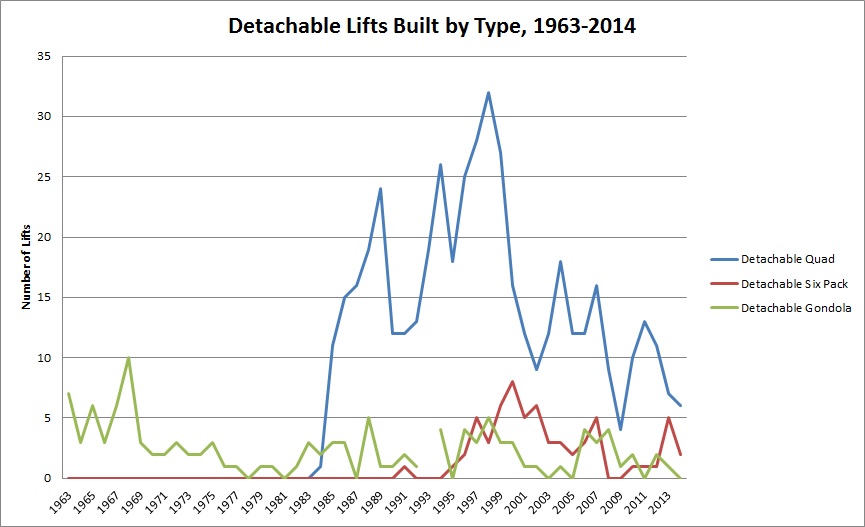
On the detachable side, the number of gondolas built each year remains fairly steady, usually under five per year.  Of the 473 high speed quads built to date, most went in between 1986 and 2007.  Detach quads peaked in 1998, when 32 were built in one summer.  Six packs peaked two years later but have always been less popular than quads.  Last summer was the worst year for detachable construction since the technology was invented; just eight were built in all of the US and Canada.  2015 will be better with at least 16 being built right now.

Continue reading

Pulse Lifts

These days building a detachable lift means a capital investment of at least $3 million plus around $100,000 in annual maintenance.  A so-called ‘pulse’ lift offers the speed of a detachable system with similar infrastructure to a traditional fixed-grip lift.  Chairs or cabins are grouped together into ‘pulses’ and the entire lift slows down for loading and unloading.  When comparing types of aerial lifts there are always trade-offs; here they include low capacity and long headways.  Most pulse lifts can only move 300-600 passengers per hour and headway – the time a passenger has to wait for a carrier to show up – can be minutes instead of as low as six seconds.  Perfect for certain applications but unsuitable in most.

Pine Ridge lift at the Yellowstone Club, Montana.

There are currently 17 pulse lifts operating in the US, Canada and Mexico; all but three are gondolas.  Nearly all were built in the last 15 years.  Panorama Mountain Village, Northstar California, Steamboat, Snowmass, Canyons Resort, and Le Massif all use pulse gondolas to connect village areas.  These lifts are usually less than 3,000 feet long and convenient for skiers and non-skiers alike.  Other pulse gondolas are attractions in their own right such the Iron Mountain Tramway at Glenwood Caverns Adventure Park, SkyTrail at Trees of Mystery, the Gondola at Royal Gorge Bridge Bridge & Park and the Riverfront Park SkyRide in Spokane.  There is also a new Leitner-Poma pulse gondola in Orizaba, Mexico with tripod towers that are hundreds of feet tall.

Spokane Falls SkyRide, built by Doppelmayr.
Riverfront Park SkyRide, built by Doppelmayr.

Snow Valley in Edmonton, Alberta has a very unique pulse chairlift built by Doppelmayr in 2008.  Instead of having groups of 3-5 chairs, it has just two groups of 20 closely-spaced quad chairs.  Because it is only 850 feet long, the lift can move 1,378 skiers per hour at up to 5 m/s, the same speed as most detachable lifts.  In fact the ride is only about a minute.  The lift slows to a beginner-friendly 0.8 m/s for loading and unloading.  Because of the low speed, skiers ride around the bullwheel at the top and unload facing down the hill.  It’s the only lift I know of with 180-degree unloading.

Continue reading

What’s in a Lift Name?

036

I respect ski resorts that come up with creative, well-thought-out names for their lifts.  A lift’s name will usually last decades and be passed on to subsequent lifts in the same location.  KT-22 is an example of a lift name so iconic I do not even need to say the resort.  Yet more than 900 lifts in the US and Canada have no name at all or go only by a letter/number.  Many resorts have a bunch of lifts with generic names like “T-Bar” and “Beginner.”  I set out to identify some of the most frequently-used names in hopes that the ski industry can be more creative in the future.  Here are the top 10:

  • Summit. There are 38 lifts called Summit including nine Summit Expresses.  Forty-four more lifts have other words added such as Mt. Snow’s Grand Summit Express.  The temptation to name a lift Summit is obvious but it is hardly a helpful name when we are talking about machines that ascend mountains.
  • North. While only ten lifts are called North, 34 more are named North Bowl, North Creek, North Face, etc.  The other compass directions are almost as common – there are 28 West lifts, 22 East lifts and 21 South lifts.  Not very creative and I would argue most ski resort guests have no idea which direction is which.
  • Blue.  Most ski areas have gotten away from painting their lifts bright colors and giving them corresponding names since the Forest Service banned such displays.  However there are still 23 Blue lifts, 20 Green, 19 Silver, 15 Red & Gold, 7 Yellow, and a handful each of Orange, Pink and Purple lifts.
  • Eagle.  A surprising 26 lifts have the word Eagle in their name including four that are Eagle Express.  Other resorts go further with Flying Eagle, Soaring Eagle, Screaming Eagle, Golden Eagle and Copper’s American Eagle.  Other popular animal names include Bear and Elk.  These aren’t bad names; they are just too common.
  • Village.  The US and Canada have 17 Village lifts including 4 Village Gondolas.  I put these in the same generic category as Summit.
  • Sunrise.  Some resorts try to get past East and West by using Sunrise and Sunset.  The result is 15 Sunrise lifts and almost as many Sunsets.  For an industry centered on snow, the word sun is very popular.  I count 9 Sunnysides, 8 Sundances and 8 Sunshines among others.
  • Meadow. Learning lifts in particular seem to suffer from generic naming.  Meadow is by far the most popular name for a beginner lift at 18, followed by Easy Rider at 12, Beginner (10) and Discovery (8.)
  • Skyline.  A logging term for transporting timber by cable, Skyline is a natural name for a ski lift.  But with 12 Skyline lifts and counting, it’s time to use some new logging terms.
  • Panorama.  There are seven of theseWinter Park tried to put a spin on it with Panoramic Express but it’s still not very creative.

Last summer’s construction season had two new Summit lifts, 3 Sun variations, a Meadow and a Discovery.  Hopefully 2015 will be better but it’s looking like we may see three more Summit chairs!

The 3S Gondola

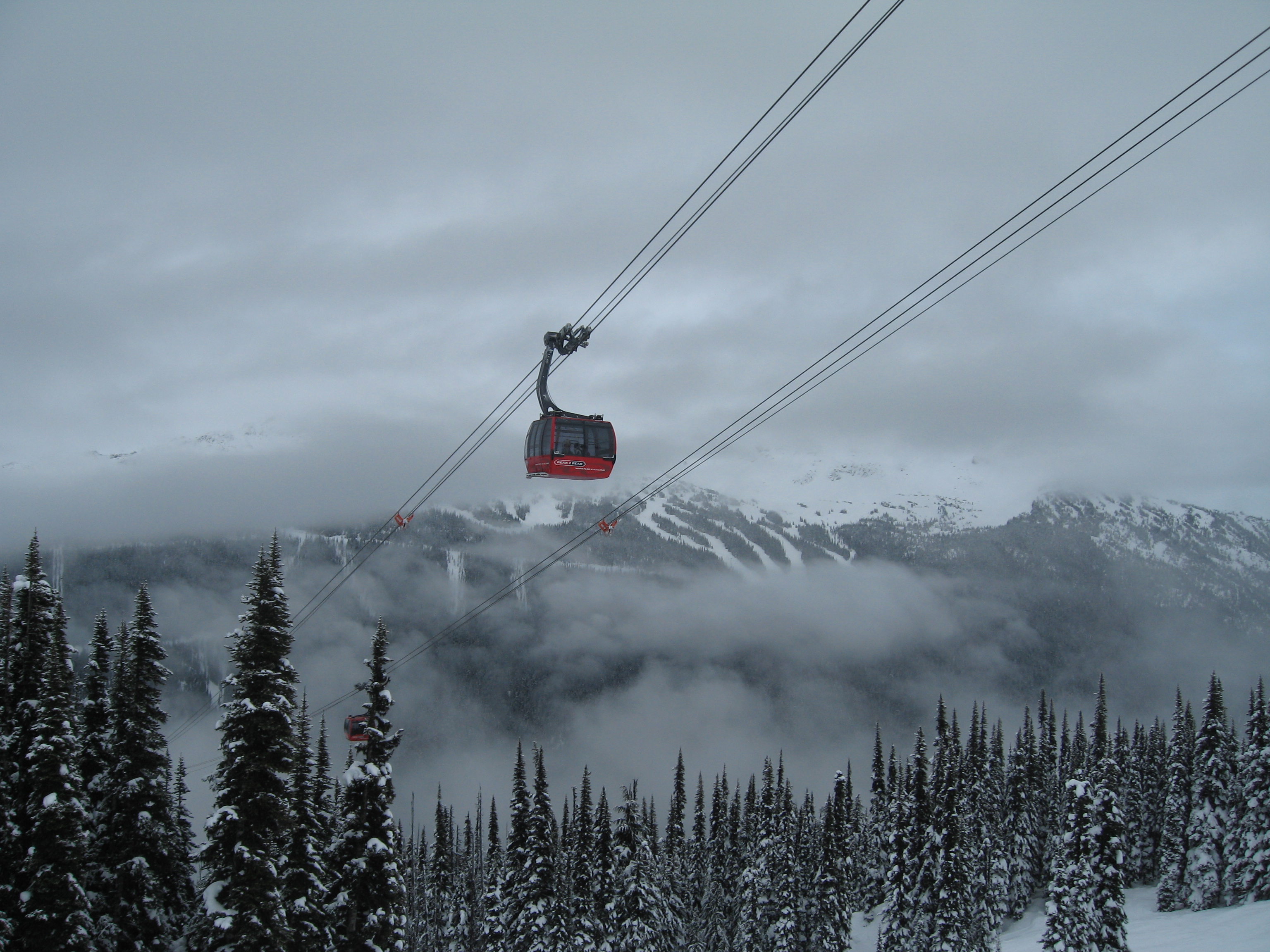
A “3S” is a detachable gondola with two track ropes and one haul rope.  It combines the speed and stability of a tram with the capacity of a gondola.  Cabins generally hold about 30 passengers.  3S systems can move up to 4,500 passengers per hour at up to 8.5 meters per second.  They can withstand high winds and traverse long spans between towers.  These highly capable lifts are also expensive.  Only 12 3S gondolas have been built.  Perhaps the most famous of them, Whistler’s Peak 2 Peak, cost $51 million!

3S Gondolas are huge machines.

The 3S was developed by VonRoll of Switzerland.  The first one to open was the Alpin Express at Saas-Fee in 1991.  A second section opened in 1994.  When Doppelmayr merged with VonRoll in 1996, they inherited the 3S technology.  Doppelmayr built its first 3S in 2002 at Val d’Isere, France.  Called L’Olympique, it accesses the famous ski area of Escape Killy.

Kitzbuhel, Austria opened the 3S Bahn in 2004.  It connects two ski areas across a valley with an 8,200 foot-long unsupported span.  Four years later, Doppelmayr connected Whistler and Blackcomb with the Peak 2 Peak, featuring an even longer unsupported span of 1.88 miles.  Peak 2 Peak’s highest point above ground is an incredible 1,427 feet.  It remains the only 3S gondola outside of Europe.

Whistler-Blackcomb's Peak 2 Peak Gondola.
Whistler-Blackcomb’s Peak 2 Peak Gondola.

Leitner got into the 3S business in 2009 with a system in northern Italy.  The towns of Renon and Ritten were connected by a 2.8 mile-long 3S.  This was the first 3S built outside of a ski resort.  Another urban 3S was built across the Rhine River in Koblenz, Germany in 2010.  This Doppelmayr system moves 3,800 passengers per hour in each direction.  Also in 2010, Doppelmayr built the Gaislachkogl 2 at Solden, Austria.

Continue reading

Lifts by State (and Province)

Ever wanted to know how many lifts are operating in each state?  Read on.  Colorado has the most operating lifts of any state with 275.  California is close behind with 263 followed by New York (189) and Michigan (165).  There are only 9 states with more than 100 lifts each.  The majority of states have fewer than 20 lifts today.  Five sad states have no aerial lifts at all to my knowledge – Alabama, Arkansas, Delaware, Hawaii and Louisiana.  (Louisiana used to have a 6-passenger Poma gondola called MART that crossed the Mississippi River.)

Each one of Canada’s 10 provinces has at least 3 lifts used for skiing.  Only the Nunavut and Northwest Territories do not have a lift.  Quebec has the most lifts by far with 226 followed by British Columbia (165), Ontario (162), and Alberta (87).

The average age of lifts varies significantly by region.  Maryland’s 7 lifts average 17 years old while Ohio’s 33 lifts are more than twice as old at 34.4 years.  Utah and Montana stand out as having new lifts averaging 19.4 and 19.9 years old, respectively.  Places with really old lifts tend to be in the East and Midwest.  Wisconsin, Minnesota, Michigan, Ohio and New York all have lifts that average more than 30 years old.

It’s also interesting to look at which brand has the most operating lifts in each state/province.  25 states/provinces are dominated by brands which disappeared decades ago – Yan, Riblet, Borvig and Hall.  Borvig dominates in 5 eastern states – IL, VA, IA, ME, and PA.  Hall lifts are pervasive in many eastern states – ND, CT, MA, NY, WI, MN, OH, and SC.  Riblet still dominates all of the northwest and some of the midwest – MO, OR, WA, SD, AK, NM, IN, MI, and KY.  Yan takes its home state of Nevada and neighboring California and Arizona.

Doppelmayr is the most common lift brand in surprisingly few states – MD, GA, MT, NJ, NH, ID, and NC.  The story is different in Canada where Doppelmayr is the top brand in most of the country – BC, MB, SK, AB, QC, and NB.  Despite being gone for a decade, CTEC and GaraventaCTEC are still the most popular in Utah, Wyoming and West Virginia (thanks solely to Snowshoe Resort.)  Finally Poma and Leitner-Poma take their home state of CO plus VT and ON, NL, PEI and NS in Canada.