Catamount to Build Fifth Chairlift

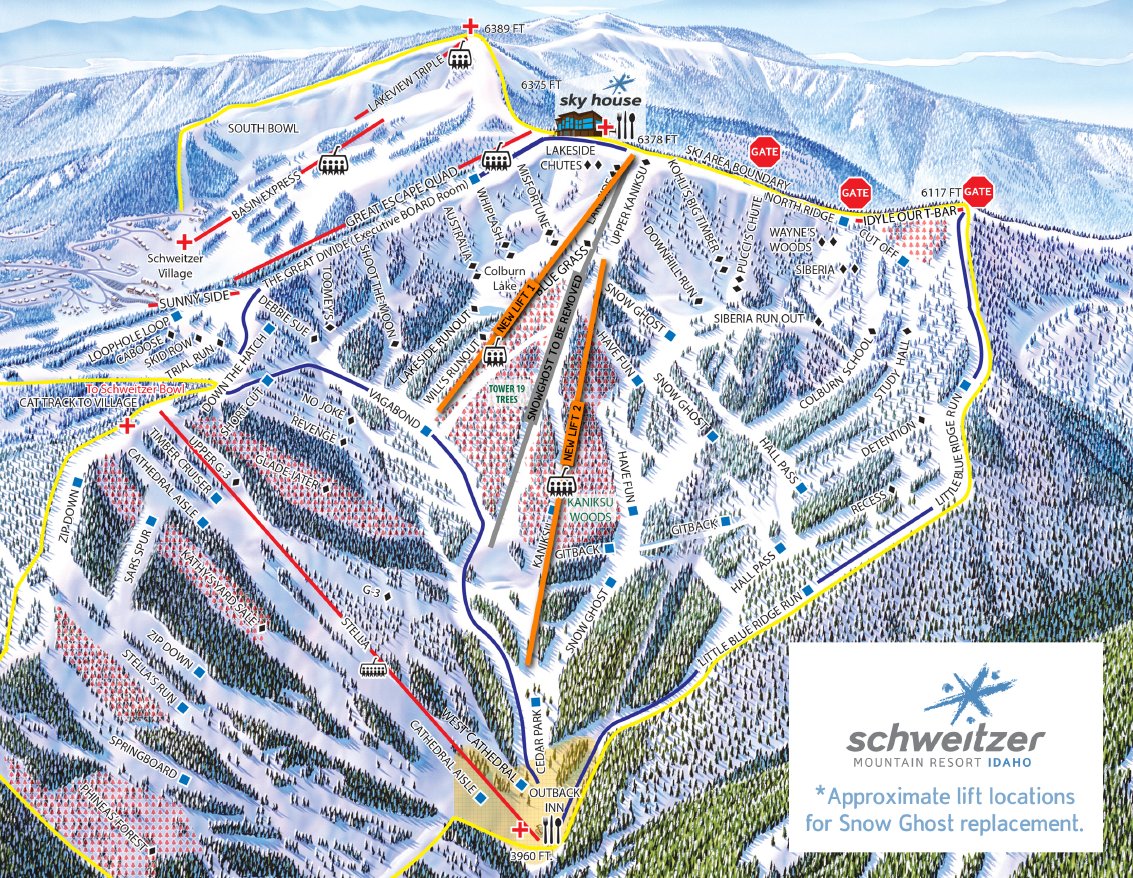
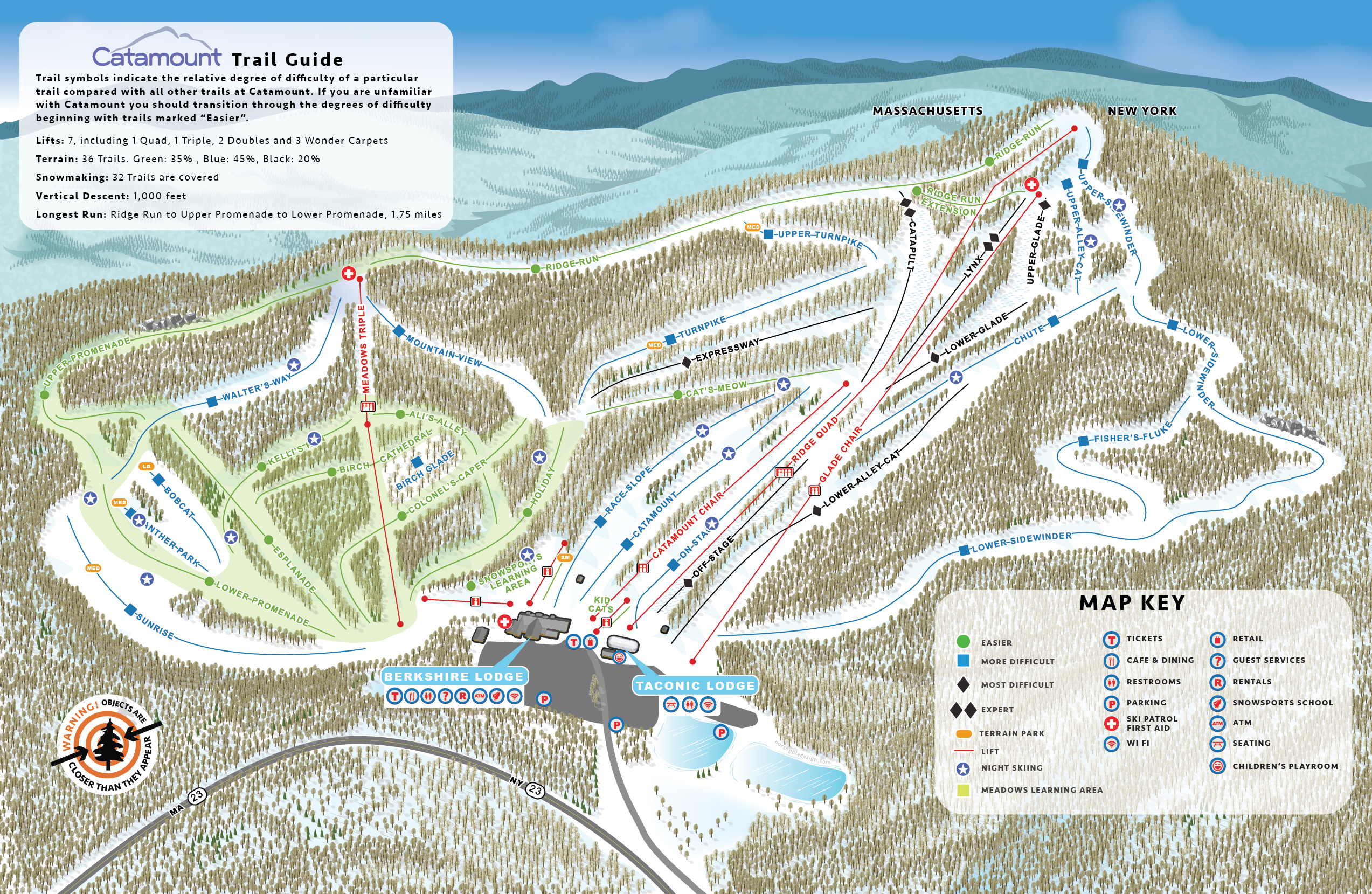
NewTrailMap17-18

The Schaefer family bought Catamount Ski Area just three months ago but already has grand plans for their second ski resort.  The co-owners hope to bring the same success to Catamount the group did to Berkshire East, now a year-round destination that saw two new lifts since 2007.  Catamount, which sits partly in Massachusetts and half way in New York, is eighty years old.  Previous owners Tom Gilbert and Rich Edwards became unable to make the capital investments they knew they needed to.  “To remain really competitive in the ski industry there’s many things that need to be done, and we’ve been trying over the years to raise some capital to do these projects,” Gilbert told the Berkshire Eagle in May following the sale announcement. “We realized we were not successful in raising capital and realized we needed to bring something in.”  Berkshire East paid $650,000 for the mountain and retired Catamount’s $1.6 million in outstanding debt.

beast16
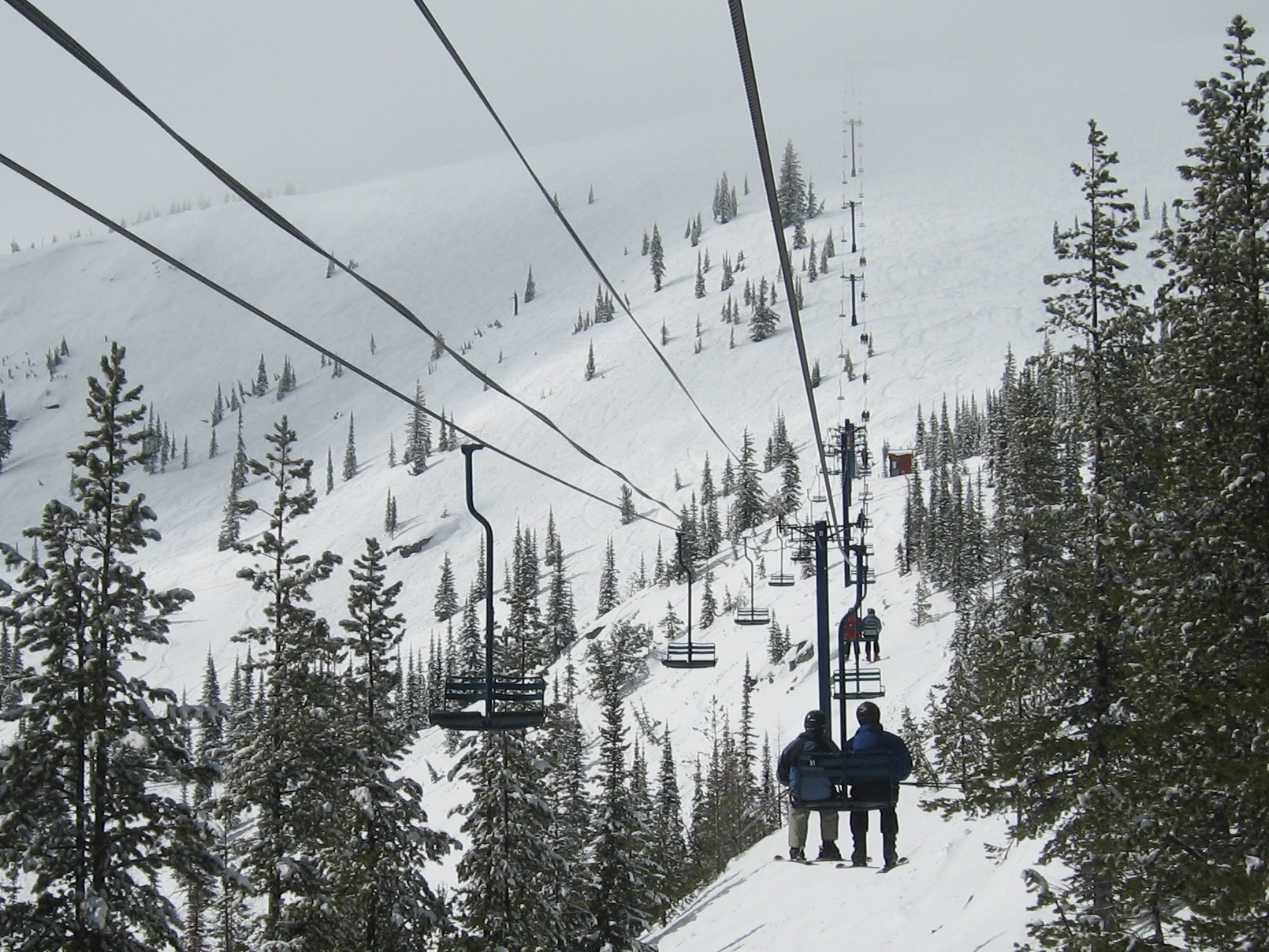
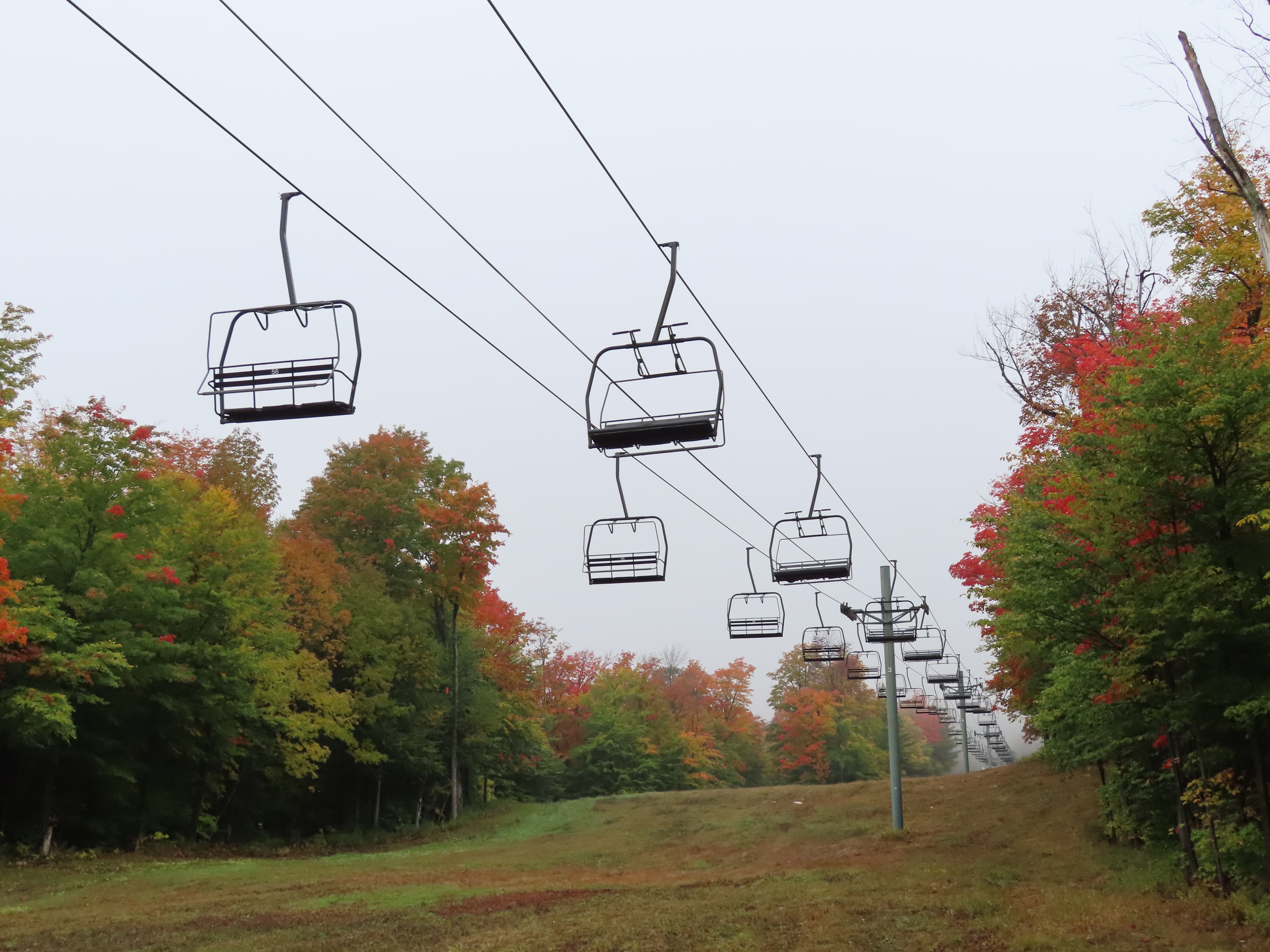
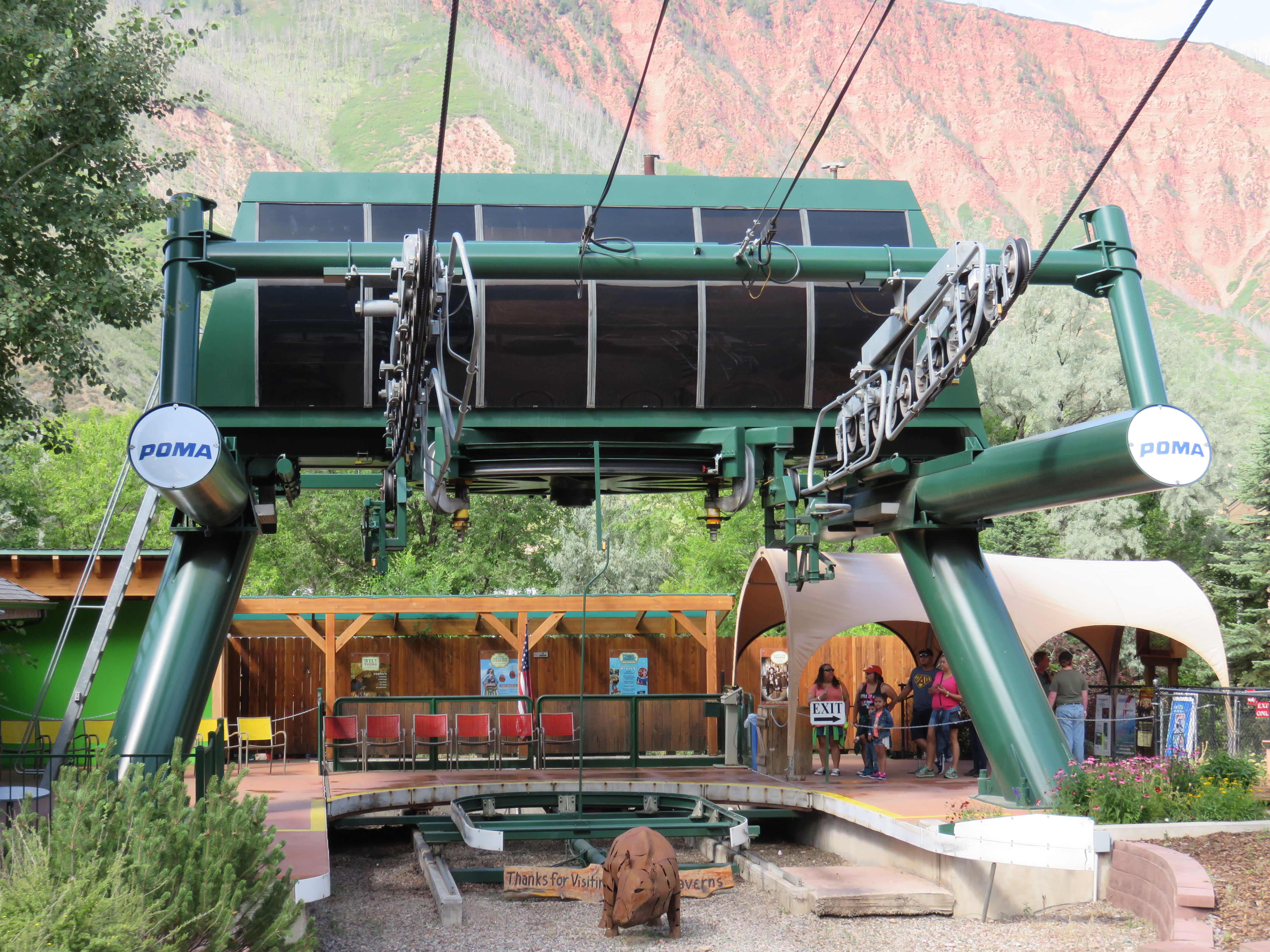
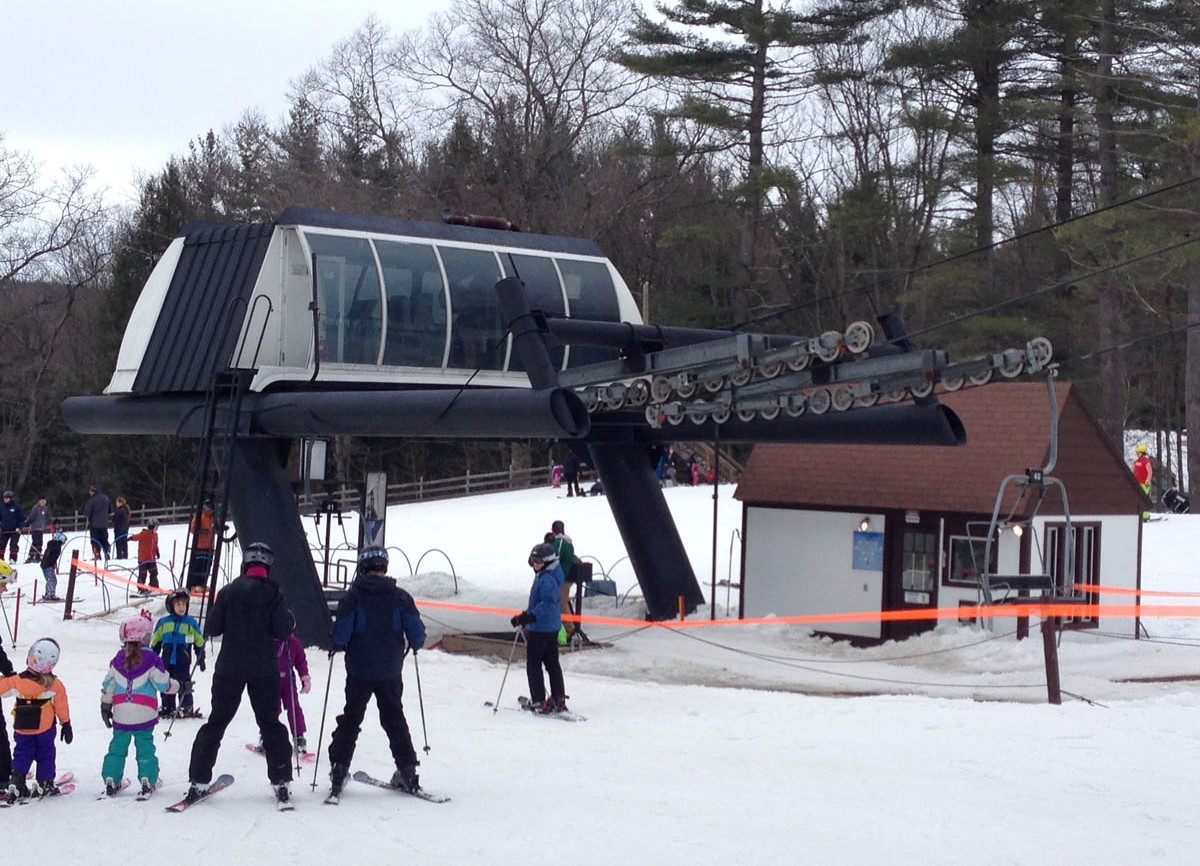
This Poma lift could find a third home on the Massachusetts-New York border.  Photo credit: chairlift.org

A new triple chair will soon improve the beginner experience on the Massachusetts side of the mountain.  The lift is likely to be a 1987 Poma Alpha model which began its life in Vermont as Magic Mountain’s Sun Corner lift.  Magic went dark only four years later and the triple flew south to Berkshire East, where it was the Summit lift.  Skytrac replaced it with a quad in 2014 and the Poma has sat awaiting a new home ever since.  Ironically, a used chairlift from Stratton will finally return lift service to Magic’s Sun Corner this fall after 27 years.

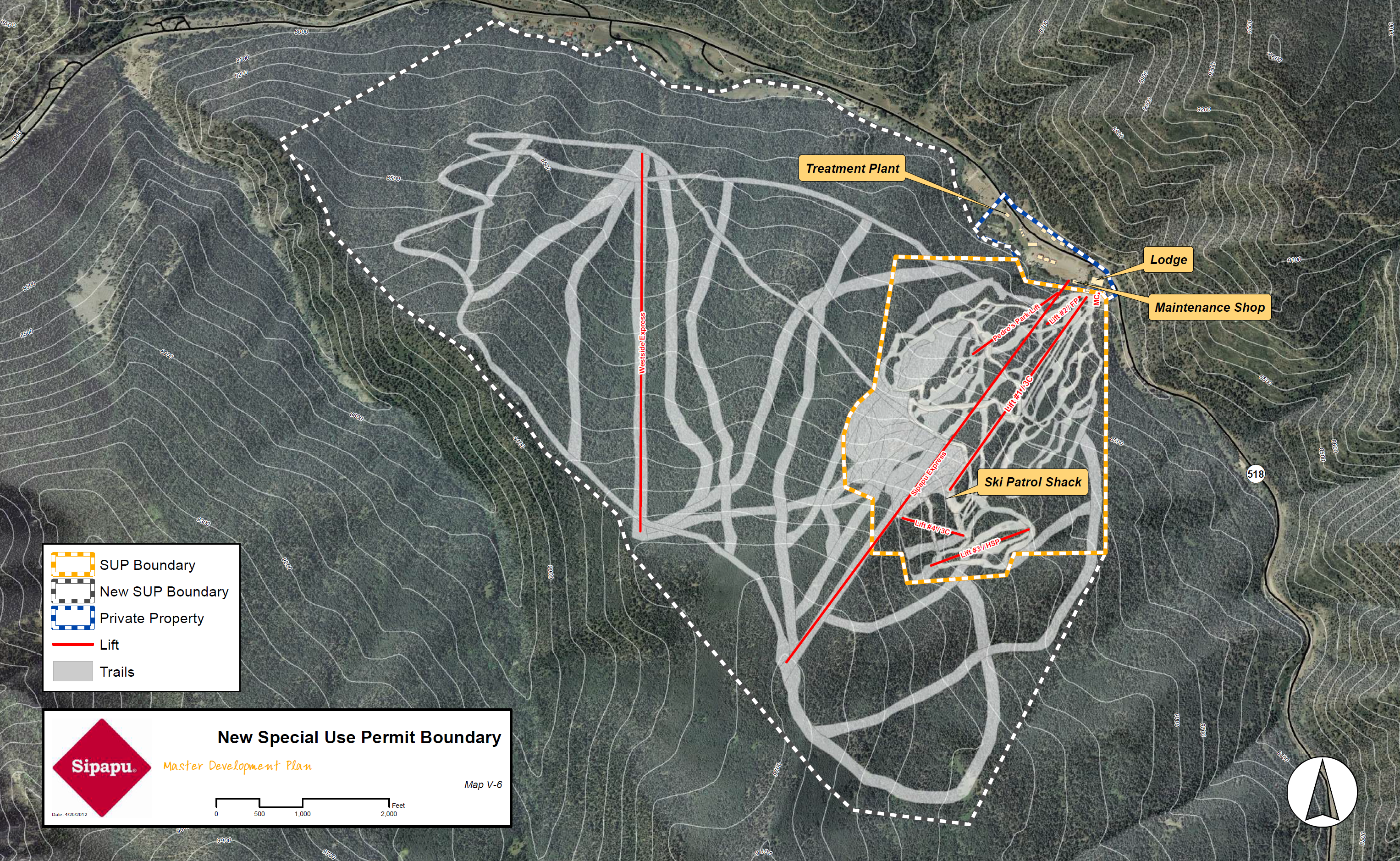
Catamount’s new 1,600′ lift will run up up the Esplanade trail.  I suspect this will be a 2019 project but there’s a chance it could happen sooner.  The triple will complement four existing lifts, which are two SLI doubles, a Thiokol triple from Solitude, Utah and a Garaventa CTEC quad relocated from Belleayre, New York.  Catamount also plans to add a brand new 7,600 square foot lodge.

Lee Canyon Inches Closer to New Lifts

IMG_1392

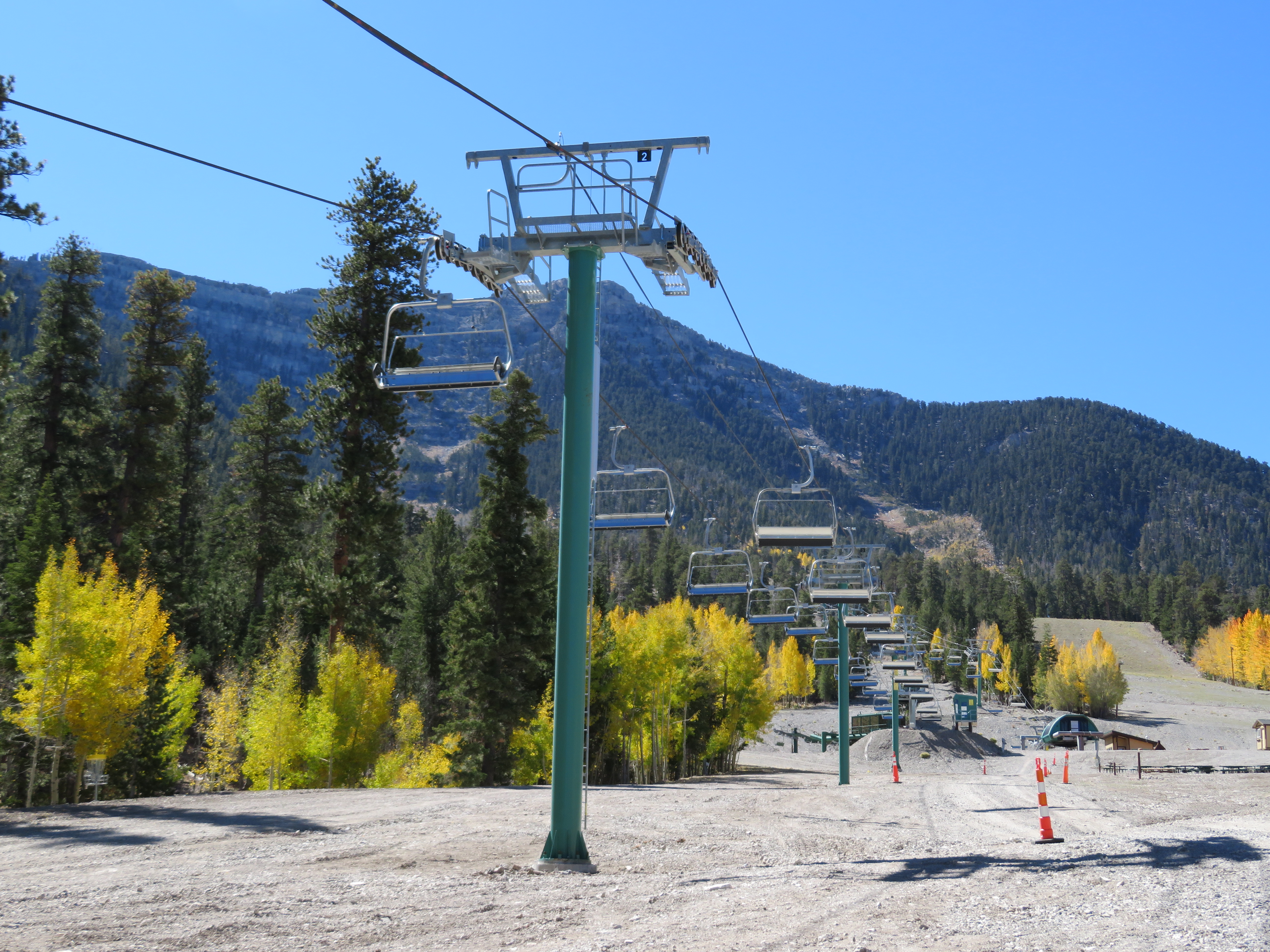
Well over two million people in the Las Vegas region have just one ski resort within day trip reach, a unique situation among western US metros.  The mountain is Lee Canyon, which operates three fixed-grip chairlifts on 785 acres flanking Charleston Peak.  On Wednesday, the Forest Service published a 219 page Draft Environmental Impact Statement for a major expansion and upgrade plan developed by longtime owner Powdr Co.  Two alternatives would each add a pair of fixed grip quads and two new carpets lifts while a no action option would see the resort remain within the operating footprint it has since 1967.

alternative1
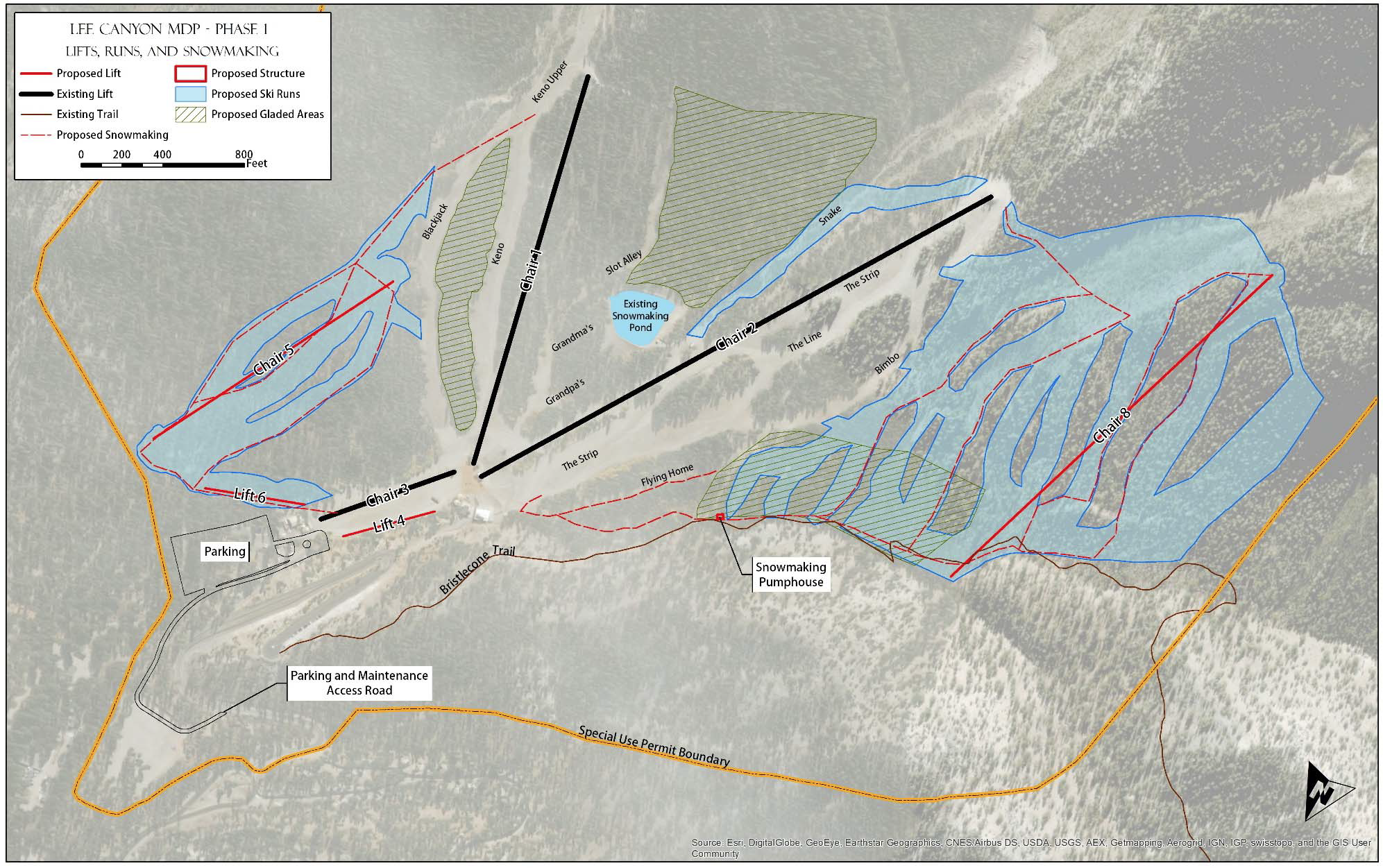
The first alternative would see two new trail pods, expanded snowmaking and a few new buildings.

Goals of the expansion are to update and renovate ski area infrastructure, balance lift and trail capacity, meet growing demand from Las Vegas and the surrounding area and expand year-round recreational opportunities.  The proposed Chair 5 pod would become the next step up from the Rabbit Peak bunny hill, providing beginners and low intermediate skiers the opportunity to transition to a chairlift and ski a variety of longer green runs. Chair 5 would be an 1,800 person-per-hour fixed-grip quad chairlift with a loading conveyor. The lift would be 1,400 feet long, with a vertical rise of 310 feet. It would be a top drive lift with approximately 7 towers.  In order to access the Chair 5 bottom terminal, a new 500 foot conveyor, Lift 6, would be installed from near the bottom terminal of Chair 3 to near the bottom terminal of Chair 5.

alternative2
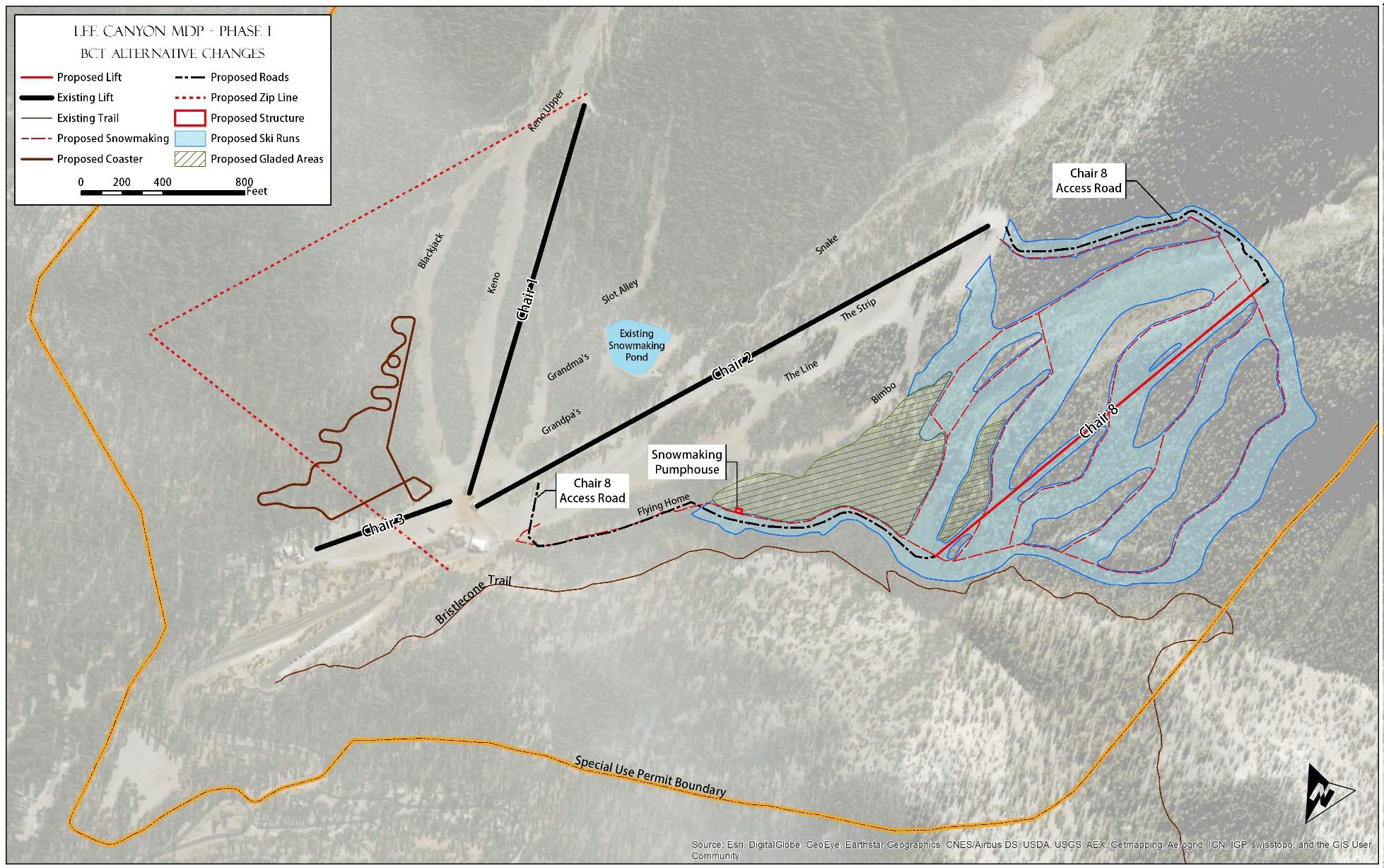
The second alternative would truncate Lift 8 and associated trails to avoid crossing the popular Bristlecone Trail.  Chair 5 would still be included but is not shown on this map as it would be the same as in alternative 1.

Similar to the existing Chair 2, Chair 8 would be a step up in difficulty from Chair 5, accessing mostly intermediate runs with some easier and some more difficult terrain within that category. It would be a fixed-grip quad chairlift with a capacity of 1,800 pph, 2,200 feet long, with a vertical rise of 650 feet. It would be a bottom drive lift with approximately 16 towers.  With alternative 2, the lift would be shortened to load higher up.  Other proposed improvements in both alternatives are new biking and hiking trails, a new skier services building, another parking lot, expanded snowmaking, a zip tour and mountain coaster.

Continue reading

Weighing the Next 42 Years at Sunshine Village

sunshine 251
This high-speed quad is the only lift on Goat’s Eye Mountain at Sunshine Village, a peak which could eventually be home to four lifts.

I wrote briefly a few weeks ago about Parks Canada’s proposed site guidelines for Sunshine Village, the second largest ski resort in Banff National Park.  Banff Sunshine operates a unique gondola and nine quad chairlifts within a UNESCO World Heritage site surrounded by spectacular scenery – the only resort to span two Canadian provinces.  This document will govern the public-private partnership between Sunshine Village Corporation and Banff National Park through 2060.  Currently, Sunshine’s capacity is capped at 6,000 skiers, though Sunshine says it only has enough parking for 4,500.  The future could allow for more visitors – but exactly how is up for debate.

Site guidelines Parks Canada proposed last month set a new skiers at one time figure of 8,500 at build-out compared with the 11,500 settled upon at Lake Louise and 3,800 at nearby Mt. Norquay.  Sunshine says it “reluctantly” agreed to the 8,500 number a few years ago even though the resort could theoretically reach 12,900 persons at one time (PAOT).  The new Parks Canada plan includes a gondola reliever lift as well as three new lifts in Lower Meadow Park, Hayes Hill and Goat’s Eye II, areas which currently sit within the Sunshine lease area.

SSV18_SunshineSiteGuidelines_
A gondola or tramway could reach the top of Goat’s Eye Mountain with just one tower.  But Banff National Park does not currently support this idea.

Continue reading

Warner Bros. Unveils Hollywood Skyway Concept

la-1531174039-ketytsxgsm-snap-image
The Hollywood Skyway would bring visitors to one of LA’s most popular but hard to reach landmarks.  Photo credit: Warner Brothers Entertainment

The Los Angeles Times reports this morning that Warner Bros. Entertainment is seeking to build a $100 million aerial tramway in California’s largest metropolis.  The one mile, $100 million project would improve public access to the famed Hollywood sign atop Mt. Lee and include a new visitor center, viewing platform and walking paths.  The company already operates a popular studio tour on the site of the proposed lower terminal.

The Hollywood Skyway would be entirely funded by Warner Bros. but occupy some public land in Griffith Park, home to the iconic sign since 1923.  Therefore, operating revenue would be shared with the City of Los Angeles.  Nearby neighborhoods have struggled to cope with the flood of tourists seeking to get a glimpse from every possible direction with no formal viewing area.  A ride on the Skyway would take six minutes from a parking garage to the northwest that Warner Bros. owns in Burbank.  “This requires a bold solution,” the firm’s facilities chief Jon Gilbert said to the Times. “If we really want to make a difference … it’s got to be something compelling. Partial solutions are not going to do the trick, and people will continue to inundate the neighborhoods.”

Warner Bros. is owned by WarnerMedia, which became part of AT&T less than a month ago.  A similar gondola floated a year ago would load at Comcast-owned Universal Studios Hollywood.  More than 90 chairlifts, gondolas and tramways now operate at non-skiing venues such as parks and zoos in North America.  Powerhouse competitor Walt Disney Co. is currently building a series of gondolas at its flagship theme park in Florida.  A statement from Warner Bros. argues the Skyway is the best option in Hollywood:

Given our close proximity to the north side of the Hollywood sign, we believe we offer a solution that has the least impact on the environment — protecting and preserving Griffith Park — and the surrounding residential neighborhoods.  We understand there are a number of possible solutions being considered, but we are confident the City’s feasibility study will show our proposal to be the best option — an option that can be built and operated at no cost to the taxpayer and that will provide public benefit to the City of Los Angeles and its residents.

The Hollywood Skyway project could take around five years to complete.  The chosen technology appears to be a reversible aerial tramway rather than a continuous movement gondola system.  This surprises me given the large volume of potential visitors.  The need for air conditioning could be a factor as well as a desire to build as few towers as possible in an urban park.  In my view, a 3S gondola would be the best of both worlds and one Warner Bros. could likely afford.

Nordic Valley Envisions Expanding with a 4.3 Mile Gondola

Nordic Valley lies northeast of Salt Lake City, near much larger Snowbasin and Powder Mountain. Photo credit: Ski Utah

The new operator of Utah’s Nordic Valley, Mountain Capital Partners, has high hopes for what is currently the littlest ski resort in Utah.  MCP is the fast-growing Durango, Colorado-based outfit led by James Coleman that now operates six ski resorts in the four corners region.  Less than three years after acquiring Purgatory and Arizona Snowbowl, Mr. Coleman entered into an operating agreement with Nordic Valley’s owners in April.  Now we know one of the reasons why he went to Utah.

map-thumb

The centerpiece of master plan released this month is a 4.3 mile gondola stretching from North Ogden to a summit elevation of 8,100′ before descending into Nordic Valley’s base area near Eden.  It would be the third longest gondola system in the world and some 6,000 feet longer than anything in the United States today.  “In addition to offering direct-to-resort access in a scenic 12-minute ride, the gondola will also help cut down on canyon traffic and vehicle emissions,” notes the recently-launched nordicvalleyproject.com website.  A similar gondola was once eyed to connect Ogden to Snowbasin and the proposal reminds me in some ways of the successful Silver Mountain Gondola project which transformed Kellogg, Idaho.

IMG_5733
Nordic Valley currently has three fixed grip chairlifts with a vertical rise of 1,110 feet.

Nordic Valley has attempted to expand upward and outward multiple times over its 50 year history but never before had access to the kind of capital needed to undertake what is now mapped.  The plan includes nine new chairlifts surrounding the new gondola, which would likely be built in two sections.  “We’re passionate about the ski industry, and about giving families and individuals the freedom and opportunity to experience the outdoors,” MCP notes.  “With an improved guest experience, the new Nordic Valley will be better positioned to grow the ski industry, compete with other area resorts, and bolster Ogden’s status as a first-rate recreation destination.”

Continue reading

Forest Service Launches Aspen Mountain Pandora Analysis

pandoramap

The White River National Forest will consider yet another new lift project over the coming months, this time high on Aspen Mountain.  A Notice of Proposed Action released today comes as the most-skied forest in the country simultaneously weighs proposals for two new lifts on Vail Mountain, two in McCoy Park at Beaver Creek and one at Aspen Highlands.  For Ajax, Aspen Skiing Company proposes to build the long-dreamed of Pandora lift to the east of the current Gent’s Ridge lift while adding 148 acres of new terrain.  The 4,191-foot top drive detachable quad would likely meet the Forest and SkiCo’s shared goals of enhancing terrain variety, improving circulation and providing reliable and consistent snow coverage.

pandoraexpansionsatellite

Unlike many of its peers, only 37 percent of Aspen Mountain occupies National Forest lands while the other 63 percent is privately held.  The new lift would traverse some of each and move up to 2,000 skiers per hour to the summit.  Vertical rise would be 1,220′ compared with 1,079′ at the longer and flatter Gent’s Ridge.  Aspen Skiing Company also proposes to add 53 acres of snowmaking coverage on six existing trails nearby.  A 30 day public scoping period runs through June 15th and input is being accepted online.  Project engineer SE Group has prepared an interactive web app to assist the public and there will be an open house as Aspen’s Limelight hotel next Wednesday night.  Aspen Snowmass hopes to win approval around the new year and build as early as 2019.

Building a Better Lift One in Aspen

IMG_8222
The third time may be the charm as the Aspen community is set to weigh the future of the Shadow Mountain lift over the coming months.

Come November 6th, Aspen residents will vote for Governor, U.S. House, and likely whether a ski lift should return to the original base of Aspen Mountain.  SE Group and the City of Aspen today posted 61 pages of study on the new Lift One with a focus on where to site the bottom terminal, a question which has lingered since 1972.  Goals include retaining the historic structures of the first Lift One, threading the needle between two new developments, and improving skier flow.  An aggressive proposed timeline begins Tuesday with review by the City Council that could culminate with a new gondola-chair combination lift spinning by late 2019.  That would be 48 years after a shortened SLI-Riblet double dubbed 1A eliminated easy access for much of the town to Shadow Mountain.

img_8196
This is the primary lift for one of the few World Cup courses in America.

The current lift starts about four towers higher than the 1946 single chair did and, like its predecessor, has reached the end of its useful life following decades of service.  The International Ski Federation makes no secret the obsolete machine is a big reason why Aspen does not host World Cup skiing as often as some of its peers.

option1

But things are finally looking up – or actually down.  SE Group analyzed nine chondola, chairlift, surface lift and funicular options and ones dubbed Option 1 and Option 7 were identified for detailed study that commenced in February.  An A and B variation were added to alternative number 7, leaving four scenarios in play to bring the lift back into town.  Option 1, shown above, would put the bottom terminal level with Gilbert Street between the old Lift 1 terminal and the “new” one.  Because of space constraints with Aspen Skiing Company’s preferred Telemix (chondola in Poma parlance), the lift would likely be a straight gondola or possibly a detachable chairlift.  Skier access from above would be excellent but the public would have a 40-foot vertical climb to get to the load point from town.  Furthermore, the developer of the proposed Lift One Lodge would have to give up an entire building worth of units.  The historic lift terminal and remaining towers from the first Lift One could be retained, which is an important community objective.  This is deemed a viable, but not best option.

Continue reading

California Express Draft Environmental Impact Statement Released

Web-Header-CA Express

A 16 minute flight between Squaw Valley and Alpine Meadows took a jump forward this morning as the Truckee National Forest and Placer County released the draft environmental impact statement for the California Express gondola.  The big three stage lift was first proposed by the owner of both mountains, KSL Capital Partners, more than two years ago and is now being championed by Alterra Mountain Co.  At 808 pages, the EIS required under the National Environmental Policy Act outlines three possible alignments which could unite the steeps and village at Squaw Valley with the beginner and intermediate paradise of Alpine Meadows.

Two of the alternatives are new while the other two should be familiar to readers of this site.  Other concepts such as a pulse gondola, expanded shuttle service and even an underground train were eliminated as part of the preliminary review, which was completed by SE Group and Ascent Environmental of Sacramento.  Alternative 1 is the required no-action option, which would keep Squaw Valley and Alpine Meadows separate but equal.  Shuttle buses would continue running every 30 minutes between the two mountains, which already share a common lift ticket.

californiaexpressalternatives

The lift would move 1,400 skiers per hour in 8-passenger cabins painted white to blend in with the winter environment.  It would operate from 8:00 am to 6:00 pm with skiing allowed from the mid-station(s) when conditions permit.  There would be separate drive systems and separate cabin parking facilities at each end so two sides could operate independently.  The middle section of the lift would operate as part of the Alpine Meadows side and approximately 40 percent of the cabins would be stored at Squaw Valley with the remaining 60 percent at Alpine during storm events and the summer.

Continue reading

Mayor, Dodgers Back a 3S Gondola in Los Angeles

Chavez+Flyover+Rendering

One of the last remaining Major League Baseball stadiums not serviced by permanent public transportation could be reached by gondola in 2022, says a group with early support from the Los Angeles Dodgers and Mayor Eric Garcetti.  Aerial Rapid Transit Technologies LLC presented the idea to the Metro regional transit authority this morning as part of its Extraordinary Innovation unsolicited proposals program.  The tricable system would link Dodgers Stadium to Union Station, the busiest rail hub in the Western United States.

The 3S would be capable of transporting 5,000 passengers per hour and direction along a 1.25 mile route before, during and after Dodgers Stadium events.  It would cross over Chinatown and Interstate 110 with a terminus on the southeastern side of the ballpark with an unknown number of towers in between.  Utilizing 30 to 40 passenger cabins, the lift would be the largest gauge gondola in the western hemisphere and was selected for its optimal capacity and ease of accessibility.  “This is a major investment in the future of Los Angeles, with a zero-emission, sustainable technology that is increasingly popular for urban areas throughout the world,” noted Martha Welborne, project director for ARTT in a press release. “We look forward to working with Metro to make it a reality.”  Welborne is a former Senior Vice President of Corporate Real Estate at Disney and also served as Chief Planning Officer at LA Metro.

Mayor Garcetti commented on the project too, saying, “Dodger fans know better than anyone: making history means swinging for the fences and never stopping until you get home.  Our team has been at the center of so many landmark moments for Los Angeles, and this bold idea to ease congestion could transform how Angelenos — and millions of visitors — experience our city on their way to and from the ballpark.”  Lakers legend Magic Johnson also tweeted his support.

The estimated $125 million project would be funded privately but require the blessing of various public entities, especially to secure a lease at or near Union Station.  The founding principal of ARTT is McCourt Global, whose Chairman and CEO Frank McCourt formerly owned the Dodgers.  Much work lies ahead for the group including specific route selection and public outreach.  Operations are eyed for 2022, six years before Los Angeles hosts the Olympics for a third time.

Dodger+Stadium+Rendering

Vail Proposes Upgrading Game Creek Lift

vail 4-1-07 187
The Game Creek quad is one of seven first generation Doppelmayr detachables built on Vail Mountain between 1985 and 1989.  Only three remain as Vail Resorts renews the fleet, which could continue this summer.

When Vail Resorts unveiled its $150 million 2018 spending plan in December, it included seven new lifts in Australia, British Columbia, Nevada and Utah.  Notably, none were earmarked for Colorado, where the company operates four of the largest resorts in the state with nearly 80 lifts between them.  We learned on Thursday Vail Resorts’ North American skier visits were down 1.9 percent this season through April 15th but lift ticket revenue increased 3.7 percent, keeping MTN on solid financial footing.  Commenting on the season, CEO Rob Katz told investors, “We are pleased with our results as the 2017/2018 ski season concludes, particularly considering the historically low snowfall across our western U.S. resorts for much of the ski season.  Our results throughout the 2017/2018 ski season highlight the stability provided by our season pass, the benefit of our geographic diversification and the success of our sophisticated, data-driven marketing efforts.”

gamecreekmap

Now the mothership – Vail Mountain – could be getting in on the new lift action as neighbors Arapahoe Basin, Copper Mountain, Loveland and Winter Park do the same this summer.  A Vail Resort Summer 2018 Construction project page posted Thursday on the White River National Forest website notes that Game Creek #7 is proposed to be upgraded.  While there are no supporting documents yet and the project is listed as “developing proposal,” recent history would indicate the 1985 high-speed quad will be replaced with a new detachable quad or six place chairlift.  Vail has already added ten new lifts in the past eleven years and three of the most recent were of the six variety from both Doppelmayr and Leitner-Poma.  Vail has made no formal announcement but the Forest Service expects to conduct public scoping in May followed by a decision in June.