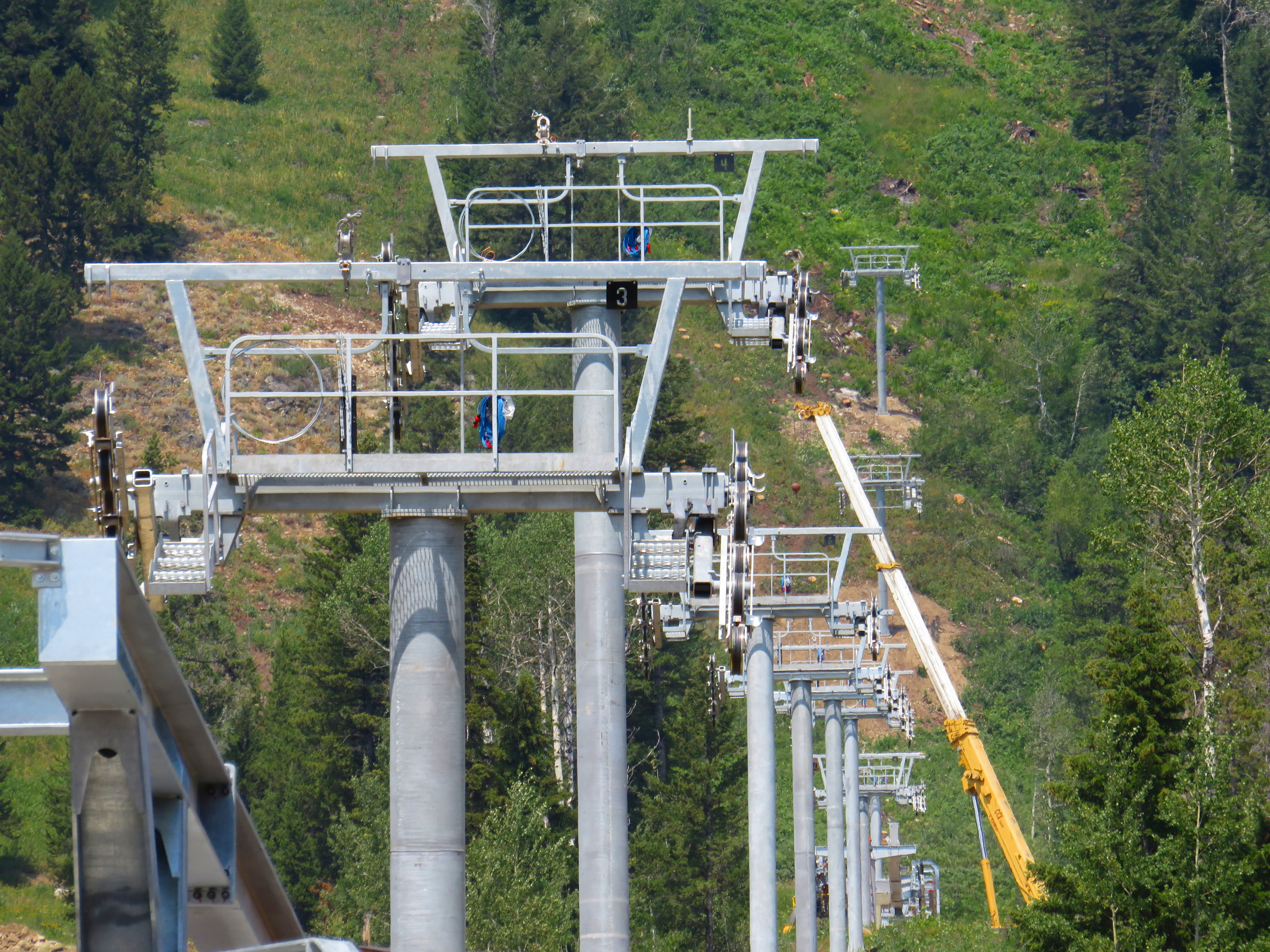
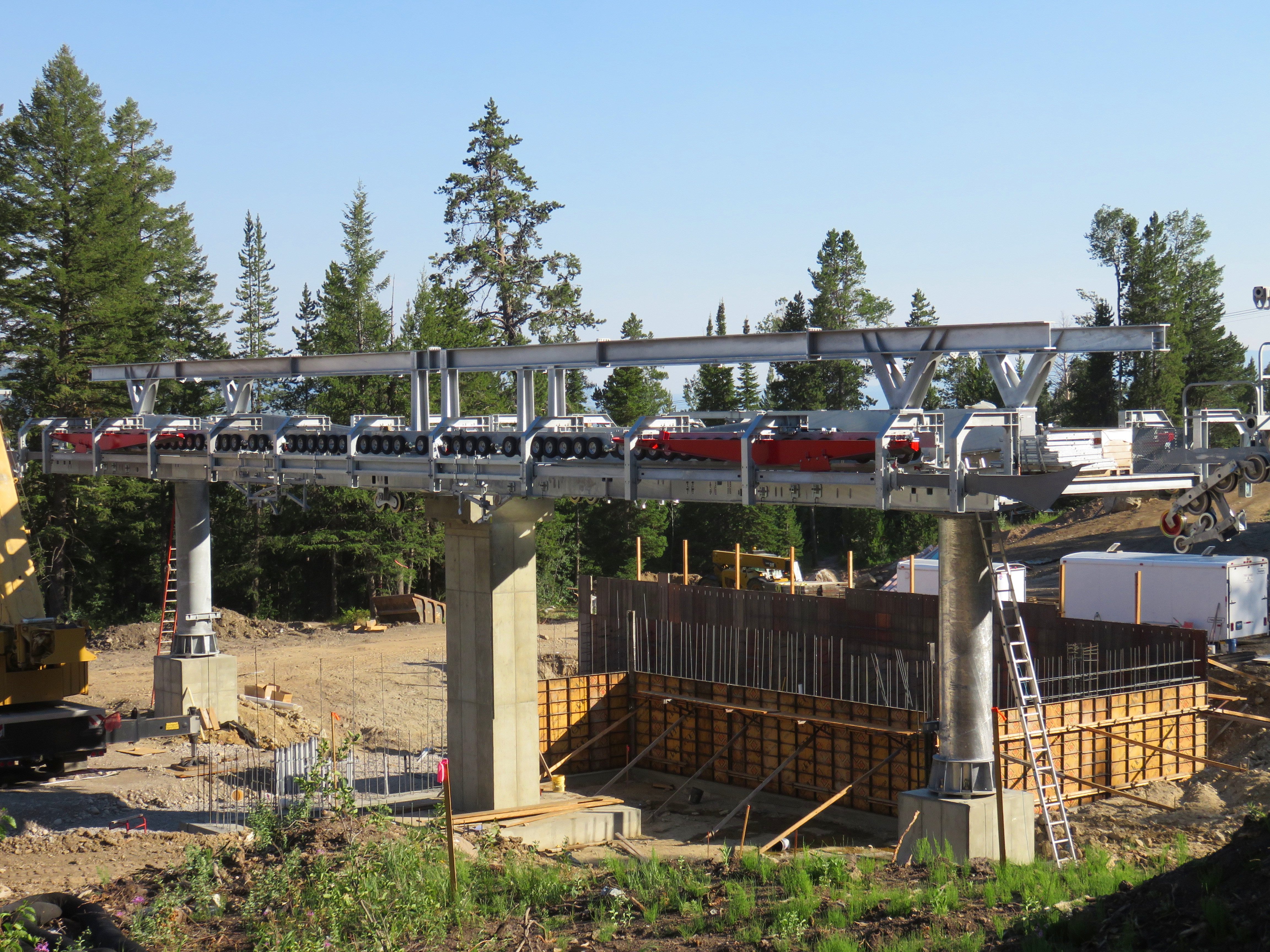
When riders on the tram ask about the construction going on at JHMR this summer, they rarely believe an entire gondola can be built in one summer. “That’s going to be done this winter?!,” they say. The answer of course is yes, and after a few months of work you can start to see why. Since Doppelmayr flew the new gondola’s towers in late July, work has shifted to the mid and top terminals. Over four days last week, a crane set the steel beams and tunnels for the Solitude mid-station. This station is huge and will eventually serve a beginner complex with magic carpets, a rental center, cafeteria and more. It will also be the site of the gondola’s cabin storage and maintenance facility, to be built next summer.
Doppelmayr crews put together the erector set at Solitude.The mid-station is big in both height and length!
Not much has changed at the bottom station, where steel was set in early July. The top/drive terminal is now the center of the action, where the last concrete for the masts will be poured this week.
The largest ski resort company in the world, Vail Resorts, announced a deal this morning to buy North America’s biggest ski mountain for just over USD$1 billion in cash and stock. The acquisition of Whistler Blackcomb brings Vail Resorts’ portfolio to a dozen mountain resorts including the most-visited in the United States, Canada and Australia. Vail Resorts, Inc. will also own six of the top ten mountains by skier visits in North America. The company has been looking to grow internationally since acquiring Australia’s Perisher Resort in 2015.
Whistler Blackcomb Holdings currently trades on the Toronto Stock Exchange. CEO Dave Brownie says the company’s board has been “monitoring the unique challenges facing the broader ski industry due to the unpredictability of year-to-year regional weather patterns.” As a result, the Whistler Blackcomb board accepted a takeover offer from Vail that places a 43 percent premium over Friday’s stock price, valuing W-B Holdings at CDN$1.39 billion.
The deal is expected to close before the end of the year. On the season pass front, Whistler Blackcomb will quit the Liftopia-powered Mountain Collective pass after this season and join Vail’s Epic Pass. Epic pass-holders will have access to 253 lifts at Vail’s 12 resorts in three countries.
Whistler Blackcomb announced a $345 million capital improvement plan called Renaissance earlier this year that will include new lifts on both mountains over the next 20 years and Vail intends to continue investing in this initiative.
With the Olympics opening tomorrow in Rio de Janeiro, the world looks to a seaside metropolis with more than six million residents and the first South American city to host an Olympic Games. While Brazil has no ski resorts, Rio features aerial lifts ranging from hundred year-old tramways to modern gondolas connecting the city’s favelas to the regional transit network.
The famous Sugarloaf Mountain twin tramways were among the world’s first cableways of any kind when they debuted in 1912. A century later, Brazilian President Dilma Rousseff championed development of a five-section Poma gondola connecting some of Rio’s largest slums, modeled after the pioneering gondola network in Medellín. In 2013, Doppelmayr built a three-station gondola in Morro da Providência, serving more than 5,000 residents in one of Rio’s oldest favelas. Further urban cable projects proposed for Rio have faltered as the city works to combat challenges we’ve become all too familiar with leading up to the Games.
Teleférico do Alemão is one of the largest and most complex gondola systems in the world with six stations and 152 10-passenger Sigma Diamond cabins. Built by Poma and operated by private train company SuperVia, Teleférico do Alemão opened July 7, 2011. The system is capable of transporting 3,000 passengers per hour over 2.2 miles of dense neighborhoods in 16 minutes. The lift changes angle four times, including a 100-degree turn at Alemão Station.
Teleférico do Alemão’s striking gondola stations also serve as community centers. Photo credit: Mario Roberto Duran Ortiz via Creative Commons
70,000 residents are eligible for two free rides daily on the gondola, which links favelas in the Complexo do Alemão to the Bonsucesso train station. Six expansive rooftop stations that feature banks, stores and social services rise above the favelas. The gondola system cost approximately $74 million to build and serves 9,000 daily riders. Initial ridership estimates of 30,000 per day have not been realized as Rio has struggled to attract non-residents to ride the teleférico through crime-ridden neighborhoods. Unlike in Medellín and La Paz, residents have criticized the construction of an expensive gondola through communities that lack electricity, clean water and basic sanitation.
Check out photos and video of a four-section system with two haul ropes, glass-floor cabins and Leitner Ropeways’ first gondola aligned in the shape of a triangle, set to open this month at a nature park in Spain.
South American cities are world leaders in urban cable transport, with 24 urban gondolas either opened or planned in Bogotá, Caracas, Guayaquil, La Paz, Lima, Medellín and Rio de Janeiro. I’ve written extensivelyaboutLa Paz, Bolivia’s capital that went all in on cable transport with eleven gondolas either operating, under construction or planned. But a full decade before the creation of Mi Teleférico in La Paz, Metro de Medellín opened the first of three Metrocable gondola lines in Colombia’s third largest city. Metrocable Line K was the first urban gondola to seamlessly link with a subway anywhere in the world, providing under-served and poor neighborhoods access to the city’s transport network. Metrocable’s J, K and L lines, with ten stations over 5.8 miles, now compose a quarter of the Metro de Medellín network. All three Metrocable lines are 8-passenger monocable gondolas built by Poma.
Line K debuted in 2004 with a shockingly low construction cost of $26 million. Its four stations branch off from the Acevedo Metro station over a length of 6,798 feet, giving three neighborhoods access to the core subway Line A that opened in 1996. This gondola rises 1,309 feet with a rope speed of 5 m/s. Metrocable Line J opened in 2008 at a cost of $47.5 million, serving four more stations from the terminus of the shorter subway Line B. Line J is longer than the original K at just under 9,000 feet. A ride with seamless transfers between buses, two Metro subway lines and two Metrocable lines costs less than a dollar.
Medellín’s Metro system features two subway lines and three Metrocable lines with two more under construction.
Teams from Doppelmayr and Timberline Helicopters put on a show yesterday in Teton Village as they flew 21 towers for JHMR’s new Sweetwater Gondola. The new gondola rises out of the base area with a mid-station at Solitude and tops out next to Casper Restaurant. With each tower flown in 4-6 sections, Brian and his co-pilot completed somewhere around a hundred laps up the hill over six hours using a UH-60 Black Hawk. There’s still a lot of work to go before November 24th but Sweetwater is starting to look like a lift!






 Lift Blog