As the shutdown drags on, there are at least 13 resorts waiting on federal analysis of new lift projects by my count.
A group of homeowners who invested to build the bubble six pack at the Hermitage Club worry Berkshire Bank could foreclose on the chairlift.
Whistler Blackcomb loses its claim to the world’s longest unsupported lift span but now features the longest continuous gondola system and the highest capacity gondola in North America.
Taos says goodbye to two more chairlifts – that’s four in one summer!
Song Mountain, NY is replacing its 1965 Thunderbird T-Bar with a chairlift. Anyone know where it’s from?
The Rainforest Adventures crew gets one Skytrac back in action and works to repair the other following Irma’s devastation of St. Maarten.
Scroll through these photos of a new high-speed quad in Switzerland with four stations, three sections, two haul ropes and only one drive!
Albany gondola group to be led by former chief executive of the New York State Department of Transportation and Federal Highway Administration Thomas Madison, Jr.
Portland’s next Transit on Tap talk on Jan. 24th features the story of the Portland Aerial Tram. The lift turns ten with a celebration planned for Jan. 28th.
A veteran mechanic dies after falling from a catwalk at Killington’s Skyeship Gondola.
Yesterday’s New York Timesdaily 360 video comes from the world’s largest urban gondola system.
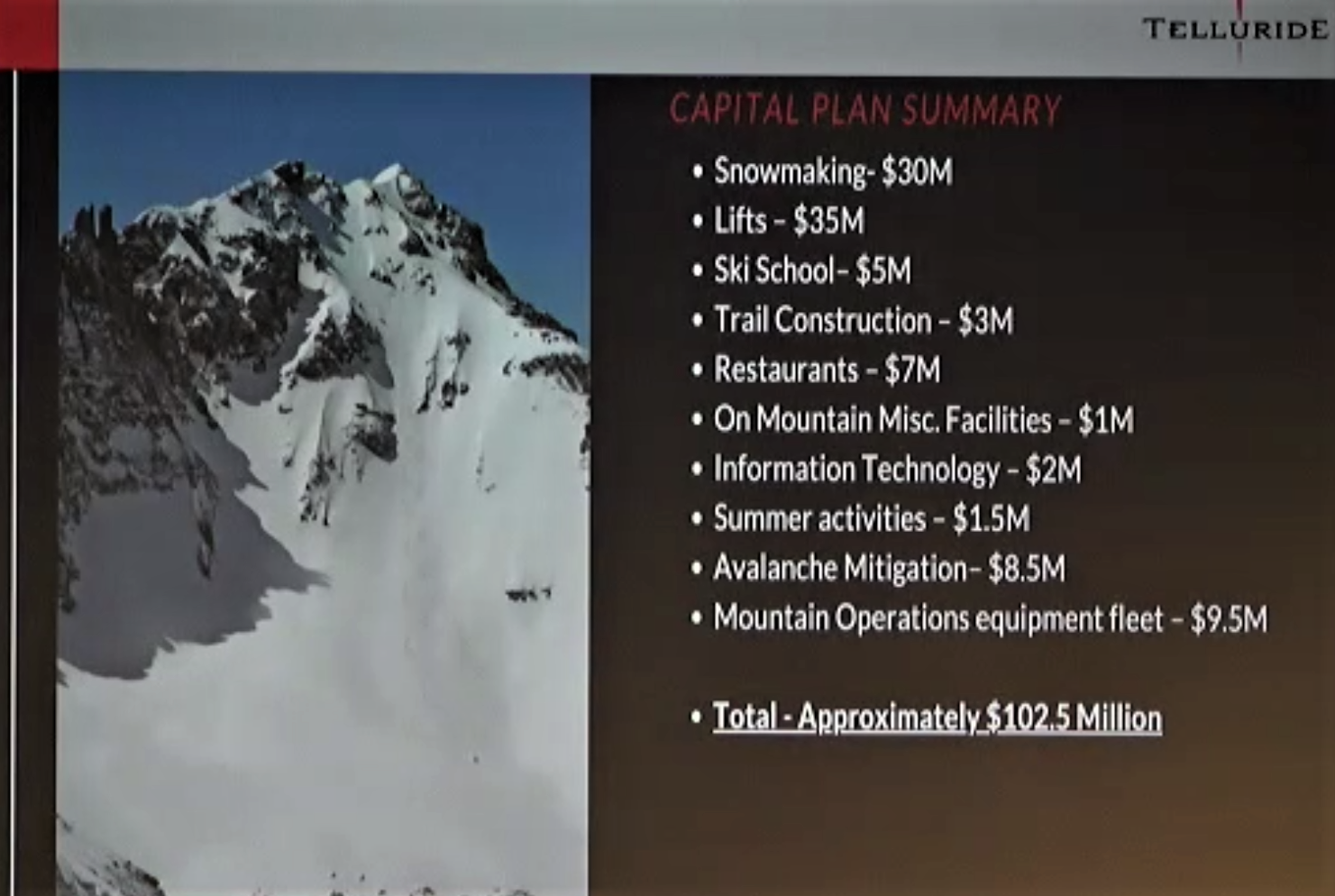
Telluride Ski Resort, which crested 500,000 skier visits for the first time last season and operates 14 chairlifts, released a new master development plan this month aimed at upgrading key lifts and adding a few new ones over the next decade. At opening in 1972, Telluride had just five double chairlifts but now, together with the town of Mountain Village, is home to North America’s largest gondola transit system and one of the most successful destination resorts.
Existing conditions, including the relatively new Revelation Bowl and Prospect Bowl expansions.
Telski’s last MDP from 1999 included several lift projects that are still approved but not yet completed. Most notably, the Palmyra Basin lift would rise 1,165 vertical feet lift to serve intermediate terrain above the Prospect Express, which itself was built as part of a four-lift expansion in 2001. Also in this area, a new 1,500′ surface lift is approved to serve the Gold Hill chutes above the Revelation lift, which debuted in 2008 as Telluride’s only Leitner-Poma lift.
More lift upgrades are added in the latest master plan. The first is bringing Gold Hill Express capacity from its 1,500 pph to 2,200 by adding more chairs. This lift was initially approved as two separate lifts with 1,200-1,500 pph each, but was combined into one lift with a higher design capacity. Gold Hill is a 2001 Doppelmayr, one of four Telluride built in one very busy summer.
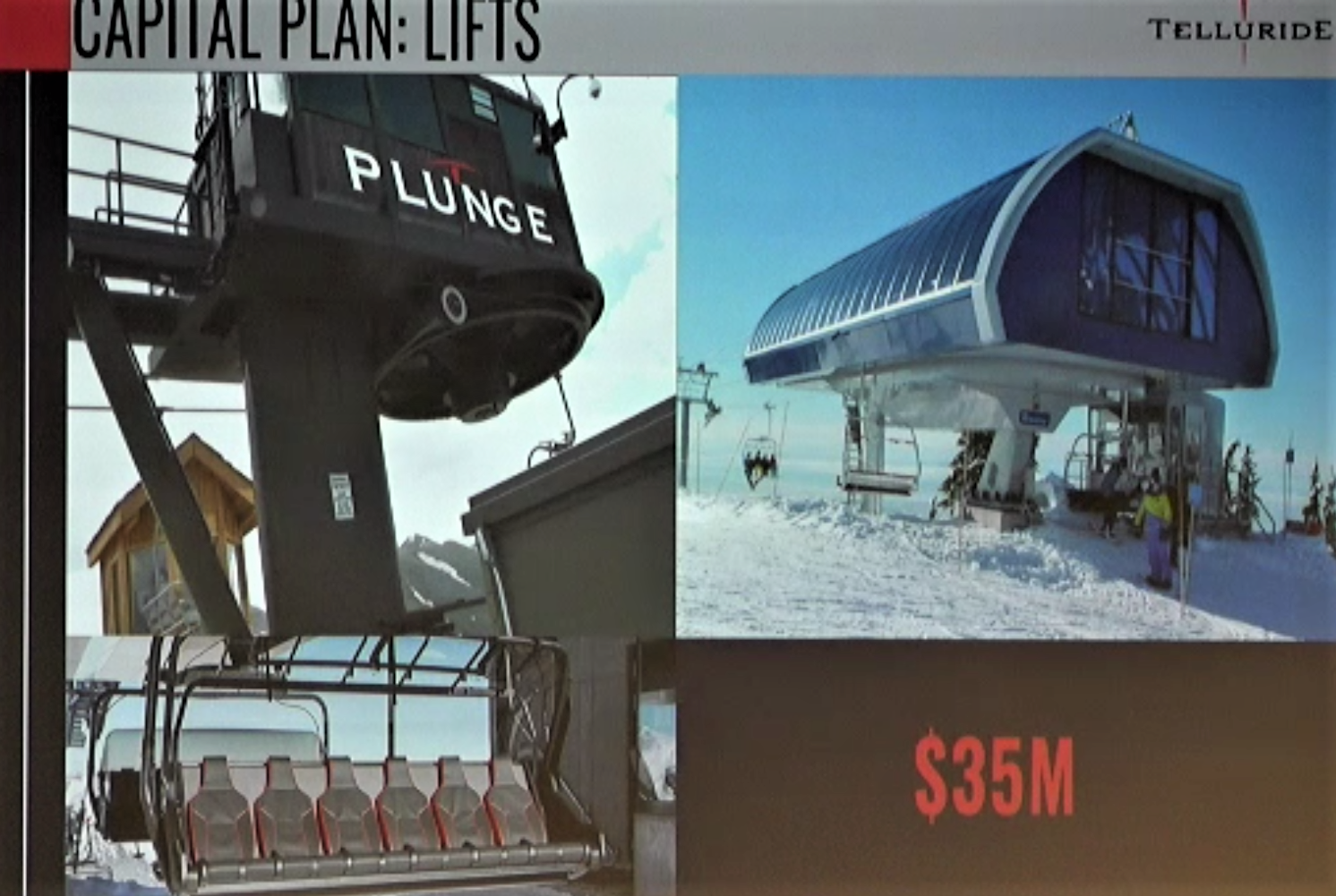
Another planned project that will surprise no one is a Plunge lift replacement. The existing 1985 CTEC triple has had a reduced hourly capacity of 1,042 pph ever since safety bars were installed, due to their added weight. At 6,260 feet slope length, a ride takes nearly 13 minutes. A 1,000 f.p.m. detachable quad is proposed to replace Plunge with an initial capacity of 1,800 pph and designed to reach 2,400.
Saddleback Mountain Foundation raises $750,000 towards the purchase of Maine’s second largest ski area which closed in 2015. The group plans to replace the Rangeley double and Cupsuptic T-Bar with new lifts and eventually expand with a new Magalloway lift.
A gondola cabin rises from Mountain Village towards the Town of Telluride. The transit system now operates into the fall each year in addition to winter and summer. Photo credit: Telluride Ski Resort
Twenty one years ago this December, a first-of-its kind gondola system opened between Telluride and Mountain Village in one of the world’s great mountain towns. The 3-stage Garaventa CTEC gondola cost $16 million to build but is completely free to ride. Thirty-nine million passengers later, this unique system operates 275 days each year and 19 hours per day. The lift features three haul ropes and cabins interline between sections 1 and 2, from Oak Street to Station St. Sophia and Mountain Village. Section 3 further connects Mountain Village Center to Station Village Parking. The Town of Mountain Village owns and operates the gondola (at a cost of $4 million a year) with funding from Telluride Ski & Golf, the Telluride Mountain Village Owners Association and San Miguel County. The parties in 1999 agreed to fund the gondola through 2027, but with over 100,000 operating hours the existing machine may not last until then.
To give you an idea how critical this transportation link has become to people who live, work and visit Telluride, dates of operation are announced three years in advance and a fleet of buses replaces gondola service whenever down time reaches 30 minutes or more. Custom lightning protection on towers maximizes up-time year round. The gondola’s aggressive operating schedule makes upgrading an aging system challenging. A $6 million overhaul completed in 2007 and 2008 replaced many of the systems moving parts in phases.
In 2014, the U.S. Department of Transportation agreed to fund an engineering study of the gondola due to its crucial role in public transportation. Not surprisingly, Doppelmayr submitted the winning bid to perform the study and released their findings last fall. The 239-page report looked at adding system capacity, transitioning to level walk-in boarding, replacing major components and/or rebuilding the entire system. Russ Oberlander of Doppelmayr concluded ultimately that, “past and continued maintenance, along with the capital replacements and upgrades of the Mountain Village Gondola system could allow the system to run indefinitely.”