Hello readers- for the next two weeks I am floating the Grand Canyon without access to the internet. I’ve scheduled a few posts for my absence, otherwise lift blogging will resume Nov. 5th –Peter from Flagstaff, Arizona.
Mexican President Enrique Peña Nieto inaugurates Mexicable today with free rides all week and an impressive span of service: 4:30 am to 11:00 pm. Mexicable also features the first Leitner DirectDrives in North America.
Three public agencies agree to fund $15,000 preliminary study of Austin’s Wire idea with results to be released in nine weeks. Hint: 19 stations is way too many.
El Paso’s Wyler Aerial Tramway, built in 1959, breaks down.
93 percent of the 3.8 million people who visited Banff National Park last year arrived in a personal car. Across North America in places like Yosemite, Glacier and Banff, resource managers are struggling to find transportation solutions amid record visitation and constrained capacity. Banff National Park is unique – a very popular town of the same name with 7,500 residents that lies in the middle of a 2,500-square mile park. In 2015, the Town of Banff saw the most visitors in at least the last 15 years, continuing its average growth rate of 1.8 percent per year. So far in 2016, the daily vehicle count in town exceeded its 24,000-car comfortable capacity on at least 48 occasions. More troubling, vehicle volume increased eight percent this summer and is projected to exceed 24,000 on 270 days a year by 2045, with a crush load of 40,000 vehicles on peak days. This is in a town smaller than two square miles surrounded by mountains.
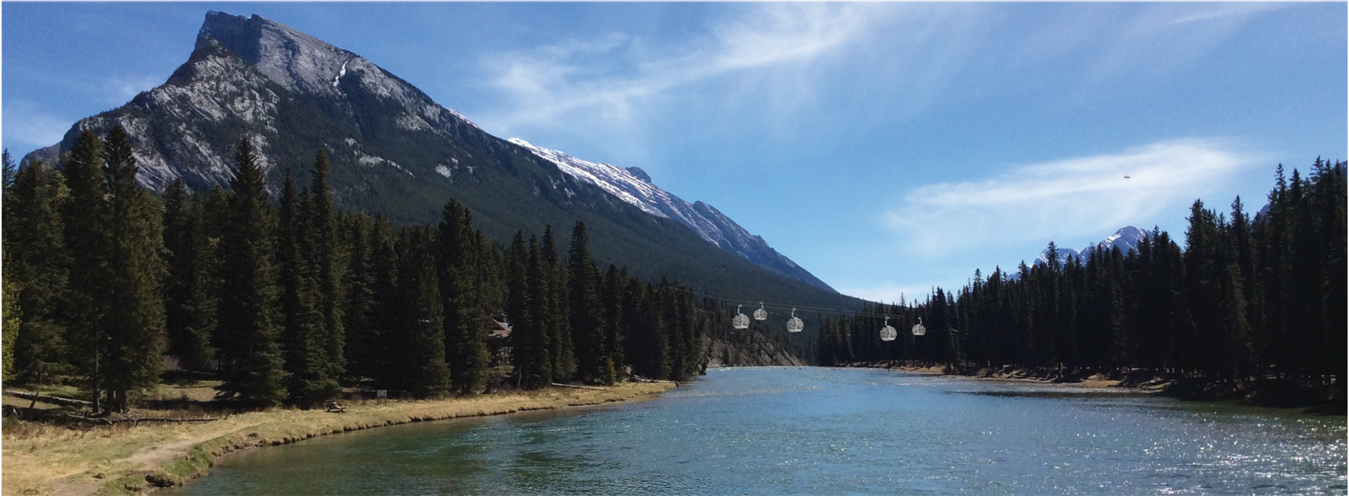
A 5-stage gondola from Banff Avenue towards Tunnel Mountain and the Banff Springs Hotel is proposed in a new study.
Challenging problems demand innovative solutions. This spring, the Town of Banff embarked on a long-term transportation study to examine parking, road improvements, traditional transit and a possible gondola to connect key points surrounding downtown. The Edmonton-based consulting company Stantec identified and studied three possible gondola alignments in addition to two intercept parking lots and increased bus service. The firm’s draft report notes, “without new interventions, congestion delays are expected to increase in both severity and frequency; Banff’s road system is finite and actions must be taken to solve the issues caused by the volume of vehicles on the road system.”
The Banff community knows gondolas. The Sulphur Mountain Gondola, a bi-cable Garaventa system operated by Brewster Travel Canada sits just south of town and will likely anchor the southern end of any new gondola. Sunshine Village ski resort also lies within Banff National Park and its huge gondola connects an offsite parking lot to the slopes and village with two mid-stations along the way.
A gondola in Banff, Alberta could connect key visitor destinations while reducing environmental impacts in the middle of Canada’s most popular national park.
Commuters in a Mexico City suburb will take their first flights on a two-stage, $26 million gondola system called Mexicable in a few short weeks on Monday, October 3rd. State of Mexico Governor Eruvio Ávila announced the city of Ecatepec will join the growing list of cities in the Americas building ropeways over congested neighborhoods. The Governor’s Facebook Live test run video has been watched more than 461,000 times. Mexico joins Brazil, Bolivia, Colombia, the Dominican Republic, Ecuador, Peru and Venezuela that operate (or will soon open) gondolas for urban commuters.
In Ecatepec, two loops will combine to serve seven stations and up to 3,000 passengers per hour in each direction. The State of Mexico and its private operators Grupo IUSA and ALFA Group awarded Leitner Ropeways a contract to build the two gondolas in January 2014 and construction began later that year. The lifts were largely completed in 2015 but station build-out and testing took longer than expected and the opening comes a few months late.
The new lifts will transit three miles over 32 towers in 17 minutes, replacing a bus line that takes 45 minutes. 185 10-passenger Sigma Diamond cabins painted in Mexico’s national colors will move up to 26,000 commuters each weekday. Line speed is 5 m/s and the span of service will be 17 hours per day. A ticket will cost eight pesos (43 cents) and the line will complement the Mexibus line 4, a 20-mile Bus Rapid Transit (BRT) line currently under construction.
Jared Ficklin and Michael McDaniel are co-creators of The Wire, a brand and concept for urban gondolas in what Forbes calls America’s next big boom town. Designers by trade, they began speaking about their vision to tech conferences and business groups in 2012, leading to a TED Talk in early 2013. If the lifts in Zillertal, Austria can move up to seven million people a day, they asked, why haven’t gondolas entered the transportation picture in our densest landscapes? The presentation was enthusiastically received and Jared gave it a second time at TEDx Kansas City in 2013 to a crowd of more than 4,000. Three years later, Jared and the team at argodesign are at work on a plan for Austin’s first line, Wire One. This week, Jared graciously answered my questions about the project and what comes next.
Peter: How did your background as a designer shape your vision for urban cable in Austin?
Jared: First it gave me access to amazing people like Michael McDaniel and the whole group of other designers that worked on the original Wire Vision for Austin at frog design. It also gives me more designers here at argodesign that are working on the current vision for the first pilot line in Austin, Wire One. It takes a group of designers to come up with something like The Wire, there has been many who contributed, they are all awesome.
Product design is my specialty and really good product design figures out how a technology seamlessly improves the lives of those using it. By contrast, often it seems modern transportation planning begins with a technology looking for a place to be, followed by hoping users will make use of it. As product designers, we came to urban cable from an experiential point of view arrived at using the tools of Design Research & Experience Based Design. After talking to users (people driving around the city) we saw that urban cable is a technology that matches closely the transportation experience Austinites and others in the U.S. are looking to have. Most importantly, urban cable with its unique fitment into the second story and ability to span obstacles can achieve routes people actually want to use. It does this without displacing routes they currently use. We call this principle of doubling the carrying capacity of a route Additive Supply. Culturally, urban cable also offers the personal space and quiet environment people said they would be comfortable in while allowing them to maintain their habits of transportation on demand (also known as not wanting to follow schedules.) By starting with the experience the rider is looking for, we hope to drive adoption and avoid unrealistic costs per rider that ultimately burden the community. I believe the most expensive form of mass transit you can build is the one that nobody uses.
Being a designer has given me a chance to work professionally on feasibility studies in partnership with Engineering Specialties Group and others. The experience of studying system feasibility have greatly clarified the current vision for The Wire. This will sound like a plug, but I mean it as advice to those undertaking this design and engineering challenge. Combining the skills of design research & product design with the traditional skills of architecture and engineering is a great mix for designing systems. That mix can bring to bear a full arsenal of knowledge allowing one to really study routing, ridership, cost & experience in very detailed fashion. Anyone doing any kind of transportation feasibility should seek out design researchers and really talk to users from a product standpoint. The end results of system deployments will improve.
Peter: Cities in South America, Europe and Asia have urban cable operating today. Which example globally is most similar to The Wire proposal?
Jared: Medellín, Caracas or La Paz. All are purpose-built as mass transit to connect neighborhoods with the city center. They leverage the ability to utilize eminent domain in the least intrusive manner to gain the most benefit per dollar on routes that have a meaningful impact. They considered cultural impact in their design yielding adoption and ridership. These are all things we have envisioned The Wire to have in Austin.
The White River National Forest conditionally approves new lifts at Arapahoe Basin including a Beavers chair, Zuma surface lift, replacements for Molly Hogan/Pallavicini and removal of Norway.
A consortium led by Poma beats out Doppelmayr in the bidding to build a two-stage urban gondola over water in Guayaquil, Ecuador with a second line in the works.
South America now makes up 17 percent of Doppelmayr’s global revenue, approximately equal to North America.
Peru’s President recently visited the ancient fortress of Kuelap, where Poma is 90 percent finished with a new 8-passenger gondola. The only problem? The haul rope hasn’t been installed yet. So crews slung cabins from towers for the Presidential photo-op to make it look closer to being done!
South American cities are world leaders in urban cable transport, with 24 urban gondolas either opened or planned in Bogotá, Caracas, Guayaquil, La Paz, Lima, Medellín and Rio de Janeiro. I’ve written extensivelyaboutLa Paz, Bolivia’s capital that went all in on cable transport with eleven gondolas either operating, under construction or planned. But a full decade before the creation of Mi Teleférico in La Paz, Metro de Medellín opened the first of three Metrocable gondola lines in Colombia’s third largest city. Metrocable Line K was the first urban gondola to seamlessly link with a subway anywhere in the world, providing under-served and poor neighborhoods access to the city’s transport network. Metrocable’s J, K and L lines, with ten stations over 5.8 miles, now compose a quarter of the Metro de Medellín network. All three Metrocable lines are 8-passenger monocable gondolas built by Poma.
Line K debuted in 2004 with a shockingly low construction cost of $26 million. Its four stations branch off from the Acevedo Metro station over a length of 6,798 feet, giving three neighborhoods access to the core subway Line A that opened in 1996. This gondola rises 1,309 feet with a rope speed of 5 m/s. Metrocable Line J opened in 2008 at a cost of $47.5 million, serving four more stations from the terminus of the shorter subway Line B. Line J is longer than the original K at just under 9,000 feet. A ride with seamless transfers between buses, two Metro subway lines and two Metrocable lines costs less than a dollar.
Medellín’s Metro system features two subway lines and three Metrocable lines with two more under construction.
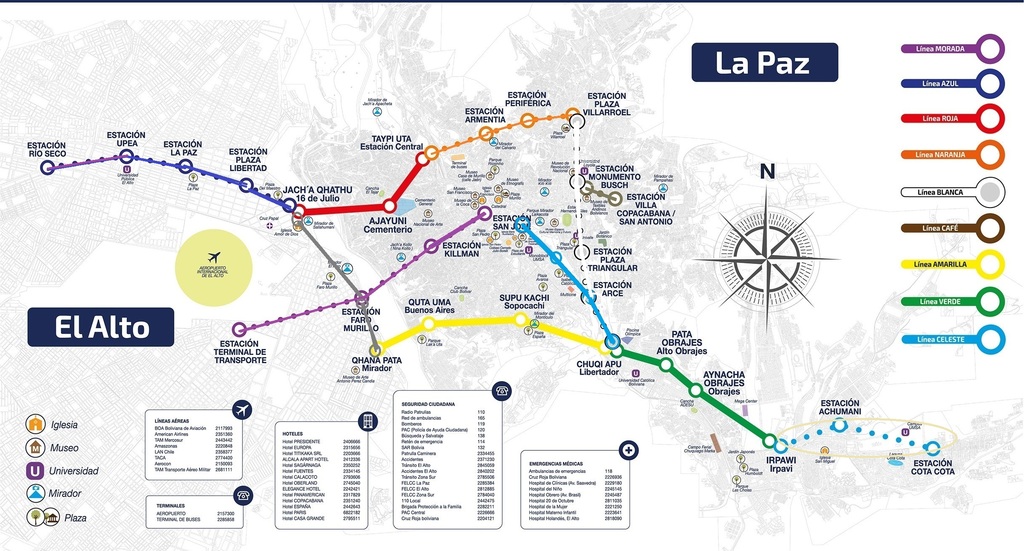
The urban ropeway revolution will continue in Bolivia’s capital city of La Paz, where President Evo Morales announced Friday an 11th gondola line, LineaCeleste (Sky Blue Line) will join the Mi Teleférico gondola network. La Paz and the neighboring city of El Alto announced the Red, Yellow and Green gondola lines in 2012 and the world’s largest urban gondola system opened throughout 2014. President Morales unveiled plans for phase two with six more lines in 2015 with another added to the mix last February. All 11 lines will be 10-passenger monocable detachable gondolas built by Doppelmayr. This latest investment of $110 million comes on top of $234 million for phase one and $450 million for the first six lines of phase two.
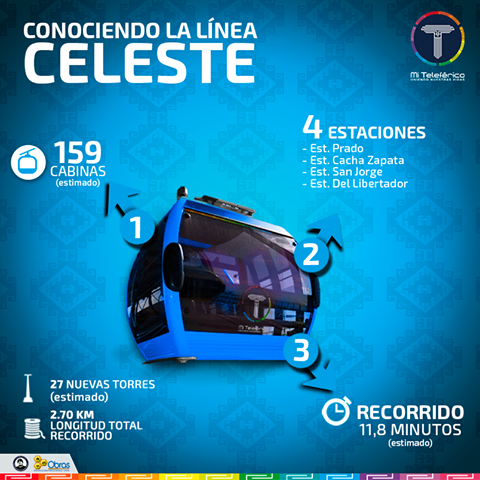
The Sky Blue branch will stretch nearly 9,000 linear feet with four stations, 27 towers and 159 CWA 10-passenger cabins. It is expected to be the busiest line in the system, serving the heart of the city and up to 4,000 passengers per hour at six meters per second. The three existing lines operate at up to 5 m/s. A trip from end to end on Linea Cileste will take 11.8 minutes. A line previously dubbed Sky Blue will now be known as the Gold Line. At the current rate, Mi Teleférico is going to run out of colors soon!
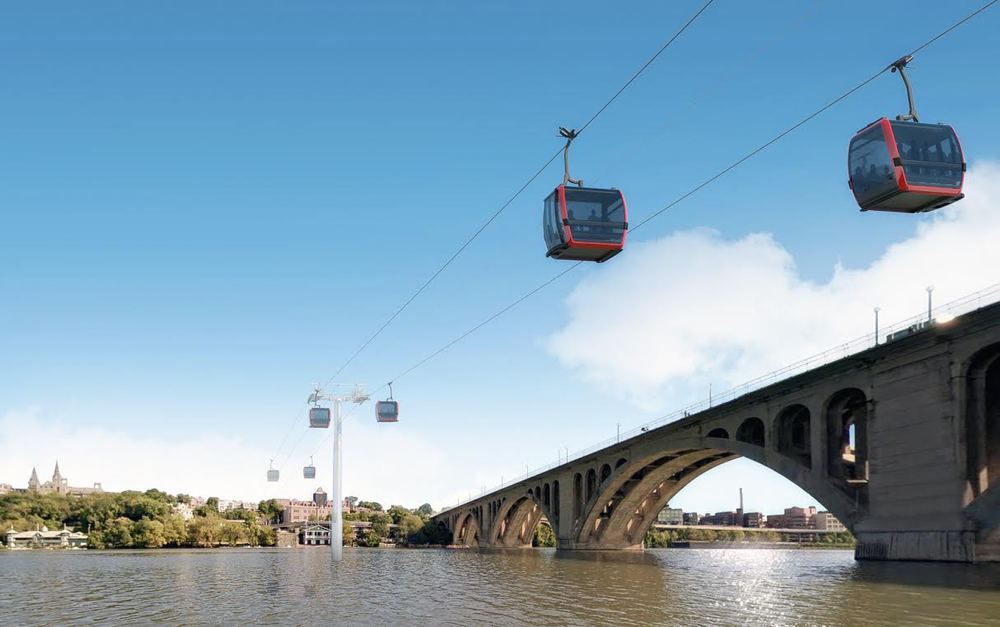
ZGF Architects will lead a team of professionals to study a possible gondola link between the Georgetown neighborhood in D.C. and Rosslyn, Virginia.
Washington, D.C. is inching closer to building the first urban transit gondola in the nation. A team of consultants let by ZGF Architects held an open house last week to update the public on the feasibility study underway for the Georgetown-Rosslyn Gondola proposed to cross the Potomac River. ZGF, whose mission is to “create beautiful spaces that best serve people and the community,” was chosen this spring from eight teams who bid on the study. Local governments, Georgetown University and private-sector businesses have dedicated $190,000 to the project to date.
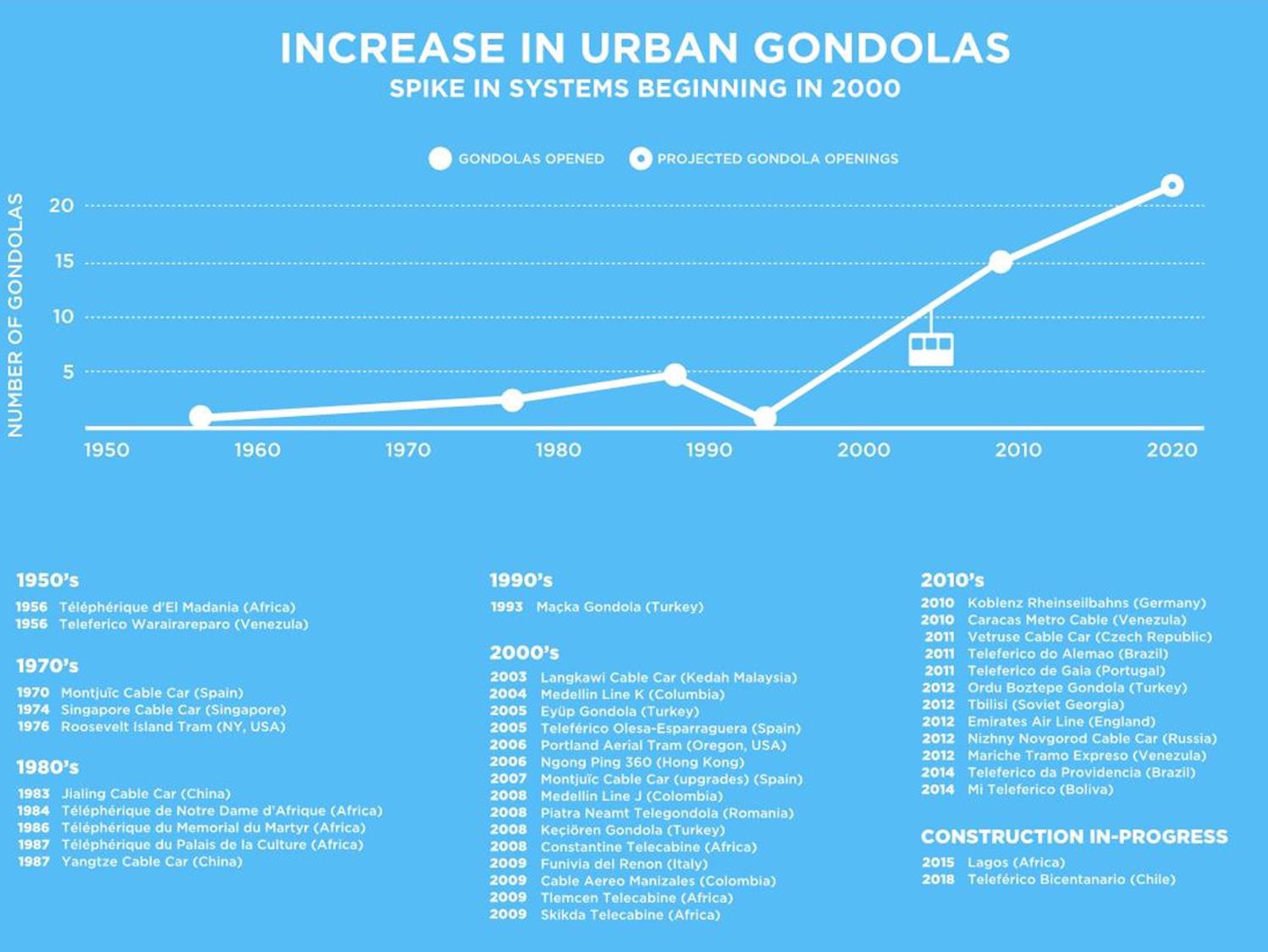
Staff presented this graphic showing the rapid growth of gondolas in cities across the globe.
At the meeting, project staff presented a Gondola 101 primer and chronicled the rise of urban cable transport globally. The presentation even included pictures from my lift database! Slides were impressively researched and something I wish every American city-dweller could sit through – explaining angle stations, towers and cabin spacing in an easy to understand way. Staff detailed four case studies: the Portland Aerial Tram, Roosevelt Island Tramway, Emirates Air Line and South American systems in La Paz and Medellín. After the formal program, community members got to check out five stations with display boards and ask questions.



 Lift Blog