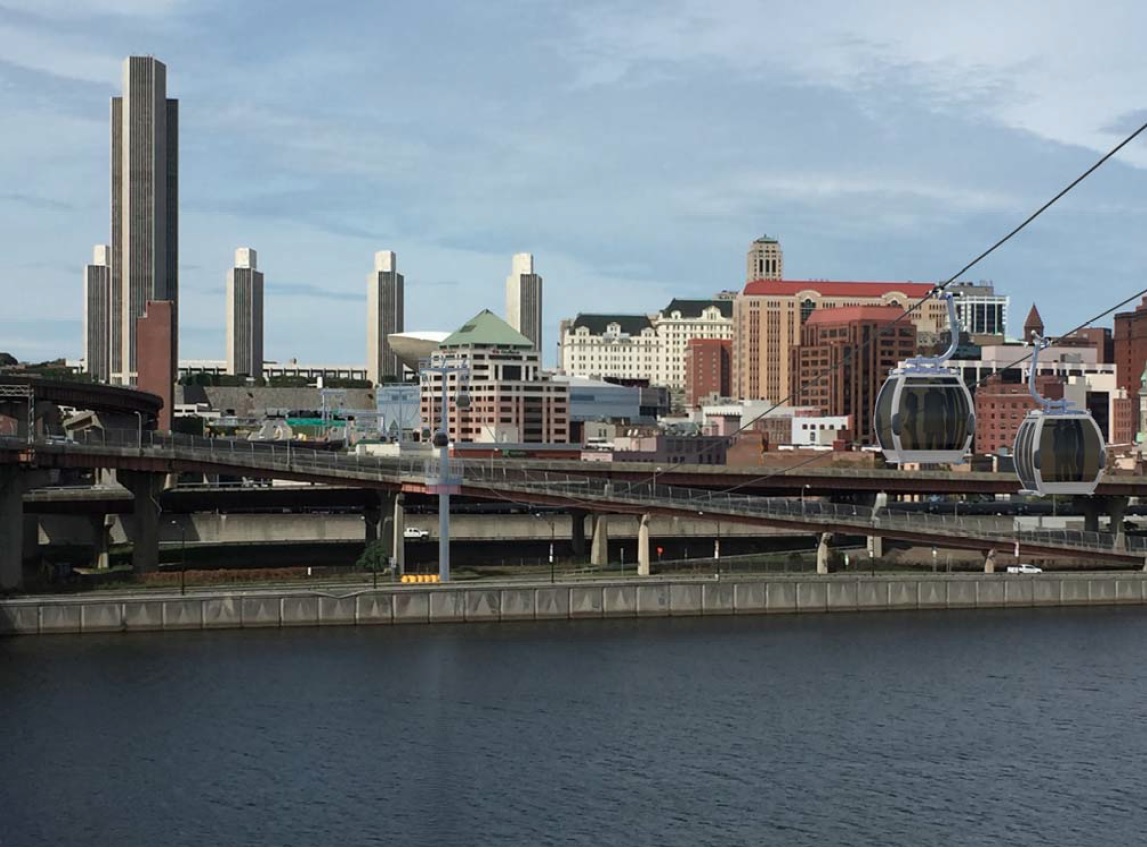
Doppelmayr and McClaren Engineering Group recently completed a feasibility study for a proposed Capital District Gondola connecting Albany and Rensselaer, NY over the Hudson River.
Two months after Doppelmayr and McLaren Engineering Group launched one of the world’s most complex gondola systems at Wynn Palace Cotai, the two companies have teamed up again on a wholly different project spanning the Hudson River in Albany, New York. McLaren Engineering, headquartered in the region, and Doppelmayr, with an office in nearby Ballston Spa, self-funded the study.
A team of six professionals engaged with stakeholders over the past three months, culminating in the document’s release this week. The gondola would connect America’s 9th busiest Amtrak station with Downtown Albany utilizing a mid-station and possible angle change. Because it has all the components of a successful urban system – key points separated by a natural barrier over a modest distance – the study results are very positive. “After three months, the Project Team finds the CDG to be feasible,” the authors note. “It retains the potential of being a transformational project that will spark increased mobility, tourism, and economic development in two areas of the cities of Albany and Rensselaer that are currently underdeveloped.”
Future Rensselaer Amtrak Capital Gondola station with enhanced station design.
Albany’s train station moved across the river to Rensselaer in the late 1960s, separating the city from its major transit hub. Goals of the gondola project include addressing the physical separation, providing a new pedestrian and bicycle connection and improving quality of life in the Capital District.
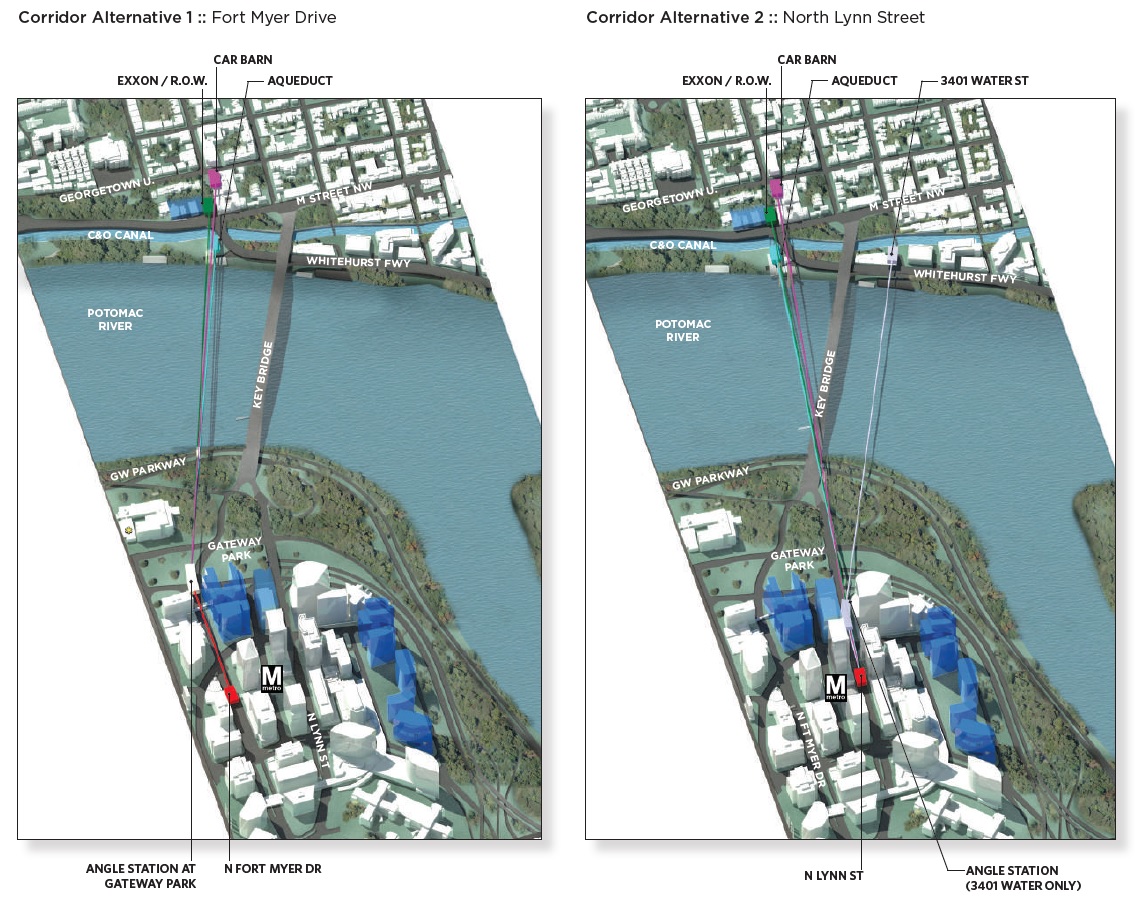
At least 6,500 people would ride a a proposed gondola from Washington’s Georgetown neighborhood to Rosslyn, Virginia daily, according to a long-awaited study released last week. ZGF Architects and Engineering Specialties Group consulted with more than 20 federal, state and local agencies along with Georgetown University and local residents. Not only is the project technically feasible, it would improve mobility for residents and visitors while positively impacting the region’s economy. The system would cost $80-90 million, expensive by gondola standards, and take approximately six years years to open.
A look at 15 possible alignments yielded two preferred alternatives. Most require an angle station in public right of way on the Virginia side of the Potomac at an added cost in the neighborhood of $7 million. Both of the above lines terminate adjacent to the Rosslyn Metro Station and the southeastern corner of the Georgetown U. campus. Towers in or adjacent to the river would be 130-150 tall to allow vessels to pass below and give riders a compelling view over the Key Bridge.
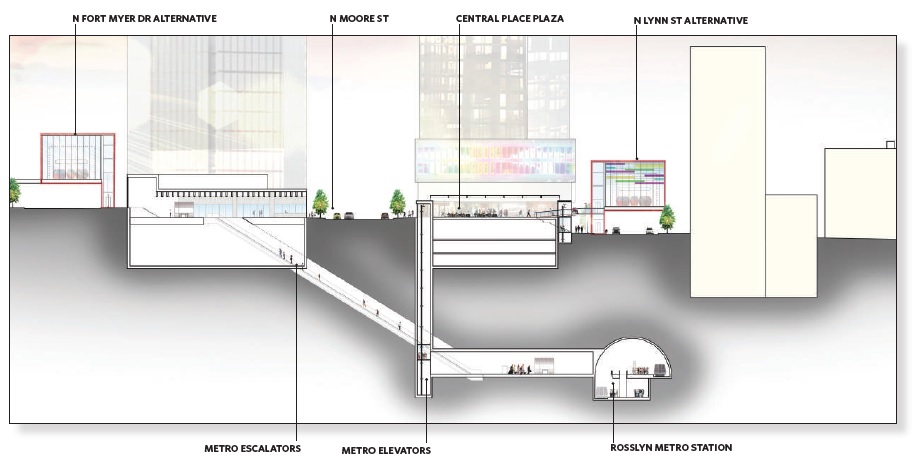
Pedestrian connections from the Rosslyn Metro Station to above ground gondola station options.
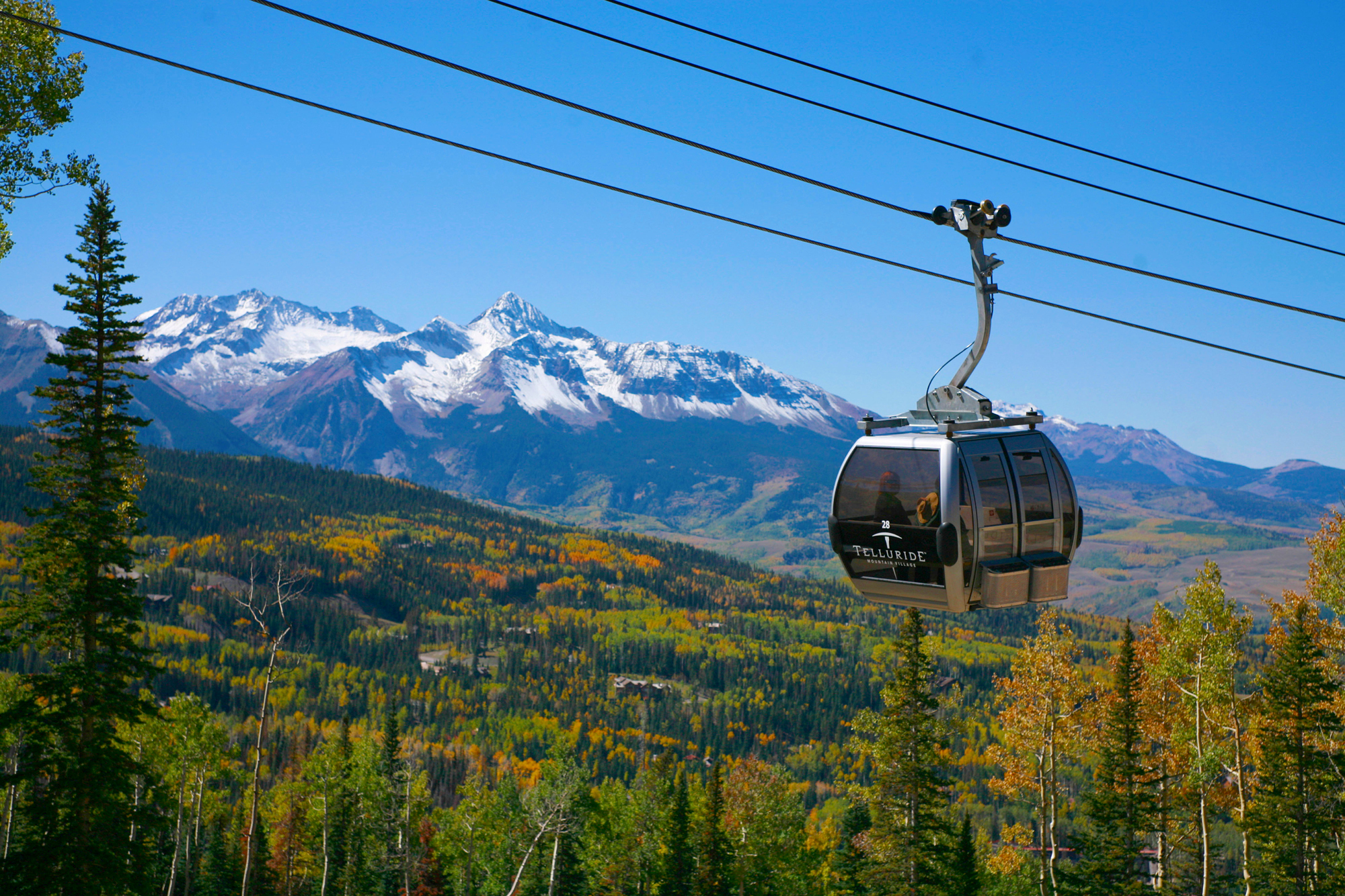
A gondola cabin rises from Mountain Village towards the Town of Telluride. The transit system now operates into the fall each year in addition to winter and summer. Photo credit: Telluride Ski Resort
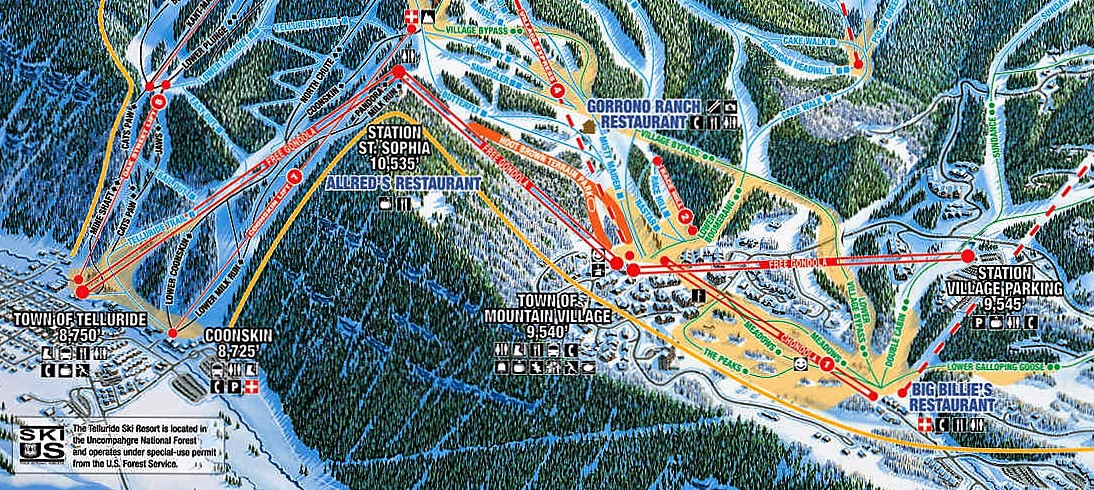
Twenty one years ago this December, a first-of-its kind gondola system opened between Telluride and Mountain Village in one of the world’s great mountain towns. The 3-stage Garaventa CTEC gondola cost $16 million to build but is completely free to ride. Thirty-nine million passengers later, this unique system operates 275 days each year and 19 hours per day. The lift features three haul ropes and cabins interline between sections 1 and 2, from Oak Street to Station St. Sophia and Mountain Village. Section 3 further connects Mountain Village Center to Station Village Parking. The Town of Mountain Village owns and operates the gondola (at a cost of $4 million a year) with funding from Telluride Ski & Golf, the Telluride Mountain Village Owners Association and San Miguel County. The parties in 1999 agreed to fund the gondola through 2027, but with over 100,000 operating hours the existing machine may not last until then.
To give you an idea how critical this transportation link has become to people who live, work and visit Telluride, dates of operation are announced three years in advance and a fleet of buses replaces gondola service whenever down time reaches 30 minutes or more. Custom lightning protection on towers maximizes up-time year round. The gondola’s aggressive operating schedule makes upgrading an aging system challenging. A $6 million overhaul completed in 2007 and 2008 replaced many of the systems moving parts in phases.
In 2014, the U.S. Department of Transportation agreed to fund an engineering study of the gondola due to its crucial role in public transportation. Not surprisingly, Doppelmayr submitted the winning bid to perform the study and released their findings last fall. The 239-page report looked at adding system capacity, transitioning to level walk-in boarding, replacing major components and/or rebuilding the entire system. Russ Oberlander of Doppelmayr concluded ultimately that, “past and continued maintenance, along with the capital replacements and upgrades of the Mountain Village Gondola system could allow the system to run indefinitely.”
93 percent of the 3.8 million people who visited Banff National Park last year arrived in a personal car. Across North America in places like Yosemite, Glacier and Banff, resource managers are struggling to find transportation solutions amid record visitation and constrained capacity. Banff National Park is unique – a very popular town of the same name with 7,500 residents that lies in the middle of a 2,500-square mile park. In 2015, the Town of Banff saw the most visitors in at least the last 15 years, continuing its average growth rate of 1.8 percent per year. So far in 2016, the daily vehicle count in town exceeded its 24,000-car comfortable capacity on at least 48 occasions. More troubling, vehicle volume increased eight percent this summer and is projected to exceed 24,000 on 270 days a year by 2045, with a crush load of 40,000 vehicles on peak days. This is in a town smaller than two square miles surrounded by mountains.
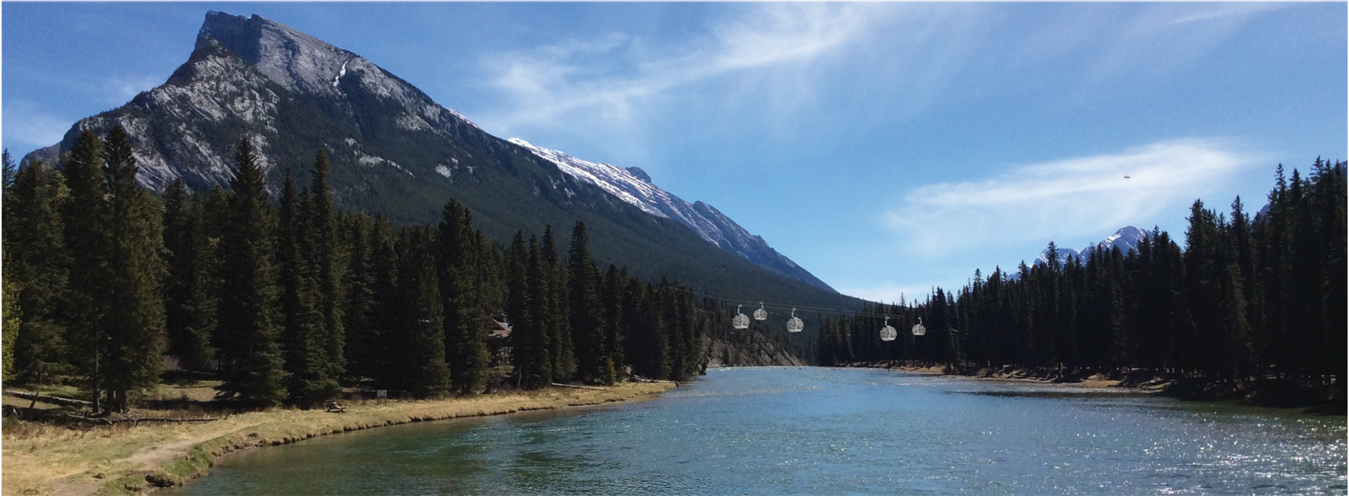
A 5-stage gondola from Banff Avenue towards Tunnel Mountain and the Banff Springs Hotel is proposed in a new study.
Challenging problems demand innovative solutions. This spring, the Town of Banff embarked on a long-term transportation study to examine parking, road improvements, traditional transit and a possible gondola to connect key points surrounding downtown. The Edmonton-based consulting company Stantec identified and studied three possible gondola alignments in addition to two intercept parking lots and increased bus service. The firm’s draft report notes, “without new interventions, congestion delays are expected to increase in both severity and frequency; Banff’s road system is finite and actions must be taken to solve the issues caused by the volume of vehicles on the road system.”
The Banff community knows gondolas. The Sulphur Mountain Gondola, a bi-cable Garaventa system operated by Brewster Travel Canada sits just south of town and will likely anchor the southern end of any new gondola. Sunshine Village ski resort also lies within Banff National Park and its huge gondola connects an offsite parking lot to the slopes and village with two mid-stations along the way.
A gondola in Banff, Alberta could connect key visitor destinations while reducing environmental impacts in the middle of Canada’s most popular national park.
The Staten Island Economic Development Corporation selected this design by Leitner-Poma to move forward as part of a proposed connection to Manhattan.
New York City’s iconic Roosevelt Island Tramway could soon be joined by a gondola linking Staten Island to Bayonne, New Jersey serving commuters and tourists alike. Staten Island has all the ingredients for a successful urban gondola: a dense (and growing) population, a geographic barrier surmountable by cable, and connections to other transit modes at both ends. This week, the Staten Island Economic Development Corporation (SIEDC) crowned Leitner-Poma of America the winner of a design competition it launched in January to promote a ropeway solution. A jury of engineers, architects and business leaders selected Leitner-Poma’s 10-passenger gondola proposal that would cross the Kill Van Kull tidal strait to New Jersey.
In its request for proposals, the nonprofit development corporation floated four possible alignments for a gondola to serve Staten Island.
According to the development group’s request for proposals, subway-less Staten Islanders suffer from some of the longest commutes in the country, averaging 90 minutes to Manhattan by ferry. A new rail tunnel under New York Harbor is estimated to cost $400 million per mile and would not be completed for a generation, if ever. Despite mobility challenges, $1 billion of redevelopment is currently underway in this suburban borough. The SIEDC’s competition encompassed 4-6 possible routes, the most ambitious of which would connect Staten Island’s northeast tip with Battery Park in Manhattan over five miles of water.
Leitner-Poma recognized the technical and political challenges of 10,000-foot spans skirting the Statue of Liberty over New York Harbor and instead settled on a shorter connection to New Jersey and its rail network. Other entrants chose routes from Staten Island to Brooklyn, where the East River Skyway is separately proposed to connect to Manhattan.
If Don McClean gets his way, Steamboat Springs will have a third ski area again in a little over a year at the site of the largest ski resort failure in American history. His company, Stagecoach Communities LLC, is under contract to buy the Stagecoach property by October and plans to rebuild the ski area that opened in 1972 and closed less than two years later. Mr. McClean has 38 years of ski industry experience working at Alyeska, Telluride, Beaver Creek and Vail. “Our intention is to create a blueprint for responsible mountain development,” he told the Routt County Planning Commission. Investors include Bode Miller and others from the Vail Valley and Steamboat Springs. Two new Doppelmayr quad chairs are planned for next summer.
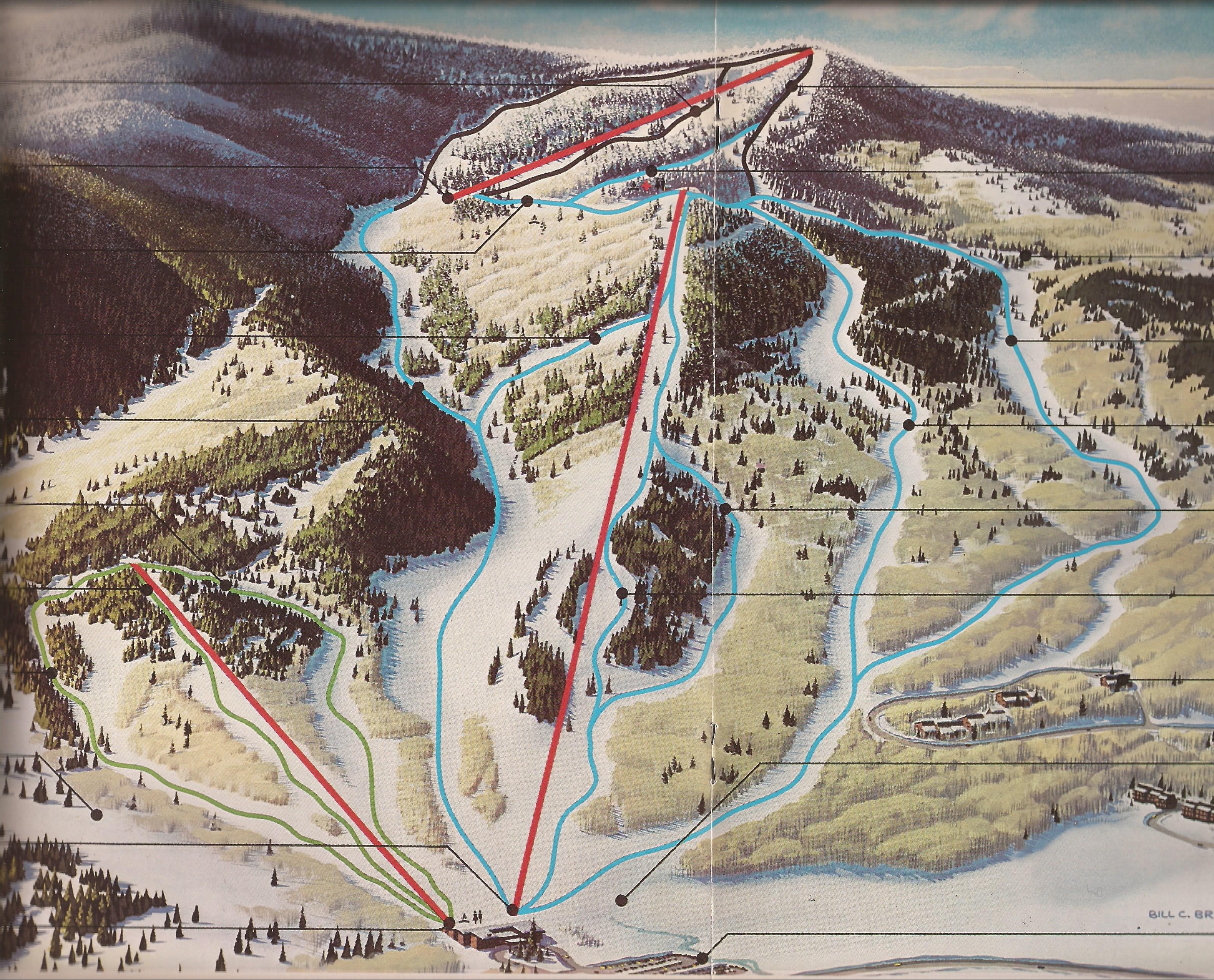
The old Stagecoach opened with three Heron-Poma double chairs in December 1972. It closed in March 1974 when its creditor abruptly pulled financing. The main lift named Big Hitch was relocated to Granby Ranch in 1988 before being moved again to Winter Park and eventually replaced by the Panoramic Express in 2007. Two other chairlifts, Little Hitch and Yellow Jacket Express, remain standing on the site and will be removed. A new high speed quad will replace Big Hitch in a similar alignment and a fixed-grip quad will reach the summit along the former Yellow Jacket Express route.
Mr. McClean surprised the County Planning Commission Thursday with plans to build temporary base facilities along with a high speed quad and fixed-grip quad on the 3,500-acre property that lies 18 miles south of Steamboat. He addresses the Commission starting at 99:45 of the Sept. 1st meeting which can be heard here. McClean noted, “[Stagecoach] will be a ski area built by skiers for skiers and riders.” Doppelmayr has already visited the site and bid the two lifts that will serve 2,200 vertical feet. The existing landowner, the Wittemyer Family, is working on the ski trails and mountain roads this fall. “It’s ready to go.” McClean said.
Big Sky Resort plans to build the most high-speed, high-tech lift network in North America over the next ten years, the company announced at media event this afternoon. Boyne Resorts Principal Stephen Kircher outlined Big Sky 2025, a $150 million road map for capital investment that includes a new North Village gondola, replacement of core lifts with bubble six-packs and additional lifts to serve new terrain. Enhanced snowmaking, new on-mountain dining and improvements to the Mountain Village will complement the massive investment in new lifts.
The rise of Big Sky from Chet Huntley’s four-lift outpost in 1973 to the Biggest Skiing in America with 26 lifts owes in large part to the Matterhorn-like mountain named Lone Peak. Boyne Resorts bought Big Sky in 1976 and slowly grew it into America’s largest ski resort by 2013 with the purchase of Moonlight Basin and the Spanish Peaks Mountain Club. Mr. Kircher noted none of the three mountains were financially sustainable in the 2000s and the uniting of the three has been transformative. Now with 5,800 acres of terrain, Boyne seeks to elevate the ski experience to match the grandeur of its mountain that is unmatched in North America. “We have a unique opportunity with the high alpine terrain here at Big Sky,” he noted.
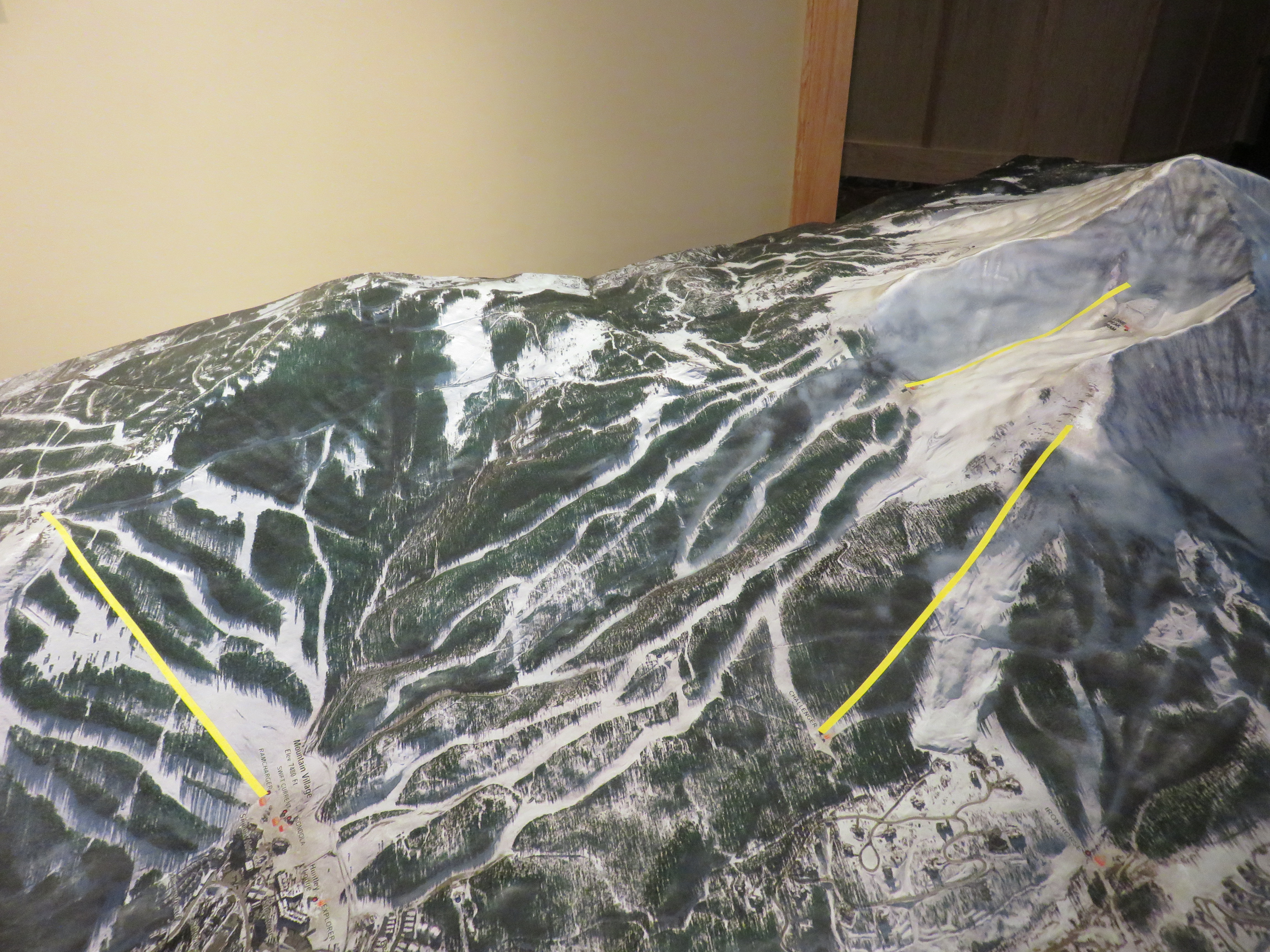
Phase one underway this summer includes the new Challenger Triple, Lone Peak Six and upgrades to Ramcharger and Lone Tree.
With $13 million of construction underway on the mountain, Big Sky Resort will operate the second third largest lift fleet in North America this winter behind Whistler Blackcomb and Park City. The sprawling complex already includes two six-packs, five detachable quads and the famous Lone Peak Tram. This summer’s new lifts are just the beginning of a plan that includes the return of a gondola and ten more lifts (eight with bubbles) within existing boundaries and beyond. Big Sky 2025 will transition the resort from one with nearly the most lifts to one with the best lifts featuring loading carpets, bubble chairs, head rests and heated seats that skiers have become accustomed to in Austria and Switzerland but rarely find in the States.
Jared Ficklin and Michael McDaniel are co-creators of The Wire, a brand and concept for urban gondolas in what Forbes calls America’s next big boom town. Designers by trade, they began speaking about their vision to tech conferences and business groups in 2012, leading to a TED Talk in early 2013. If the lifts in Zillertal, Austria can move up to seven million people a day, they asked, why haven’t gondolas entered the transportation picture in our densest landscapes? The presentation was enthusiastically received and Jared gave it a second time at TEDx Kansas City in 2013 to a crowd of more than 4,000. Three years later, Jared and the team at argodesign are at work on a plan for Austin’s first line, Wire One. This week, Jared graciously answered my questions about the project and what comes next.
Peter: How did your background as a designer shape your vision for urban cable in Austin?
Jared: First it gave me access to amazing people like Michael McDaniel and the whole group of other designers that worked on the original Wire Vision for Austin at frog design. It also gives me more designers here at argodesign that are working on the current vision for the first pilot line in Austin, Wire One. It takes a group of designers to come up with something like The Wire, there has been many who contributed, they are all awesome.
Product design is my specialty and really good product design figures out how a technology seamlessly improves the lives of those using it. By contrast, often it seems modern transportation planning begins with a technology looking for a place to be, followed by hoping users will make use of it. As product designers, we came to urban cable from an experiential point of view arrived at using the tools of Design Research & Experience Based Design. After talking to users (people driving around the city) we saw that urban cable is a technology that matches closely the transportation experience Austinites and others in the U.S. are looking to have. Most importantly, urban cable with its unique fitment into the second story and ability to span obstacles can achieve routes people actually want to use. It does this without displacing routes they currently use. We call this principle of doubling the carrying capacity of a route Additive Supply. Culturally, urban cable also offers the personal space and quiet environment people said they would be comfortable in while allowing them to maintain their habits of transportation on demand (also known as not wanting to follow schedules.) By starting with the experience the rider is looking for, we hope to drive adoption and avoid unrealistic costs per rider that ultimately burden the community. I believe the most expensive form of mass transit you can build is the one that nobody uses.
Being a designer has given me a chance to work professionally on feasibility studies in partnership with Engineering Specialties Group and others. The experience of studying system feasibility have greatly clarified the current vision for The Wire. This will sound like a plug, but I mean it as advice to those undertaking this design and engineering challenge. Combining the skills of design research & product design with the traditional skills of architecture and engineering is a great mix for designing systems. That mix can bring to bear a full arsenal of knowledge allowing one to really study routing, ridership, cost & experience in very detailed fashion. Anyone doing any kind of transportation feasibility should seek out design researchers and really talk to users from a product standpoint. The end results of system deployments will improve.
Peter: Cities in South America, Europe and Asia have urban cable operating today. Which example globally is most similar to The Wire proposal?
Jared: Medellín, Caracas or La Paz. All are purpose-built as mass transit to connect neighborhoods with the city center. They leverage the ability to utilize eminent domain in the least intrusive manner to gain the most benefit per dollar on routes that have a meaningful impact. They considered cultural impact in their design yielding adoption and ridership. These are all things we have envisioned The Wire to have in Austin.
Oberto Oberti is a man who doesn’t give up. Less than two months after the province of British Columbia revoked authorization to build his controversial Jumbo Glacier Resort, Mr. Oberti won approval today to build a 12,000-acre ski resort in the Premier Mountains west of Jasper. The resort’s master plan lays out 16 lifts surrounding Mt. Pierre Trudeau, named for the father of Canadian Prime Minister Justin Trudeau. Mr. Oberti’s storied history in Canadian skiing includes designing Kicking Horse Mountain Resort, building resort hotels in Whistler and proposing Jumbo Glacier.
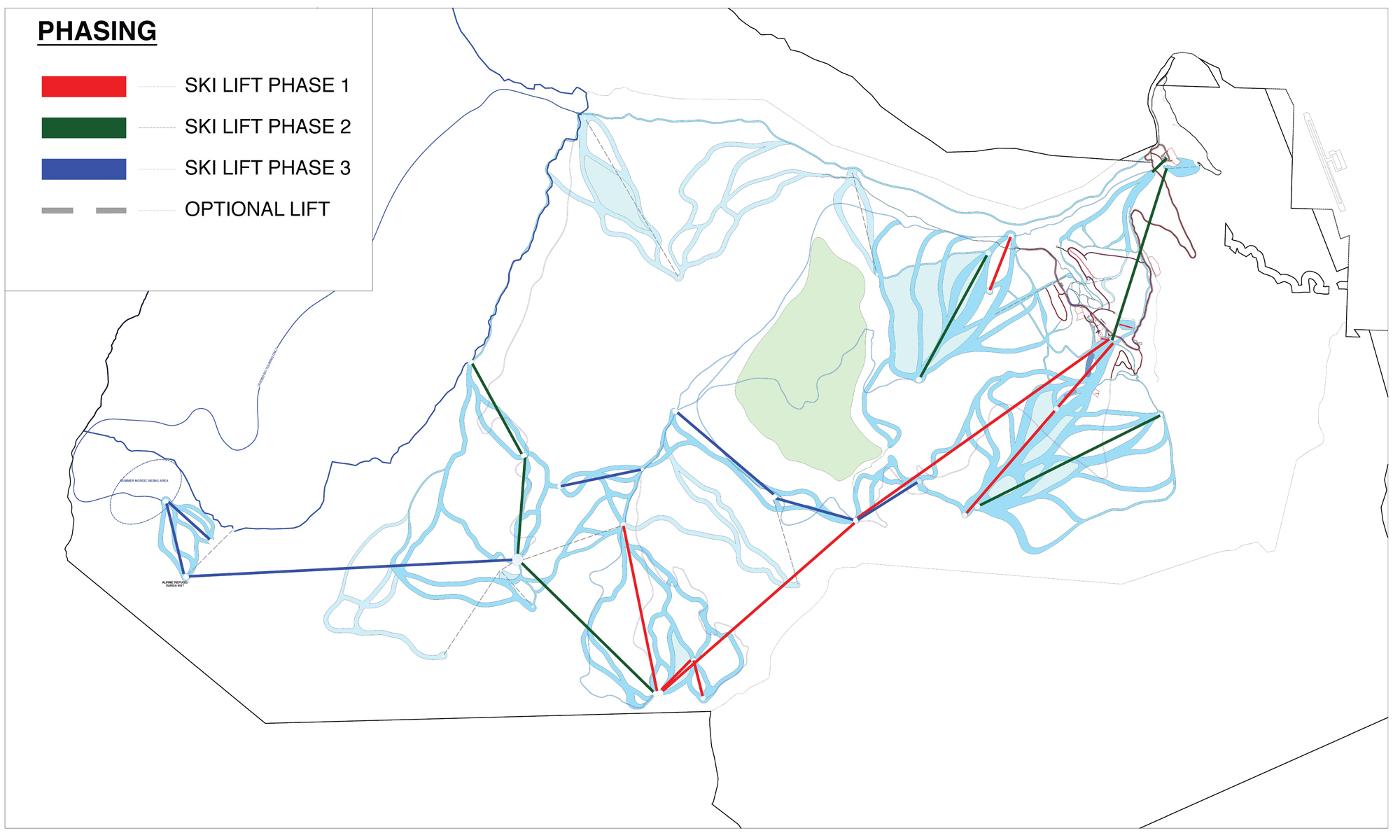
The lift layout envisions building 4 gondolas, 8 quad chairlifts and 4 T-Bars over ten years.
Valemount Glacier could eventually rise 7,415 vertical feet with the only lift-served, year-round glacier skiing on the continent. Its vertical drop would be third longest in the world, rivaled only by Zermatt and Chamonix. Total acreage could reach 12,348, nearly twice the size of the new Park City. “You have to picture this as a series of gondolas on mountains, one after another,” Mr. Oberti’s son Tommaso told Business Vancouver today. “Each mountain is taller than the preceding one.” Lifts could reach an elevation of 10,515 feet – 1,500 feet higher than Canada’s current loftiest lift at Sunshine Village.
Lefty’s Canyon from near the summit of Hidden Lake with the new Powder Mountain Village under construction earlier this summer. The Village Lift will rise through the trees in the center-right of this photo.
Powder Mountain will build new lifts in Mary’s Bowl and Lefty’s Canyon this fall if all goes according to plans filed with Weber County last month. The Village lift will be a Skytrac fixed-grip quad with a design capacity of 2,000 pph and line speed of 450 fpm. It will be 3,680′ long with a vertical rise of 582′, 105 chairs and 14 towers. A second lift called Mary’s will serve the other side of the new Summit Powder Mountain Village and top out near the Sunrise Platter. Design details for this lift have not yet been filed with the county but it will be similar in length and vertical to Village. “The plan is to have them open to the public and operating for this ski season,” Summit Powder Mountain COO Jeff Werbelow told the OgdenStandard-Examiner. Both lifts will be located entirely on private land but still must pass design review with Weber County. Future plans call for a third lift called Lefty’s linking the bottom of Village to the top of Sunrise.
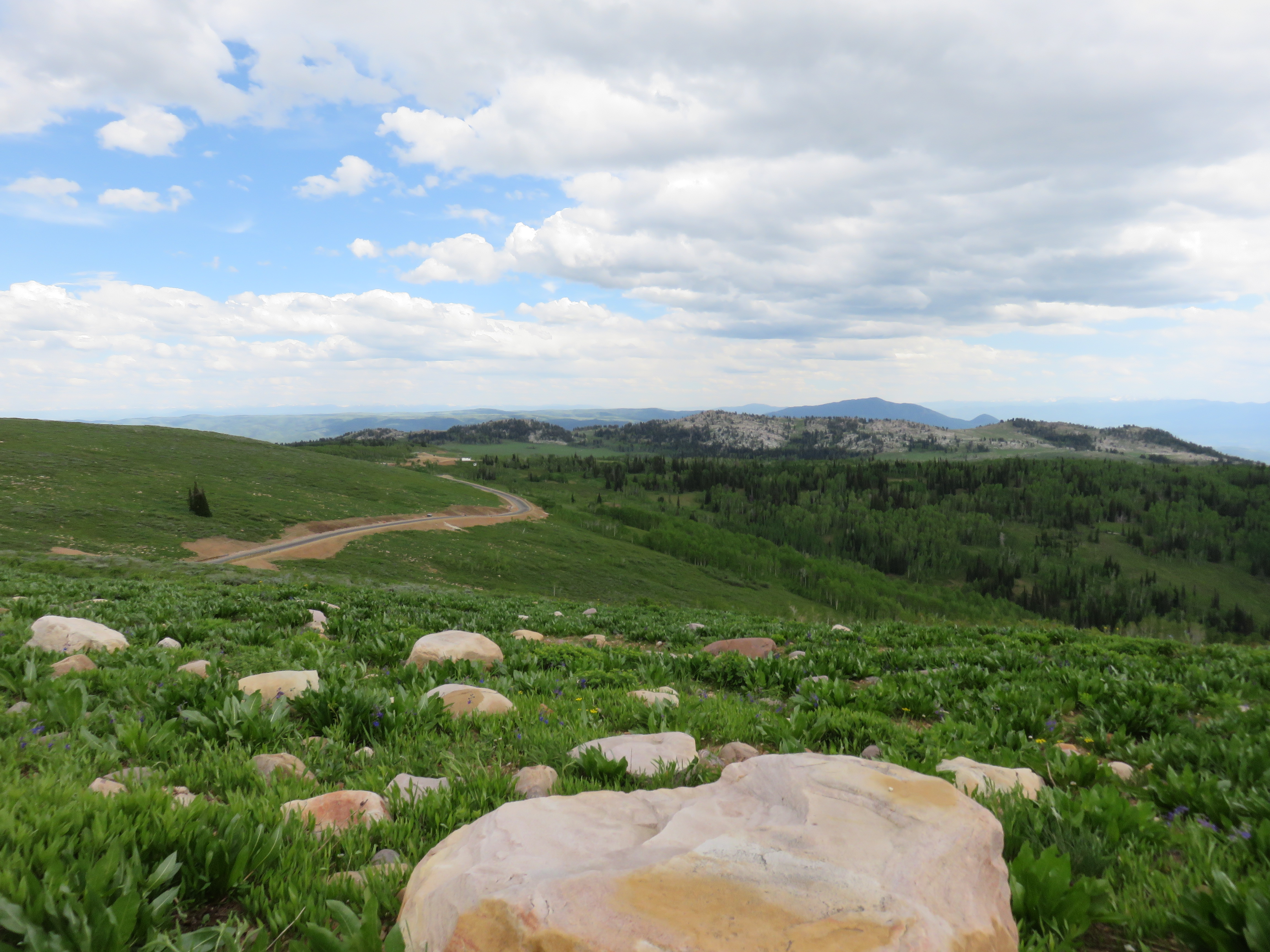
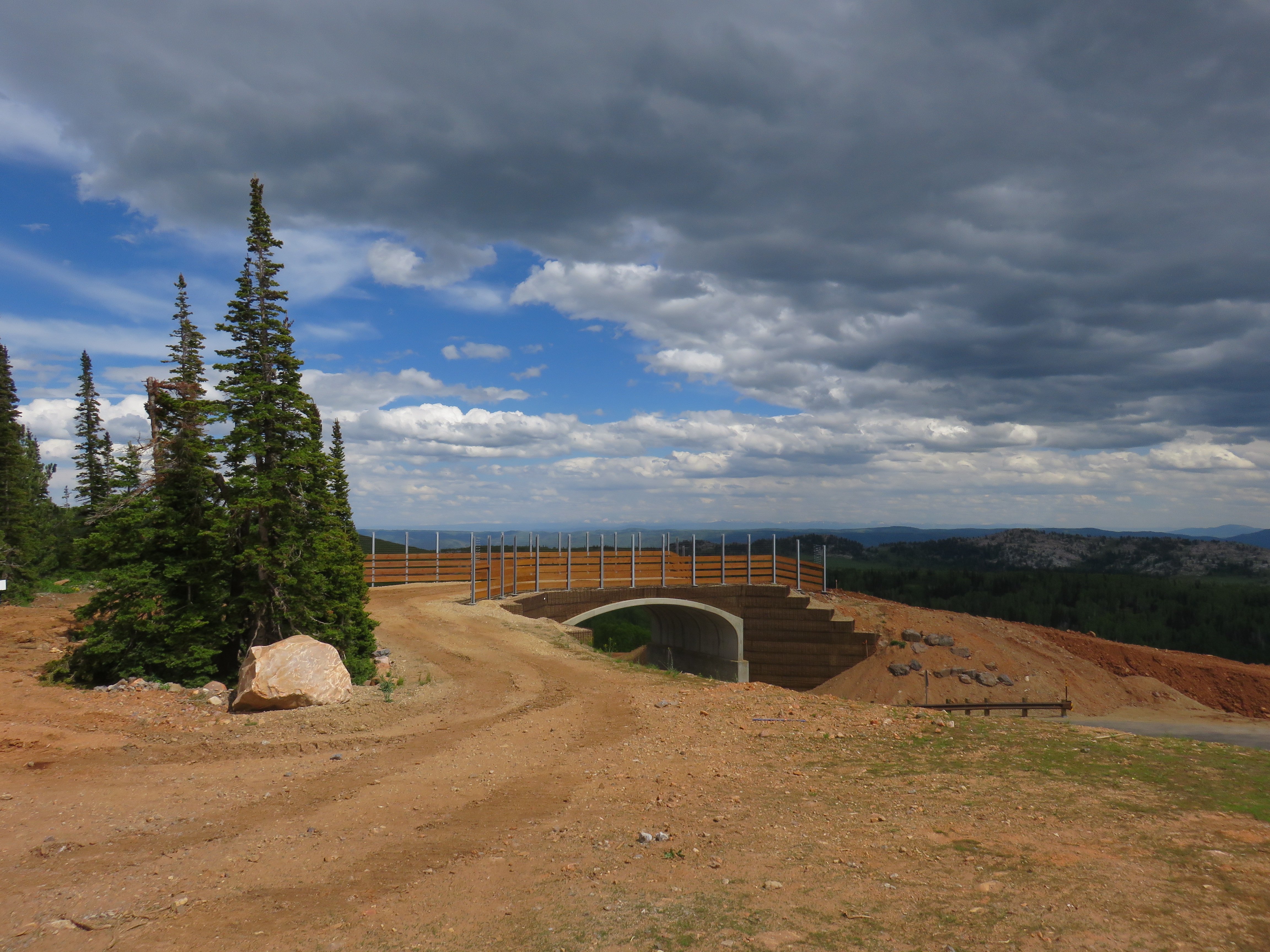
New runs and skier bridges have already been completed in Lefty’s Canyon.The new lifts will be behind the current ski area in areas not visible on Powder Mountain’s current trail map.
Skytrac will also build a new quad chair at Christmas Mountain Village, Wisconsin this fall, bringing the company to seven new lifts for 2016. Combined with Leitner-Poma, that makes 18 new lift projects in North America compared with 17 for Doppelmayr thus far. You can see a full rundown of new lifts for 2016 here.










 Lift Blog