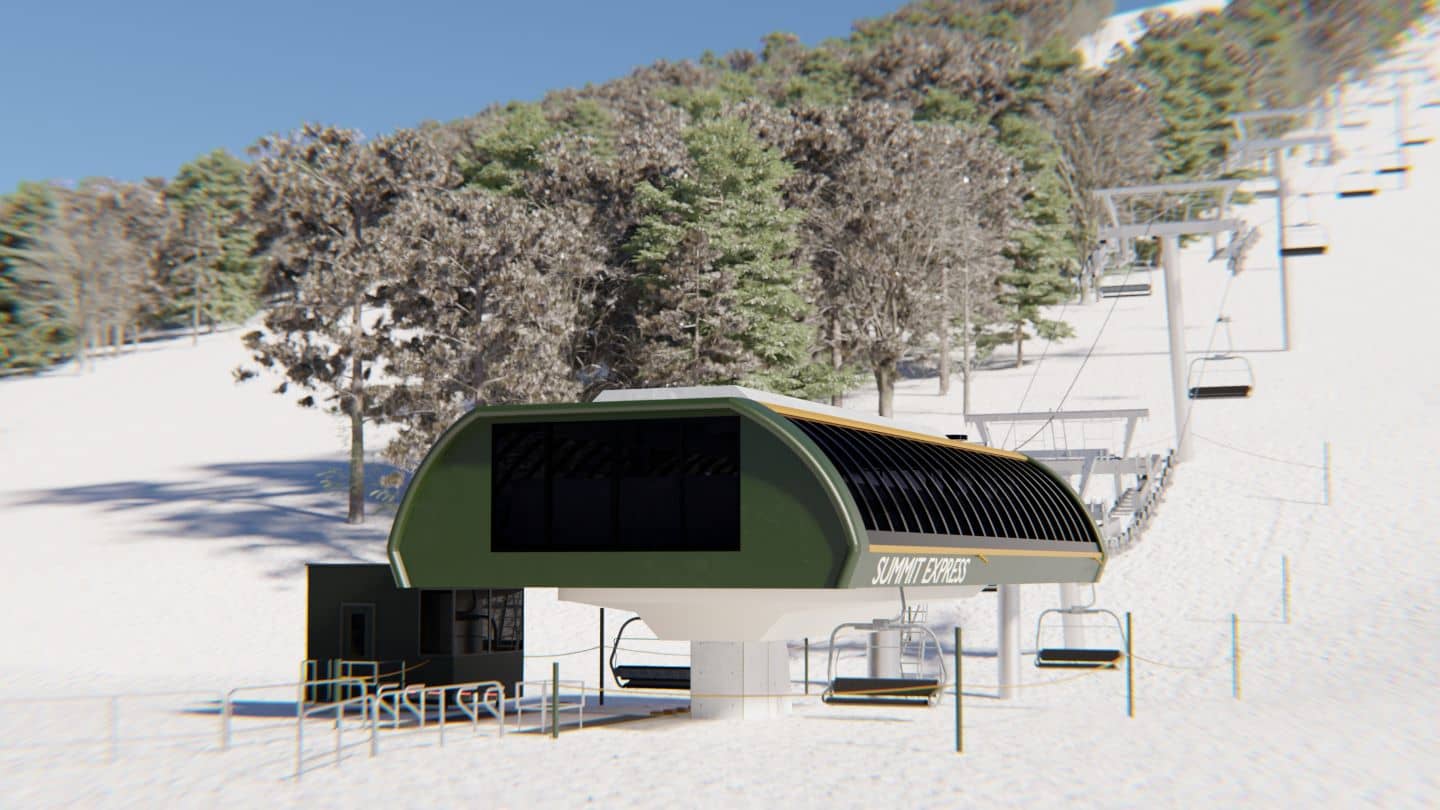
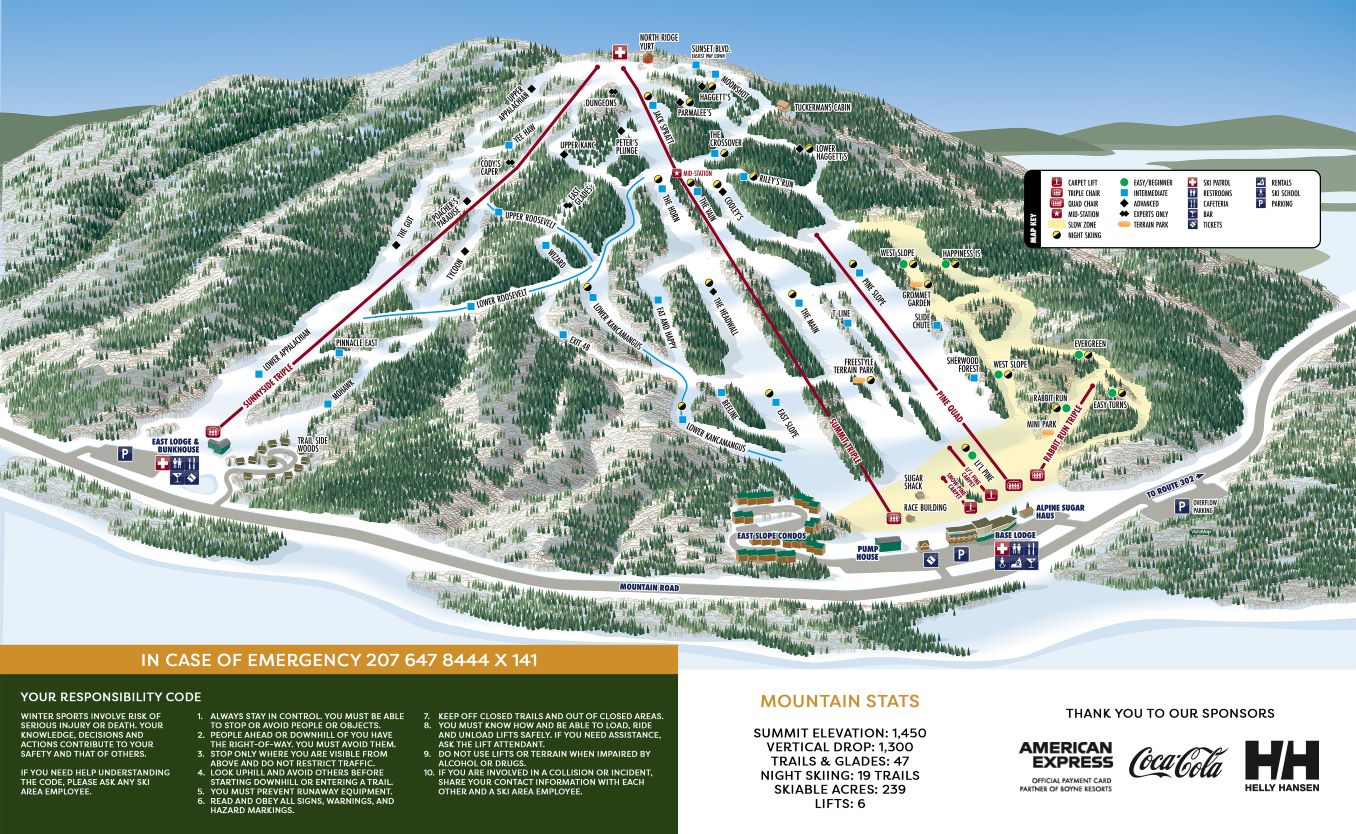
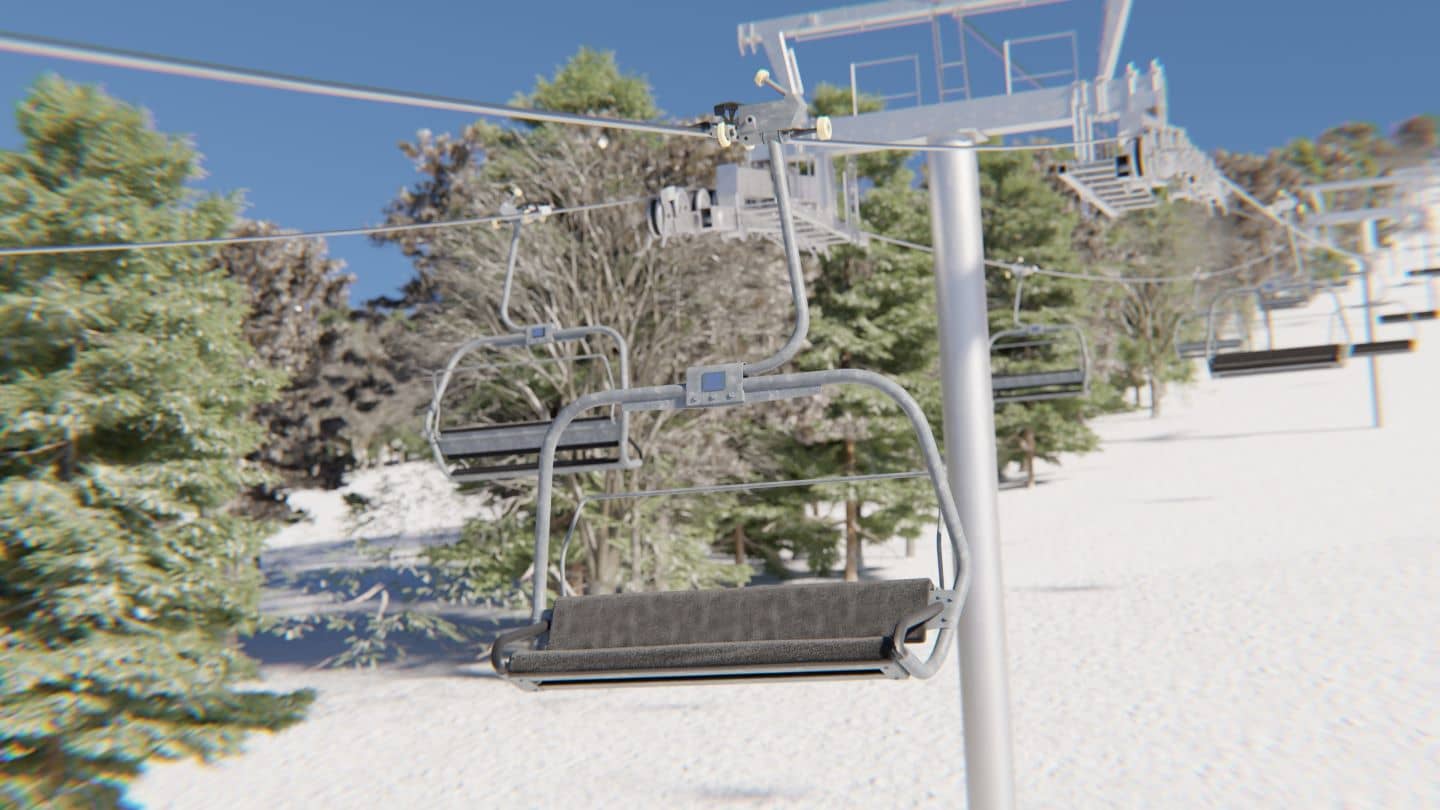
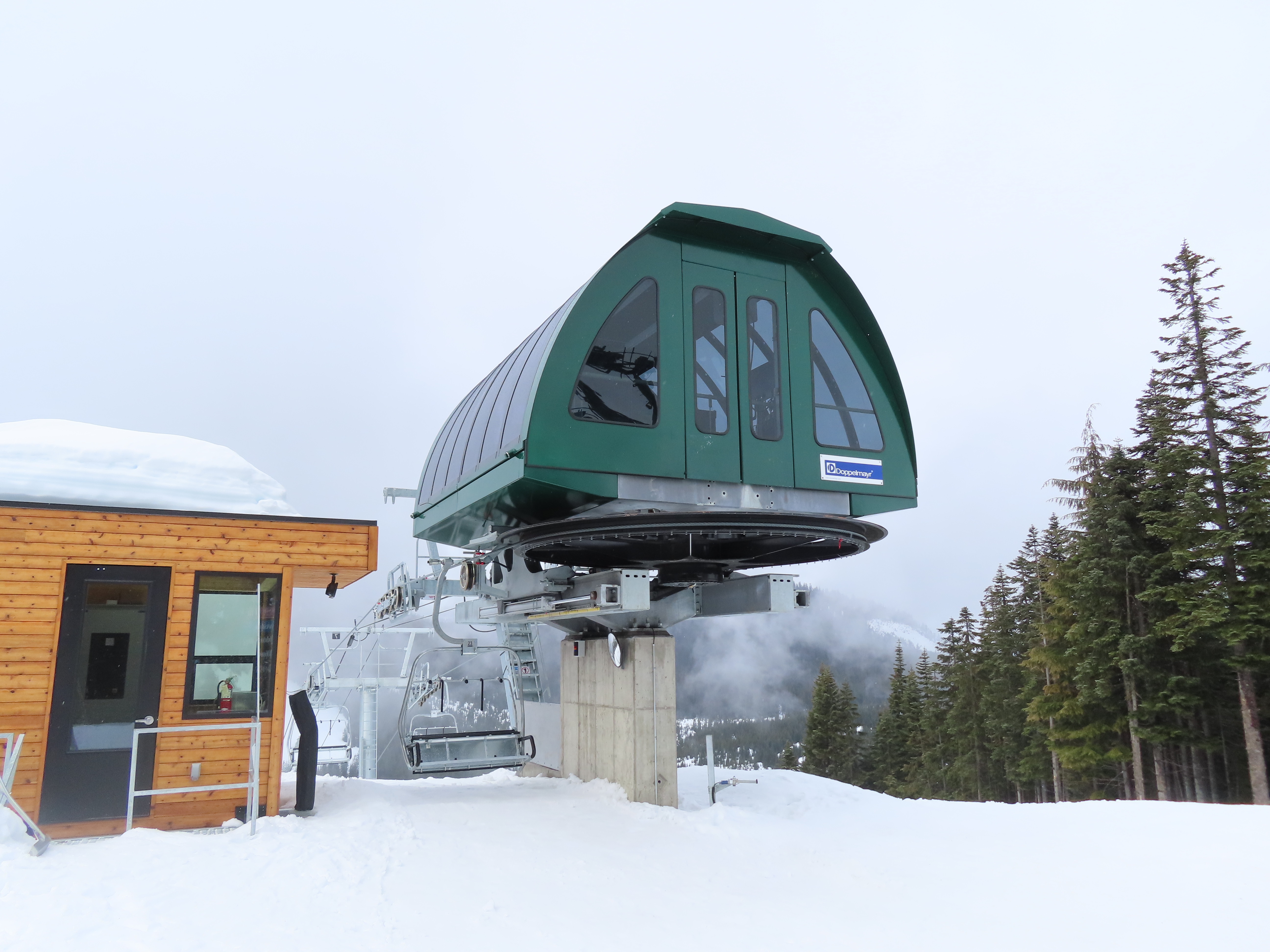
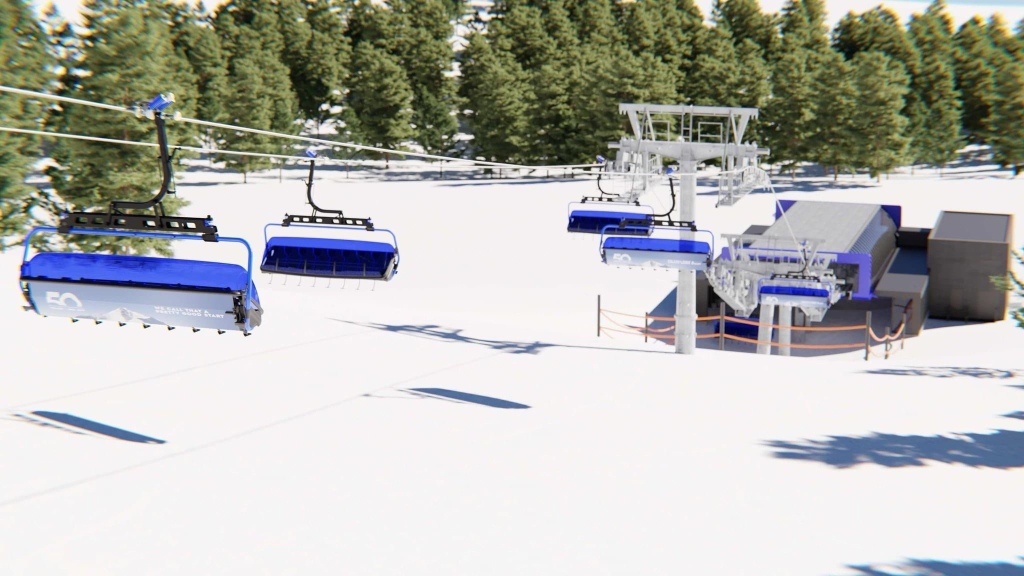
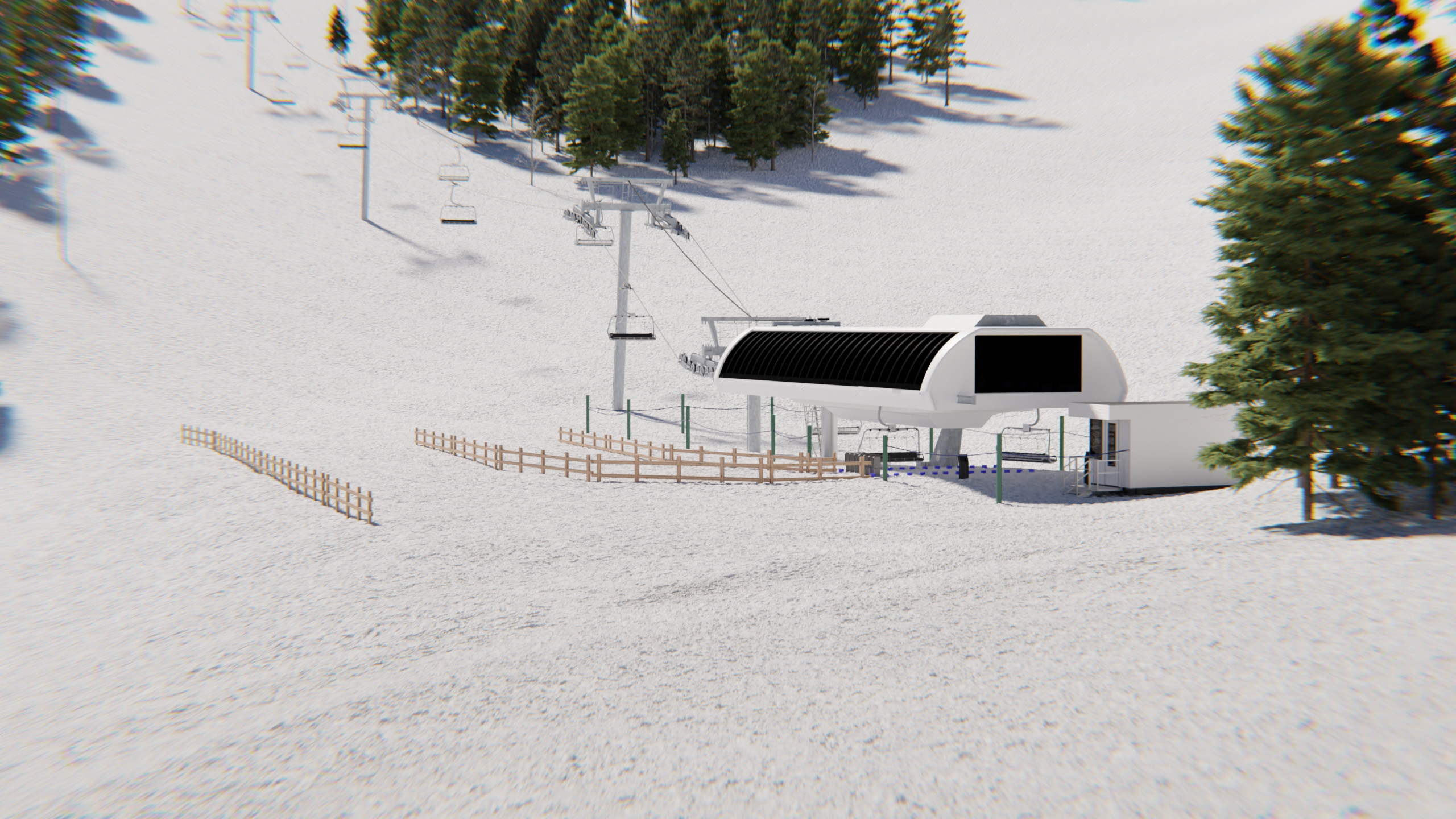
For the first time in its 86 year history, Maine’s Pleasant Mountain will feature a high speed lift next season. The new Summit Express will run 1,220 vertical feet from the base of the mountain to the top in just 4.5 minutes. The detachable quad will contain some new parts from Doppelmayr along with many refurbished components from the former Jordan Bowl Express at Sunday River. Like with the new Bucksaw Express at Sugarloaf, Pleasant Mountain is working with Doppelmayr to make the lift look and feel like a completely new machine. The existing Summit Triple, which was down for a period this season with mechanical issues, will be removed.
“We’re taking our guest experience to new heights with a faster, more efficient detachable quad from Doppelmayr,” the resort said, noting the new lift will carry 2,400 skiers per hour at 1,000 feet per minute. “We can’t wait to introduce Pleasant Mountain guests to the new lift experience.”
The Summit Express is the fifth new lift project announced by Boyne Resorts for the 24-25 season. Big Sky and The Summit at Snoqualmie also plan to debut new lifts for next winter.
Instead of building two new chairlifts at Alpental this summer, The Summit at Snoqualmie will instead build one lift at Alpental and another at Summit West in partnership with Doppelmayr. The Summit encompasses four distinct ski areas and is in the midst of a multi-year investment push called Summit 2030 that will now see at least five new lifts installed over four years. Alpental is a major focus of the plan with two lift replacements and one completely new expansion lift. Phase one was a replacement Sessel lift, which debuted this season. A brand new International triple will follow above Sessel this summer. Snoqualmie previously announced Chair 2/Edelweiss would also be replaced in 2024, but that has now been postponed one year to 2025.
Crews have already completed many of the foundations for both International and Chair 2, which ascend extremely steep terrain and have limited to no road access outside of snow season. In fact, crews this week transported the new haul rope for International up the mountain over snow in advance of this summer’s construction. “Shifting the Edelweiss timeline will allow the construction team at Alpental to focus all their efforts on completing International prior to the 24/25 season,” the resort noted. “We’ve mentioned it before but work on International is extremely challenging and time-consuming due to the lack of road access and gnarly terrain.”
Simultaneously with the International project, crews will now replace the Wildside triple with a new fixed grip quad at Summit West for next season. Wildside dates back to 1974 and had broken down occasionally in recent seasons. Summit West has traditional service roads and work can more easily be completed there at the same time as International. “[Wildside] is a much simpler installation with easier access for the construction team and is a great opportunity to get another aging lift replaced,” said Snoqualmie. Unlike the current lift, the realigned Wildside will feature a loading conveyor and restraint bars.
New Chair 2 at Alpental will now debut in winter 2025-26, the fourth season in a row with a new lift on Snoqualmie Pass. In the meantime, skiers can enjoy one more season on the classic Riblet to the top.
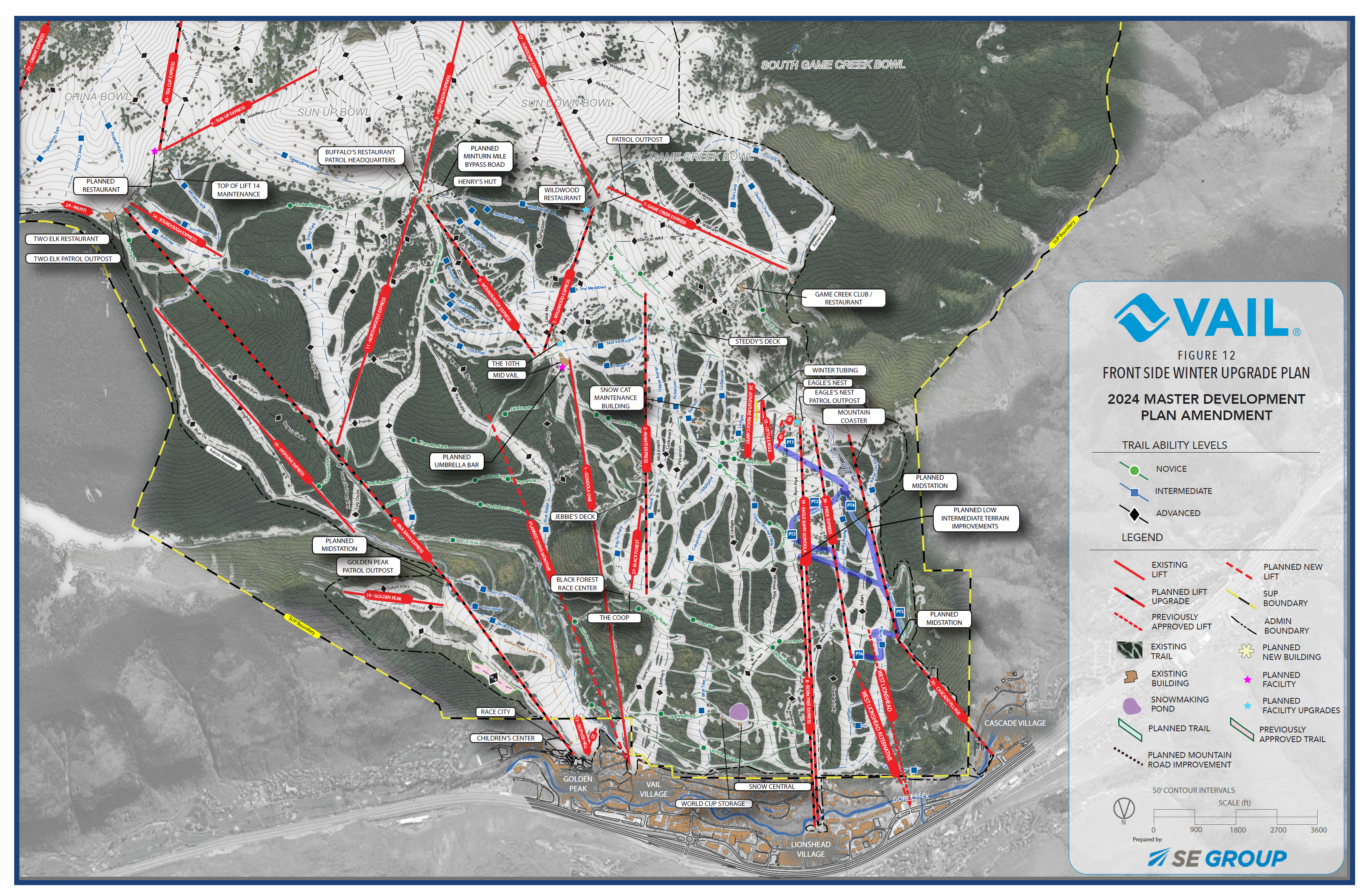
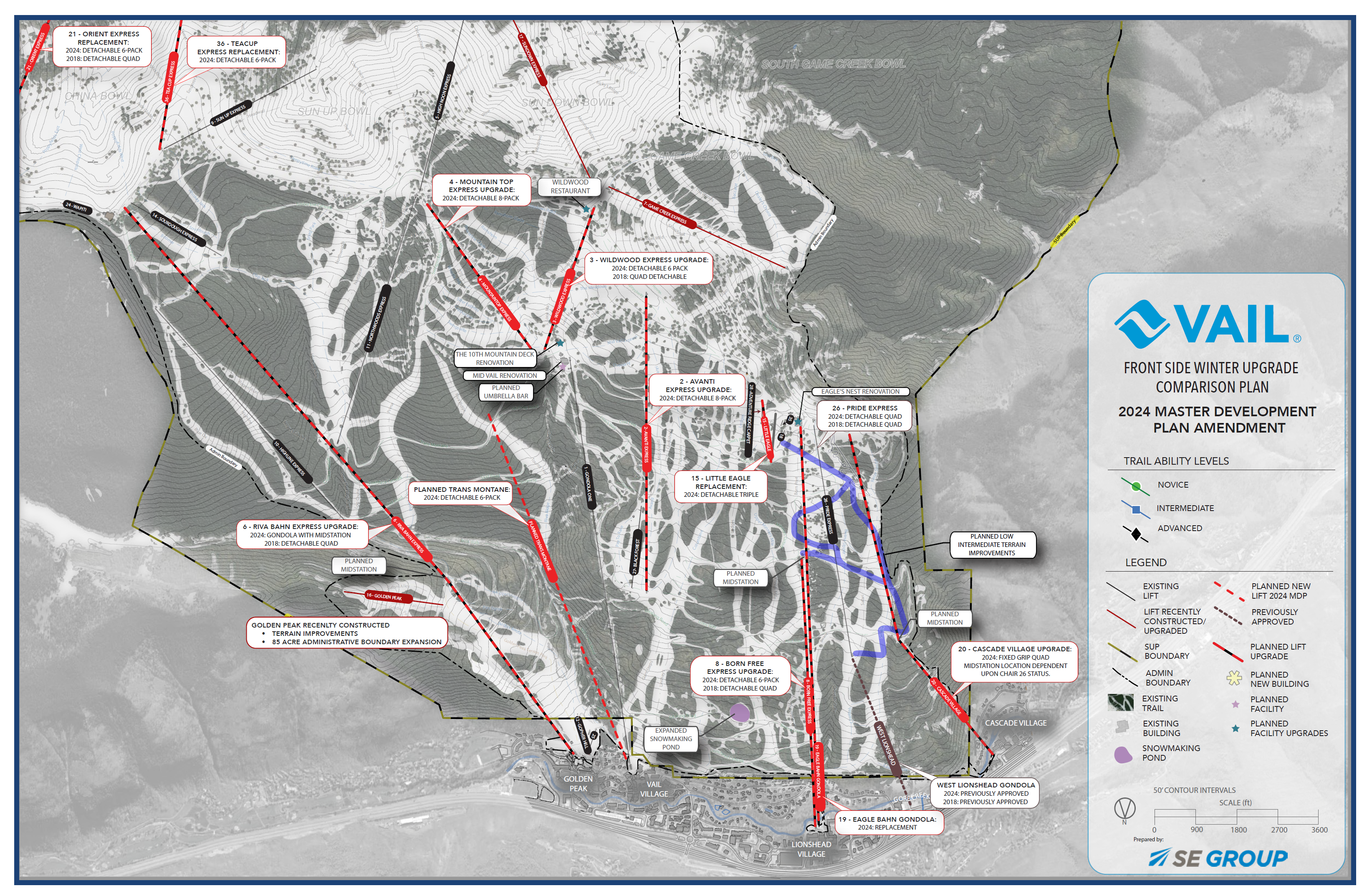
With one of the largest lift fleets in the country and a dozen recent additions, Vail Mountain could probably stop building lifts for awhile and be fine. However a new 2024 Master Development Plan, accepted by the Forest Service last month, suggests investment will continue at Vail Resorts’ flagship mountain. The new plan is a collaboration between Vail, SE Group and the Forest Service and replaces a 2018 MDP. It’s important to note that resort master plans are conceptual in nature and don’t constitute approval of specific projects. But Vail has big plans, or at least big ideas.
Today Vail operates two gondolas, 21 chairlifts, four surface tows and seven conveyors designed to accommodate 23,690 guests on the mountain. However the resort is managed to a capacity of 19,900 skiers per day, a planning target that won’t change as lifts are upgraded and reconfigured. “Vail desires to maintain certain capacities, particularly the lift network capacity, in excess of the manage-to threshold in order to ensure a high-quality guest experience,” the plan notes. If implemented completely, it would increase lift network capacity by about seven percent to to 25,420 guests. “The goals of Vail are to continue operating at less than full capacity, but add lifts and lift capacity where needed in order to improve circulation, ease congestion, spread skiers out, more fully utilize underutilized terrain and keep wait times at lifts at a comfortable level and, therefore, maintain a high level ski experience for guests,” notes the MDP.
A major focus of the upgrade plan is moving guests up and out of Vail’s base areas. When Vail occasionally makes headlines for an epic lift line, it’s often at a gondola base first thing on a powder morning. To address this, five new egress lifts are planned. First the Eagle Bahn Gondola at Lionshead is earmarked for replacement. “Given its year-round, day and night operations, freight hauling duties, and limited capacity, the gondola will need a major overall or potentially an upgrade during the life of this plan,” notes the MDP. Built by CTEC in 1996, Eagle Bahn is technically a twelve person gondola; however, Vail has operated the gondola effectively as an eight passenger gondola. A new Lionshead gondola will likely feature 12 passenger cabins and move 3,200 riders per hour.
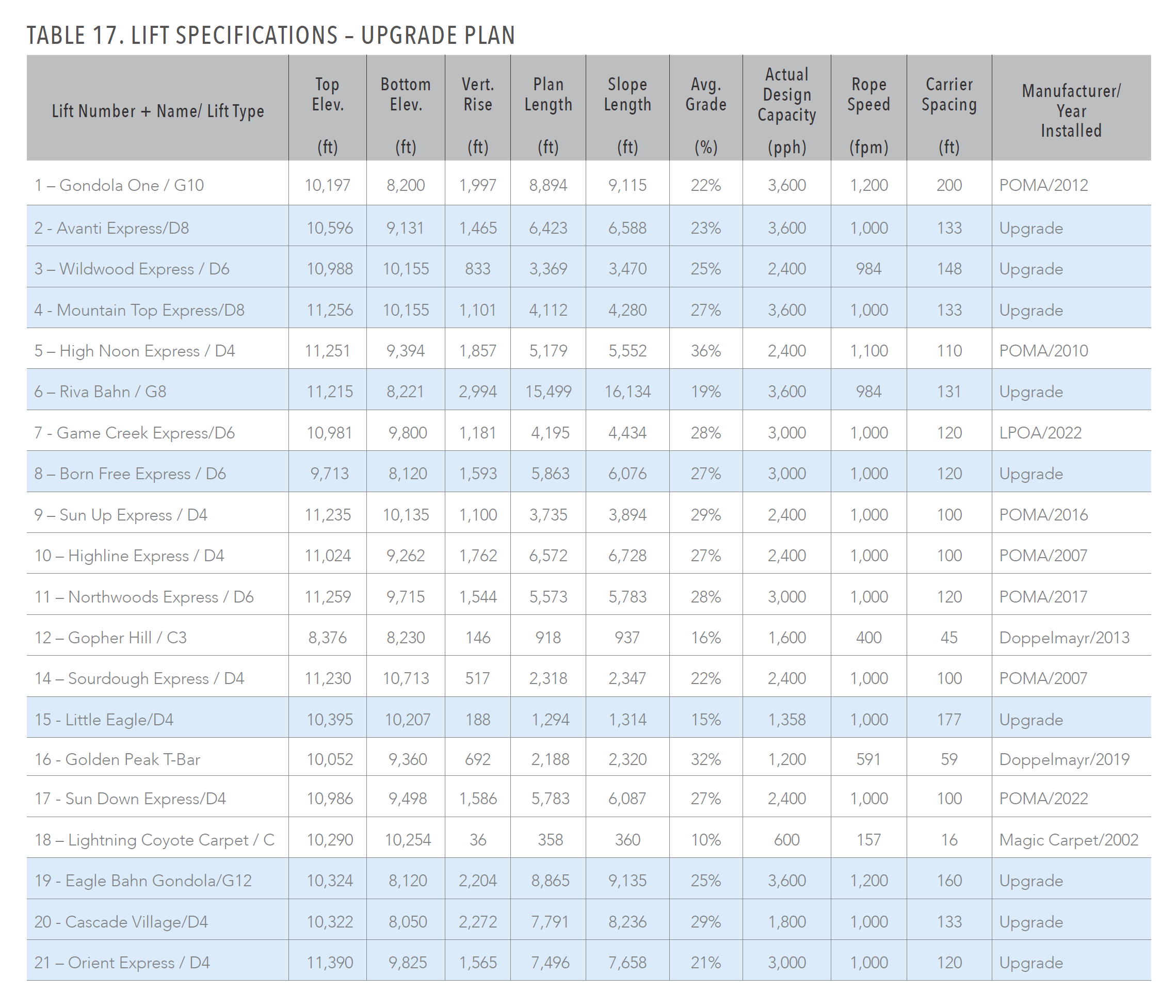
On the Vail Village side of the valley, the Riva Bahn Express is planned to become a third gondola extending all the way to Two Elk Lodge. The new lift would continue to feature a mid-station on Golden Peak but the top terminal would move thousands of feet up the mountain. “Due to the extended alignment, it will have an enhanced role in transporting guests to the back bowls rather than having guests access this terrain using Northwoods Express #11,” the plan notes. This eight passenger gondola would be a beast, stretching more than 16,000 linear feet and rising nearly 3,000 vertical feet from base to summit.
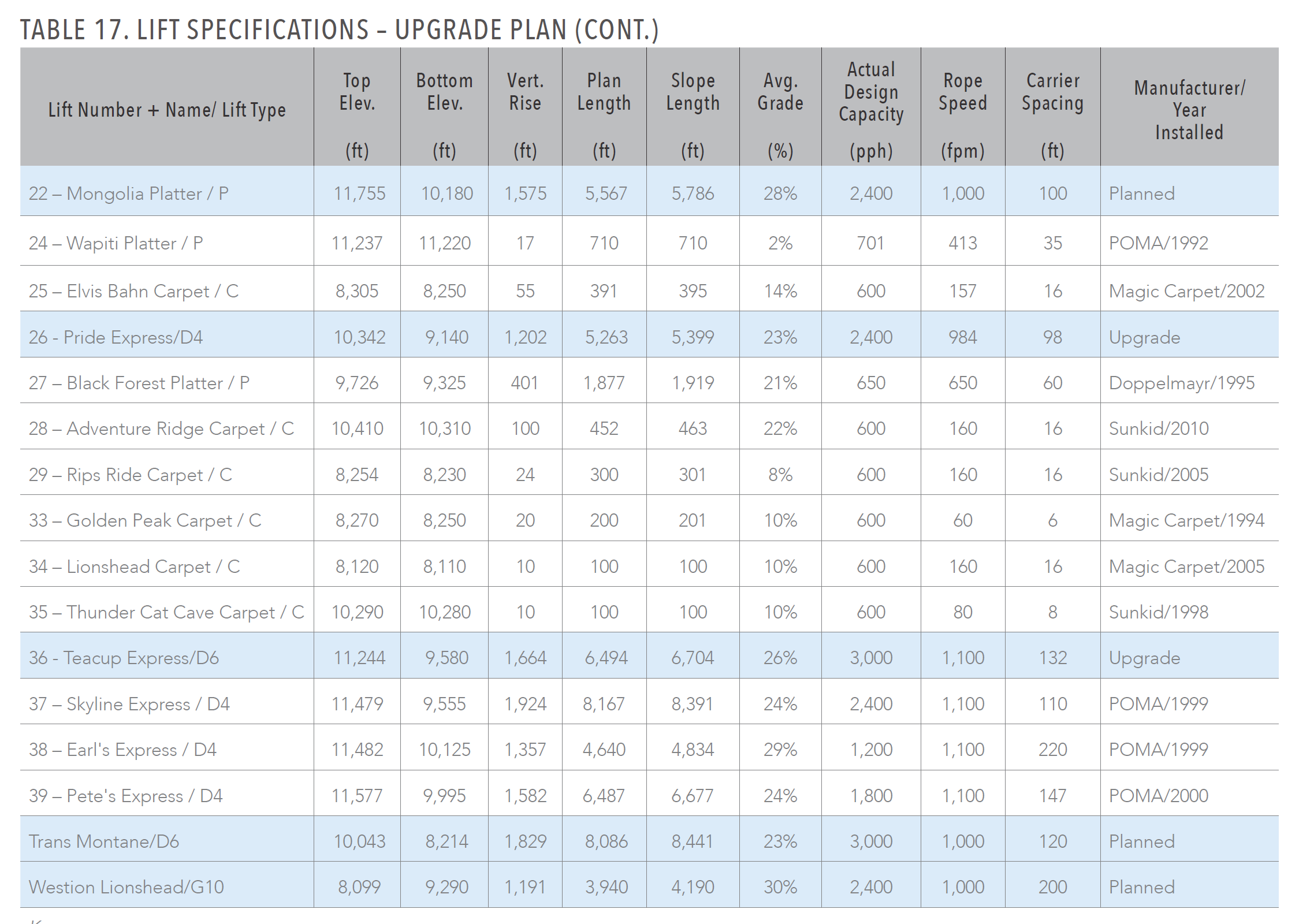
Also envisioned for Vail Village is a completely new lift with the working name Trans Montane. This 8,400 foot long six pack would start adjacent to the workhorse Gondola One and rise to mid-mountain, providing much-needed capacity and redundancy out of Vail Village. The top station would sit where the Riva Ridge and Trans Montane runs merge and provide access to Northwoods Express. Trans Montane would carry 3,000 guests per hour with a vertical rise of 1,829 feet.
Another new out-of-base lift in Lionshead has already been approved by the Forest Service but not constructed. Once known as Ever Vail and now called the West Lionshead lift, this would be either a detachable chairlift or 10 passenger gondola with a capacity of 2,400 skiers per hour. A couple possible alignments are under consideration with approximately 1,200 feet of vertical unloading near the base of Pride Express #26. Also at Lionshead, Born Free Express #8, is slated to become a six pack while continuing to run parallel to the Eagle Bahn Gondola. This lift is the only original CLD-260 detachable left on the front side, dating back to 1988.
Finally on the out-of-base egress front, the longest fixed grip lift at Vail, Cascade Village #20, would also go detach. This one would be a quad, either following the existing alignment or running further up the mountain to Eagle’s Nest. The lengthened option would include a mid angle station with the lift totaling 2,272 feet of vertical rise. Once all new lifts are in place, guests could choose from seven different gondolas and chairlifts capable of moving 21,000 skiers each hour.
Numerous chairlift replacements are also envisioned on the upper mountain. Even relatively new lifts may be replaced with more modern and larger capacity versions. The first is Avanti Express #2, which would go from a six to an eight place (Vail Resorts just this season opened its first eight place chairlift in North America at Whistler and apparently sees more possibilities in the future.) Mountaintop Express #4 also could be up-gauged from a six to an eight. If either of these projects happen, existing equipment would likely be reinstalled on Vail Mountain or elsewhere in the Vail Resorts portfolio.
Wildwood Express #3 and Pride Express #26, both aging CTEC detachables, would be replaced by newer technology high speed quads or six packs. Little Eagle #15, another one of the three remaining fixed grip chairs at Vail, would be replaced with a detachable quad to create an improved beginner experience. The alignment would move slightly as well and increase in length.
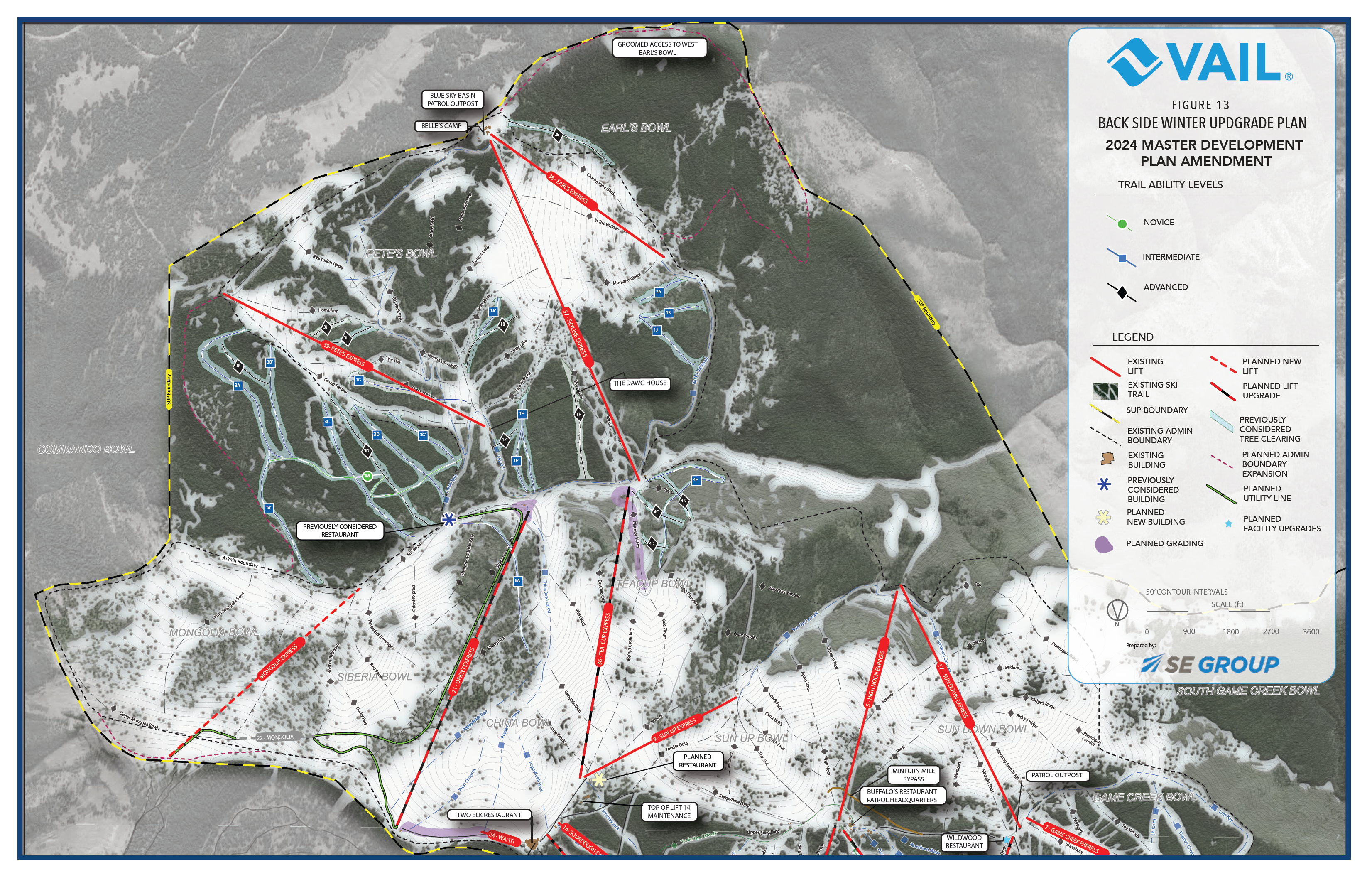
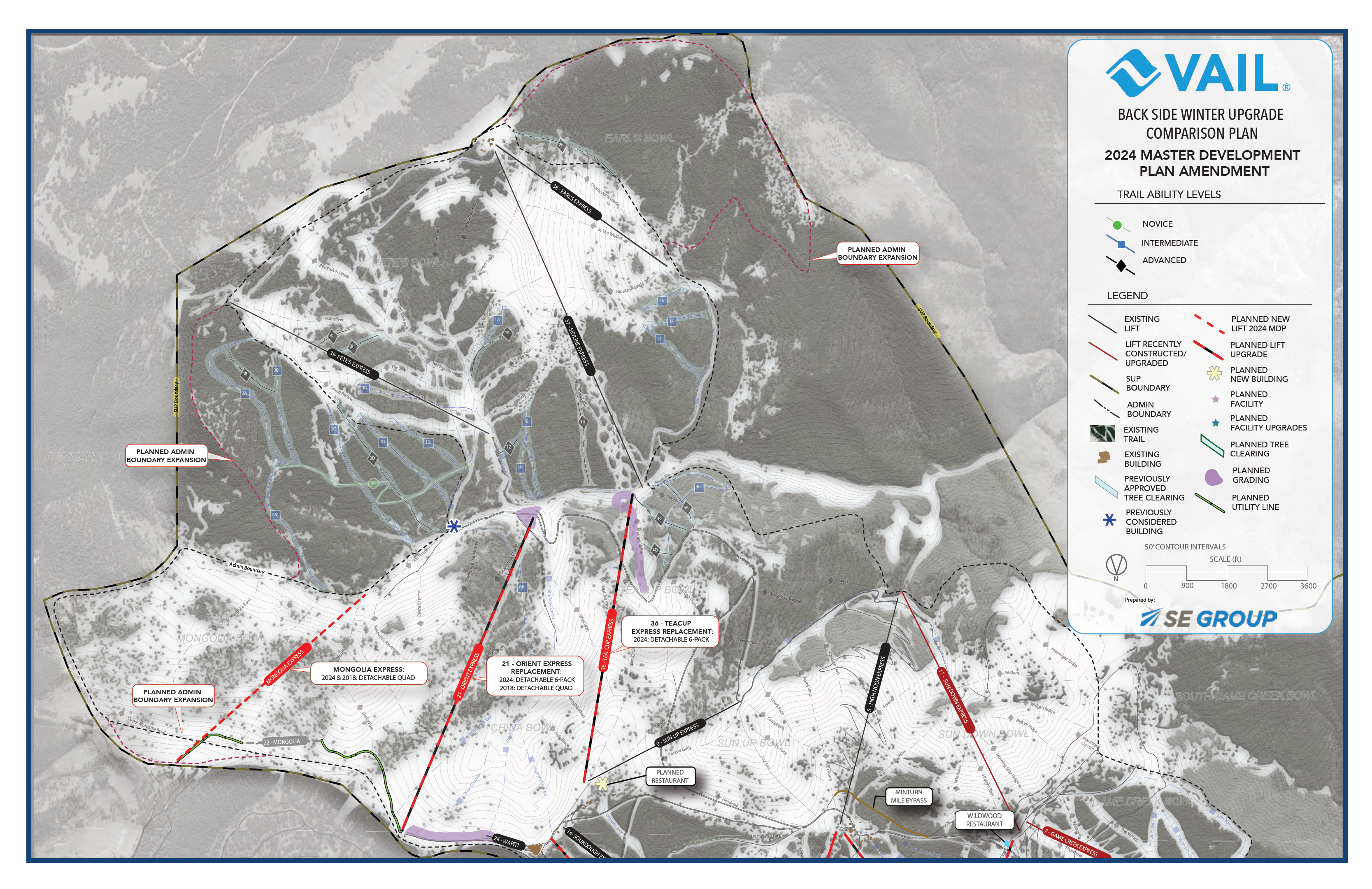
Vail’s Back Bowls are the other location where viral lift line photos occasionally originate. In China Bowl, the 1988 build Orient Express #21 is slated for retirement. “This chairlift is the only access to Mongolia, and Siberia bowls, so reliable service is critical to access the back bowls of the resort,” notes SE Group. The new lift would become the first six pack in the Back Bowls. Nearby, Teacup Express #36 could also go from a quad to a six seater. Finally, a completely new Mongolia Express quad is proposed to run from near Two Elk Creek to the ridgeline above the existing Mongolia Platter. This would create a direct route up Mongolia Bowl and become the sixth detachable lift in the legendary back bowls.
No lift upgrades are planned in Blue Sky Basin, however a variety of trails remain in Vail’s plans. The MDP also contains plans for snowmaking improvements, new lodges and summer activities across the mountain. The full plan is available on the Forest Service website here.
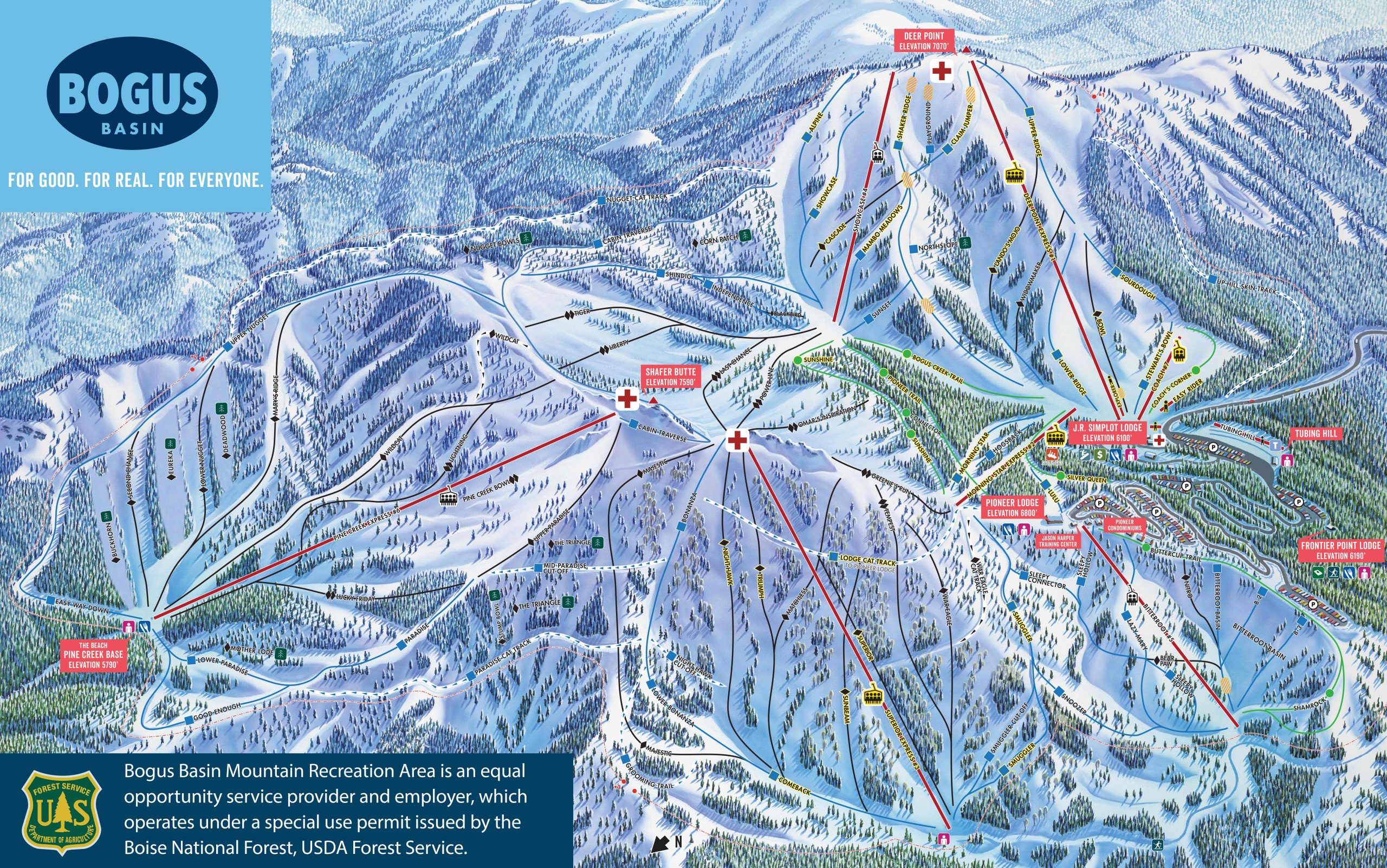
The nation’s largest nonprofit ski area will embark on two lift replacement projects this summer after initially planning just one. Bogus Basin has signed a contract with Skytrac to build the fixed grip quads replacing the aging Coach and Bitterroot chairlifts. The mountain notes the local population grew more than 25 percent between 2010 and 2020 with strong demand for winter recreation. “Bogus Basin is rising to this occasion, continually enhancing our product offerings to ensure everyone has a special experience on their local mountain,” the resort said in a blog post announcing the projects.
The Forest Service already approved the plan to replace Coach, a 1981 Yan double. The Yan beginner lift is in its second location and originally ran where the Deer Point Express spins today. The new Skytrac will follow a longer alignment, spanning 1,412 feet in 2.9 minutes. Vertical will increase from 163 feet on the current double to 323 feet. Bogus will create a wraparound beginner run off the top that is almost 3.5 times longer than the current bunny slope along with adding additional groomed and gladed intermediate terrain. New snowmaking and lighting are also planned for Coach.
Bogus Basin acknowledges that both Coach and Bitterroot were initially planned to become detachable quads in the mountain’s 2015 master plan. However, costs for detachables have risen dramatically in the Covid era. Bids from both manufacturers exceeded $6 million for a 1,400 foot detachable quad at Coach. Just five years ago, Bogus purchased a high speed quad more than twice as long for $4.3 million. Luckily Skytrac came in with a $2.5 million bid to replace Coach with a fixed grip quad and Bogus realized it could use the savings to also replace Bitterroot.
The mountain is a 501(c)(3) organization run by a board of directors that invests all profits back on the mountain. “Bogus Basin is charged with the fiduciary responsibility of the community’s investments to ensure excellent and sustainable recreation for the Treasure Valley,” the resort notes. “When analyzing the statistics of the Coach chairlift upgrade, opting for a fixed-grip quad translates to a slightly longer ride time of 1.5 minutes compared to a high-speed quad, while saving over $2,500,000 for a second lift upgrade.”
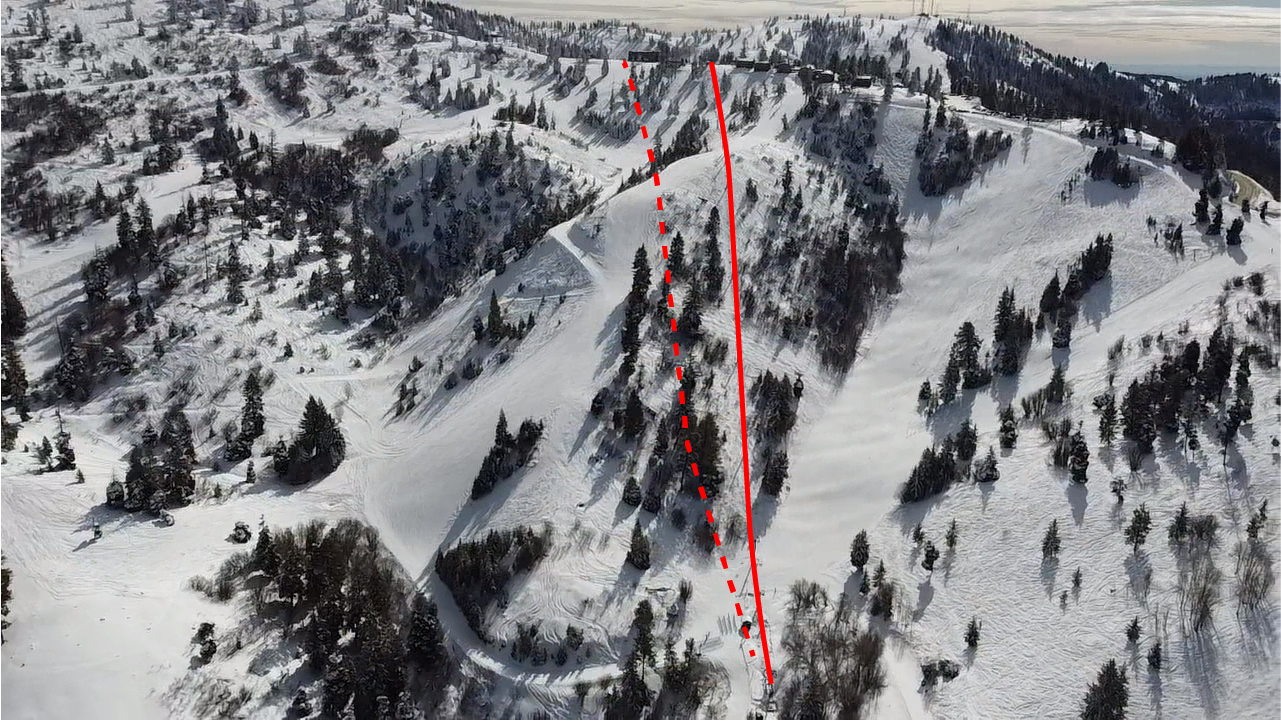
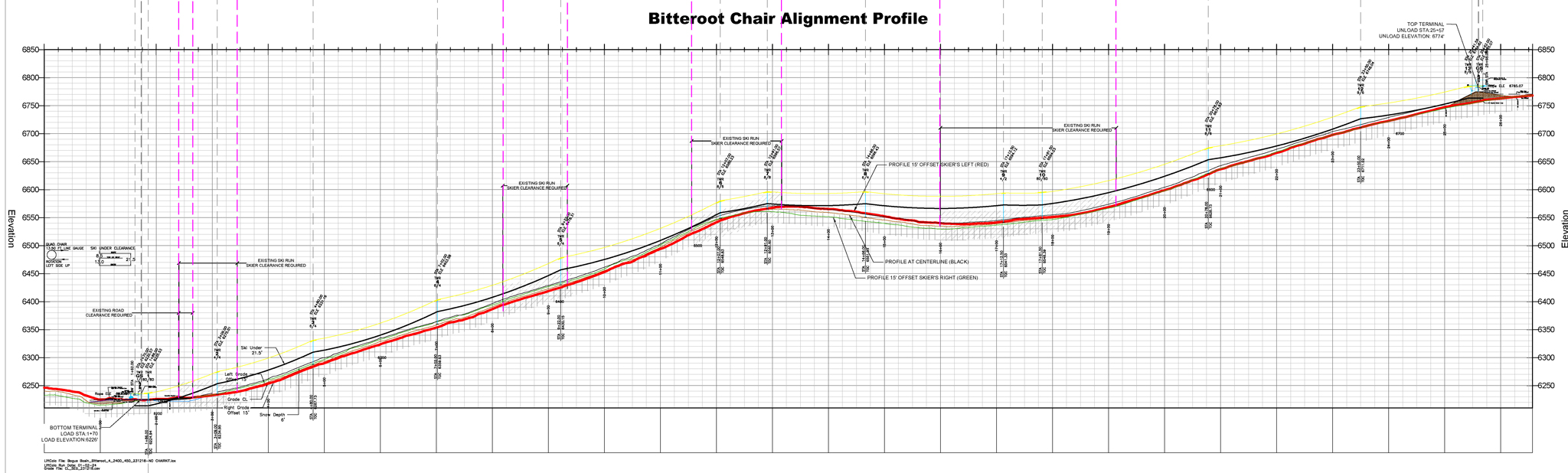
Bitterroot is a Riblet double dating back to 1973 that only operates on weekends and holidays. The new Skytrac will run in an improved alignment and perhaps more often. The top station will move to the North side of the Pioneer Lodge and ride time will decrease to 4.9 minutes. “Guests will now have more convenient access to the lodge’s amenities as well as the runs that access Morning Star Express, Bitterroot quad, and Superior Express chairlifts,” the mountain notes. This second new Skytrac will run 2,462 linear feet with a vertical rise of 538 feet. Bitterroot is located entirely on private land thus its replacement does not require Forest Service approval.
Bogus Basin notes that it has invested more than $60 million since 2017 and will continue to make improvements to serve Boise’s growing population. Bogus has up to three future chairlift installations and numerous snowmaking and facility upgrades on tap after this busy summer.
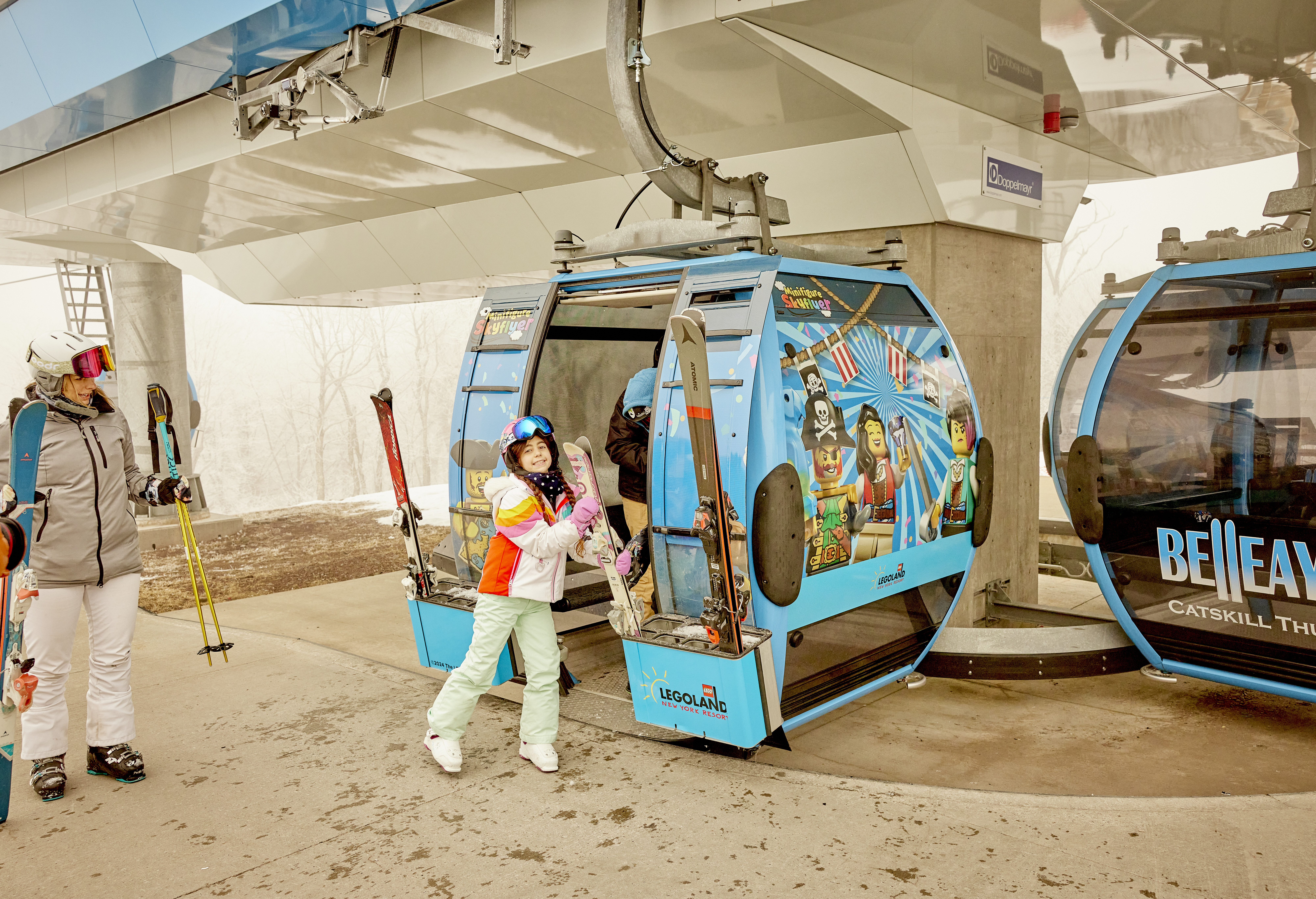
The first gondola lift at any Legoland park worldwide will open this summer at Legoland New York, located near the town of Goshen. The Leitner-Poma system will traverse the park with two stations and seven individually-themed gondolas carrying up to 10 passengers each. “There’s a lot to enjoy at Legoland New York, but it’s a big resort and our fans asked us for more ways to move easily from the upper and lower levels of the Park,” said divisional director Stephanie Johnson in a release. “We take our guests’ feedback seriously and the Minifigure Skyflyer gives them a way to do exactly that while igniting creativity, sparking imagination, and inspiring movement through disco and dance.”
Each Sigma cabin will feature a unique and colorful theme. “Guests can expect a fully immersive, interactive experience on the Minifigure Skyflyer from queuing to disembarking,” the park said. “Prior to boarding, guests can help “charge” the cable car batteries through hand-powered cranks then follow the rainbow road before reaching the boarding platform’s disco-themed dance floor.”
Britain-based Merlin Entertainments operates Legoland parks under license from the Lego Group of Denmark. The New York outpost opened in 2021 with a small number of attractions but has continued to grow. Gondola construction is already underway and the new ride is set to debut this summer. In the meantime, Legoland New York has partnered with Belleayre Mountain to offer a preview with two specially-wrapped Legoland gondolas now flying on the mountain’s Catskill Thunder Gondola.
A building boom will continue this summer in Gatlinburg, the lift capital of the Southeast. Ober Mountain plans to construct two new Doppelmayr quad chairs replacing aging lifts. The first fixed grip quad will replace the 1981 Borvig Black quad, which services ski runs in the winter and mountain biking trails in the summer. The second new quad will replace the 1962 Carlevaro-Savio Scenic double, which accesses a mountaintop overlook. The two Alpenstar quads will be the first new lifts built at Ober in 43 years.
The news comes on the heels of recent lift projects at Anakeesta, Gatlinburg SkyPark, Harper Brothers Mountain and SkyLand Ranch, all of which operate within a ten mile radius in the Great Smoky Mountains. Ober Mountain operates nearly the entire year with multiple lifts serving skiing, tubing mountain biking, scenic rides and an alpine slide in various seasons. The mountain is in the midst of a multi-year rebirth under a new, local ownership group that has also invested in new snowmaking and downhill bike trails. Doppelmayr expects to begin building the new chairlifts in March with completion scheduled for October.
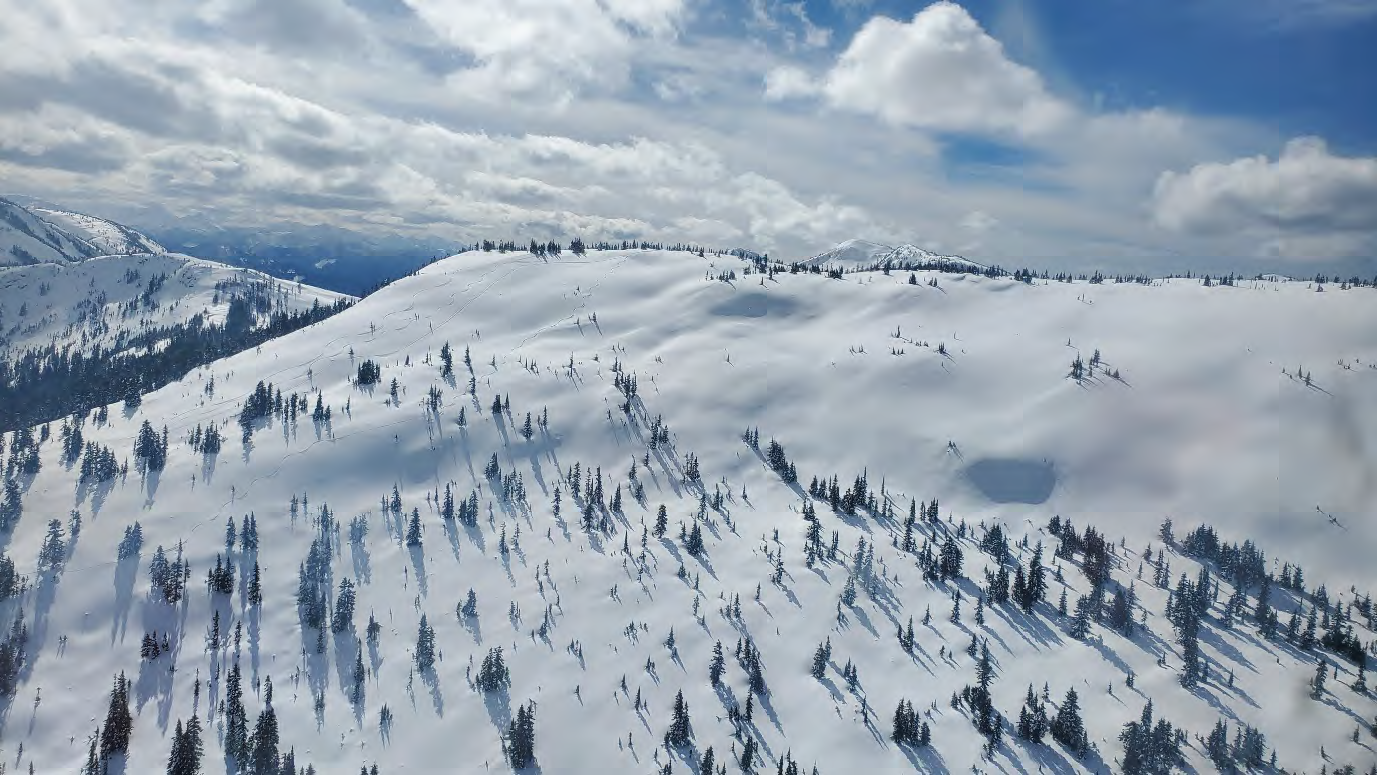
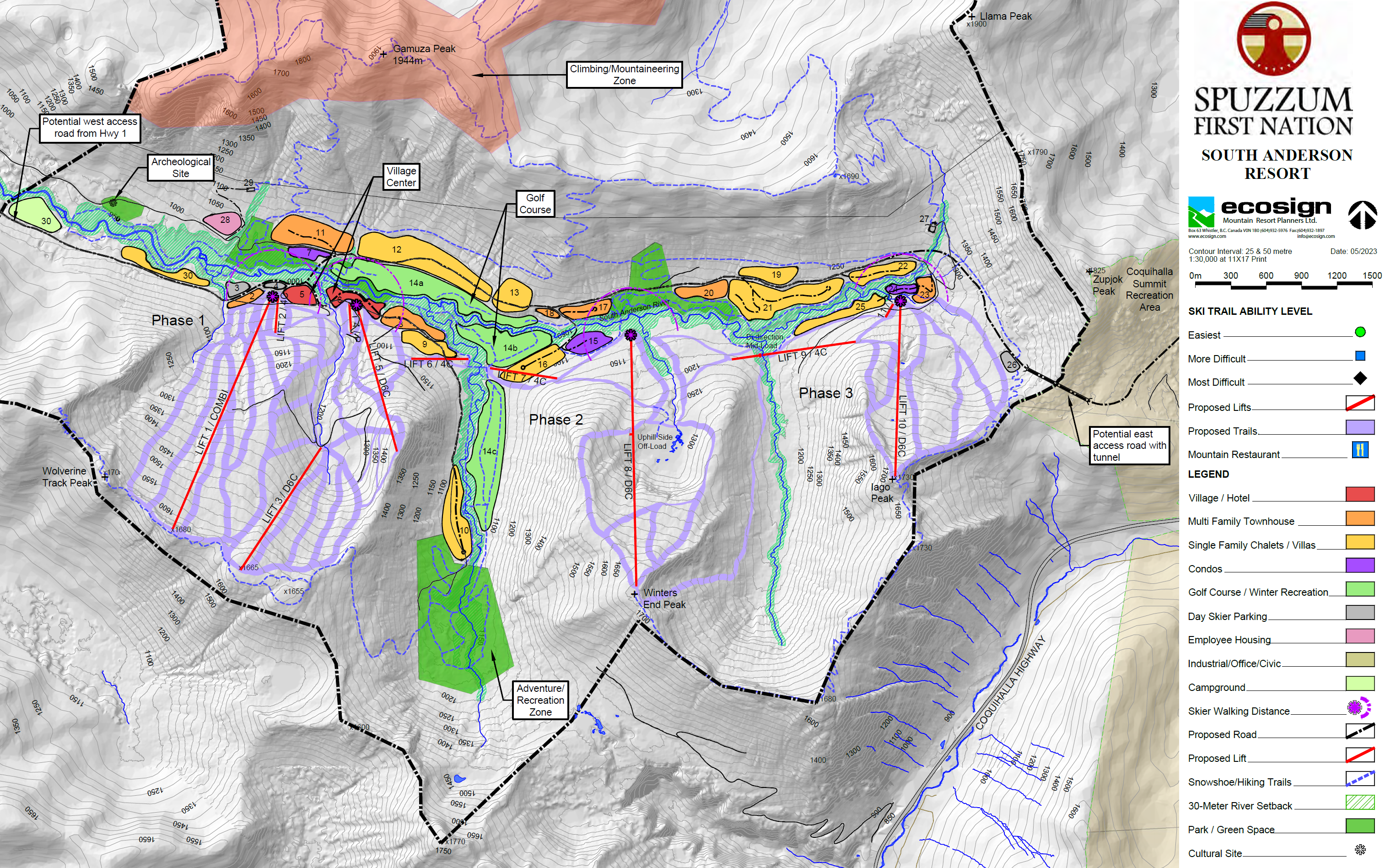
South Anderson Mountain Resort has joined the growing list of new ski resort and scenic gondola proposals in British Columbia. This week Spuzzum First Nation Chief James Hobart detailed plans for the indigenous-owned and operated mountain resort north of Hope. The site sits two hours east of Metro Vancouver and 40 miles north of the Washington State border along existing logging roads.
Spuzzum First Nation would like to build a four season resort primarily to provide jobs and financial opportunities for its members. The band “aims to create an exceptional all-season mountain resort that will allow visitors to experience the beauty and recreation opportunities in the Cascade Mountains in an environmentally responsible manner.”
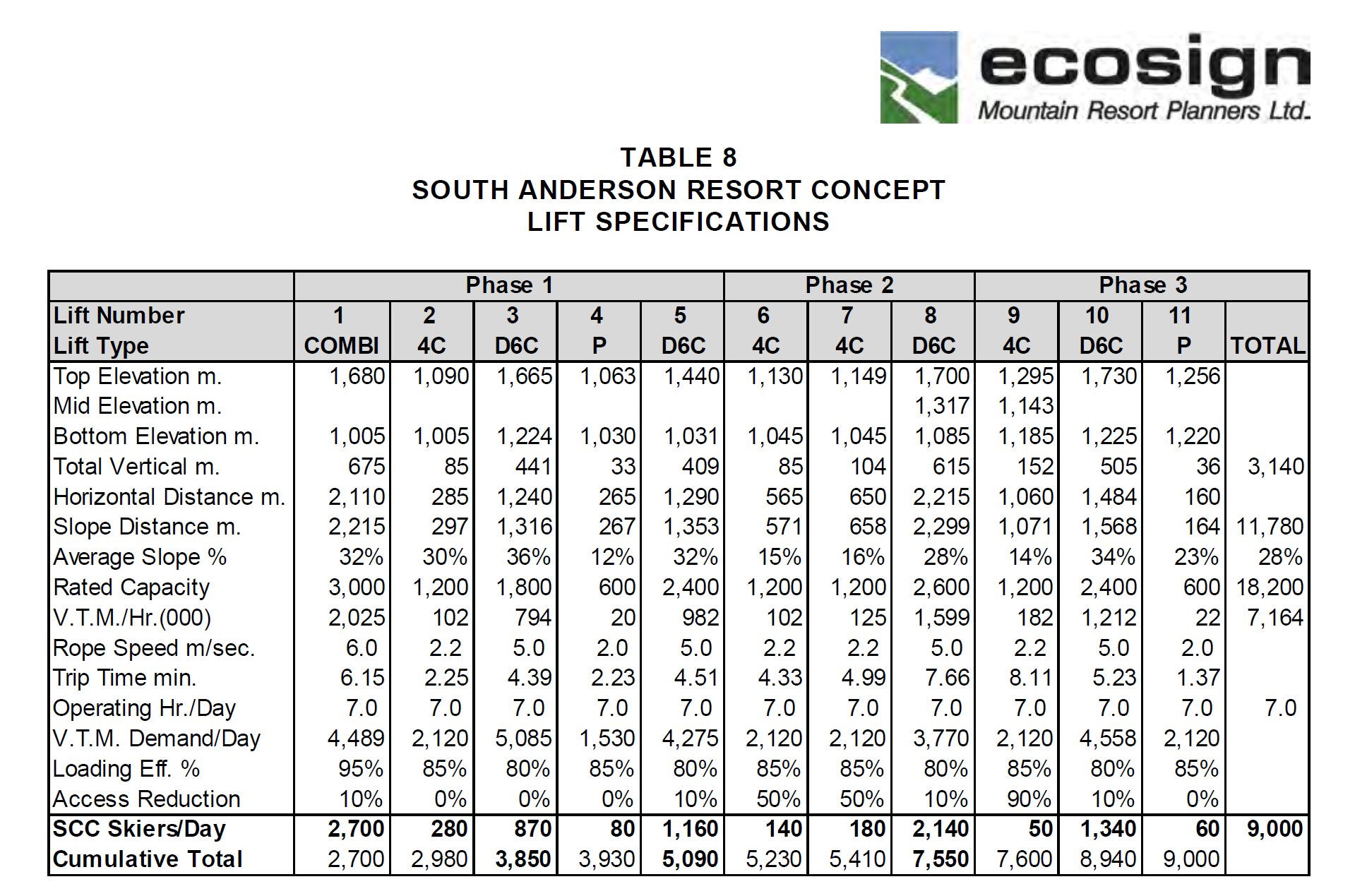
Ecosign Mountain Resort Planners of Whistler developed the concept for a mid-sized resort capable of accommodating 9,000 skiers per day. Five lifts would be built in phase one with 11 lifts by phase three. Westernmost phase one lies on Wolverine Track Peak where a base-to-summit combination lift would carry 3,000 guests per hour. This would be the largest lift at the ski area with a vertical rise of 2,215 feet. Phase one would also include two six packs, a fixed grip quad and platter lift. Phase two would see a third six pack built on Winters End Peak along with two short connector quads. Finally, a fourth six pack would be constructed on Iago Peak, topping out at an elevation of 1,730 meters or 5,676 feet. A bi-directional quad chair would be required to connect Iago Peak to Winters End Peak that would feature a mid-loading station in the valley between the two mountains.
The resort would cater primarily to guests from the Lower Mainland but also Western Washington with a total drive to population nearing 3.1 million. Vancouver and Seattle are currently adding about 100,000 people per year and a study showed increased population in Metro Vancouver and the Fraser Valley alone will generate an additional 329,000 skier visits for local mountain resorts by 2032. South Anderson Mountain Resort would be designed to host around 150,000 skier visits its first season and up to 400,000 in year ten.
While British Columbia is much more accommodating to resort development than Washington State, numerous proposals have come and gone without being funded or built. Garibaldi at Squamish, a megaresort proposed near Whistler, recently fell into receivership. Whistler Blackcomb itself has an ambitious master plan to expand west that Vail Resorts has yet to start. Two competing propoents are vying to build on crown land near Chilliwack – the Cascade Skyline Gondola and Bridal Veil Mountain Resort. Nearby Sasquatch Mountain Resort has approval for a $1.5 billion expansion that has yet to get off the ground. Elsewhere in British Columbia, Valemount Glacier and Jumbo Glacier both fizzled in recent years.
The Province of British Columbia is expected to review the Spuzzum First Nation’s initial Expression of Interest and make a positive or negative recommendation in the coming months.
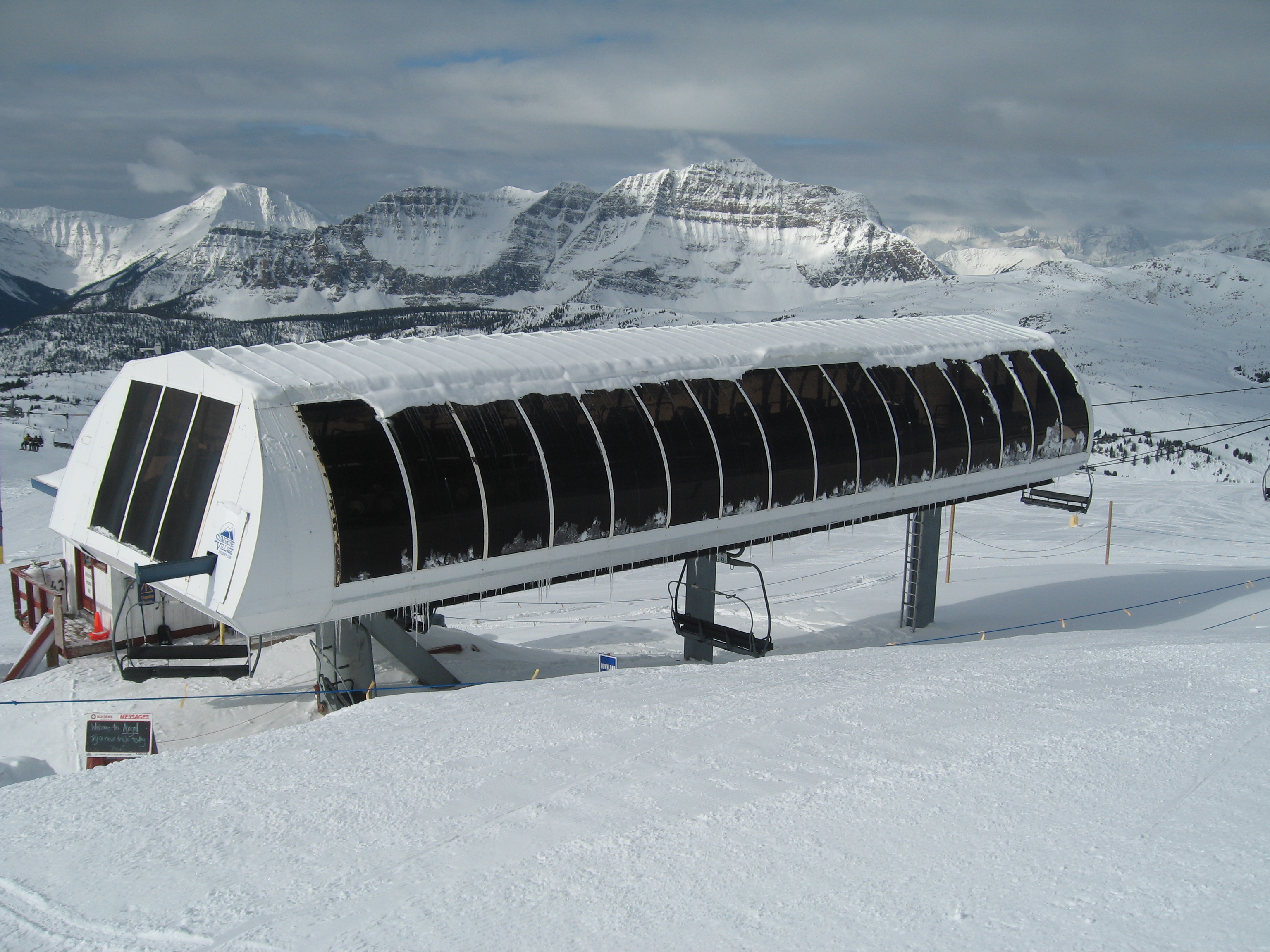
Canada’s second largest resort without a high speed lift plans to build one soon. Castle Mountain, located in Southwestern Alberta, today announced it has reached an agreement in principle to acquire Sunshine Village’s outgoing Angel Express for an undisclosed sum. The 1988 Poma detachable quad will be retired this spring to make way for a new six person bubble chair at Sunshine.
“We are excited to be acquiring such a great lift from a reputable industry partner,” said Dean Parkinson, Castle Mountain Resort General Manager. “It is a great thing to be keeping this lift in Alberta and we appreciate Sunshine’s willingness to work with us on this purchase,” he continued. No location or timeline for reinstallation was announced. One logical scenario would see the quad replace the Sundance triple, Castle’s main out-of-base lift which opened in 1996. The used detachable could also replace the Huckleberry or Tamarack lifts. Perhaps more likely than either of those locations is an entirely new alignment. Castle’s latest master plan identified 10 different locations for possible future lifts as the resort grows. “When information is available on the reinstallation location and the expected timeline, we expect to share this in future press releases,” said Castle.
Once this project is complete, the largest remaining North American mountains without detachable lifts will be Red Mountain, British Columbia (4,200 acres); Discovery, Montana (2,200 acres); Bridger Bowl, Montana (2,000 acres); Lost Trail Powder Mountain, Idaho/Montana (1,800 acres); and Silverton Mountain, Colorado (1,800 acres).
Big Sky will become the first US ski area to replace a six place chairlift with a larger machine next summer on the north flank of Lone Peak. Replacing Six Shooter, the new North Side 8 will be the longest eight place in the world and crown Big Sky as the only North American resort with two eight places and three bubble D-Lines. The latest-generation Doppelmayr lift will run at six meters per second, reducing ride time out of Madison base by 30 percent.
Big Sky Resort parent company Boyne Resorts is partnering with local real estate developer Lone Mountain Land Company to realize this ambitious project, which will feature 80 chairs and 29 towers along an approximately 8,700 foot alignment. The outgoing Six Shooter is only 20 years old but was designed for a different era when Moonlight Basin operated separately from neighboring Big Sky. The two ski areas merged in 2013 and Six Shooter quickly became a bottleneck. The Garaventa CTEC lift can only move 1,800 skiers per hour and suffers periodic down time in part due to a line curve necessitated by previous property boundaries. Now that Big Sky owns Moonlight Basin ski terrain, the new lift can run in a straight alignment and carry nearly twice as many riders. “Replacing Six Shooter has long been an ask of our guests,” said Troy Nedved, Big Sky Resort’s General Manager. “The lift replacement doubles the uphill capacity at one of our last remaining pinch points, and will enhance what is one of the resort’s coldest lift rides with bubbles and heated seats.”
Up to 2,745 skiers per hour will load the new lift about 40 feet uphill of the current Six Shooter drive station to create more queuing space. In addition to now-standard Big Sky features of blue bubbles, a loading conveyor and a four ring direct drive, North Side 8 will also feature automatic lowering/locking lap bars and the United States’ first Fatzer Performa-DT haul rope for a smoother ride. Chairs will be parked inside both terminals at night rather than a separate parking building, another first for Big Sky. Construction is set to begin this spring with opening planned for late 2024.
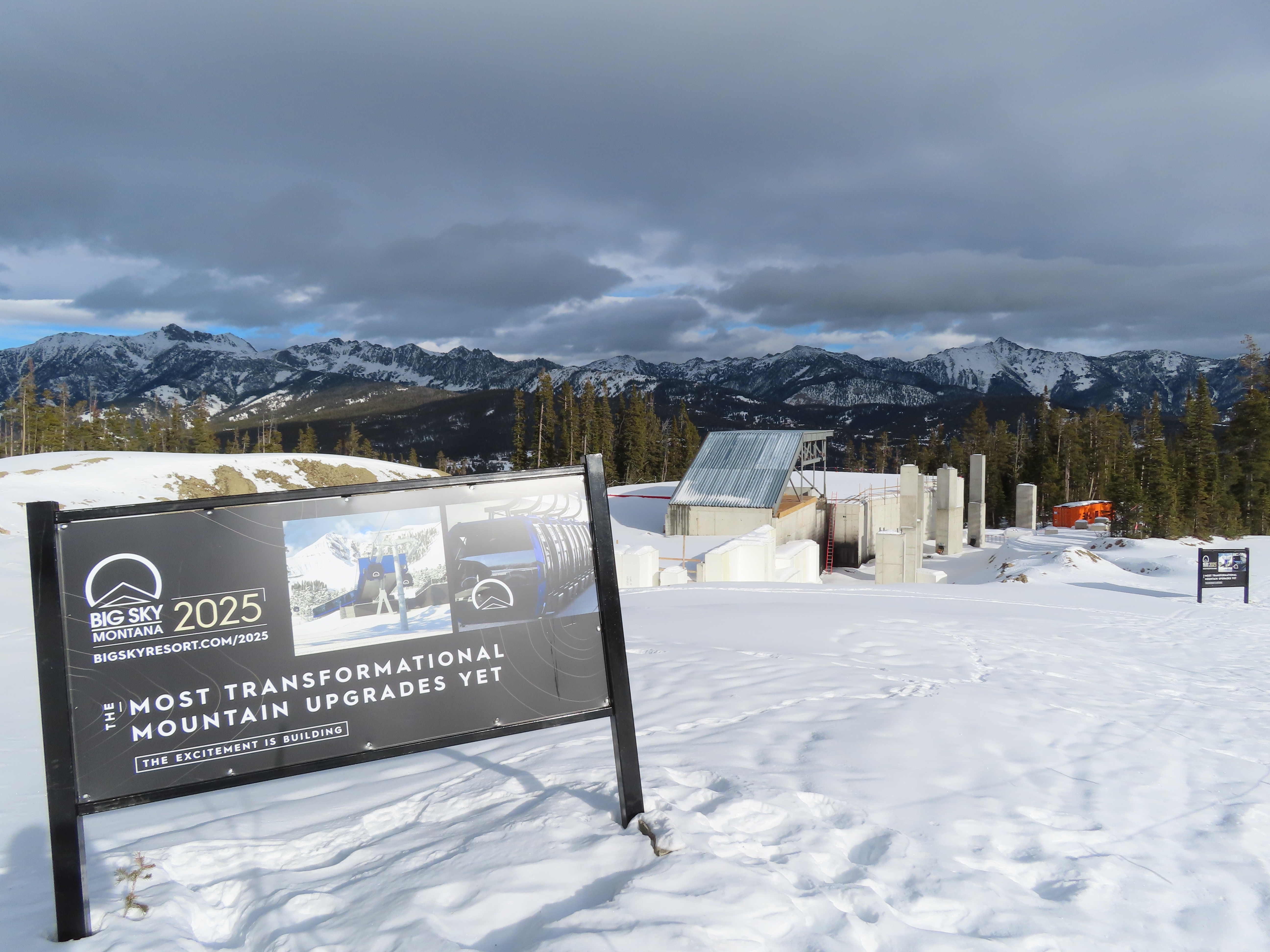
The under construction Explorer Gondola is set to debut for the 2025-26 ski season at Big Sky.
News of North Side 8 comes at an exciting time in Big Sky just days after the new Lone Peak Tram debuted as the latest component of the Big Sky 2025 capital push. “Big Sky Resort is at the forefront of transforming the North American ski experience by adding the most advanced and comfortable lift system to our mountain,” noted Nedved. “This lift replacement, our seventh in as many years, supports our long-standing reputation for having some of the shortest lift lines in the Rockies.” Big Sky also recently commenced construction of a two stage D-Line gondola running from the Mountain Village to the new tram. A second two stage D-Line gondola is planned to link the new One&Only Moonlight Basin to the Madison base area and North Side 8.
🎉 Surprise! 🎉 We are on our way to replacing 6 Shooter, with construction beginning summer of '24 + a scheduled opening for the 24/25 winter season ☃️
Fresh off replacing both major lifts on the Warm Springs side of Bald Mountain, Sun Valley today announced its next lift project will enhance the guest experience on Seattle Ridge. Following the debut of new four and six place lifts just last week, Doppelmayr will return to Baldy in 2024 to replace the Seattle Ridge detachable quad with a detachable six pack, increasing capacity by 20 percent. Interestingly the lift will not be a D-Line like the just-opened Challenger but rather a UNI-G à la Flying Squirrel and Broadway. The project is currently under Forest Service review alongside a future Christmas replacement as Sun Valley works to retire its entire fleet of seven Yan detachables built in the 1980s and 1990s.
“Seattle Ridge is home to some of Sun Valley’s most beloved intermediate, family-friendly terrain and more recently with the Sunrise expansion, some of its best off-piste terrain,” said Pete Sonntag, Vice President and General Manager of Sun Valley Resort. “Over the last five years, we’ve been able to increase the skiable terrain serviced by Seattle Ridge chair by over 200 acres, and we believe the chairlift upgrade is coming at the perfect time as we continue our investment in the mountain experience at Sun Valley,” he noted. Construction is expected to begin in April with the new Seattle Ridge six place opening to skiers late next year.