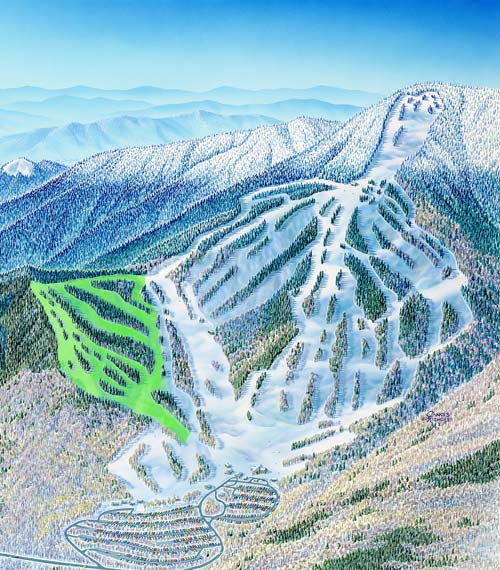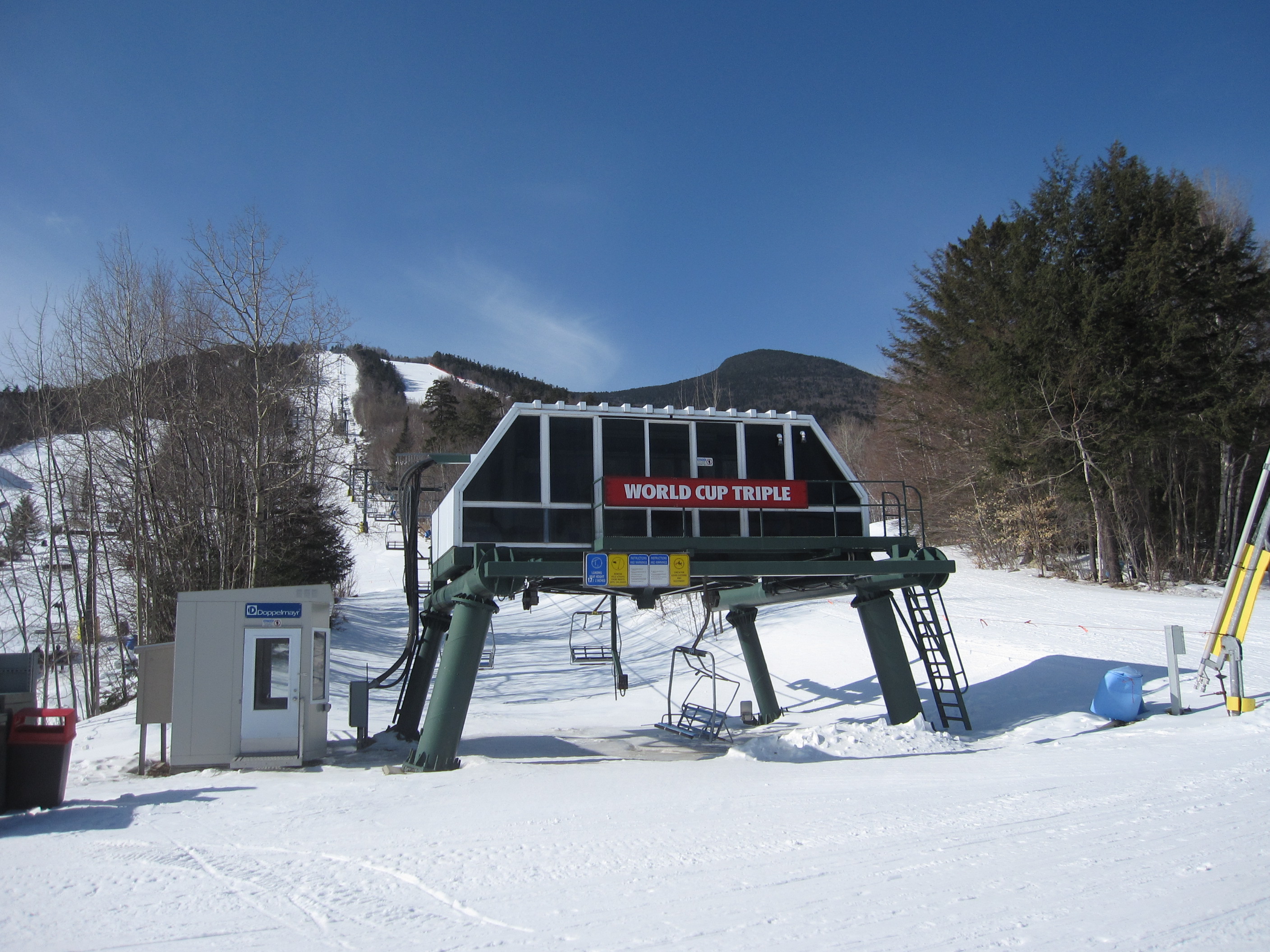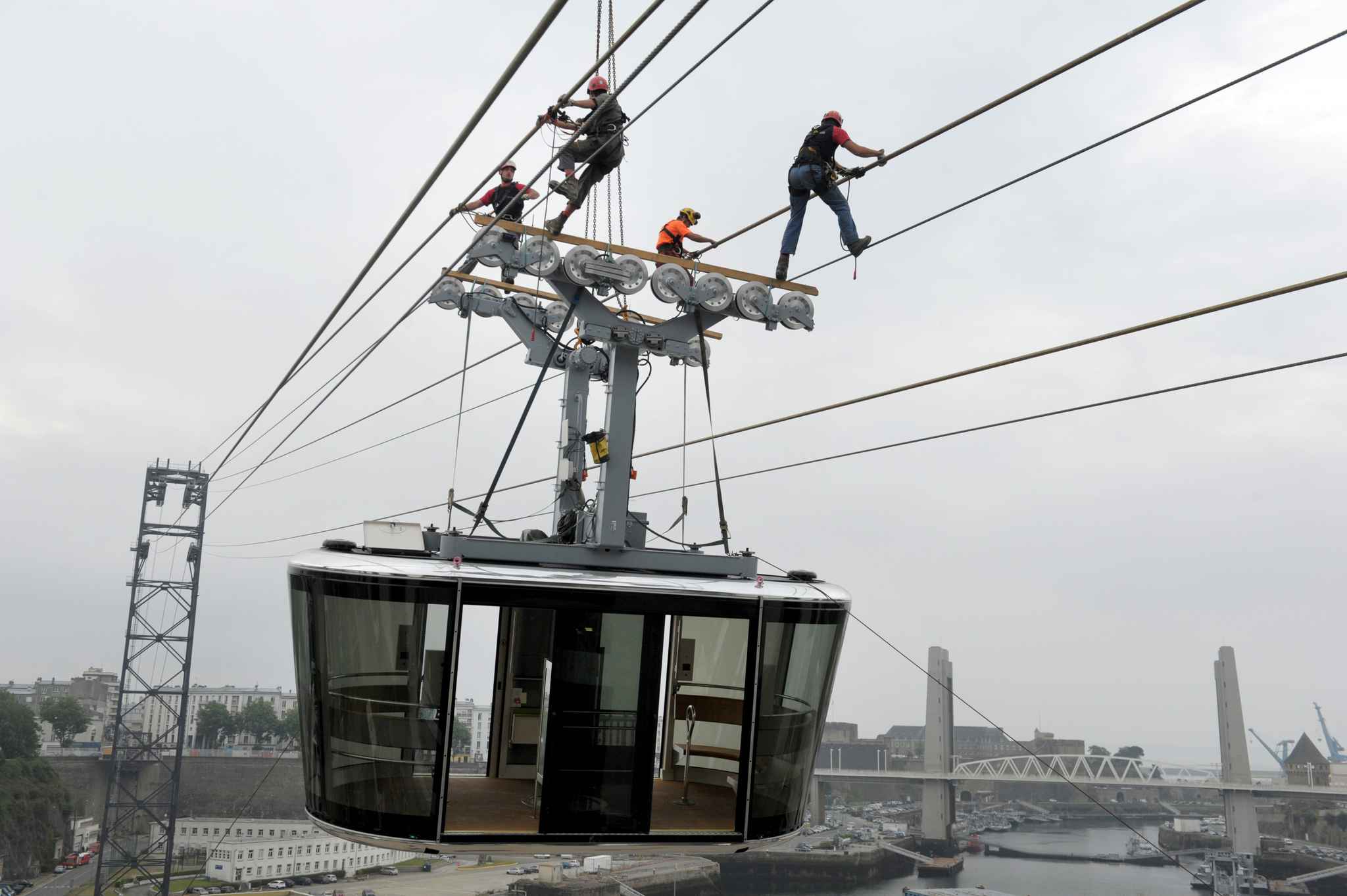
- A movement is afoot to turn Saddleback into a Mad River Glen-style cooperative.
- Red Mountain seeks to raise $5-10 million through crowdfunding.
- Leitner Ropeways launches interactive map of installations since 1996.
- With the haul rope being pulled, Mi Teleférico anticipates an early 2017 opening of the Blue Line in La Paz with 5 stations, 38 towers and 208 gondola cabins.
- Killington renews permit for the Pico interconnect to include four chairlifts and 110 acres of new terrain.
- BMF wins a contract for an 8-passenger gondola and six-pack at a new venue for the 2022 Beijing Winter Olympics. The company is currently building 5 lifts in Switzerland along with ones in Val Thorens and Moscow.
- New York University gets behind the East River Skyway as a solution to the looming L-Train subway closure in NYC.
- Public gets a sneak peak inside the Banff Gondola’s new $26 million top station.
Big Sky 2025: A $150 Million Vision for the Next Decade on Lone Peak
Big Sky Resort plans to build the most high-speed, high-tech lift network in North America over the next ten years, the company announced at media event this afternoon. Boyne Resorts Principal Stephen Kircher outlined Big Sky 2025, a $150 million road map for capital investment that includes a new North Village gondola, replacement of core lifts with bubble six-packs and additional lifts to serve new terrain. Enhanced snowmaking, new on-mountain dining and improvements to the Mountain Village will complement the massive investment in new lifts.
The rise of Big Sky from Chet Huntley’s four-lift outpost in 1973 to the Biggest Skiing in America with 26 lifts owes in large part to the Matterhorn-like mountain named Lone Peak. Boyne Resorts bought Big Sky in 1976 and slowly grew it into America’s largest ski resort by 2013 with the purchase of Moonlight Basin and the Spanish Peaks Mountain Club. Mr. Kircher noted none of the three mountains were financially sustainable in the 2000s and the uniting of the three has been transformative. Now with 5,800 acres of terrain, Boyne seeks to elevate the ski experience to match the grandeur of its mountain that is unmatched in North America. “We have a unique opportunity with the high alpine terrain here at Big Sky,” he noted.

With $13 million of construction underway on the mountain, Big Sky Resort will operate the second third largest lift fleet in North America this winter behind Whistler Blackcomb and Park City. The sprawling complex already includes two six-packs, five detachable quads and the famous Lone Peak Tram. This summer’s new lifts are just the beginning of a plan that includes the return of a gondola and ten more lifts (eight with bubbles) within existing boundaries and beyond. Big Sky 2025 will transition the resort from one with nearly the most lifts to one with the best lifts featuring loading carpets, bubble chairs, head rests and heated seats that skiers have become accustomed to in Austria and Switzerland but rarely find in the States.
Instagram Tuesday: Builders
Every Tuesday, we pick our favorite Instagram photos from around the lift world.
Crazy Gondola Opens at Wynn Palace Cotai
It seems the lift companies can build just about anything these days, even a gondola that turns six times at the request of a casino magnate. Steve Wynn opened his $4.2 billion Wynn Palace yesterday in Macau, China along with one of the most complex gondola lifts ever built. The casino’s SkyCab is monocable detachable that turns six times. Doppelmayr designed the lift to run slowly enough that cabins can round four different bullwheels at line speed while only detaching at two loading and unloading stations, one of which has a ~110-degree angle on the roof of the main lobby. An upcoming rail station will be integrated with the second station. The entire system relies on the same principles Doppelmayr used to build a gondola at a zoo in Sweden that also makes six angle changes.

CWA adapted standard 8-passenger Omega cabins into 6-passenger VIP versions with custom audio-visual systems and air conditioning. Doppelmayr Cable Car will manage operations and maintenance for the system under a long-term contract. If you are looking to make a career move and like the sound of dragon bullwheels, they are hiring.
Will North America Build a New Tram Ever Again?

Jackson Hole Mountain Resort stunned the ski world June 24, 2005 announcing the iconic aerial tramway up Rendezvous Mountain would carry its final riders in 2006. The Kemmerer Family, owners of the resort since 1992, decided to retire the 40-year old jig-back at the first concerns about safety. “This decision has been extremely difficult and quite honestly a very sad one,” Jay Kemmerer lamented at the announcement. “We know this may impact our business, business to Jackson Hole and the State, but we must move on.”
JHMR did move on but not in the way many feared. After two years of study, the Kemmerers opted to build a new 100-passenger Garaventa tramway at a cost of $31 million. A bi-cable gondola was cheaper and seriously considered but failed to uphold the tradition set by the original tram in 1966. National Ski Areas Association President Michael Berry said of the 2006 deal with Garaventa, “This huge investment by JHMR ownership to build a new tram stands alone in our industry. The tram at Jackson Hole is recognized around the world as a lift that access some of the most spectacular terrain in North America.” Big Red, as it quickly became known, was the first new tramway built at a U.S. or Canadian ski resort since the Alyeska Tramway in 1992. The next newest tram was Cannon Mountain’s, dating back to 1979. Almost a decade later, only Jackson Hole and Alyeska have built large new aerial tramways in the last 37 years (for this post I’m talking about multi-cable tramways carrying 25+ passengers. Arguably the “beer can” trams at Big Sky and Snowbasin are really reversible gondolas.)

Switzerland is home to 97 large aerial tramways. Italy has 59, Austria 40, France 35 and Germany 18 for a total of 249 in the Alps. Compare that with 21 tramways operating in all of North America: 14 in the United States, 4 in Canada and 3 in Mexico. Only a third of those are directly used for skiing with the rest dedicated to sightseeing or public transportation. More than half the trams operating in North America were built in the 1960s and 1970s with varying degrees of upgrades along the way. As the chart below shows, the aerial tramway staged a slight comeback in the last decade but aside from Jackson Hole and Alyeska, the trend has nothing to do with skiing.

The Royal Gorge Bridge & Park in Colorado hinted at the future of tramways in 2013 when it lost its tram to a wildfire. Instead of rebuilding, the park contracted with Leitner-Poma to build a reversible gondola at a fraction of the cost of a new aerial tramway. Even with just six 8-passenger gondola cabins, the new system can move more passengers than the old tram.
Challenger & Lone Peak Six Updates from Big Sky
Challenger
The first of two new Doppelmayr lifts under construction at Big Sky Resort this summer is a fixed-grip triple chair with loading conveyor replacing Challenger. A 1988 Superior Tramway double to the upper reaches of Lone Peak suffered gearbox damage last February (while I was on it) and never ran again. The new lift will be 25 percent faster than the old, ascending 1,670 feet in 9.5 minutes. Concrete for the new triple is finished except for the operator house footers up top. The triple chair will feature Doppelmayr’s Tristar bottom drive/bottom tension station with a simple return bullwheel up top. Interestingly, Boyne Resorts has ended up with four Tristar lifts after recent incidents at Sugarloaf (x2,) Big Sky and Sunday River.
About half of the tower footings were built from scratch while others were kept from the old lift that ran in the exact same alignment. Challenger will have 18 towers versus 15 on the old double. Both terminal locations have been completely re-graded with much more room for loading and unloading. Tower tubes and crossarms are in the parking lot ready to fly any day now.
Talking Wire Austin with Designer Jared Ficklin
Jared Ficklin and Michael McDaniel are co-creators of The Wire, a brand and concept for urban gondolas in what Forbes calls America’s next big boom town. Designers by trade, they began speaking about their vision to tech conferences and business groups in 2012, leading to a TED Talk in early 2013. If the lifts in Zillertal, Austria can move up to seven million people a day, they asked, why haven’t gondolas entered the transportation picture in our densest landscapes? The presentation was enthusiastically received and Jared gave it a second time at TEDx Kansas City in 2013 to a crowd of more than 4,000. Three years later, Jared and the team at argodesign are at work on a plan for Austin’s first line, Wire One. This week, Jared graciously answered my questions about the project and what comes next.
Sunday River to Build New Lift on Spruce Peak
Sunday River announced this morning a $2.1 million Doppelmayr fixed-grip triple will replace the Spruce Peak triple, where a terminal literally fell over last month. Willis MountainGuard and Boyne Resorts deemed the lift a loss after suspected grout failure sent the top station sliding from the bedrock it was anchored to the weekend of July 9th. The 1986 Borvig triple was Sunday River’s second oldest lift and the new version will re-use its new Chairkit loading conveyor. Doppelmayr will also replace the top terminal of Sunday River’s other Borvig triple on Locke Mountain.

Exactly when the new lift will open is unclear. Doppelmayr already has a packed summer building 17 lifts across the US and Canada. In the meantime, most of Spruce Peak can be accessed from the Chondola and Aurora lifts.
This is far from the first (and won’t be the last) late-season lift replacement after unexpected disaster. On June 11, 2012, a wildfire burned through Ski Apache in New Mexico, damaging two chairlifts and a gondola. The Native American tribe that owns the mountain announced a $15 million deal with Doppelmayr on September 5th and three new lifts were completed by January.
British Columbia Approves up to 16 Lifts at Valemount Glacier
Oberto Oberti is a man who doesn’t give up. Less than two months after the province of British Columbia revoked authorization to build his controversial Jumbo Glacier Resort, Mr. Oberti won approval today to build a 12,000-acre ski resort in the Premier Mountains west of Jasper. The resort’s master plan lays out 16 lifts surrounding Mt. Pierre Trudeau, named for the father of Canadian Prime Minister Justin Trudeau. Mr. Oberti’s storied history in Canadian skiing includes designing Kicking Horse Mountain Resort, building resort hotels in Whistler and proposing Jumbo Glacier.

Valemount Glacier could eventually rise 7,415 vertical feet with the only lift-served, year-round glacier skiing on the continent. Its vertical drop would be third longest in the world, rivaled only by Zermatt and Chamonix. Total acreage could reach 12,348, nearly twice the size of the new Park City. “You have to picture this as a series of gondolas on mountains, one after another,” Mr. Oberti’s son Tommaso told Business Vancouver today. “Each mountain is taller than the preceding one.” Lifts could reach an elevation of 10,515 feet – 1,500 feet higher than Canada’s current loftiest lift at Sunshine Village.
News Roundup: Commonwealth
- Highland Mountain Bike Park is closed this week as crews reinforce a 1987 Borvig triple top terminal foundation, surely as a result of the Sunday River Spruce Peak incident. The bike park, which is no longer a ski resort in the winter, hopes to re-open tomorrow.
- At Sunday River, Spruce Peak’s haul rope has reportedly been cut. Its sister lift, the 1984 Borvig Locke Mountain triple had its rope removed from the top bullwheel.
- Cardrona Alpine Resort in New Zealand will build a Doppelmayr 6/8 chondola for next season.
- Splicer Bill Alsup died last Tuesday in a crane accident at the age of 78. He started working for Poma in 1959, ran the Poma distributorship in Vermont for more than 25 years and was also an Indy Car driver.
- Steamboat inches towards two new gondolas.
- Leitner-Poma of America is designing the huge gondola from Queenstown to The Remarkables that would have three stations, 80 towers and cost approximately $36 million.
- Italy’s first heated-seat chairlift will be an 8-pack.
- Ski Magic, LLC signs purchase agreement for Magic Mountain and will immediately begin work required by the Vermont Passenger Tramway Board to make lifts operational. First priority is the Pohlig triple chair that’s sat idle the past two seasons. Geoff Hathaway, President of the new ownership group commented, “it was either Magic or Whistler Blackcomb. I think we got the better deal.”
- Aspenites continue to argue over the placement of 1A’s new lower terminal.