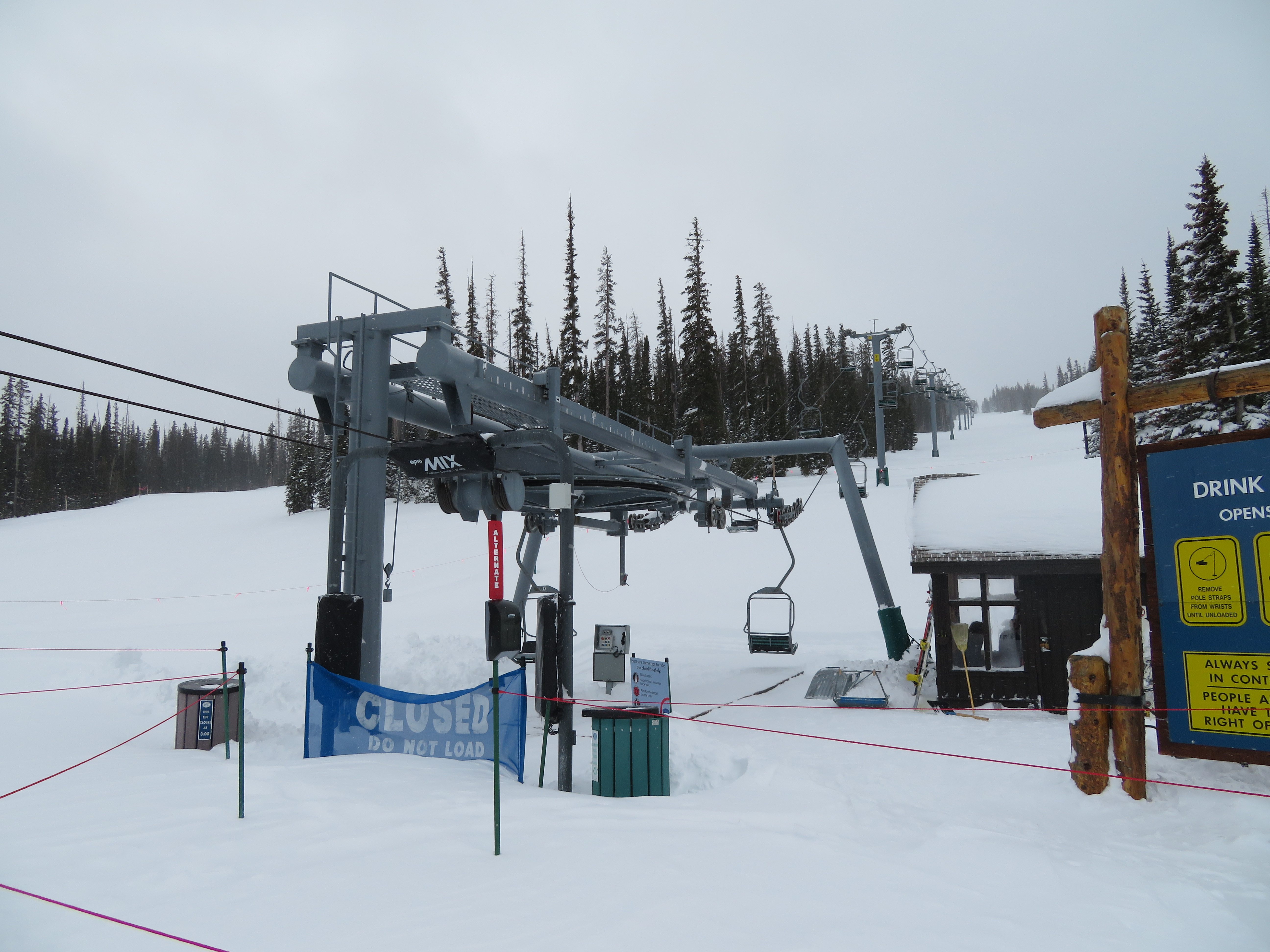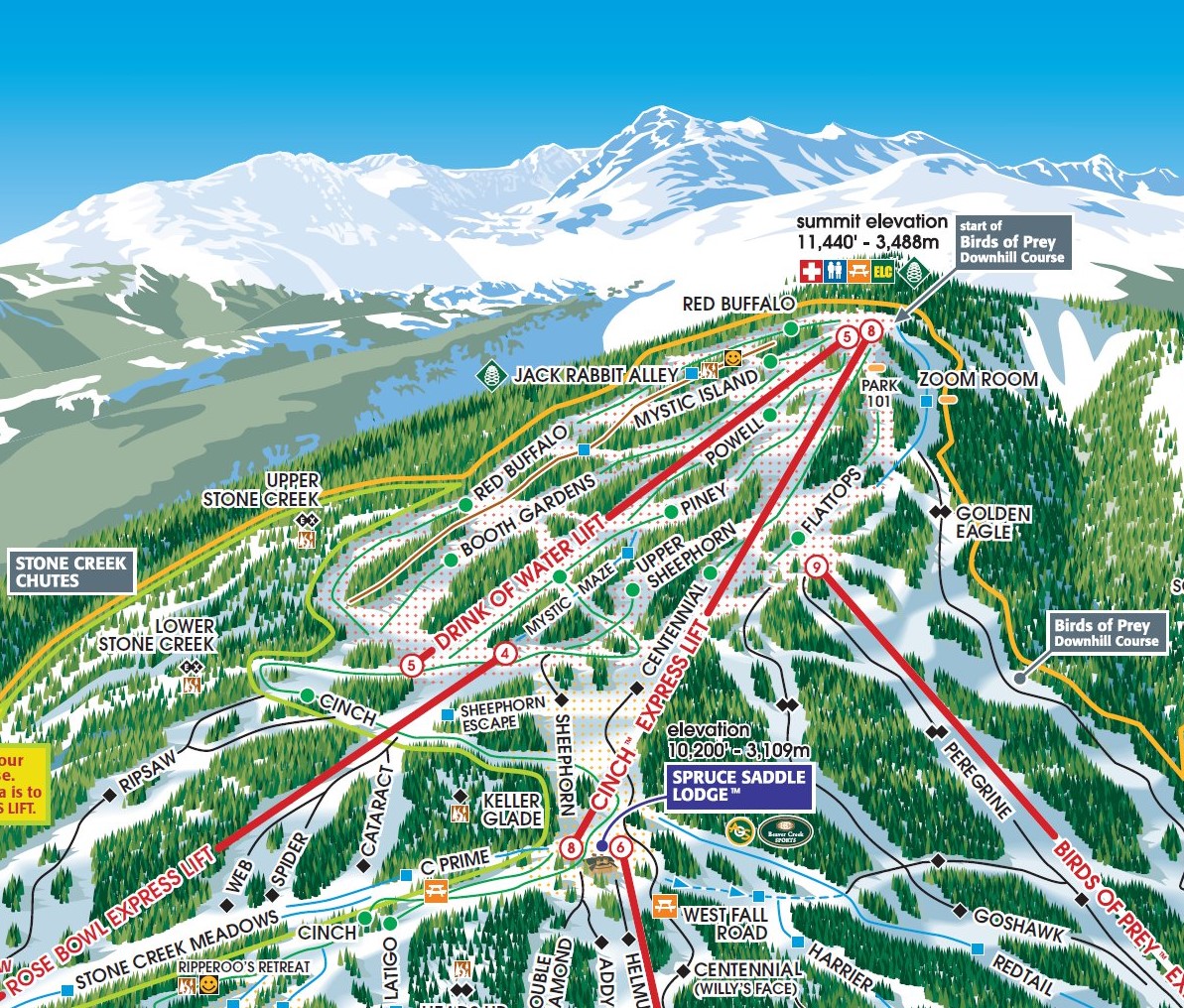
Adding to the big December announcement of new six-packs at Vail, Breckenridge and Keystone, Vail Resorts today revealed another high-speed lift will replace Drink of Water at Beaver Creek. The new 4,300′ high-speed quad will reduce the ride time from 8.6 to 4.3 minutes and nearly double capacity. “Upgrading this essential beginner lift will provide high-speed lift access to the amazing beginner and intermediate terrain at the top of Beaver Creek, increasing capacity and making for a seamless lift experience for our guests on the hill,” said Beth Howard, chief operating officer. “We expect this improvement to take significant volume off Cinch Express, Beaver Creek’s second most-popular lift, and it really is an improvement befitting of Beaver Creek’s luxury, family experience, as it enhances a key beginner and family area of our mountain.” The Drink of Water double is the last remaining lift at Beaver Creek from the resort’s inaugural season in 1980.
Drink of Water will be retired in April. Next season, Beaver Creek will only have two fixed-grip lifts remaining – Highlands and Elkhorn.
The Red Buffalo Express will almost certainly be built by Doppelmayr USA, as Beaver Creek operates an all Doppelmayr/CTEC fleet of 16 lifts. The four new detachable lifts in Colorado are part of Vail Resorts’ $100 million capital plan this year and we learned this week the six-packs at Vail, Breck and Keystone will be installed by Leitner-Poma. Eldora, Wolf Creek and Aspen are also likely to build new lifts for 2017-2018.
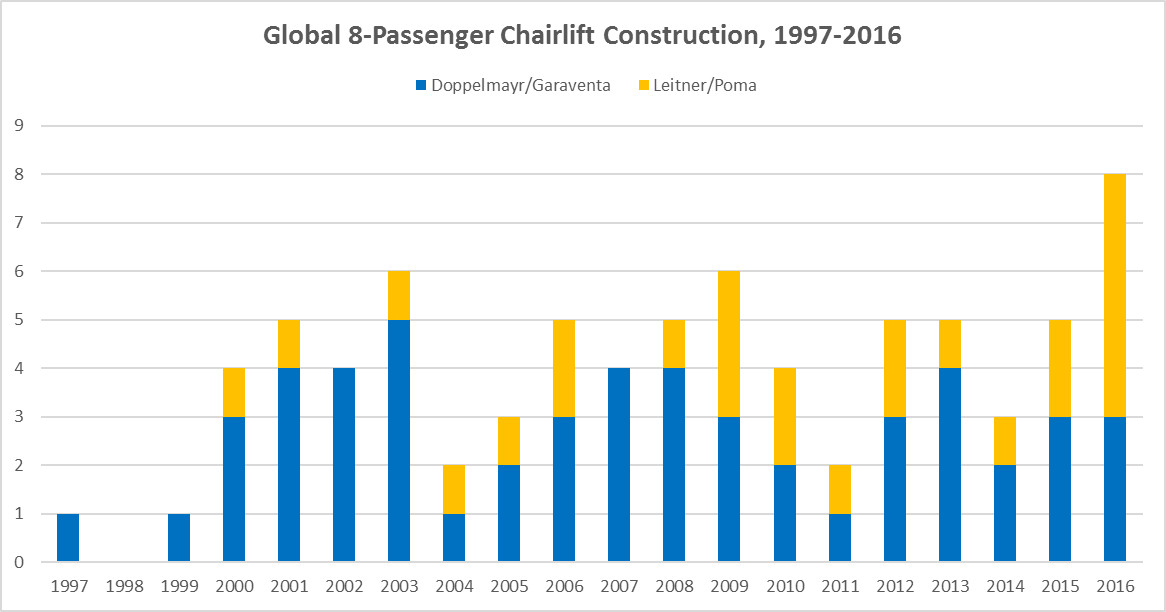
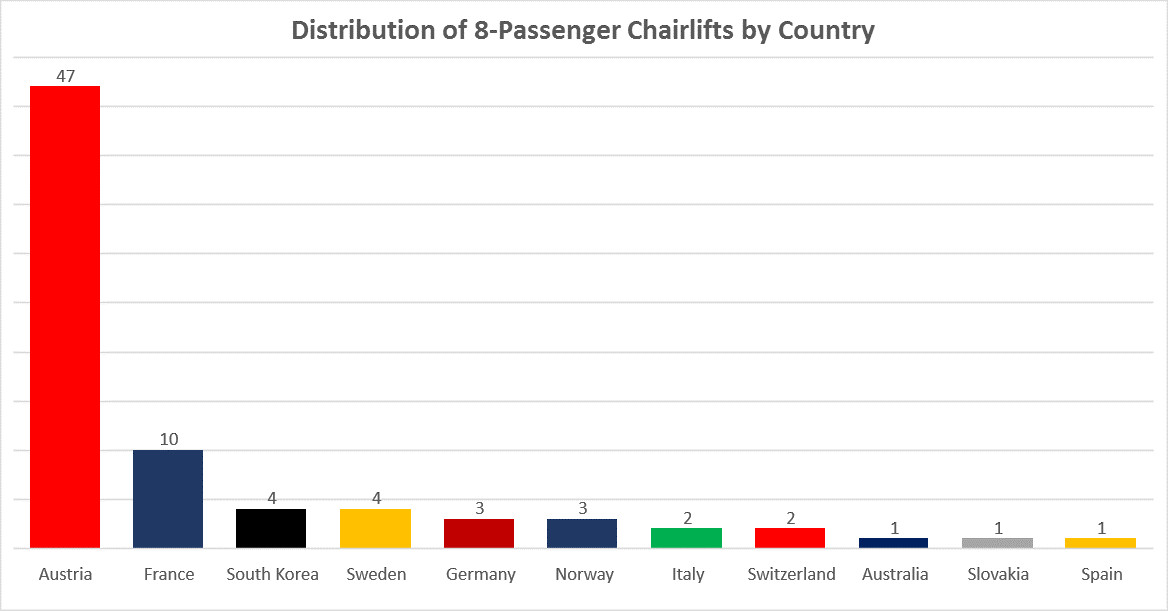
Eight new eight-passenger chairlifts debuted this ski season, the highest number in history. Twenty years since the technology debuted, Doppelmayr, Garaventa, Leitner and Poma have now built a combined 78 of these mega chairlifts on three continents and in eleven countries. With 2016 seeing the greatest number of eight-passenger chairlifts constructed, a question on everybody’s mind should be: when will the world’s second largest ski market finally build one?
Doppelmayr debuted eight-passenger chair technology in 1997 (in Norway of all places) and continues to be the market leader, having built two-thirds of those operating today. But for the first time ever the Leitner-Poma Group installed more than Doppelmayr and Garaventa combined last year. In 2006, Leitner built the first combined installation with eight-passenger chairs and 10-passenger gondola cabins and there are now seven of these across Europe. Bubble chairs and seat heating came along in 2000 and nearly every new eight-passenger lift features both these days. In total, 60 percent of eight seaters globally have bubbles and half sport heated seats.
Austria is home to over 60 percent of the world’s eight-passenger chairlifts and exactly five have ever made it out of Europe. Australia and Asia each got their first in 2003 but several leading ski markets have never gone there – among them Japan, Canada, China and the United States.
A new lift changes a mountain. In this story, the mountain is a volcano and the actors are Mt. Bachelor, Doppelmayr, Highlander Lift Services & Construction, Timberline Helicopters and the Forest Service. Cloudchaser: The Story Behind Building a New Lift is one of the best videos you’ll see in awhile.
Congratulations to the team on a job well done. Thanks to their efforts, Mt. Bachelor is now the sixth largest ski resort in the United States!
“We don’t fly the helicopter and we don’t tie the knot.” – Paul Johnston, Highlander Ski Lift Services & Construction.
View of Eglise Mountain earlier this season with new trails cut over the past two summers. The expansion will include at least three new lifts.The Yellowstone Club in Big Sky, Montana will likely build not one, but three new lifts this summer as it adds Eglise Mountain to its expansive roster of ski terrain. The second section of a future two-stage gondola, along with a detachable bubble quad chair and new beginner triple chair are all slated to debut in time for the Club’s 17th winter season next year.
Doppelmayr USA will build the new lifts and already poured many of the tower and terminal footings last summer. The upper section of the 8-passenger Eglise Gondola will debut first, with the lower stage to be added when the 550,000 square-foot Village Core is substantially completed. That project, located adjacent to the Warren Miller Lodge, is also underway and currently the biggest construction project in Montana. A dedicated building in the village will eventually house the new gondola’s base terminal, not far from the Lodge lift.
Heavenly’s Comet Express remains closed following a Jan. 1st rope evacuation, apparently due to a gearbox issue. This is one of the reasons Vail Resorts is replacing its fleet of 1980s-vintage detachable quads.
Ski Area Management‘s lift construction survey dropped this week. Highlights from its outlook for 2017:
“We’re off to a strong year for ’17, there are lots of people asking about lifts…It’s very positive compared to the previous two years.” – Jon Mauch, Senior Sales Manager at Leitner-Poma
“There’s a lot of enthusiasm about what could happen under a Trump administration. People expect deregulation and a more business-friendly climate.” – Mark Bee, President at Doppelmayr USA
“We’re seeing lots of requests quotes, lots of major modifications and retrofits…It’s all being driven by the age of the existing lift infrastructure.” – Carl Skylling, General Manager at Skytrac
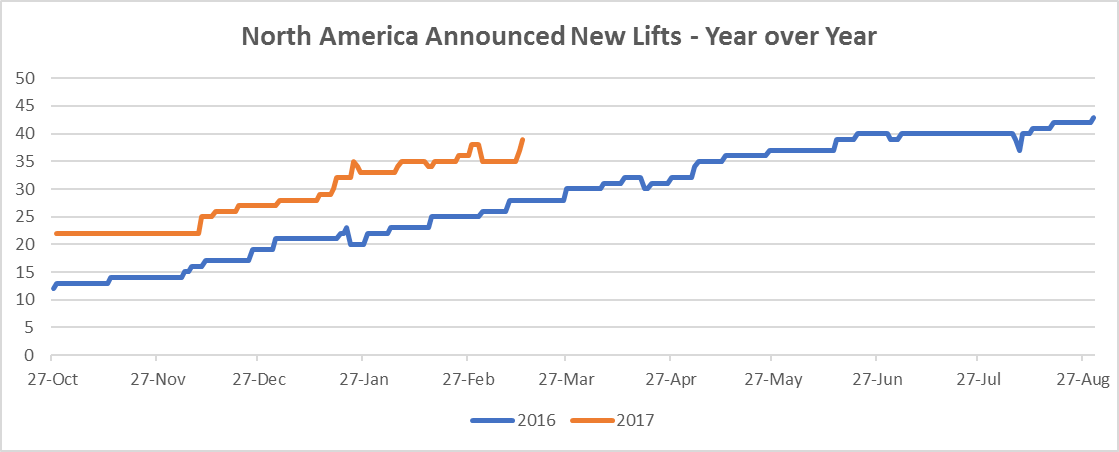
I’ve already identified 29 new lifts likely to be built in 2017, pacing well above the last few years for mid-January.
Leitner-Poma, Georgetown University, ZGF Architects host urban gondola forum with speakers from the Portland Aerial Tram and Medellín Metrocable, among others.
With one of three chairlifts out of commission, Big Tupper, NY is unlikely to open this winter.
14-year old boy falls from the Emerald Express at Whistler.
Costa Rican officials and Doppelmayr Mexico sign letter of intent to build Central America’s first urban gondola.
2015/16 was the second best year in Doppelmayr’s history, the company reported yesterday. Sales increased 5 percent over last year, reaching €834 million ($880.3 million.) Global headcount also rose by 127 employees to 2,673, half of which work in Austria. Net income was €80 million.
The largest market for Doppelmayr in 2015 continued to be Austria, followed by Switzerland, France and Italy. Latin America now accounts for 16 percent of the global total, higher than North America. Southeast Asia, namely Vietnam, is a key emerging market for the company. By the end of next year, Doppelmayr will have completed the world’s longest mono-cable gondola, the longest 3S, the largest aerial tramway and built the tallest towers in the rapidly-developing nation.
The United States and Canada fell to 5th among Doppelmayr’s largest markets in 2015/16.
Winter resorts accounted for 82 of Doppelmayr’s 103 projects last year. That means about 20 percent fell into the tourism, material transport and urban transportation categories. 103 is actually a ten year low in terms of number of projects, but those realized in 2015/16 tended to be large. Some highlights from last fiscal year include:
Kirchenkarbahn, the first D-Line installation, to be followed by several more this year.
Tower 6 of Grand Targhee’s new Blackfoot lift above Teton Valley, Idaho.
More than sixty inches of snow buried the Tetons since I last visited Grand Targhee, but that didn’t stop team Doppelmayr from making a ton of progress on the new Blackfoot lift. Timberline Helicopters assisted flying towers on October 20th and the haul rope was spliced November 12th. With comm-line installation last week, the new quad chair is almost finished.
New Blackfoot marks a huge change from the center pole chairs and wooden ramps of the classic Riblet. Both the load and unload areas were re-worked over the summer and are way more spacious. The new quad will move 840 more skiers per hour (to 1,800 from 960) with a minute faster ride time. A Tristar-model drive station features an auxiliary engine capable of running the lift at nearly full capacity during a power outage. Although it’s a bummer Targhee had to delay opening last week, the recent nice weather no doubt helped crews finishing the new lift. This week’s forecast looks solid so hopefully we’ll be lapping Blackfoot soon!
Doppelmayr and McClaren Engineering Group recently completed a feasibility study for a proposed Capital District Gondola connecting Albany and Rensselaer, NY over the Hudson River.
Two months after Doppelmayr and McLaren Engineering Group launched one of the world’s most complex gondola systems at Wynn Palace Cotai, the two companies have teamed up again on a wholly different project spanning the Hudson River in Albany, New York. McLaren Engineering, headquartered in the region, and Doppelmayr, with an office in nearby Ballston Spa, self-funded the study.
A team of six professionals engaged with stakeholders over the past three months, culminating in the document’s release this week. The gondola would connect America’s 9th busiest Amtrak station with Downtown Albany utilizing a mid-station and possible angle change. Because it has all the components of a successful urban system – key points separated by a natural barrier over a modest distance – the study results are very positive. “After three months, the Project Team finds the CDG to be feasible,” the authors note. “It retains the potential of being a transformational project that will spark increased mobility, tourism, and economic development in two areas of the cities of Albany and Rensselaer that are currently underdeveloped.”
Future Rensselaer Amtrak Capital Gondola station with enhanced station design.
Albany’s train station moved across the river to Rensselaer in the late 1960s, separating the city from its major transit hub. Goals of the gondola project include addressing the physical separation, providing a new pedestrian and bicycle connection and improving quality of life in the Capital District.
The new Sweetwater Gondola at Jackson Hole Mountain Resort awaits its first passengers November 13, 2016.This story begins in the mid-1930s, when Paul Petzoldt went skiing with two friends, thinking about the future. “Below Buck Mountain, north of Wilson, there was one mountain that stood out,” he wrote in his autobiography, Teton Tales. “It was difficult, and we knew it would be difficult for beginners unless there were places lower on the mountain that would be level enough to teach skiing. We had no money, and we had no connections. We just knew that some day there was going to be a big ski area there.”
That mountain was Peak 10,450, today known as Rendezvous Mountain. Eight decades later, when you board the Jackson Hole Aerial Tram and again upon exiting, a safety message reads, “our mountain is like nothing you have ever skied before…it is huge…with dangerous cliff areas and dangerously variable weather. You could make a mistake and suffer personal injury or death.”
As David Gonzales remarked in his 2002 book, Jackson Hole: On a Grand Scale, “Missing are the hallmarks of a typical American ski area – the wide, artificial swaths of snow streaming down a forested hillside…Instead, Jackson Hole’s trails blend seamlessly with the avalanche paths and scree fields that abound in the Tetons.” In fact, a group of Salt Lake City investors who surveyed the area in the late 1950s regarded the Cache Creek drainage in the Gros Ventre Mountains as the only suitable site for a ski resort in Northwestern Wyoming. They recruited University of Denver ski coach Willy Schaeffler to come to Jackson and survey. He came and went, unimpressed with the mellow terrain in the Gros Ventres. According to Pete Seibert, Schaeffler said the same about about a yet-to-be-developed Vail Mountain.
The Sweetwater Gondola begins a new era in the shadow of Big Red for 2016-17.Retiree Paul McCollister, general contractor Alex Morley, John Gramlich and Ernie Hirsch of the U.S. Forest Service carved their first turns on Rendezvous Mountain on Christmas Day 1962. Three years later, they presided over the opening of three double chairs (two Hall, one Murray-Latta) followed by an aerial tramway in July 1966. “The very ruggedness that attracted Morley and McCollister to the Tetons proved a hurdle,” notes Gonzales. “The mountain was steep, remote and cold. Convincing skiers that these were actually positive attributes would require reserves of determination that the construction of the ski resort had only begun to tap.” Investors came and went over a tumultuous first thirty years of the Jackson Hole Ski Corporation. Mr. Golzales wrote, “Morley suspected the resort would not last more than a couple years. But McCollister endured, recruiting Pepi Stiegler to accompany him to ski shows in order to drum up interest. It was a hard sell. Though many skiers had heard about Jackson Hole, they’s also heard that the Wyoming resort was too remote, too steep and too cold. ‘Everybody told you this,’ Stiegler recalls. ‘It was discouraging.'”
Harry Baxter, marketing director from 1974 to 1995, at one point tried to re-brand The Big One as the Gentle Giant, with trail maps noting, “there is more intermediate skiing on the small mountain, Apres Vous, than 90 percent of America’s best.” When the new Casper high-speed-quad launched, it was marketed as “All new, all blue.” Even today, the summer tram announcement reads, “the aerial tram, together with the Bridger Gondola and a variety of other lifts, offers more expert, intermediate and beginner terrain than most resorts in the United States. Yet many still regard the home of Corbet’s Couloir, Teton Gravity Research, Doug Coombs and the Tram as the wild west of skiing.
From opening in 1965 until the mid-1990s, Jackson Hole added just four new chairlifts. In the same period, Vail built 31 new ones, as the Ski Corp. struggled to even stay afloat. That all changed in 1992, when Jay Kemmerer and his family bought out not only Paul McCollister, but other investors he had taken on in tough times. The Kemmerer Family wanted to reinvest in Wyoming, and they’ve done so to the tune of $130 million. The Thunder Quad in 1994. Wyoming’s first detachable lift, Teewinot, in 1996. Bridger Gondola in 1997. A new Apres Vous in 1999. Moose Creek and Union Pass in 2000. Sweetwater in 2005 and a $32 million aerial tram opening at the height of the Great Recession in 2008. Followed by three new lifts in five years – Marmot, Casper and Teton.