
- Doppelmayr will bring D-Line to France for the first time this fall.
- A child is okay after falling from a Big White chairlift onto a busy road.
- Ski California to host its first Lift Maintenance and Operations Education Conference June 5-7 at Squaw Valley.
- After weathering a challenging season with a narrow profit, Sunlight considers building a truly new lift for the first time in half a century.
- An empty cabin falls from an early model Poma gondola in France, leading to a rope evacuation and significant media attention.
- Fatzer produces a 6.5 mile long, 60 mm wide rope for what may be the new longest monocable gondola, location unknown.
- Mt. Timothy, BC is “flat broke” and will likely close without public funding.
- Leitner delivers the first Symphony cabin for the world’s highest 3S by helicopter.
- The financially-challenged Hermitage Club closes for the season.
- Garaventa names a new CEO.
- A state economic development authority delays consideration of a $28 million loan guarantee for The Balsams.
Doppelmayr
Beech Mountain Adding Two Doppelmayr Quads
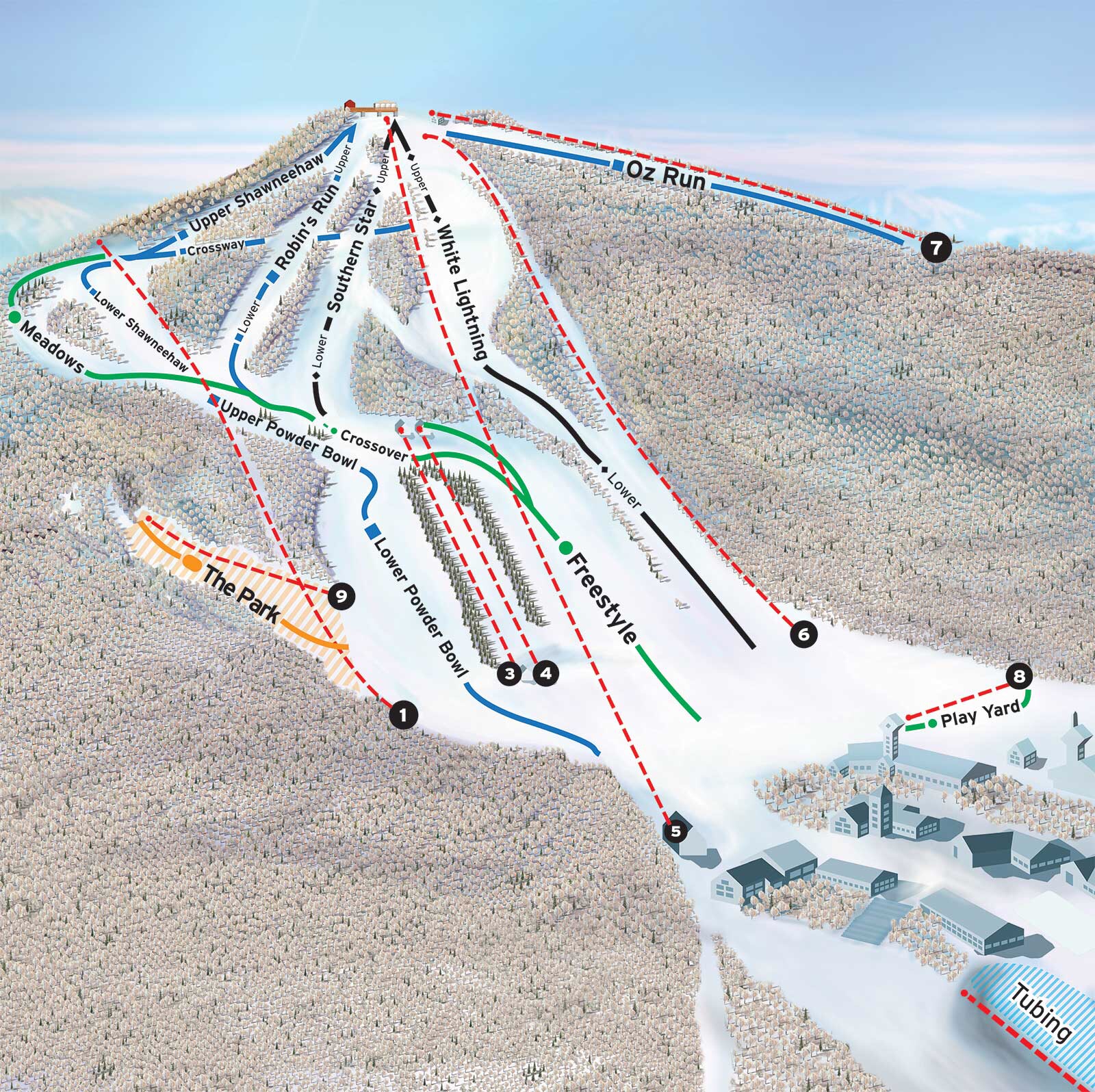
Beech Mountain, North Carolina will replace two of its workhorse chairlifts ahead of the 2018/2019 winter season as had been rumored for weeks. Lift 5, which ascends to the 5,506-foot summit and was originally built in 1987, is currently being disassembled in preparation for the installation of a new Doppelymayr fixed-grip quad. The new lift will include a loading conveyor to ensure safe boarding, higher travel speeds and shorter trip times. Lift 5 will now include 144 chairs with a 6.5 minute ride time accommodating 2,400 people per hour.
This marks only the second time in North American history that a fixed-grip chairlift will replace a detachable one, though there could be more in the near future. Sugarbush, Vermont swapped the 1990 Green Mountain Express for a fixed quad in 1995, though the route went detachable again in 2002. Willamette Pass, Oregon’s detachable six-pack is currently up for sale, eyed to be replaced with a fixed-grip lift that would be more affordable to operate. A used T-Bar may also rise this summer at Ascutney, Vermont on the site of a former high-speed quad. If Tamarack, Idaho is ever able to rebuild the Wildwood Express, it could be another detachable-turned-fixed-grip scenario.
Back to Beech, Lift 6, currently a double chair with parts from Goforth Brothers, Hall and Doppelmayr, will be replaced with another Doppelmayr fixed-grip quad. This one will feature 106 chairs and a 6.5 minute travel time with a capacity of 2,000 people per hour. Both quad lifts will feature footrests, upholstered seating and back rests. Guests can now expect to reach the mountain’s 5,506-foot summit with easy on-and-off loading, comfortable seating, and a more efficient layout to eliminate congestion.
La Paz Debuts Sixth & Seventh Urban Gondolas

Under blue sky at 12,000 feet, the President of Bolivia pressed start at high noon yesterday for Línea Blanca, the newest gondola in the world’s urban ropeway capital. Surprising thousands gathered for the occasion, President Evo Morales then proceeded to inaugurate the first section of the Sky Blue line, initially slated to open later this year.
The day was momentous as seven color-coded gondola lines now stretch contiguously throughout La Paz and El Alto with no significant gaps between them. From this weekend, Mi Teleférico (My Cable Car) includes approximately 140,000 feet of haul rope, 962 gondola cabins, 168 towers and 26 stations. The scale is almost unbelievable and there are still four more lines in development!
Built by Doppelmayr like most of Mi Teleférico, the White line services four stations with 131 10-passenger cabins. It’s capable of transporting 3,000 passengers each hour on a 13 minute trip between the Sky Blue (Celeste) and Orange (Naranja) lines. The initial section of Celeste was once planned to be part of a four-section White line which was later split to serve additional neighborhoods and prevent any one line from becoming too congested. Like most of the world’s largest gondola system, I’m pretty sure the White Line is made up of two separate haul rope loops and vault drive systems with cabins that rotate through both.
Government: Human Error Caused Gudauri Rollback
Georgian Minister of Economy and Sustainable Development Dimitry Kumsishvili held a press conference today to announce initial findings of an investigation into the rollback of a 2007 Doppelmayr quad chair at the Gudauri ski resort, which injured 11 people a week ago. French firm Bureau Veritas confirmed the lift’s initial stop was caused by a power outage. “After the chairlift was stopped, the operator had to introduce specific sequence of procedures and after implementation of the certain actions, the operator had to switch the chairlift on to the diesel generator power and bring the tourist to the safe site,” a translated press release reads. “Unfortunately, according to the current conclusion, the operator made a mistake. The combination of the actions that he should have had carried out were not implemented in compliance with the relevant instructions – it was a human error.”
The report notes the chairlift had undergone an inspection in December and was in “perfect technical order.” The operator on duty at the time has been fired and may face criminal charges at the conclusion of the investigation. The Head of Gudauri Mountain Management and Deputy Director of the Mountain Resort Development Company have both resigned in the wake of the incident. Georgia is in active talks to retrain employees from Gudauri and other ski areas, though staff had been to training courses at Doppelmayr headquarters in Austria in 2017 and Poma was on site offering training opportunities as recently as January. The government says there are 15 total chairlifts in the country that are “in line with the world’s advanced standards.” A statement from Doppelmayr linking to the release notes, “We hope that the injured persons are getting well soon. This remains the most important point at the moment.” According to Minister Kumsishvili, all of those injured have been released from hospitals and invited to return to ski next year for free.
Doppelmayr Takes Ropeway Configurator to the Next Level
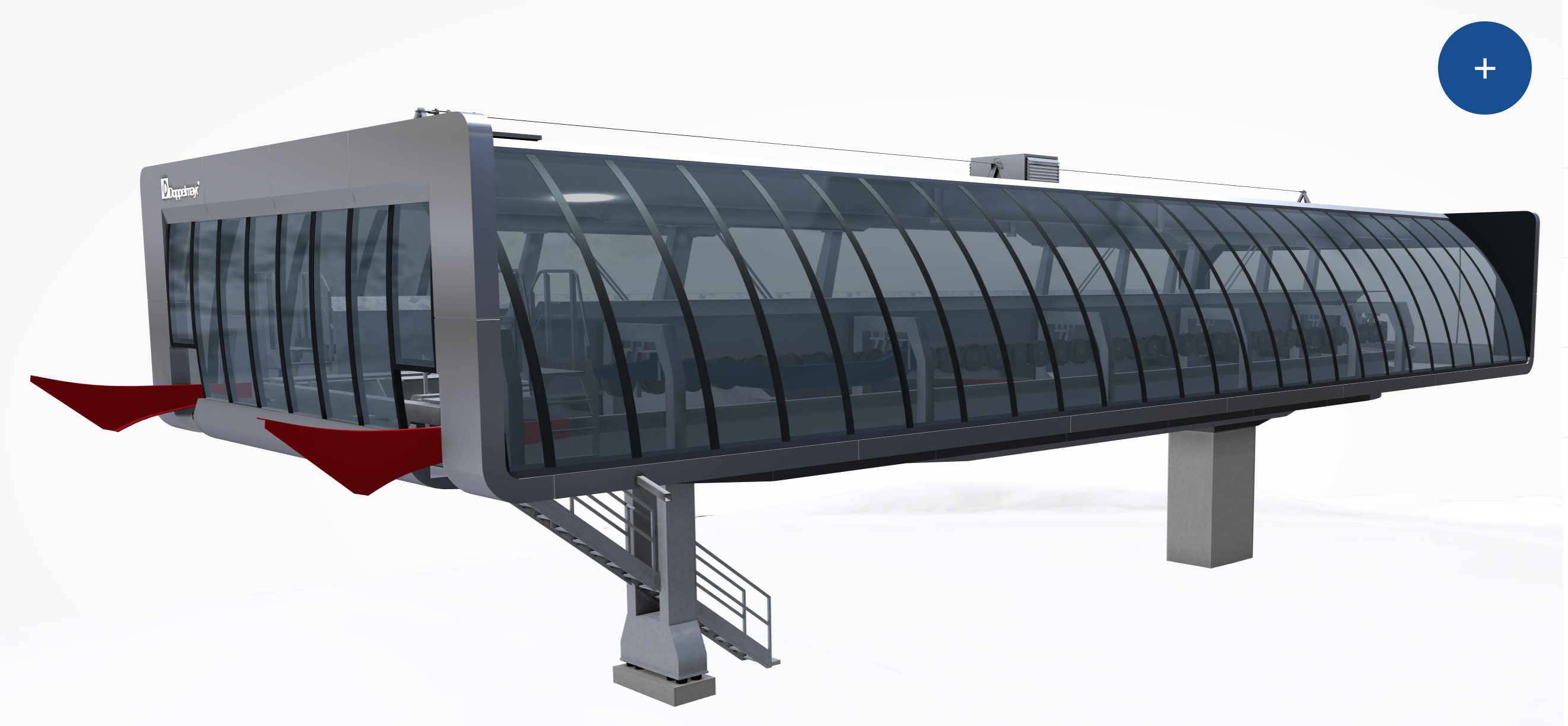
What if you could launch a new lift at your favorite mountain? Say, for instance, you owned the Jackson Hole Mountain Resort and wanted to upgrade the popular Thunder fixed-grip quad. Guests are seeking a faster ride but wind is an issue and you don’t want to overcrowd the storied Amphitheater and legendary Laramie Bowl. The neighbors to the north are going D-Line but the media facade doesn’t quite fit in with the Teton landscape. With Doppelmayr’s latest generation ropeway configurator, part of Doppelmayr Interactive, anyone with a computer can visualize the lift of their dreams. For Thunder, I came up with a modest capacity D-Line six place in gray and red.
I spent way too much time testing out other hypotheticals on the new version tonight. Another one: Arizona Snowbowl is considering Doppelmayr for its new base-to-summit combination lift. With the configurator, owner James Coleman could customize D-Line and non D-Line versions of six-passenger chairs and 10-passenger gondola cabins from anywhere. My mock up includes galvanized D-Line bubble chairs and and Omega cabins in Snowbowl blue. You can create whatever you like and then take a zoomable 360-degree spin.


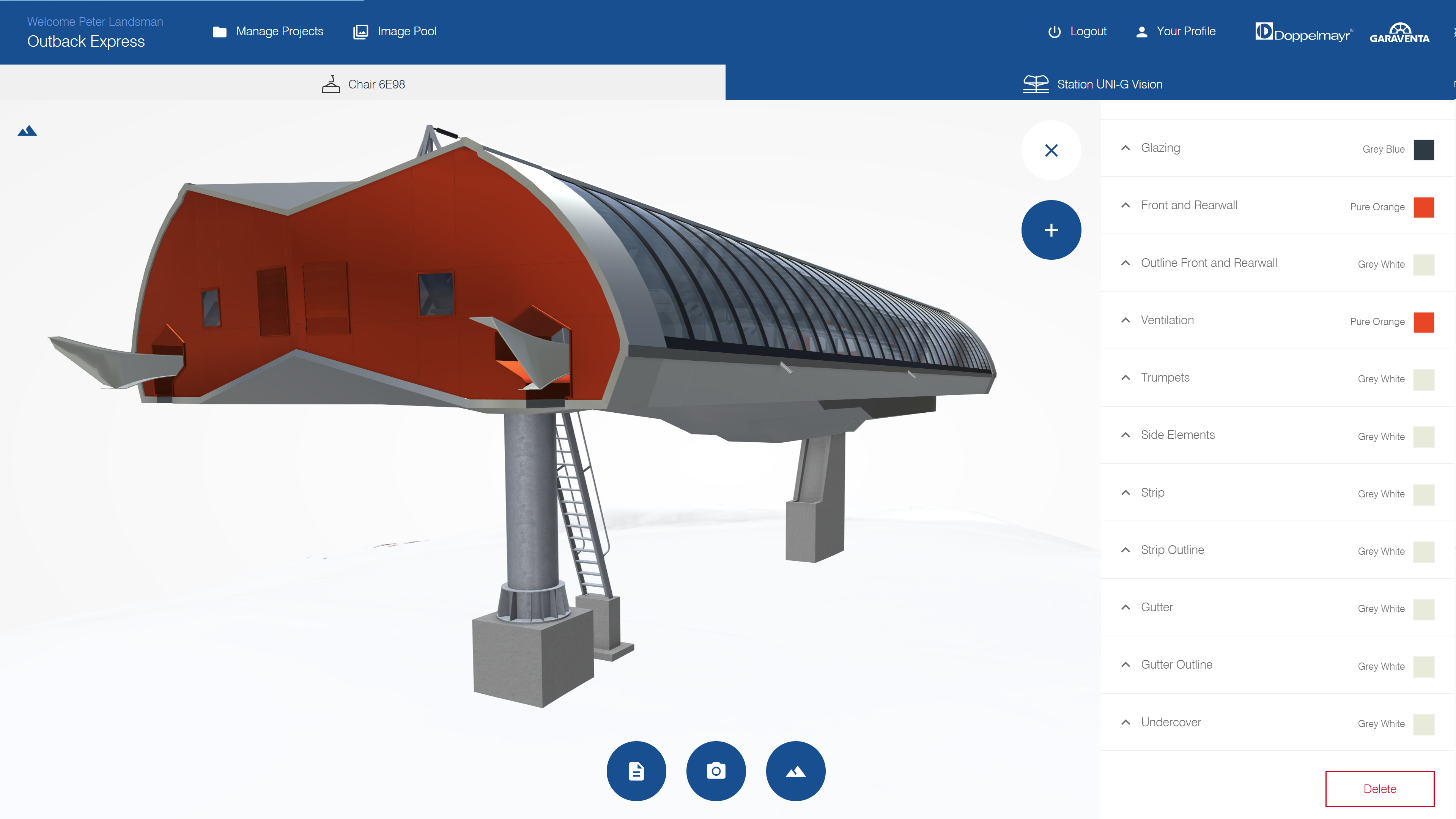
Last one: say a group of investors finally fronts the money to purchase the beautiful Saddleback Mountain in Maine and wants to build a signature lift to replace Rangeley up the heart of the mountain. No D-Line this time, simply a modern take on classic green and gray for a new UNI-G six-pack launching in late 2019. If only it was this easy!
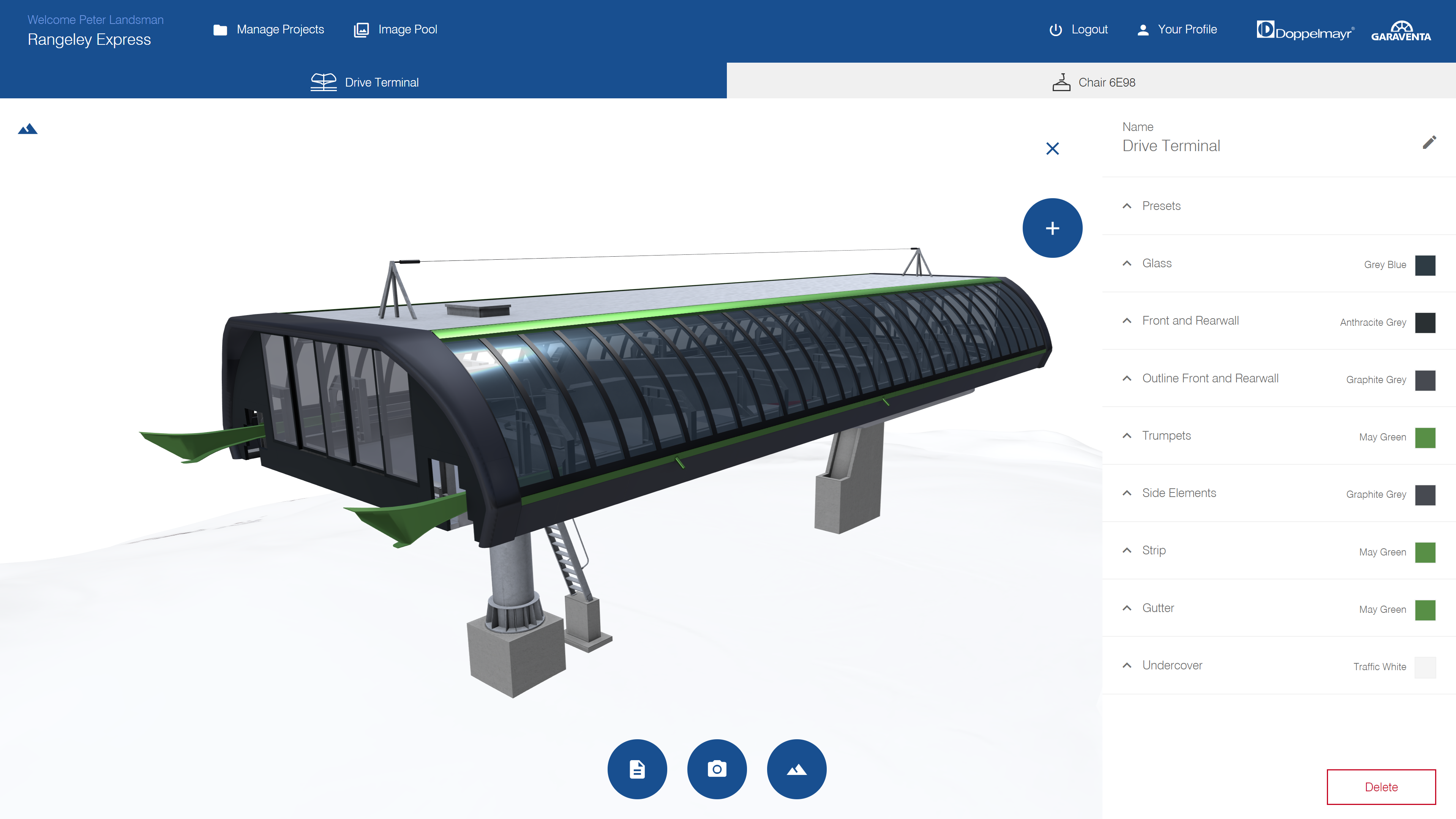
Just like a real lift, the possibilities are endless. Models now available to customize are 6E98 & 6DCD chairs, CWA Omega IV-8 LWI & Omega IV-10 SI D cabins, and UNI-G, UNI-G Vision, D-Line R1 & D-Line R2 stations. You can even upload background images and logos to customize your dream lift with any colors in the RAL spectrum. For those with access to the Doppelmayr customer service portal, your existing account works to save and send your creations. Pretty darn cool!
News Roundup: Available
- The latest Doppelmayr Wir highlights Yellowstone Club’s expansion and more.
- The Gondola Project updates us on the Leitner-Poma tram project at San Francisco’s Salesforce Tower transit center.
- Aspen Skiing Co. eyes opening the Pandora quad chairlift on Aspen Mountain in 2020.
- Majella Group CEO Sebastian Monsour tells the Bangor Daily News his Australian company is still working to close on the purchase of Saddleback Mountain while a former employee is suing for unpaid wages.
- A Montana community grapples with options for Teton Pass, a closed ski resort listed for $650,000 with one SLI double.
- In advance of its new gondola, Silver Star’s 1970 Mueller is listed for sale on SAM.
- CWA launches a slick new website and refreshed logo.
- Val Neigette, Quebec will close for good on April 1st and its 1990 Doppelmayr quad is on the market.
- An editorial in the Park Record floats the cool idea of a gondola from offsite parking at Kimball Junction to Park City’s Sun Peak zone with a possible mid-station at Utah Olympic Park.
- Big White’s Powder Chair will soon be available for $150,000 CAD.
- Alpine Media Technology raises $1 million to bring digital screens to more lifts including Winter Park’s new gondola.
- SkyTrans hopes to build and operate a $2 million gondola at an Illinois winery.
- A lawsuit against Sugar Mountain filed by the family of a child who jumped from a lift after closing has been settled.
- Leitner’s fifth 3S gondola will be a spectacular one with Symphony cabins and a combination gondola/railway/transit station.
- A Jacksonville, Florida developer proposes a river crossing gondola.
- What appears to be Walt Disney World’s gondola cabin maintenance facility is taking shape.
- Instagram suggests the Hermitage Club may have reached a deal to open this weekend following a state-ordered closure.
Whistler Blackcomb Hosts Summer Projects Open House

Monster Doppelmayr UNI-G XXL terminals are headed to British Columbia for the first time. Whistler Blackcomb and Vail Resorts held a community open house last night to detail plans for what will be a packed summer building four new lifts on both iconic mountains. The largest component of the $52 million project is a new Blackcomb Gondola announced in December.


The beastly gondola will load where the current Wizard lift does before continuing to a very large mid-station located below the current Solar Coaster base. An even larger cabin parking facility will be built in the trees to the west of the dual terminal. The second stage of the gondola (separate haul ropes and drives) will continue after a slight angle change to Rendezvous just below the current Solar Coaster unload. 10-passenger cabins will depart every nine seconds yielding a 4,000 passenger hourly capacity – second highest ever in North America.
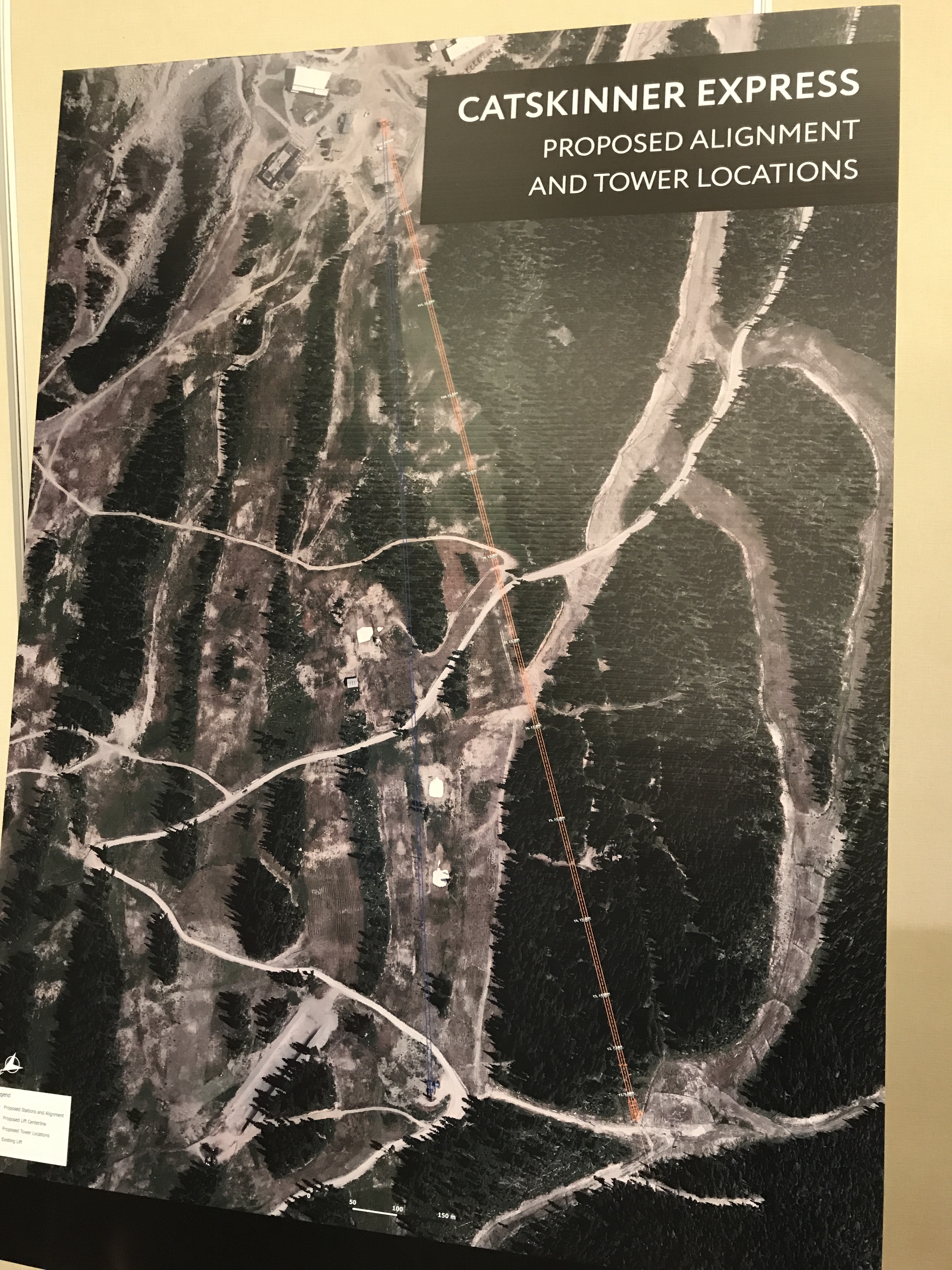
Also on Blackcomb, a new, longer Catskinner four place detachable will start to the southwest of the existing Yan triple chair. This lift will have 97 chairs reused from Emerald Express and 14 new towers. Emerald’s Spacejet-style terminals will also come over from Whistler.
High-Speed Rollback in Georgia Injures Eight
While we in North America were sleeping, a serious lift incident unfolded in the Caucasus Mountains, where Europe and Asia meet. Videos posted to YouTube and Facebook show a Doppelmayr fixed-grip quad picking up speed in reverse and chaos ensuing on an already crowded powder day. Any riders who didn’t jump were thrown from the lift at the drive bullwheel or pinned between mangled chairs. Georgia’s Ministry of Economy says eight people sustained non life-threatening injuries.
Another picture shows chairs piled up after the lift came to a stop on what would normally be the arrival side of the drive station. Some grips held on while others were ripped from the haul rope after going around the bullwheel.
https://www.instagram.com/p/BgYOYHKFJkE/?taken-by=yuri_leontyev
From looking through Doppelmayr Worldbooks, I believe the lift in question is called Sadzele, built in 2007 as one of six lifts at the Gudauri ski resort. Note that fixed-grip lift models Doppelmayr sells in the U.S. and Canada differ significantly from those found in Europe and elsewhere.
Alterra Building New Lifts at Stratton, Tremblant and Winter Park
Alterra Mountain Co., the new operator of eleven leading North American mountain resorts, today announced a transformational capital investment of $130 million to be followed by hundreds of millions more over the next five years. New lifts will debut at Winter Park Resort in Colorado, Mont Tremblant in Quebec and Stratton Mountain Resort in Vermont in time for next winter. Competitor Vail Resorts revealed a similar $150 million plan for 2018-19 with six new lifts across its resorts last December.
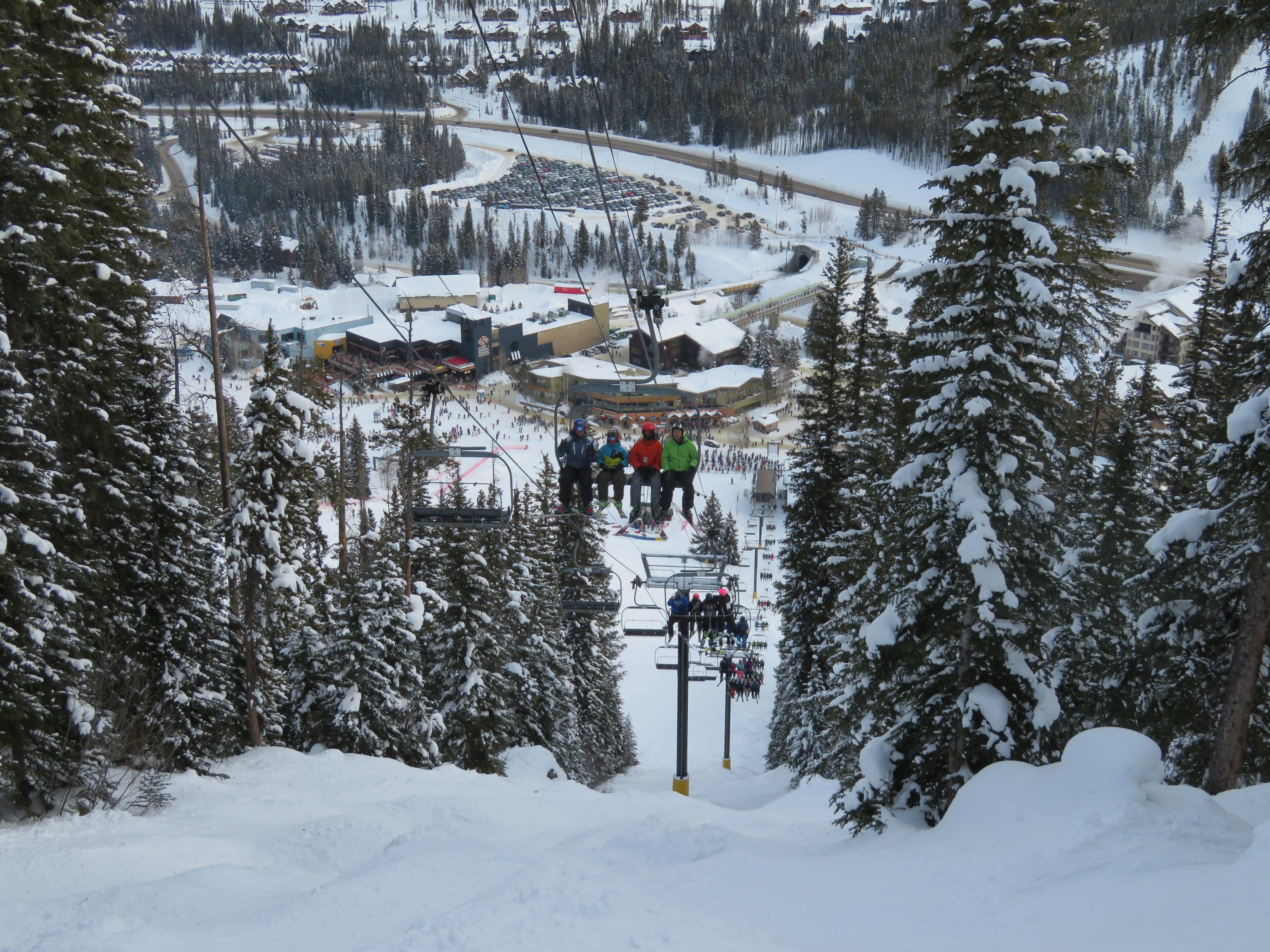
The largest single project for Alterra is a 10-passenger Zephyr Gondola at Winter Park replacing the current 1990 high-speed quad, the key people mover out of The Village at Winter Park. The new $16 million Leitner-Poma lift will be capable of moving 3,600 guests per hour to Sunspot, up from 2,600, and is the first new lift at the resort since 2007. It will feature Leitner-Poma’s DirectDrive technology, reducing energy consumption and the number of moving parts that can lead to down time. The new lift may also get a new name. “Zephyr is certainly on the table but nothing’s been decided yet,” said Steve Hurlbert, a spokesman for the resort.
Disney Skyliner Reaches Skyward
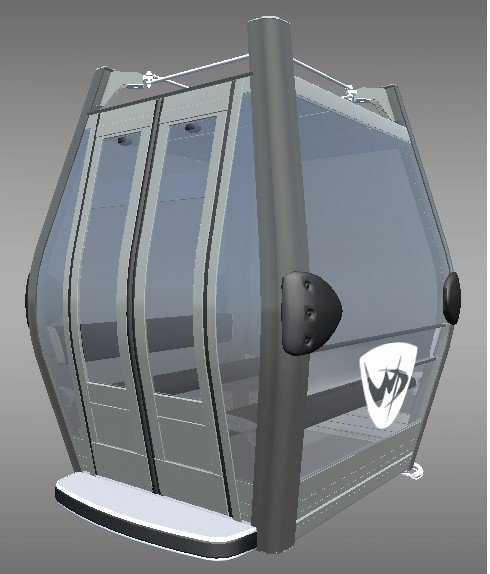
Walt Disney World is currently building America’s inaugural Doppelmayr D-Line gondola, actually three gondolas. Although Orlando is a long way from the mountains of Wyoming, the world’s most visited resort is also one of Earth’s most photographed places. So, through the magic of the internet, I am able to give a construction tour of the Disney Skyliner from afar.
Let’s start at Epcot. Foundations for this key station are taking shape but the bulk of work still lies ahead. Though they look like lift terminals, the dark green roofs are actually related to ferry boats the Skyliner will partially replace.
Next up is an angle station that Disney says will showcase the inner workings of the Skyliner as riders pass. No loading or unloading will take place here but the line will deflect around 110 degrees (double grooved bullwheel, maybe?) This one is also just beginning to be formed in what used to be a pond.

