Replacing a Crossarm in the Middle of Winter

Big White is a ski resort that lives up to its name.  Like many of its counterparts in British Columbia, the upper mountain gets pummeled by Pacific storms leaving trees and lifts looking like “snow ghosts” all winter.  On January 27th, Doppelmayr issued a service bulletin due to cracks found on the crossarms of depression towers of lifts in California, Colorado and New Hampshire.  Big White crews found damage to tower 14 of the Gem Lake Express and took the lift out of service on January 28th.

12640506_10153986374014416_1529154455560122255_o
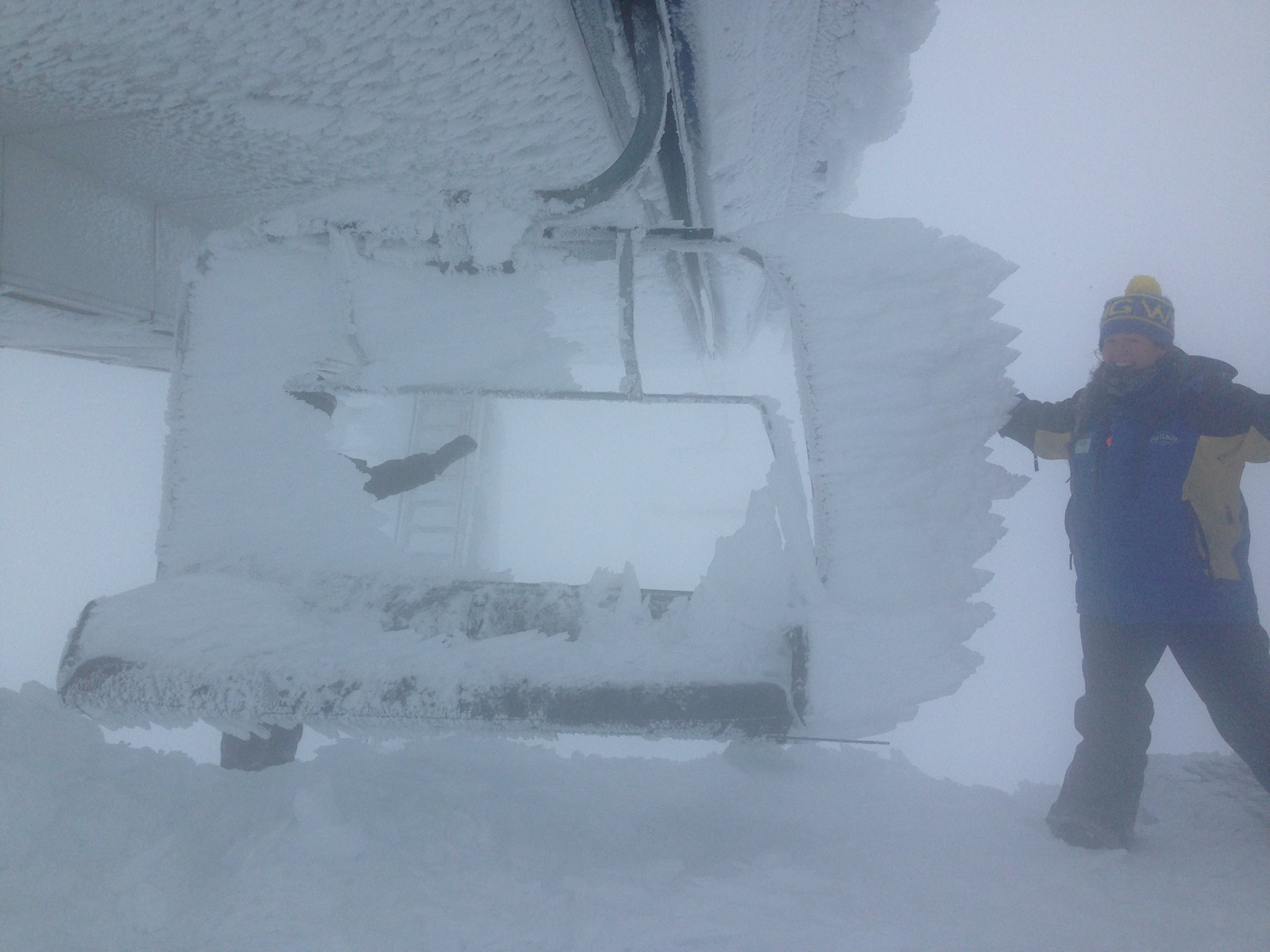
A storm coats the Gem Lake Express in feet of rime January 27, 2016.  Photo credit: Michael Ballingall

More than 8,000 feet long and rising 2,300 feet, Gem Lake accesses a huge portion of Big White’s terrain.  The detachable quad lift was built by Doppelmayr in 1996 and has 24 towers.  Tower 14 sits about two thirds of the way up the line at 5,914 feet in elevation. Gem Lake has a parking rail for some of its 128 chairs at the bottom terminal but not for the entire line.

12657759_10153999174254416_1570974804562613893_o
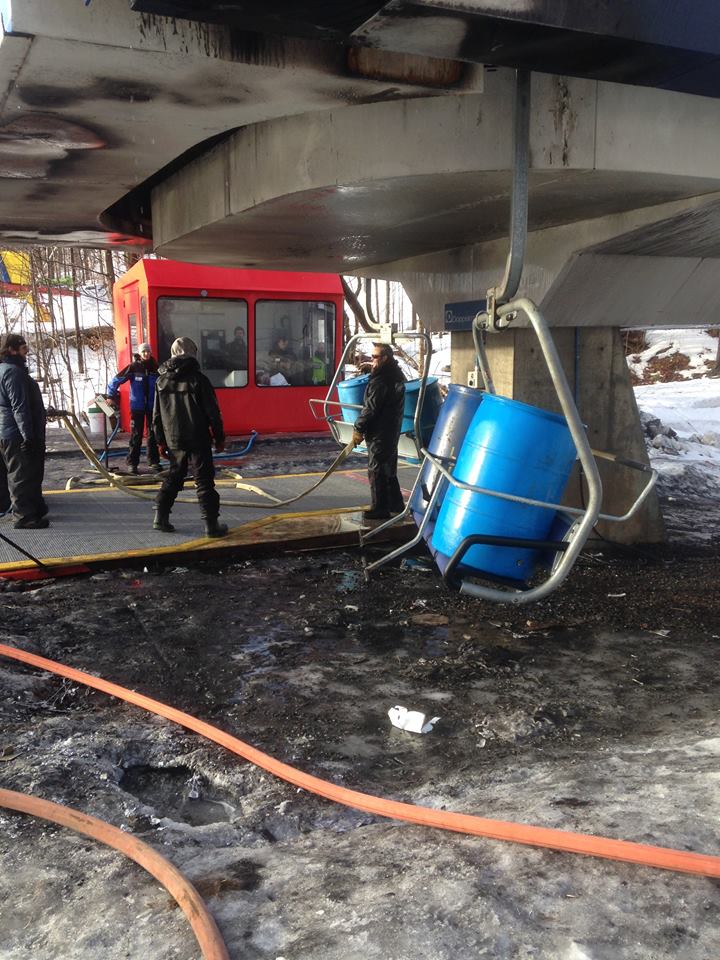
Mountain operations folks making it happen.  Here, the Big White grooming team hauls a forklift to the site of the damaged tower.  Photo credit: Michael Ballingall

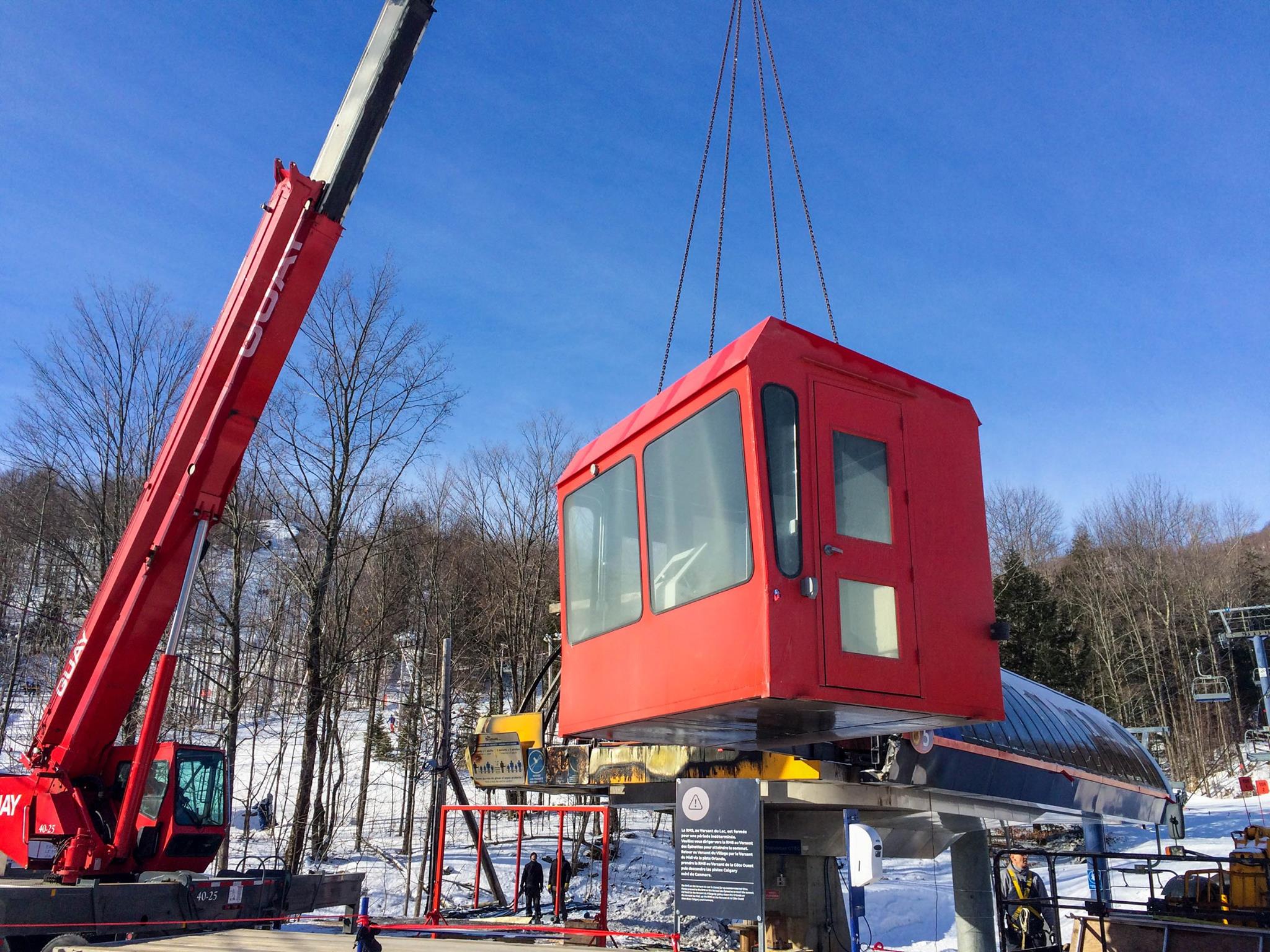
After the cracks on tower 14 were discovered, Doppelmayr fabricated a new crossarm in St. Jerome and shipped it from Quebec early last week.  Of course, the 20-foot long, 2.5 ton part got stuck in a winter storm of its own and ended up taking 119 hours to cross Canada. Meanwhile, Big White maintenance staff rigged the haul rope and removed the broken crossarm.

Continue reading

Will Detachable Lifts Get Faster?

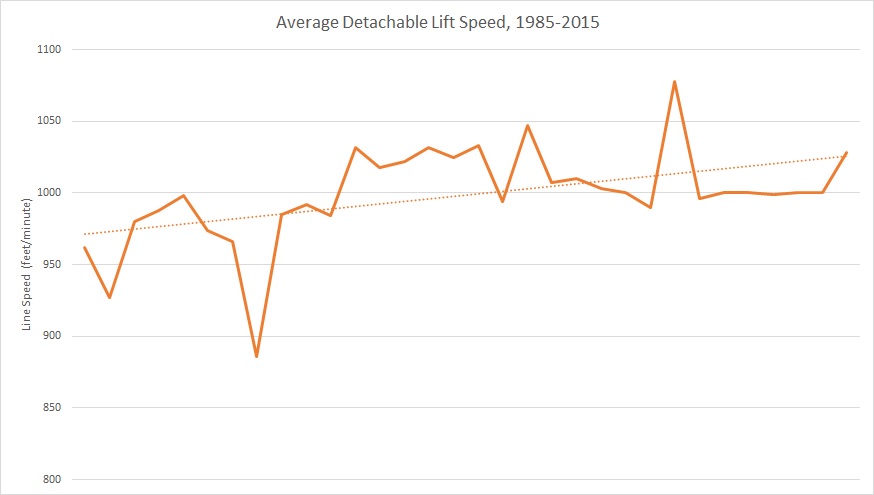
There’s a lively discussion going on over at Alpinforum about the future of detachable lifts, which haven’t gotten much faster despite huge advances in technology over the last thirty years.  The first modern detachable chairlift, Quicksilver at Breckenridge, went 787 feet a minute when it debuted in 1981.  Since then, manufacturers have installed hundreds of gondolas and chairlifts capable of going more than 1,000 fpm.

The first lift to go 1,100 fpm was the Whistler Village Gondola in 1988 and the first capable of 1,200 fpm was Stowe’s gondola in 1991.  Both were built by Poma, the early adopter of faster line speeds.  The only detachable installed in North America since 1991 capable of traveling any more than 1,200 fpm is the Peak 2 Peak Gondola, debuting in 2012. As a tri-cable gondola, P2P has an impressive capability of 1,476 fpm (7.5 m/s.) Doppelmayr claims similar systems can go up to 1,670 fpm (8.5 m/s.)  So far, the fastest 3S ever built goes 8 m/s and one that can go 8.5 will debut in Vietnam next year.  Meanwhile, 1,200 fpm (6 m/s) remains the highest speed for a single cable detachable, a stat that hasn’t changed since 1991.

avg speed over time
From 1984 to 2015, the average speed of a detachable lift in the U.S. increased by only 900 feet a minute.

The truth is the vast majority of detachable lifts built these days have the standard design speed of 1,000 fpm (5.08 m/s) and operate even slower much of the time.  In my experience, many ski areas run so-called high speed lifts at 800 or 900 feet a minute on all but the busiest of days.  As users on Alpinforum note, ski resort operators care more about reducing stops, wear and tear than shaving thirty seconds off a ride time that the average guest won’t even notice.

Continue reading

News Roundup: Fansipan Legend Opens

  • Contract awarded for India’s first urban gondola, to cost $24 million and open within two years.
  • Just a week after sanctions on Iran were lifted, Bartholet announces it’s building a gondola system on the resort island of Kish.  A definite upgrade from the salvaged Yan detachable installed last year in Isfahan (if you’re wondering, it made the journey from Silver Star, BC.)

Le Relais to Replace Three Lifts with a Six-Pack

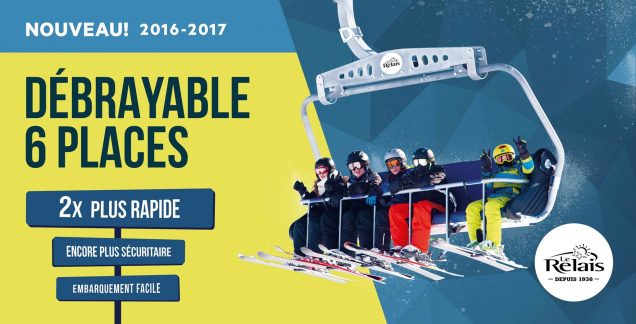
I always find this time of year exciting as ski resorts announce new lifts projects, many of which catch me by surprise.  This week we learned Le Relais Ski Centre, located just outside Quebec City,  will replace three lifts with a Doppelmayr six-pack capable of moving a huge 3,600 skiers an hour. Two T-bars (a 1960s Mueller and 1987 Doppelmayr) as well as a fixed-grip quad (1987 Doppelmayr) will be removed.

12622297_1030693673658395_4018913786064831678_o

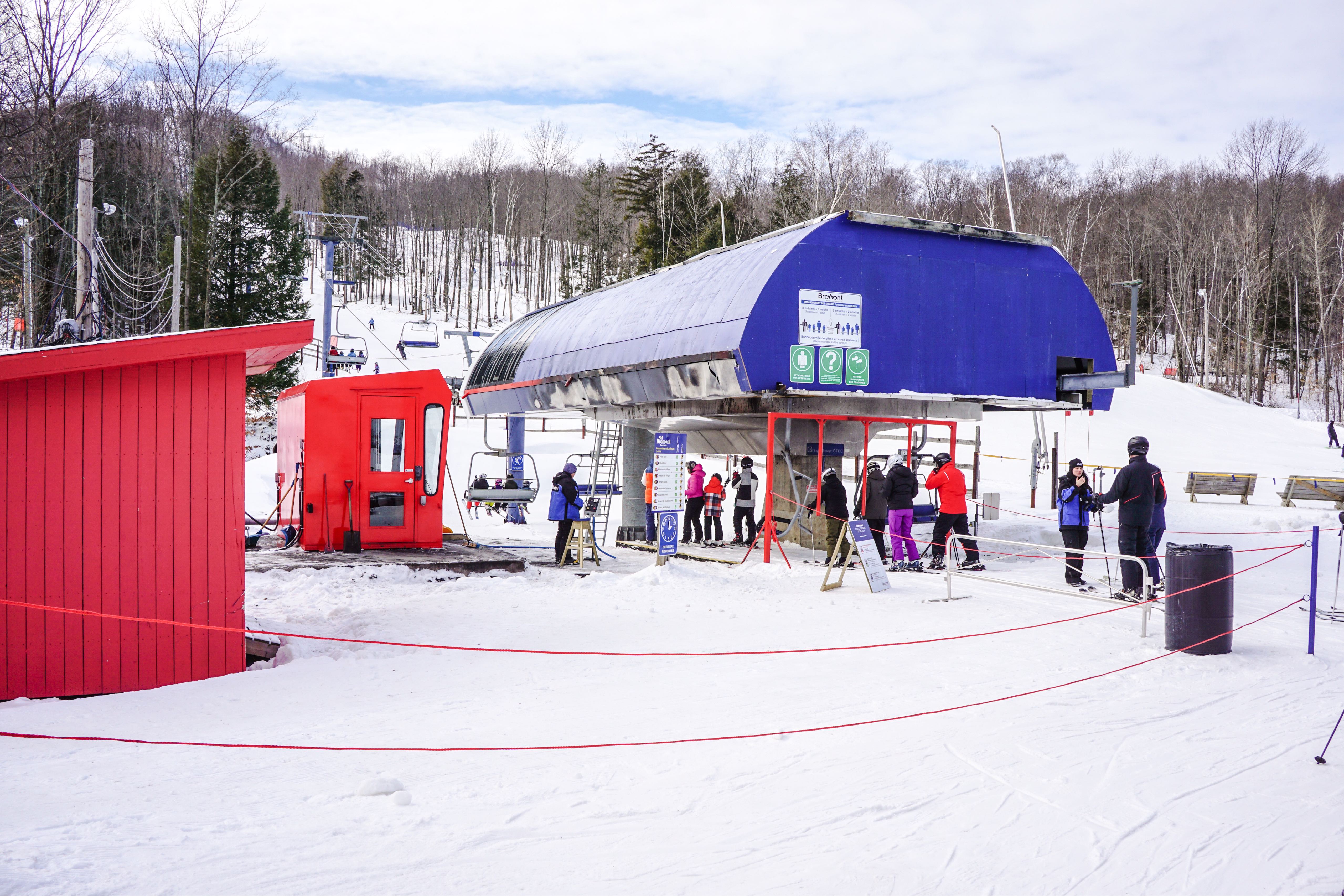
A project like this would normally re-use existing towers tubes, but Le Relais has some crazy offset towers that support both their quad chair and 1987 T-Bar.  Thus the six-pack will get brand new towers in addition to 60 six-passenger chairs.  Slope length will be just under 3,000 feet with a vertical rise of 676′. The ride will take just three minutes at 5.1 m/s.  A Chairkit loading carpet is included in the $5+ million lift, which will be built at Doppelmayr’s plant just down the road in St. Jerome. Congratulations to Le Relais Ski Centre and the Beaulieu family on what’s sure to be a huge hit with guests.

header-mountain
Lifts B, C and D will be removed.  Next season, Le Relais will operate two modern high-speed chairlifts and two platters.

News Roundup: Ice Heist

  • Luckily Manning Park Resort was in on letting pro mountain bikers pretend to break into and operate one of their lifts.
  • When chairs can’t spin because there’s no one to staff them.
  • BMF opens its sightseeing aerial tramway in Puebla.  Its 35-passenger cabins were manufactured in Austria by Carvatech.
  • 12 year-old boy falls out of a chair at Wachusett, avoids serious injury.
  • Snowboarder accuses skier of shoving him off Aspen Highlands’ Loge Peak lift mid-ride in a story that goes viral.  Just one day later, the Pitkin County Sheriff’s Office thinks they’ve identified a suspect.
  • Doppelmayr is building an 8-passenger gondola this spring at the Oakland Zoo to serve a $62 million expansion called California Trail.  The lift will have 7 towers, 15 cabins and open in late 2017.  The zoo will continue to operate its Safari Sky Ride triple chair that was built by SkyTrans.
  • DCC (Doppelmayr Cable Car) wins a $24 million contract to build its 10th cable-propelled automated people mover in underground tunnels at Moscow’s Sheremetyevo Airport.

Jackson Hole to Build Another Gondola

The sign went up this week at Jackson Hole, which will become the 12th mountain in the United States with the distinction of having two gondolas.  The new Sweetwater Gondola will replace the Eagle’s Rest and Sweetwater chairs in two stages.  Built by Doppelmayr, it will boost out-of-base capacity by 25% and provide direct access to beginner and intermediate terrain at mid-mountain.  In the future, a dedicated learning facility with dining, lessons and rentals will open at the mid-station just north of Sweetwater’s existing bottom station. Though expensive, gondolas have proven to be extremely efficient and less intimidating than chairlifts for people learning to ski and snowboard.

IMG_9135
It looks like Doppelmayr will modify its Uni-G terminal skin in an effort to match the Poma terminals next door at Teewinot and Bridger.

This section of Rendezvous Mountain has an interesting lift history.  A Riblet double chair named Crystal Springs served a similar alignment but with no mid-station from 1978 until 1997, when it was removed to make way for the Bridger Center and Bridger Gondola.  If you ride Eagle’s Rest today, there is still one Riblet tower where the old Crystal Springs crossed under on its way up.  Eagle’s Rest is one of three original lifts opened at Jackson Hole in 1965, even before the first tram.  When Eagle’s Rest is retired this spring there will be just six Murray-Latta lifts remaining in service worldwide.  The new gondola also replaces Sweetwater, a triple chair that found its way to Jackson in 2005 by way of Winter Park. It was the Zephyr triple from 1983 to 1990 and Eskimo from 1990 to 1999 before sitting in storage for six years. Built by Lift Engineering, it was upgraded over time with Poma chairs/line gear and Doppelmayr CTEC controls.  Assuming it gets re-installed somewhere, the equipment will be in its fourth home!

IMG_9136
Sweetwater’s two sections will have around 8 towers each.

Continue reading

News Roundup: Now That’s a Model

  • Snowbasin will test solar-powered USB charging bars in five of its gondola cabins in partnership with Goal Zero.
  • Mt. Waterman in Los Angeles’ San Gabriel Mountains reopens this weekend with 3 Riblet doubles operating for the first time in five years.  The mountain will honor all tickets and passes sold since 2011!
  • Two years after his 6-year old daughter fell from a chair, a New Jersey man sues Campgaw Mountain and the town/county it’s located in for “careless and reckless” operation of a ski lift.
  • Sugarloaf just can’t catch a break.  A power failure shut down most of its lifts for hours on their first Saturday with snow.
  • Did you know Doppelmayr operates a zoo with more than 400 animals at its headquarters in Wolfurt?
  • Speaking of Doppelmayr, their interactive installation map now displays 24 world record-breaking ropeways (click the red button on the bottom left.)
  • Somebody had to do it.  Spirit Mountain, Minnesota becomes the first to offer lift-served, downhill fat biking starting Sunday.
  • Whistler Village Gondola cabin #84 returns to its roots in the Alps as The Coffee Gondola.
  • What appears to be a Doppelmayr quad chair rolls back in China, screaming ensues.

News Roundup: Washout

  • Teams from Mt. Hood Meadows have repaired and re-opened the Shooting Star Express that was damaged by falling trees over Thanksgiving. Now the storm recovery turns to the Mt. Hood Express, which received ten feet of snow in one week.
  • White Pass has more snow than it did at anytime last winter but no one can get there.  Crews have been working around the clock to repair washouts that cut off the resort from both sides of the Cascades Dec. 9th.  The ski area will re-open Wednesday.

  • The Berry family says it’s close to a deal to sell Saddleback to a new owner that hopes to open by late January.  Passholders can get a refund or gift card now.
  • Aspen’s 1971 SLI double on Shadow Mountain will be replaced with a detachable quad or gondola in 2016 or ’17.  The top terminal will move 200 feet to the southwest resulting in a slope length of 3,600′ with 1,390′ vertical and a capacity of 1,200 skiers per hour.
  • Park City and Canyons are now one thanks to the Quicksilver Gondola but judging by snow conditions it’s going to be awhile before you can ski between the two.
23766151061_957a9a928c_o
Sugarloaf and Doppelmayr load test King Pine on Dec. 19, 2015.
  • James Coleman opens new quad chairs at Purgatory (Leitner-Poma) and Arizona Snowbowl (SkyTrac) with more new lifts on the way.
  • Doppelmayr secures $27 million European government loan for research and development in Austria.
  • Cherry Peak Resort opens today!  It’s the first all-new ski facility in North America since Tamarack debuted back in 2004.

More on Doppelmayr’s D-Line

More pictures and details are filtering out from Hochgurgl, Austria where the Kirchenkarbahn opened Dec. 10th.  This 10-passenger gondola wouldn’t be particularly notable but for the fact that it’s Doppelmayr’s first production model of the next-generation detachable lift called D-Line.

12322575_926354417444850_8428745707875203902_o

First a little history.  Doppelmayr introduced the Uni-G terminal in 2000, replacing the “Spacejet” model of the 1990s.  After the merger of Doppelmayr and Garaventa in 2002, the company continued to offer Stealth III and Uni-G detachable lifts in the US.  In 2003, Doppelmayr CTEC added a North American-design called the Uni-GS and built 88 of them before discontinuing the model in 2009.  With the Stealth gone since 2004, the Uni-G became the only Doppelmayr detachable product worldwide until now.

DoppTerminalComparison
Doppelmayr graphic shows terminals getting shorter over the years despite  faster line speeds.

German architect Werner Sobek designed the D-Line terminal and he’s apparently well known-enough to have an English Wikipedia page.  His enclosure is almost entirely composed of windows with a modern, boxy look that I’m not sold on.  Setting appearance aside, Doppelmayr says D-Line can support line speeds of up to 7 m/s or 1,378 feet a minute.  This is a big deal; the fastest circulating ropeway I know of today maxes out at 1,212 FPM.  The Kirchenkarbahn uses a gearbox from Eisenbeiss and controls from Frey Austria.

Continue reading