Yesterday saw the 100th post on Liftblog.com, four months after starting this project out of off-season boredom. I can see on my end that readership is increasing every week but I really would like to know who is reading and what types of posts you would like to see more of. Google tells me that the most popular time for the site is 2:00pm on Tuesdays but they cannot tell me everything. Please take two minutes to fill out the below survey and let me know your thoughts. Thanks for the support!
Poma has begun construction on a 13,000 foot gondola to the ancient Peruvian fortress of Kuelap. The $18 million system will span 2,170 vertical feet in 20 minutes and open by July of next year.
Despite having a bunch of brand new lifts that haven’t spun since the Olympics, Russia is spending $76 million to build four new lifts in 2016 at Rosa Khutor.
Sun Peaks Resort, already Canada’s second largest resort, is cutting new runs in preparation for a new West Morissey lift. If you haven’t gotten the chance to ski there, Sun Peaks has a very cool 360-degree layout with three mountains circling the village.
Berkshire East’s former Summit triple is up for sale. It’s a 1988 Poma that was previously at Magic Mountain, Vermont. The other lift on there is from the defunct Ascutney Mountain.
Alpine Valley, Wisconsin is getting a new beginner lift which will be a used Hall double with a new SkyTrac Monarch drive terminal. SkyTrac is also reportedly finishing the half-completed Stagecoach lift on the Moonlight side of Big Sky.
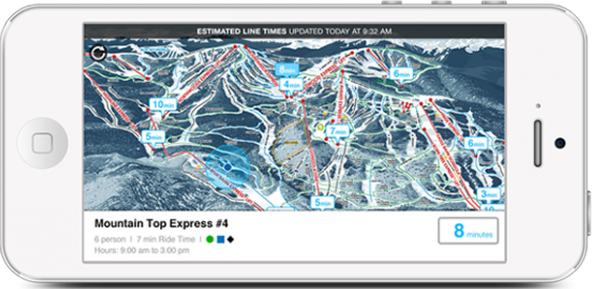
The EpicMix app will show lift wait times in minutes for major lifts at Vail’s four Colorado resorts.
Last week, Vail Resorts announced their EpicMix mobile app will provide guests with live lift wait times for 55 lifts at Vail, Beaver Creek, Breckenridge and Keystone starting this winter. Vail Resorts will use their app to track guests through lift lines to provide a crowd-sourced estimate called EpicMix Time. The technology is currently being tested at the company’s Perisher resort in Australia. Vail compares the system to Google’s Waze app, which crowd sources traffic and accident information for Google Maps. The company plans to expand the technology in future years to all its resorts and other places where guests have to wait in line such as restaurants and rental shops.
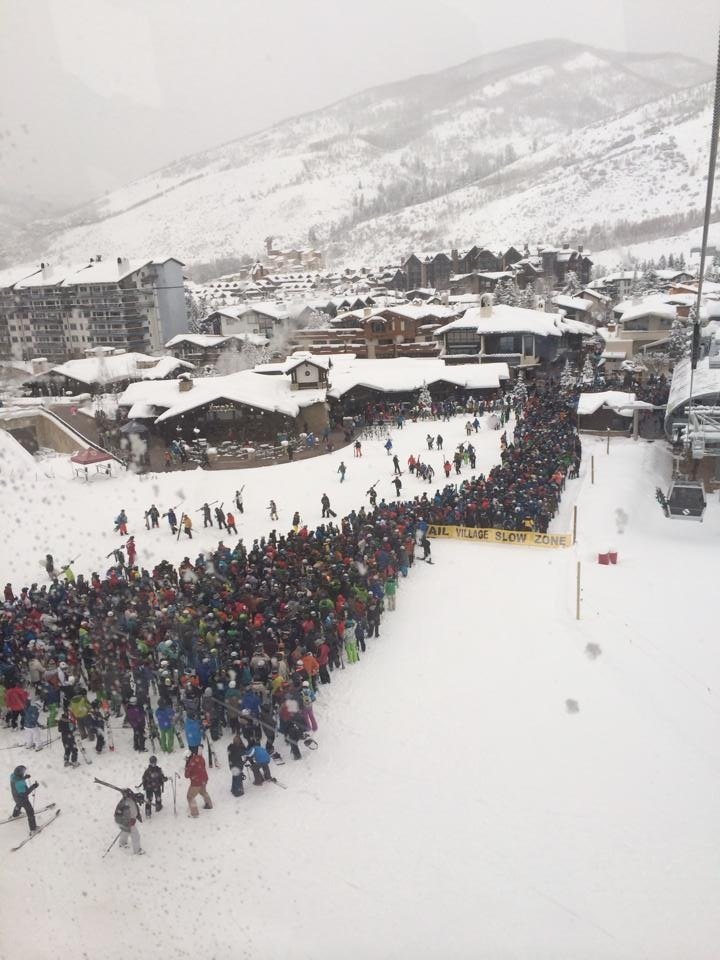
Vail’s Gondola One can move an impressive 3,600 skiers per hour but sometimes even that isn’t enough.
Other resorts have tried to provide lift waiting times in the past. For years, Whistler-Blackcomb has had lights on its lift status signs that indicate whether a lift line is less than 5 minutes, 5-15 minutes, or more than 15 minutes. I suspect Whistler’s system is powered by lift operators calling a dispatcher which is a less than perfect solution. Vail’s technology will be much more accurate and timely.
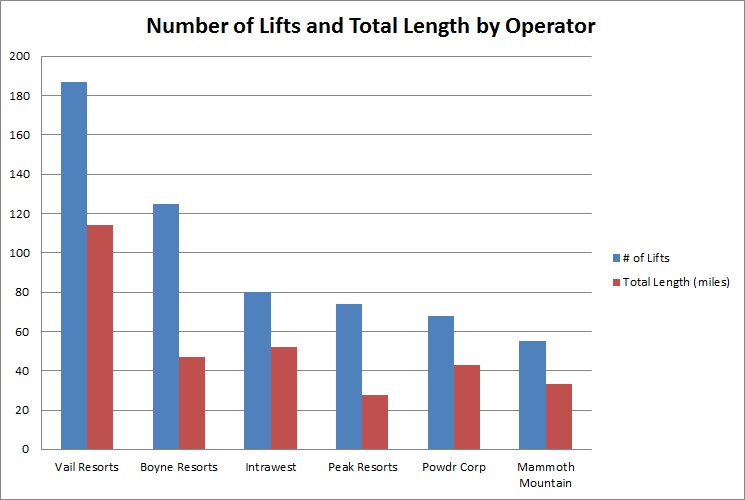
Like many industries, much of the ski business is controlled by a handful of large companies. There are six such businesses in the Americas that operate more than 50 lifts each. Their combined 589 lifts account for one fifth of all the lifts in North America and almost a third of the VTFH (vertical transport feet per hour.) The top three operators are, as you would expect, Vail Resorts, Boyne Resorts and Intrawest. But there are others including Mammoth Mountain, LLC which operates 55 lifts at four different ski areas in California and Powdr Corporation which has 68 lifts in five states.
Vail Resorts doesn’t just own lots of lifts; the lifts they operate are bigger, newer and faster than average. This winter, the company will operate 15 gondolas and tramways, 75 detachable chairlifts and 83 fixed grip chairlifts. These numbers for Vail Resorts do not even include the lifts at Perisher, the company’s newest acquisition in Australia. If you put each lift at each of Vail’s resorts end to end, the total length would be 115 miles. The average lift owned by Vail Resorts is 21.5 years old, six years newer than the national average. 56 percent of Vail’s lifts were built by Doppelmayr and CTEC, 14 percent by Leitner-Poma. Vail accounts for 11.4% of all the vertical transport capacity on the continent, with a total VTFH of 353 million!
Number of lifts for the six biggest operators and total lift length in miles.
The second biggest resort operator is privately-owned Boyne Resorts, which has 126 lifts at 11 mountains. Boyne doesn’t actually own most of the properties it operates; instead holding long-term leases through CNL Lifestyle Properties. The lifts Boyne operates are older and smaller than Vail’s. They include 30 detachable chairlifts and 85 fixed-grip chairs. Doppelmayr and CTEC built 45 percent of Boyne’s lifts, followed by Riblet at 20 percent. Boyne accounts for 5.3 percent of the total VTFH in North America or 162 million.
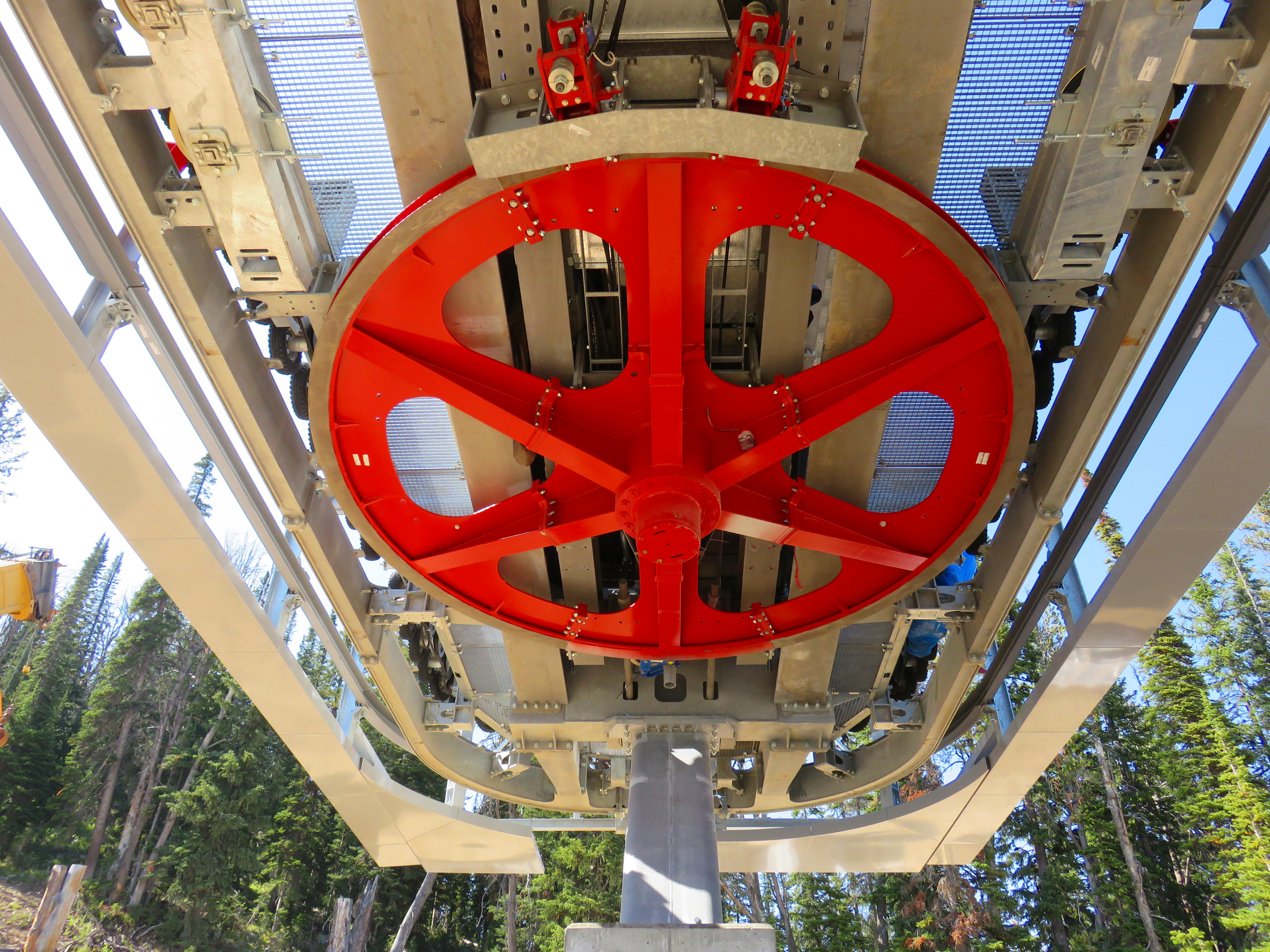
Bullwheel at the drive terminal of Jackson Hole’s new Teton detachable quad.
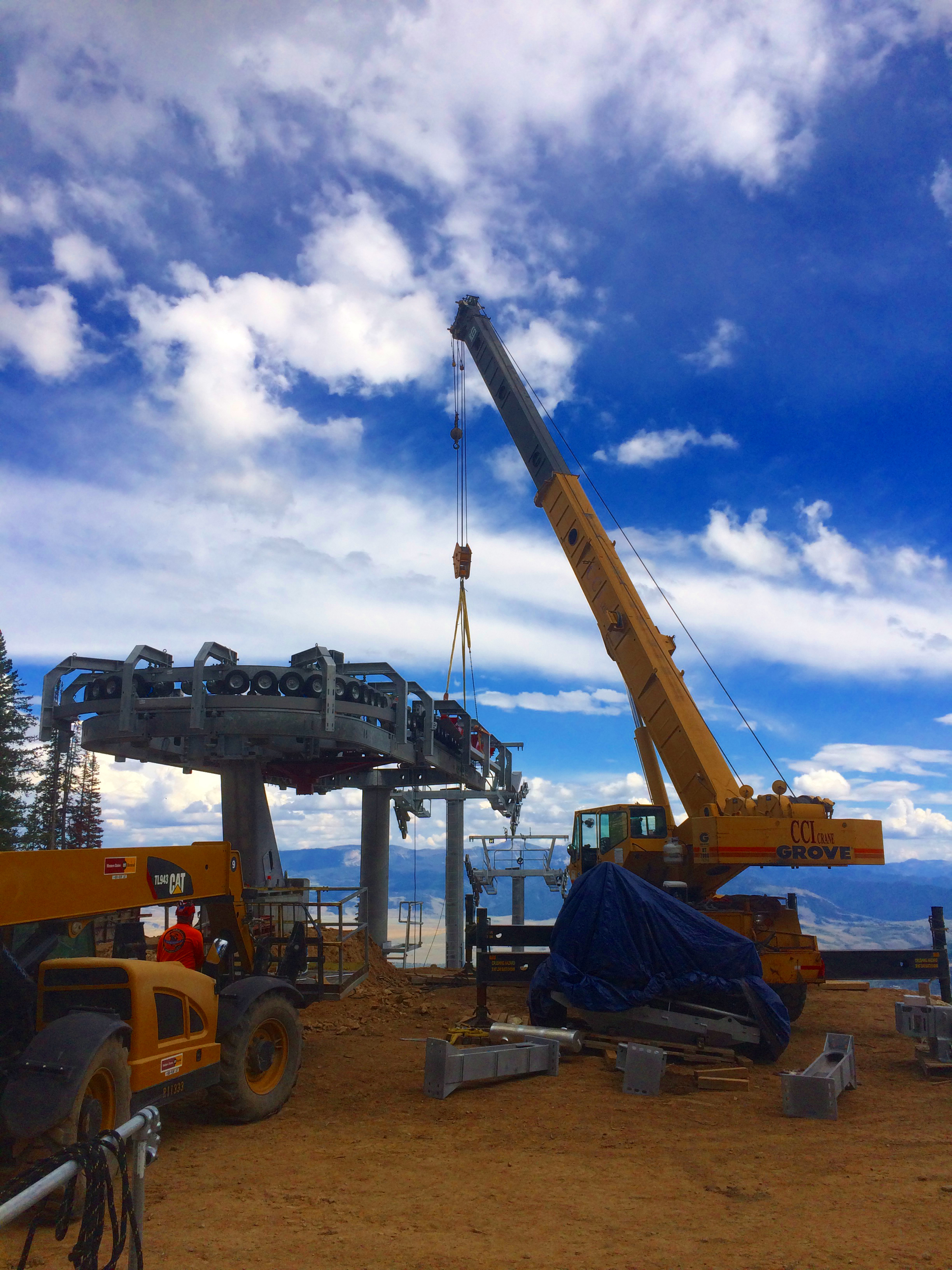
Workers from Doppelmayr began assembling the top terminal of the Teton lift by crane this week. Once the top is finished, crews will move to the bottom return terminal 1,800 feet below. The lift is on schedule to be load tested by mid-October. A new ski patrol station is also taking shape and grading continues on the new Kemmerer, Ridge and Wide Open runs. Weather permitting, the entire expansion will open December 19th.
Crane setting the last tire section for the drive terminal of Teton.
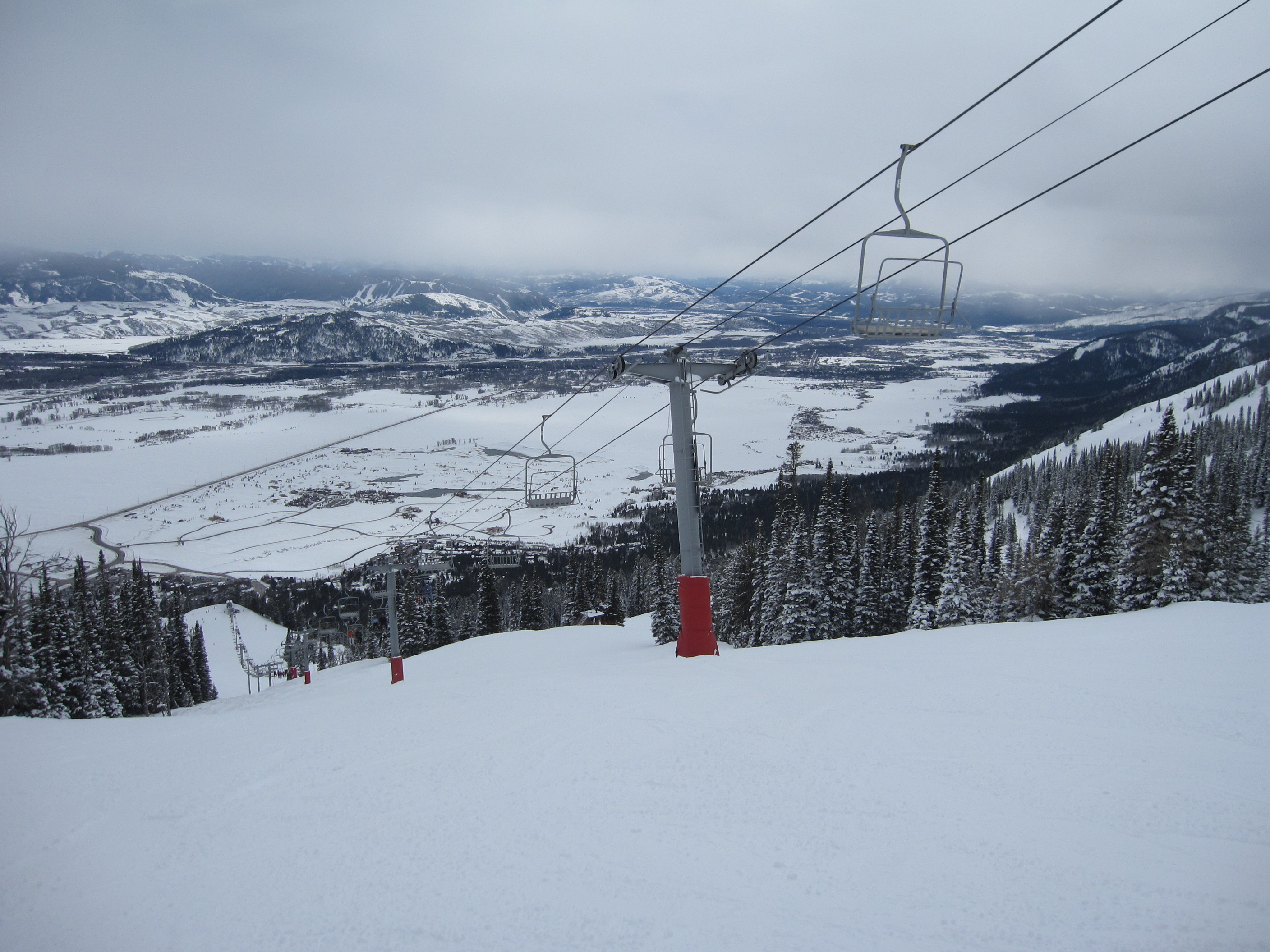
The Casper quad at Jackson Hole Mountain Resort replaced a triple chair in 2012.
Jackson Hole’s Casper lift is an example of how the right lift can revitalize an entire section of a mountain. Prior to 2012, Casper was a 1974 Heron-Poma triple chair with a 10-minute ride time. The lift and nearby trails felt like no-man’s land in between the much newer Bridger Gondola and Apres Vous high speed quad. Casper had a race course and restaurant, but few people wanted to ride the lift.
Old Casper looking pretty deserted.
In the summer of 2012, Jackson Hole invested $5 million to build a new Casper high speed quad and re-grade three major runs in the Casper pod. The race course was moved elsewhere and the entire area dubbed “all new, all-blue.” The new Casper opened December 6, 2012 and completely changed intermediate skiing at Jackson Hole.
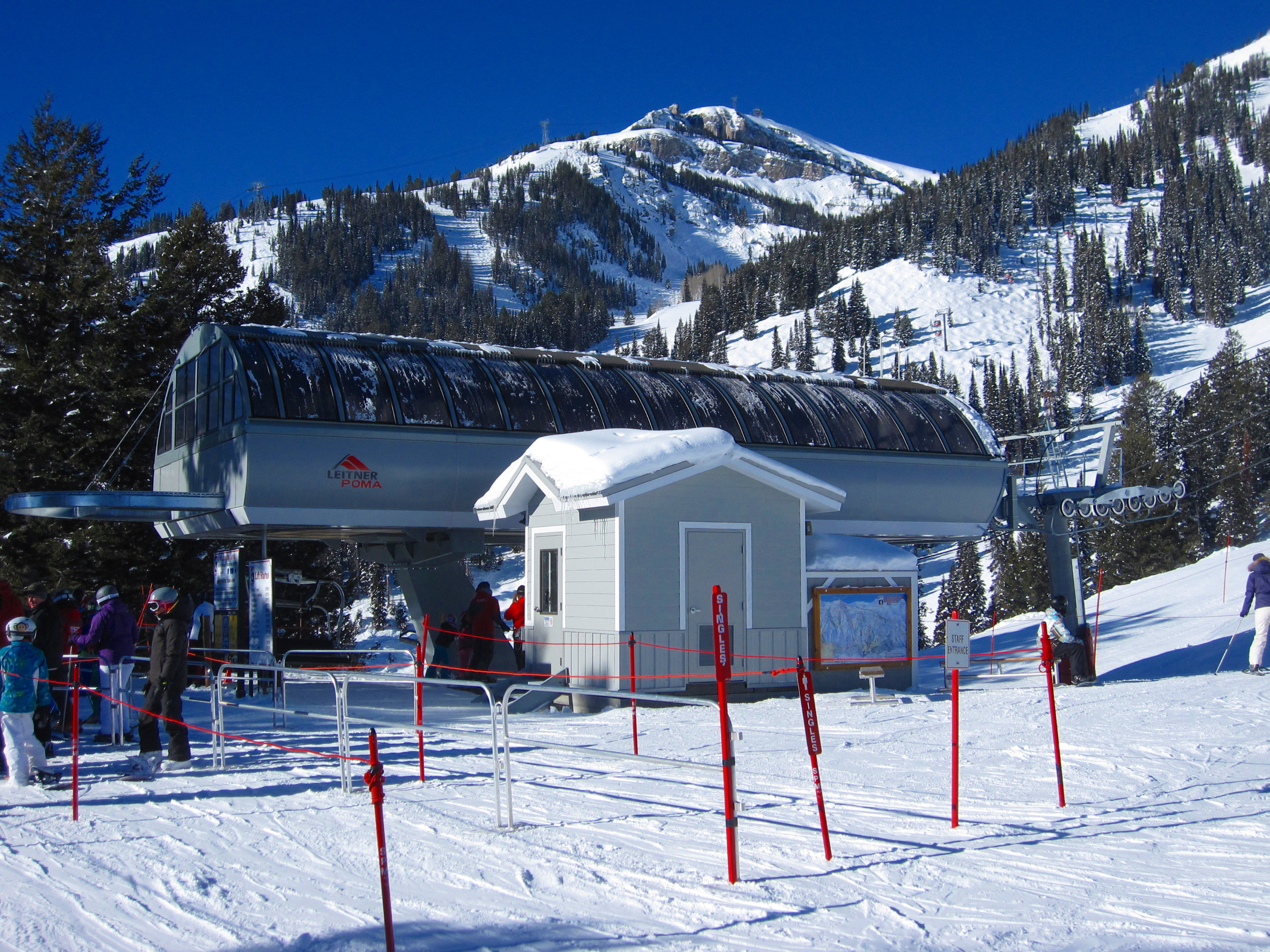
Casper has the best lift shacks on the mountain with lots of space.
Casper is one of Leitner-Poma’s first dozen lifts to utilize the new LPA terminals and grips, which debuted at Vail in 2010. While not without the usual hiccups, Casper is a machine well-liked by mechanics, operators and skiers. The lift shacks and terminals are spacious with many thoughtful features. For example, the chairs have clips that prevent seats from blowing up in high winds. The lift can auto-slow and auto-stop at pre-set wind speeds. A touchscreen at the return terminal gives operators just as much information as at the drive. Tower ladders extend all the way to the top of the lifting frames.
We’re used to lifts that run in a perfectly straight line between terminals but sometimes a lift just has to have a turn. Common reasons for this uncommon occurrence include buildings in the preferred alignment and challenging property lines. Most lifts with turns are detachable systems with angle stations which are very expensive. But not all lifts that need to turn require loading or unloading mid-way. In a handful of these cases, lift manufacturers have avoided the need for angle stations or extra bullwheels by designing towers with canted sheaves.
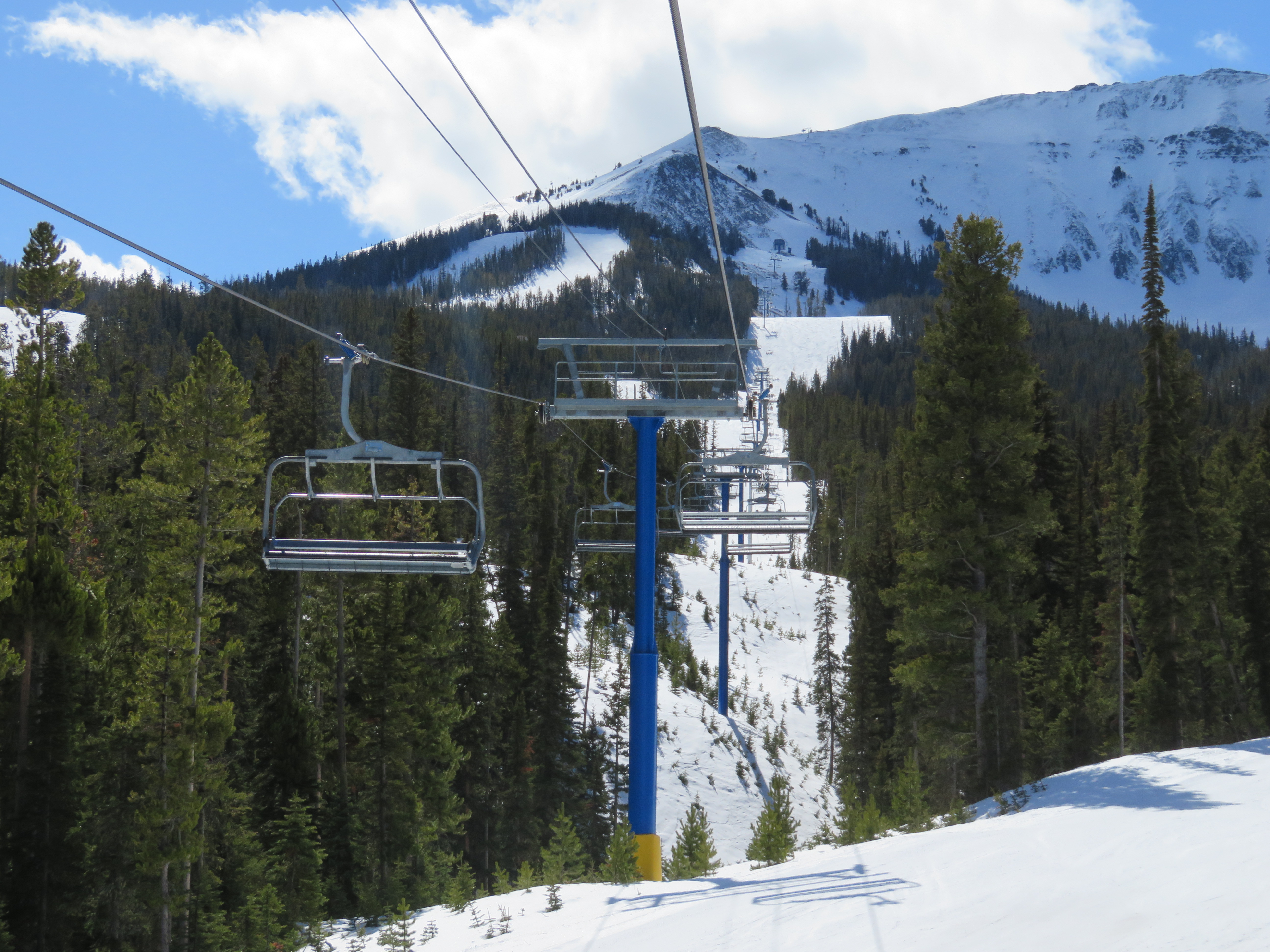
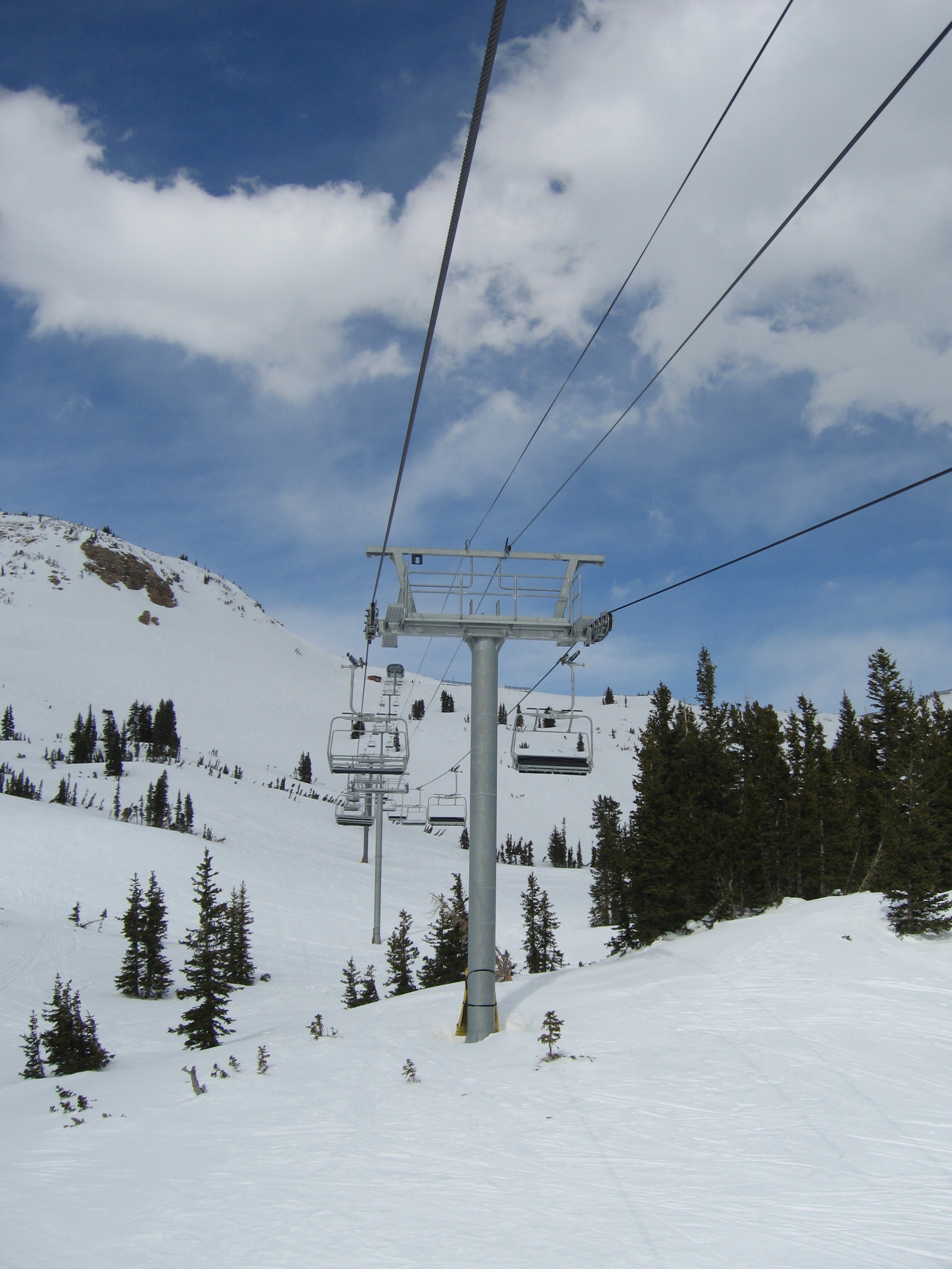
Look closely at the very top of Six Shooter at Big Sky. The last few towers are in a different alignment than the rest of the lift.
The first company to use this trick was Riblet with Chair 5 at Breckenridge way back in 1970 1986. Closely-spaced towers 10A, 10B and 11 have angled sheaves in a compression-support-compression setup. I’m not sure of the exact angle of the turn on Chair 5 but its a couple of degrees. (Edited to add later: the lower terminal and towers of Chair 5 were moved in 1986, 16 years after the lift was first built.)
The Baldy Express at Snowbird also does not run in a straight line. It’s by design!
Most of the lifts that turn using angled sheaves were built by Doppelmayr CTEC and its predecessor Garaventa CTEC and turn less than five degrees. A turn is typically accomplished over three towers with the middle of the three being a depression assembly. The Cabriolet at Park City (formerly Canyons) was the first modern lift with this setup and opened in 2000, connecting the main parking lot to village. Its five degree turn was required due to private property lines and existing buildings.
Canted sheaves on the Cabriolet at Park City, a 2000 Garaventa CTEC Stealth detachable.
A year after the experiment at The Canyons, Garaventa CTEC built another detachable with a turn for Snowbird. The Baldy Express turns between towers 10 and 12 again due to private property lines. The first six pack with a turn was the Six Shooter at Big Sky (formerly Moonlight Basin) which was built in 2003 and has a couple degree turn between towers 24 and 26. I’ve heard Six Shooter’s turn was due to a surveying mistake that would have put the top terminal on Big Sky Resort’s property. Doppelmayr CTEC engineered the turn rather than re-doing a bunch of tower bases. The irony here is that ten years later Big Sky ended up buying the land and lifts anyways.
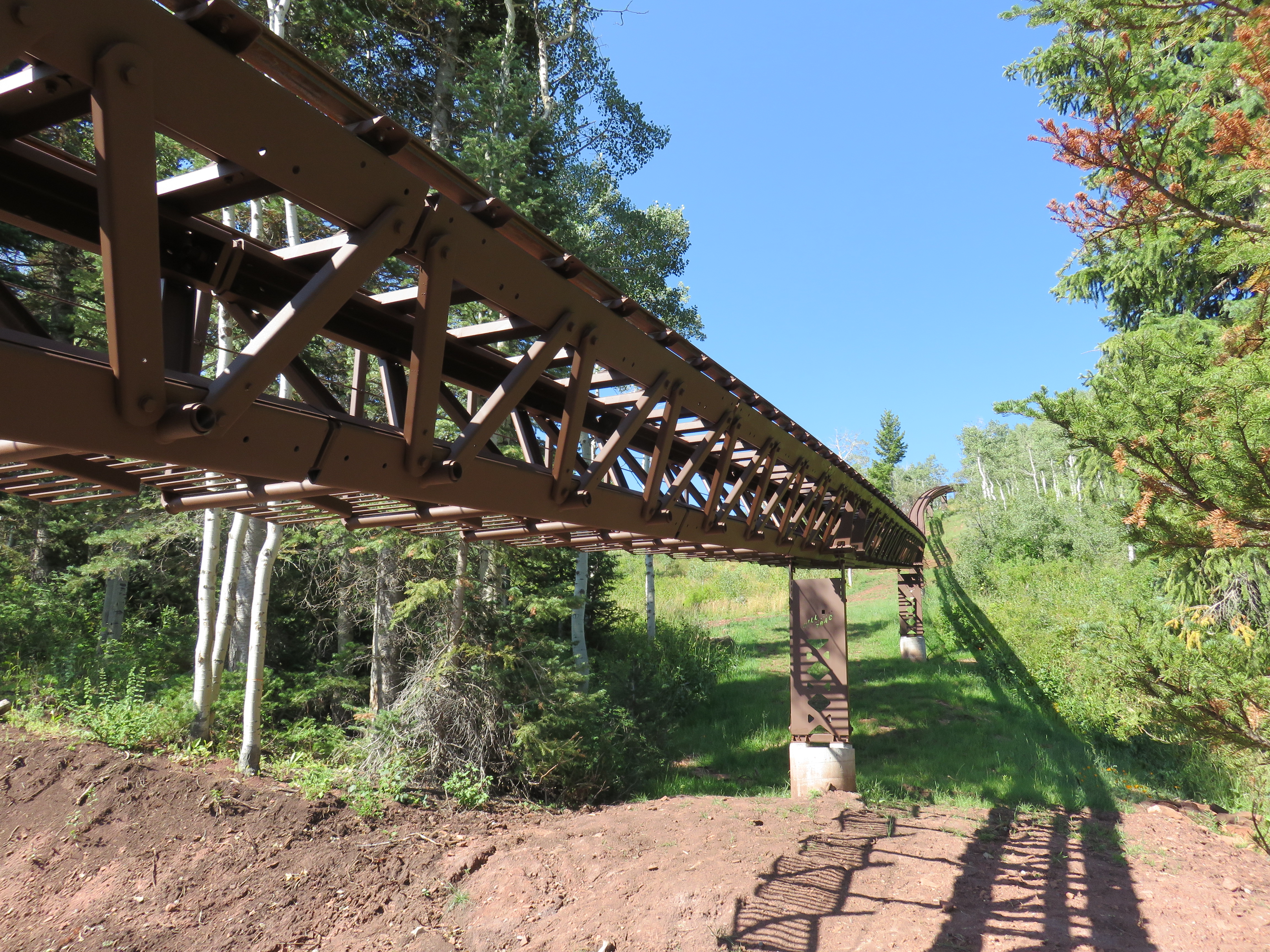
A Hilltrac funicular railway in The Colony at Park City Mountain Resort.
When I was hiking around Park City last week I discovered a large new funicular railway in The Colony development near the new gondola. It was built by Hilltrac, sister company to lift-maker SkyTrac. The funicular serves an entire neighborhood unlike others at Deer Valley that serve only one house. One section is completed with the possibility to add another section later.
The City Council of Casper, Wyoming, which owns of Hogadon Ski Area, declares one of two Riblet doubles there as surplus property to be sold. Apparently it has not spun in years and parts were cannibalized last season to keep the other lift running.
Chris Farmer, Saddleback’s Marketing Director says on Facebook that there is no news to announce re: new lift or closure. In case you don’t have Facebook, here is the statement: “Saddleback friends: I know that everyone is eagerly awaiting an announcement on our situation and recognize we are beyond the initial deadline. We remain heads down on finding a solution. As soon as we have news we will announce it. Until then, our full attention is on solving the issue. You are all important and I recognize you all want answers. I fully expect decisions will be made some time this week. Thank you for your consideration and continued support. Please do not be offended by my inability to respond to each of you individually. I hope you understand.”
Protesting lifties shut down Chile’s Cerro Catedral, demanding a 30% wage increase. Meanwhile, most of Argentina and Chile’s ski resorts have been getting tons of snow.
Echo Mountain, the closest ski area to Denver, will reopen to the public this season after failing to make it as a racer-only training mountain. The area formerly known as Squaw Pass has just one lift currently, a Yan triple chair.
South America solidifies itself as the worldwide leader in urban ropeways with the capital of Peru getting not one but two gondolas by 2017. There are already a dozen gondolas operating in Bolivian, Venezuelan, Colombian and Brazilian cities.
Doppelmayr wins a $21 million contract to build two ropeways in Georgia (the country, not the state, although there is a large Doppelmayr tram in the State of Georgia too.)




 Lift Blog