Giants Ridge puts a Riblet up for sale in advance of new lift construction. Another will be scrapped. Buttercup at Mt. Hood Meadows is also for sale.
Vail Resorts revenue up 27.5% year-over-year; no new lifts for Whistler-Blackcomb in 2017.
New Stagecoach website says two Doppelmayr chairlifts now on track to open in late 2018.
PCL Construction Services files notice of commencement for utility relocation and prep at six Walt Disney World sites widely believed to be gondola station locations with possible opening in 2019.
Wolf Ridge, NC closes for the season following lightning damage to 1988 Doppelmayr quad. The place has an interesting past; a 2006 Doppelmayr CTEC quad and 1980 Borvig were both abandoned after a 2014 fire and only two lifts remain.
Taos will apparently build three new lifts over the next two years, including a pulse gondola and high speed quad.
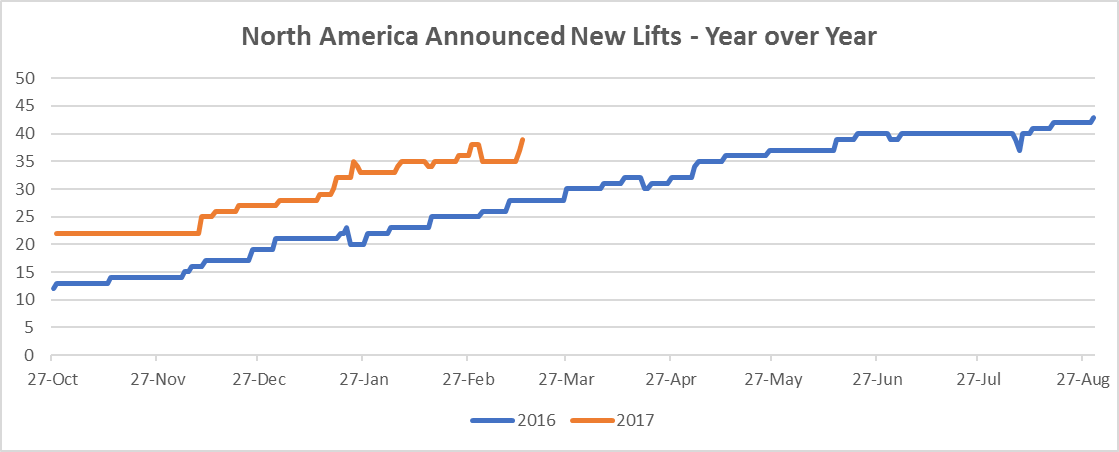
Likely new lifts for 2017 are pacing 39 percent ahead of last year, when 28 new lifts had been announced on this date. I’ve identified 39 lift projects for 2017 and if last year’s pattern holds, lift manufacturers will build approximately 57 new ropeways in N. America in 2017, the most since 2004. We’ll know by about July 1.
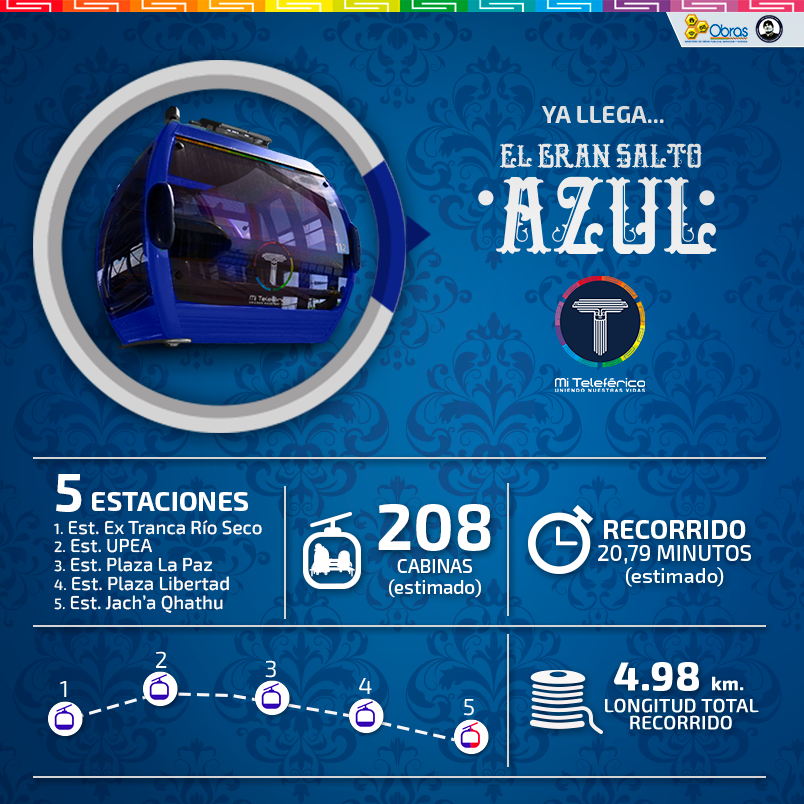
The world’s largest urban gondola network leaps forward this week with the addition of the Línea Azul (Blue Line) in the Bolivian twin cities of La Paz and El Alto. Since debuting with just one line in May 2014, the state-owned Mi Teleférico (My Cable Car) system has now transported more than 75 million passengers on its Green, Yellow, and Red gondolas. In 2015, My Cable Car committed $450 million to build six additional lines through 2020, and it ordered twomore last year. Mi Teleférico has quickly become one of Doppelmayr’s largest customers, exclusively utilizing the Austrian company’s ten-passenger monocable detachable gondola technology.
Construction commenced on Línea Azul in late May 2015 with cable pulling (by drone!) wrapping in September 2016. The first cabin launched later that month with Bolivian President Evo Morales taking the inaugural ride in November. After three more months of terminal buildout and system testing, the Blue line’s five stations are ready for show time. Línea Azul is La Paz’s longest to date, with 208 CWA Omega IV-10-LWI cabins that will cover an impressive 32,700 feet per revolution beginning March 3rd, just 645 days after groundbreaking.
Like the Red, Yellow and Green lines, the Blue line is actually two lifts with two separate haul ropes and two drive systems with cabins transferring between them. Nearly all of the Mi Teleférico network will be built this way, with multiple haul rope loops forming single “lines” with two to five stations each (most have either three or four.) Multi-stage gondolas operating with this principle in North America include WhistlerVillage and Excalibur at Whistler Blackcomb, Panorama at Mammoth and Revelation at Revelstoke Mountain Resort.
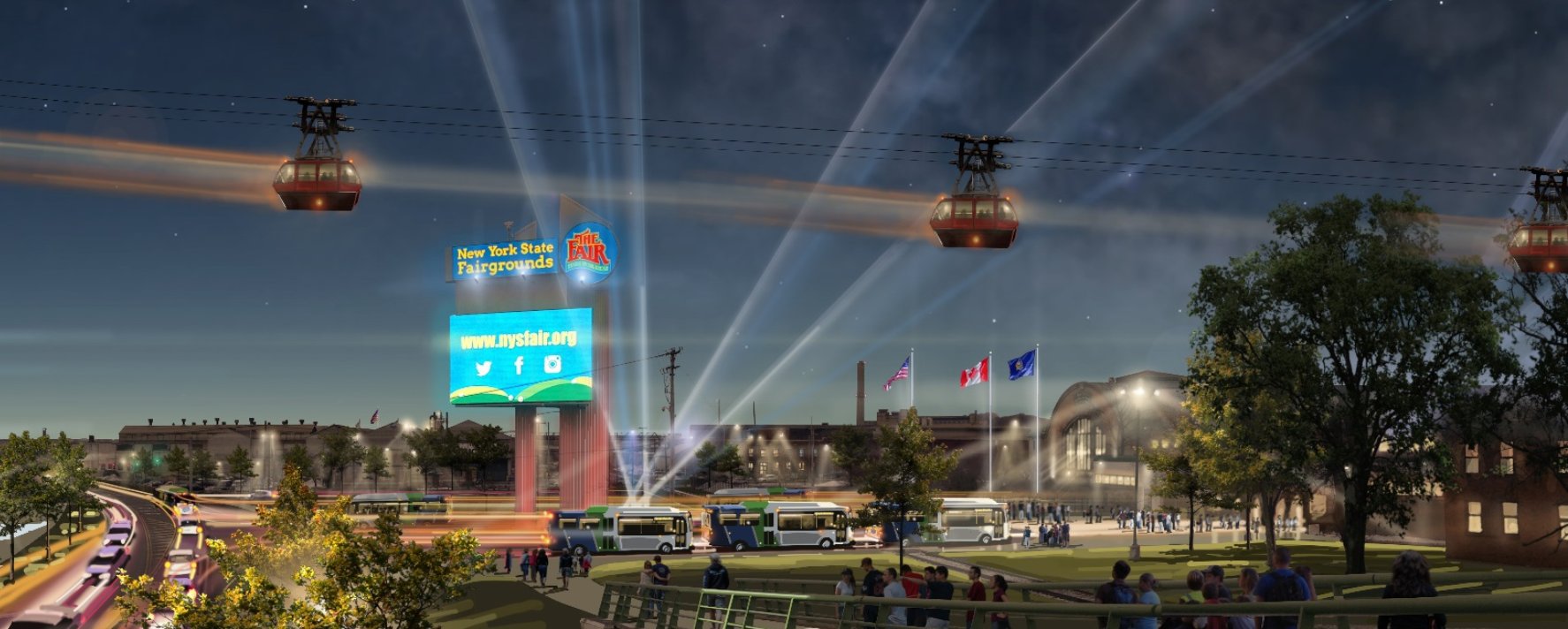
A not-so-accurate rendering of a proposed gondola at the New York State Fairgrounds in Syracuse, NY.
A $15 million gondola system will connect the New York State Fairgrounds in Syracuse to a nearby amphitheater, Governor Andrew Cuomo announced this morning. “This is very, very exciting and it brings the energy of both facilities together for a synergy between the two,” Cuomo noted, calling the planned gondola “world class.” The lift’s 38 cabins will cross Interstate 690 along a 3,700′ route. The project still requires federal approval but is scheduled for completion in June 2018.
The gondola will link more than 15,000 parking spaces at the fair to the 17,500-seat Lakeview Amphitheater, which will host major acts such as Zac Brown Band and Third Eye Blind this summer. The amphitheater gondola station will also serve Onondaga Lake Park and its network of popular trails. The state- and county-owned facilities are currently connected by shuttle buses operating on a circuitous route during major events. Capacity of the eight-passenger lift will be 1,200 passengers per hour. An expansion to 75 cabins would achieve an ultimate capacity of 2,400 per hour. A manufacturer has not yet been selected and the state will hold a competitive bid process in the coming months.
A separate, privately-funded and operated skyride lift will also be built this spring, traveling 1,500 feet over the fairgrounds with between 100 and 120 double chairs. Dozens of fairs across the country operate either chairlifts or gondolas for fair-goers, among them a new Skytrac ride at Cal Expo, a Partek chairlift at the North Carolina State Fair and the Texas Skyway gondola built at the Texas State Fair in 2007.
Governor Cuomo also announced $20 million in improvements at the state-owned Belleayre, Gore Mountain and Whiteface ski resorts today, including a new enclosed upper terminal building for Gore’s Northwoods Gondola and a new lift connecting Whiteface’s learning center to mid-station. New York State owns more lifts than any other state – 27 in total – including the Roosevelt Island Tramway. The government has been a frequent customer of both Doppelmayr and Leitner-Poma over the years.
Heavenly’s Comet Express remains closed following a Jan. 1st rope evacuation, apparently due to a gearbox issue. This is one of the reasons Vail Resorts is replacing its fleet of 1980s-vintage detachable quads.
Ski Area Management‘s lift construction survey dropped this week. Highlights from its outlook for 2017:
“We’re off to a strong year for ’17, there are lots of people asking about lifts…It’s very positive compared to the previous two years.” – Jon Mauch, Senior Sales Manager at Leitner-Poma
“There’s a lot of enthusiasm about what could happen under a Trump administration. People expect deregulation and a more business-friendly climate.” – Mark Bee, President at Doppelmayr USA
“We’re seeing lots of requests quotes, lots of major modifications and retrofits…It’s all being driven by the age of the existing lift infrastructure.” – Carl Skylling, General Manager at Skytrac
I’ve already identified 29 new lifts likely to be built in 2017, pacing well above the last few years for mid-January.
This New Year’s Day, I thought I’d review Lift Blog’s second year and make a few predictions for 2017. In 2016, North American lift construction reached a post-recession high, with large new lifts debuting at Arizona Snowbowl, Big Sky and Jackson Hole. In April, we learned Leitner-Poma acquired Skytrac, changing the manufacturer landscape in North America again. LST built its first detachable lift in France (although it’s not quite finished yet) bringing another player to the global market. 2016 also saw numberoflifts catch fire and others fallapart. Here’s a rundown of our most-clicked-on posts of 2016:
Blog wise, readership increased five-fold with more than 700 reader comments in 2016. Lift Blog now has 750 Instagram followers and almost 500 likes on Facebook. I even started Tweeting. Now a few predictions for 2017…
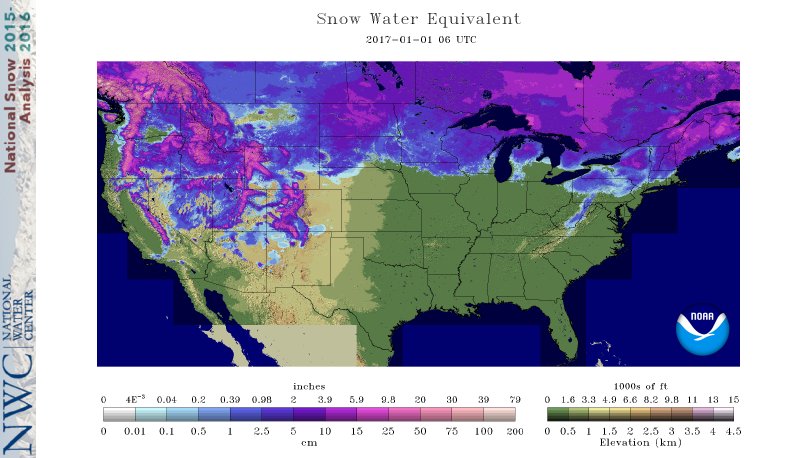
There was a lot less purple on this map on 1/1/2016, particularly in the Northeast.
North America will build more than fifty lifts for the first time since 2007. I’ve already identified 28 likely to be built this construction season with the announcement window really just beginning. American consumer confidence is at its highest level since 2001 and the snow is deep in every major ski region of North America.
An American or Canadian city will commit to building a purpose-built gondola for public transportation. New York City, Washington, Albany and Vancouver are likely candidates but there are dozens more possibilities.
Vail Resorts will go East. Since October 2010, Vail has acquired a new ski resort every nine months on average. That puts the next purchase approximately May 2017. A major New England or Mid-Atlantic mountain going Epic seems only a matter of time. Wherever it goes, Vail Resorts will invest heavily in new lifts.
A new 3S gondola will open in Toulouse, France in 2020, becoming the first dedicated tri-cable gondola system for public transport.
In its home country of France, Poma Ropeways has won a $56 million tender to realize the first 3S gondola designed entirely for public transport. Téléphérique Urbain Sud (South Urban Cable Car) will link two hospitals to Paul Sabatier University in the city of Toulouse. You may know France’s fourth largest city, with 1.2 million inhabitants, as the global headquarters of the Airbus Group.
The gondola’s 1.9 mile route will ascend a 300-foot hill called Pech David before crossing the Garonne waterway. Factors leading to the selection of a 3S over a MGD were the need for long spans between towers (just 5 required instead of 20), the ability to more easily transport wheelchairs/bicycles as well as wind tolerance. Fourteen 35-passenger Sigma Symphony cabins will circulate between three stations with an hourly capacity of 1,500 passengers per direction. At 5 m/s, the system will achieve headways of just 90 seconds and a trip will take ten minutes each way, a 20-minute improvement from today in a car. Like other successful urban gondola projects, riders of the 3S will be able to use existing fare media and easily transfer to and from metro trains or buses. Additional stages are likely to be added to the ends of the new gondola in the future.
Leitner-Poma, Georgetown University, ZGF Architects host urban gondola forum with speakers from the Portland Aerial Tram and Medellín Metrocable, among others.
With one of three chairlifts out of commission, Big Tupper, NY is unlikely to open this winter.
14-year old boy falls from the Emerald Express at Whistler.
Costa Rican officials and Doppelmayr Mexico sign letter of intent to build Central America’s first urban gondola.
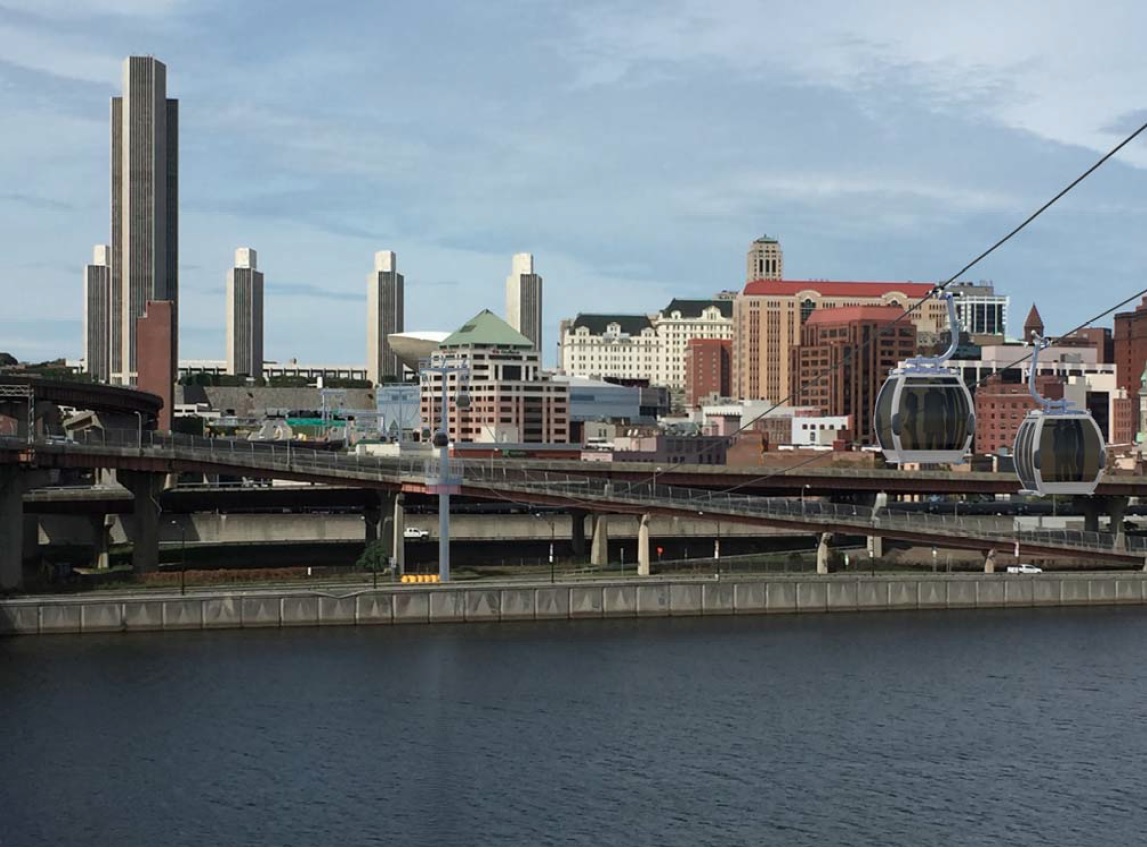
Doppelmayr and McClaren Engineering Group recently completed a feasibility study for a proposed Capital District Gondola connecting Albany and Rensselaer, NY over the Hudson River.
Two months after Doppelmayr and McLaren Engineering Group launched one of the world’s most complex gondola systems at Wynn Palace Cotai, the two companies have teamed up again on a wholly different project spanning the Hudson River in Albany, New York. McLaren Engineering, headquartered in the region, and Doppelmayr, with an office in nearby Ballston Spa, self-funded the study.
A team of six professionals engaged with stakeholders over the past three months, culminating in the document’s release this week. The gondola would connect America’s 9th busiest Amtrak station with Downtown Albany utilizing a mid-station and possible angle change. Because it has all the components of a successful urban system – key points separated by a natural barrier over a modest distance – the study results are very positive. “After three months, the Project Team finds the CDG to be feasible,” the authors note. “It retains the potential of being a transformational project that will spark increased mobility, tourism, and economic development in two areas of the cities of Albany and Rensselaer that are currently underdeveloped.”
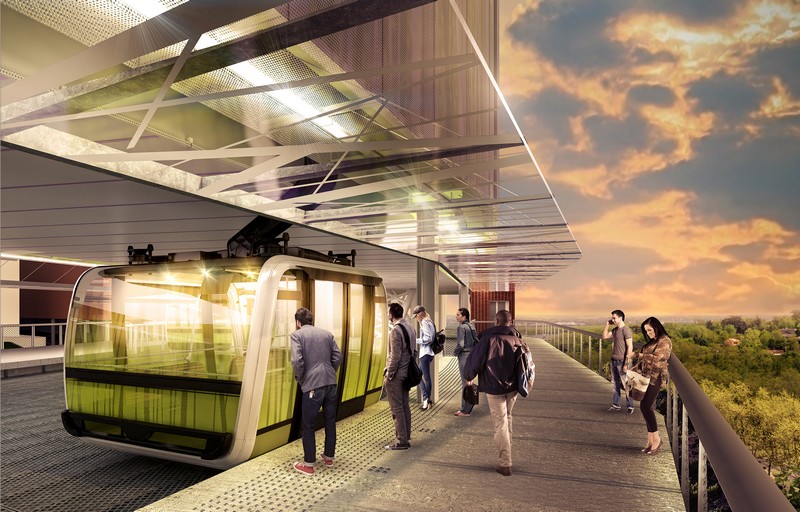
Future Rensselaer Amtrak Capital Gondola station with enhanced station design.
Albany’s train station moved across the river to Rensselaer in the late 1960s, separating the city from its major transit hub. Goals of the gondola project include addressing the physical separation, providing a new pedestrian and bicycle connection and improving quality of life in the Capital District.
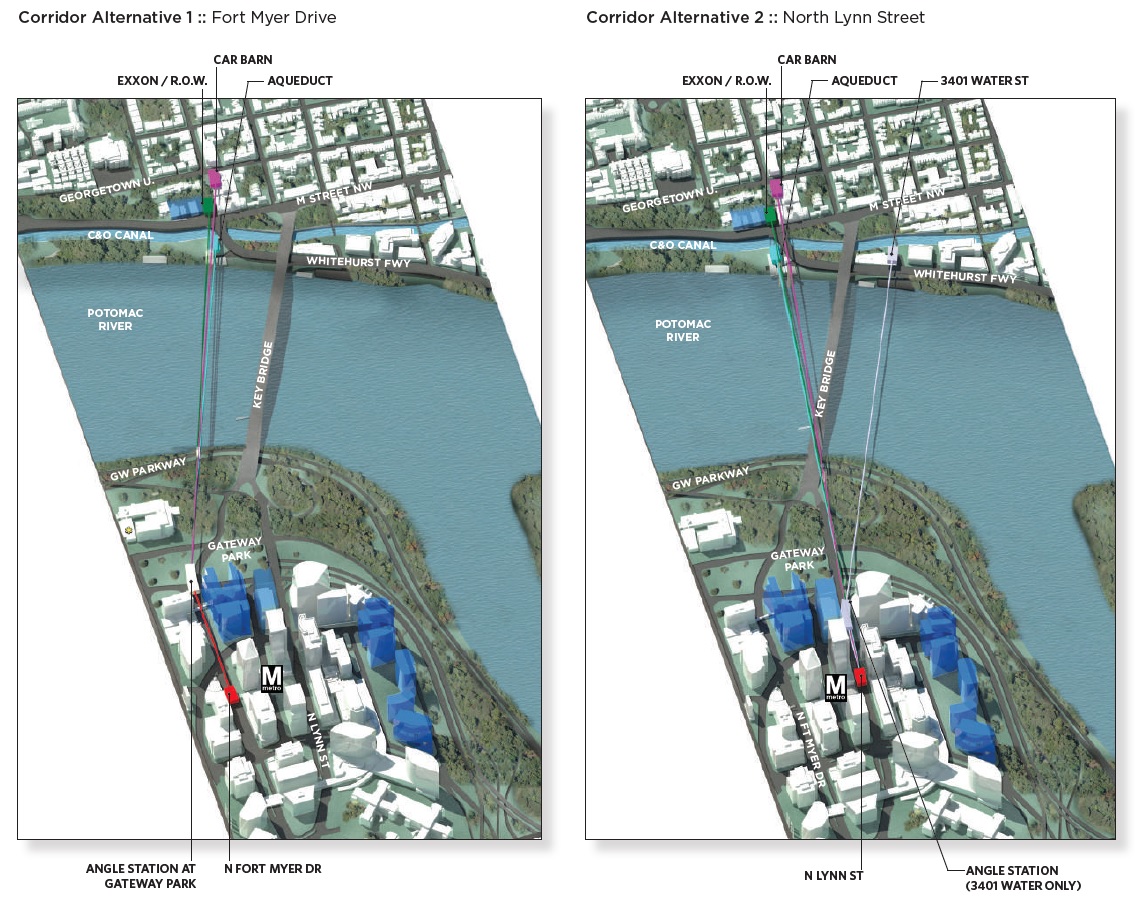
At least 6,500 people would ride a a proposed gondola from Washington’s Georgetown neighborhood to Rosslyn, Virginia daily, according to a long-awaited study released last week. ZGF Architects and Engineering Specialties Group consulted with more than 20 federal, state and local agencies along with Georgetown University and local residents. Not only is the project technically feasible, it would improve mobility for residents and visitors while positively impacting the region’s economy. The system would cost $80-90 million, expensive by gondola standards, and take approximately six years years to open.
A look at 15 possible alignments yielded two preferred alternatives. Most require an angle station in public right of way on the Virginia side of the Potomac at an added cost in the neighborhood of $7 million. Both of the above lines terminate adjacent to the Rosslyn Metro Station and the southeastern corner of the Georgetown U. campus. Towers in or adjacent to the river would be 130-150 tall to allow vessels to pass below and give riders a compelling view over the Key Bridge.
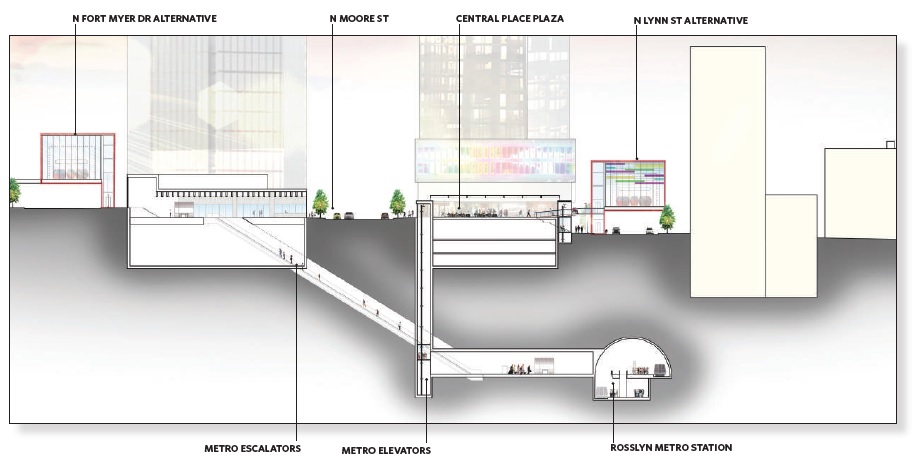
Pedestrian connections from the Rosslyn Metro Station to above ground gondola station options.




 Lift Blog
