https://instagram.com/p/5ryobXTUHm/
https://instagram.com/p/5hspN3iuZY/

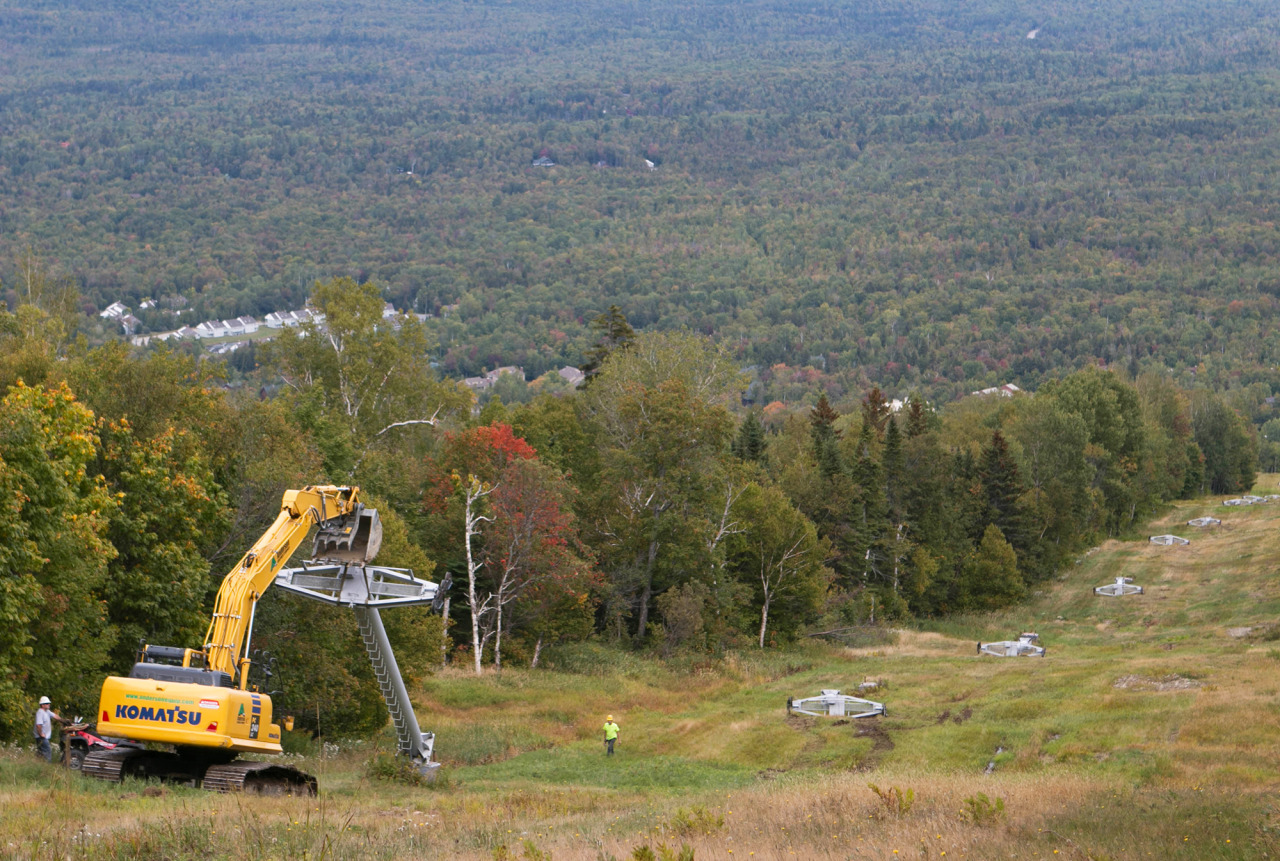
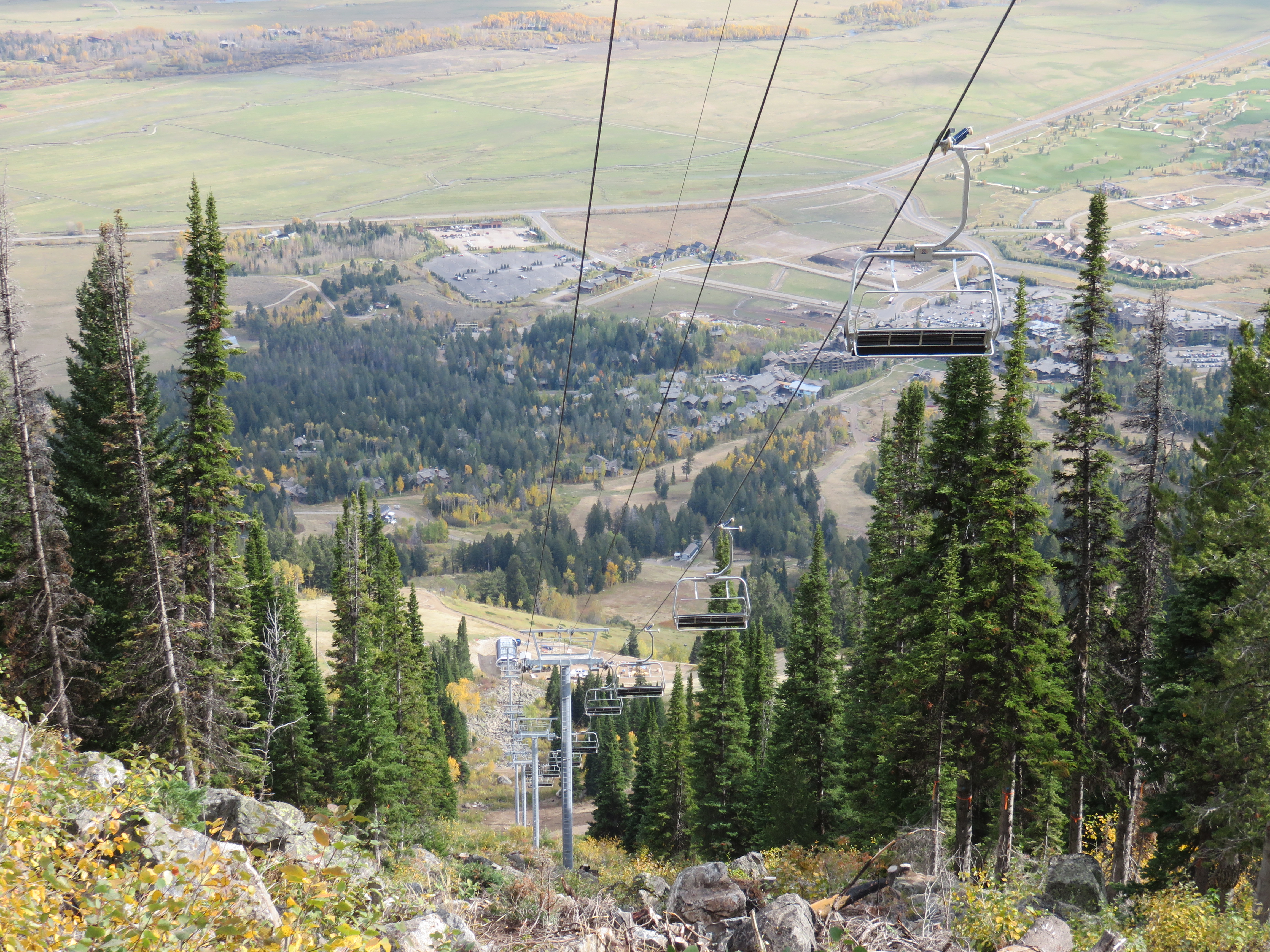
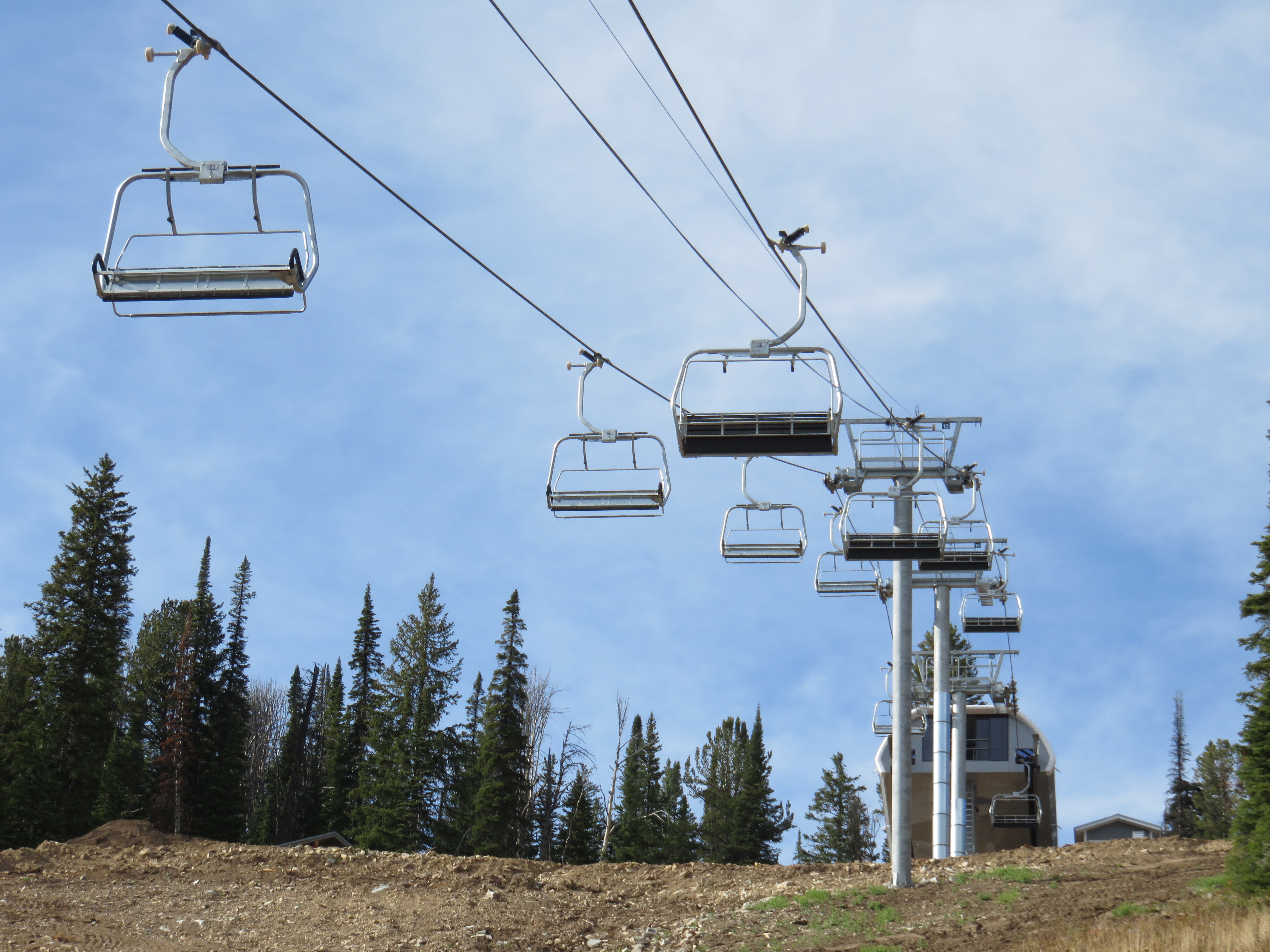
Last night I heard the unmistakable sound of a helicopter flying over my house. Around here it’s usually a search and rescue chopper but this time I looked out to see the double rotors of a Kaman K-Max. It’s the same helicopter that did the concrete footings for the Teton lift last week. Doppelmayr started flying towers early this morning and the crew worked their way down from the top, setting towers 15 through 5 before wind and snow shut them down around noon.
The K-Max can’t fly complete towers at 9,000 feet so the tubes, crossarms and sheave trains were flown separately. As the wind picked up, the pilot had to call it a day while working on tower 5 so it sits for now missing a crossarm. Tower 1 can be done with a crane when the lower terminal goes in so there are only a handful left to fly.
Vertical transport feet per hour (VTFH) is the best way to measure how lifts move people up mountains. VTFH combines hourly capacity and vertical rise into one number, usually measured in millions. Ski Area Management uses this metric each fall when they look at how good of a year it was for the lift-building business.

For a lift to score big it has to have a high hourly capacity (think lots of carriers, high speed) and large vertical rise (think big slope length with many towers.) The Jackson Hole tram has a huge vertical (over 4,000′) but very low capacity so its VTFH is only 2,654,600 – not even in the top 400. The Peak 2 Peak Gondola has a huge capacity but only rises 119 feet for a dismal VTFH of 243,950. There are 49 lifts in the US and Canada that move enough people high enough to achieve a VTFH over five million. Below are the top ten.
1. Revelation Gondola Stage II, Revelstoke Mountain Resort, British Columbia
2007 Leitner-Poma 8-passenger gondola
2,952′ vertical x 2,800 passengers per hour = 8,265,600 VTFH
2. Gold Coast Funitel, Squaw Valley, California
1998 Garaventa CTEC 28-passenger funitel
2,000′ vertical x 4,032 passengers per hour = 8,064,000 VTFH
3. Heavenly Gondola, Heavenly Mountain Resort, California
2000 Doppelmayr 8-passenger gondola
2,874′ vertical x 2,800 passengers per hour = 8,047,200 VTFH
4. Gondola One, Vail Mountain, Colorado
2012 Leitner-Poma 10-passenger gondola
1,996′ vertical x 3,600 passengers per hour = 7,185,600 VTFH
5. Centennial Express, Beaver Creek Resort, Colorado
2014 Doppelmayr 6/10 chondola combination lift
2,102′ vertical x 3,400 passengers per hour = 7,146,800 VTFH
The Portland Aerial Tram, opened in January 2007, is one of only a handful of urban commuter lifts in the United States. It connects the campus of the Oregon Health & Science University with Portland’s up-and-coming South Waterfront neighborhood. The tram was built for $57 million during Doppelmayr-Garaventa’s North American golden years when they completed three projects worth $150 million in less than two years (the others being Jackson Hole’s new tram and the Peak 2 Peak Gondola.) The Portland tram now carries more than 3,300 passengers a day, far exceeding initial projections.

The tram only rises 496 feet but it crosses a light rail line, eight lanes of Interstate 5 and eleven other roads. The bottom terminal houses the 600 HP drive motor and tram offices while the 80,000 lb. counterweight sits underneath the top station. Slope length is only 3,437 feet, allowing quick three-minute trips at 2000 feet per minute or 7 m/s. This achieves a capacity of 1,014 passengers per hour, per direction.

Why did a tram one quarter of the size of Jackson Hole’s cost $25 million more? Two words: politics and aesthetics. Designers wanted the system to be unique to Portland and aesthetically pleasing. The city held an international design competition and selected AGPS Architecture of Zurich to design the terminals, tower and cabins. The 197-foot tower is entirely covered in steel panels and lit up in colors at night. Gangloff custom-designed the tram’s two 78-passenger cabins to look like flying reflective bubbles. The top station is perhaps the most complex piece of the project, sitting 140-feet above ground and supported by angled columns.

There are 63 chairlifts in the US and Canada that stretch longer than 7,000 feet but only four over 10,000′. Six of the top ten are in the State of Colorado and all but two are detachable quads. Sun Peaks Resort near Kamloops, BC claims the title of the longest fixed-grip chairlift in the world and the only non-detachable among North America’s hundred longest lifts. A ride on the Burfield Quad takes a painful 21 minutes to go 9,510 feet (and that’s at full speed.) Below are the top ten longest chairlifts in the US and Canada.
1. Slide Brook Express, Sugarbush, Vermont – 11,012 feet
1995 Doppelmayr Detachable Quad
2. Chile Express, Angel Fire Resort, New Mexico – 10,992 feet
1996 Poma Detachable Quad
3. Sunshine Express, Telluride, Colorado – 10,732 feet
1986 Doppelmayr Detachable Quad
4. Village Express, Snowmass, Colorado – 10,074 feet
2005 Leitner-Poma Detachable Six
5. American Flyer, Copper Mountain, Colorado – 9,907 feet
1986 Poma Detachable Quad


It’s mid-July and construction is ramping up on the north side of the Jackson Hole Mountain Resort. A K-Max helicopter from Timberline Helicopters was on-site Sunday to fly concrete for the towers that couldn’t be accessed by road. The rest of the tower footings were already finished and back filled. Concrete work is also complete at the top terminal and steel will be going up shortly. The bottom terminal is a few weeks behind. Down in the parking lot, towers are mostly assembled and terminal components will be headed up the hill soon.


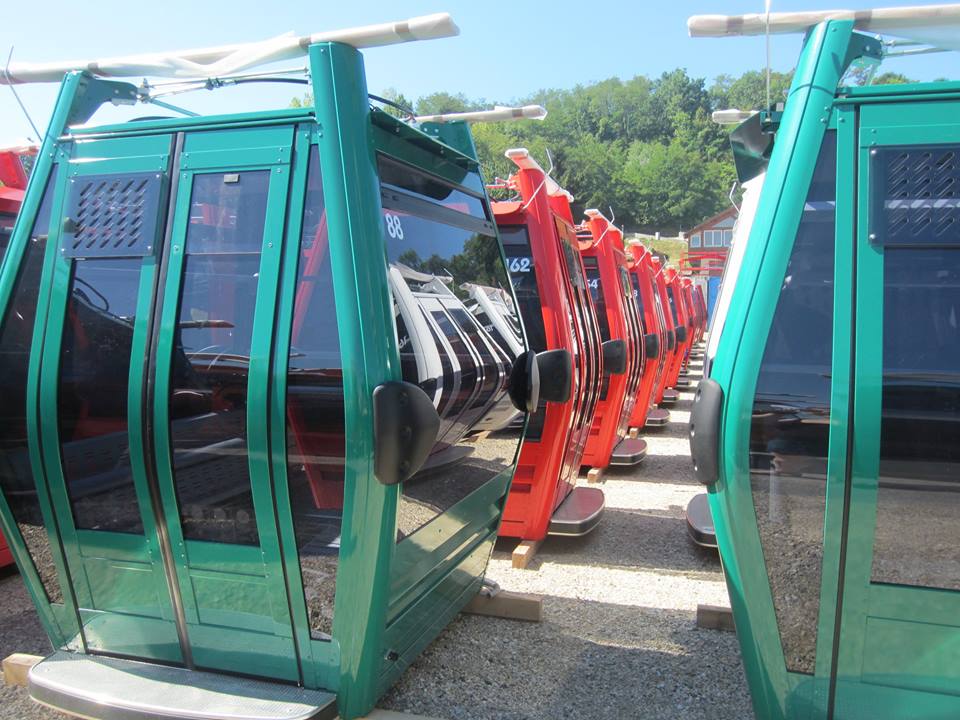
The Iron Mountain Tramway provides the only public access to the Glenwood Caverns Adventure Park located in Glenwood Springs, Colorado. Built by Leitner-Poma in 2002, it was one of the first pulse gondolas to open in North America. The system debuted with four sets of two CWA Omega III cabins and now has six pulses of three for a total of 18 cabins. Ultimate design capacity is 36 cabins in groups of three which would achieve a capacity of 543 passengers per hour per direction. With a top speed of 1,000 feet per minute, the trip takes about seven minutes including two slows along the way. If more pulses are added, the trip time will increase as the system slows to a crawl whenever cabins are loading and unloading. This is one of the disadvantages of pulse systems.

The gondola rises 1,351 feet and has a slope length is 4,432 feet. The bottom drive terminal is a Poma Alpha model with a 400 HP electric motor. Because this is also the tension terminal, the entire loading platform moves hydraulically with the motor room and bullwheel.

A unique feature of this installation is that the 18 towers also support water, natural gas and sewer lines for the summit facilities. All three lines are suspended from a 3/16″ cable attached just under each tower’s crossarm. The water line supplies 42 gallons per minute to a tank located at the summit. The Colorado Passenger Tramway Safety Board approved transport of natural gas along the line because the fiberglass pipe used has a safety factor of 30 relative to the pressure of the gas.
I sometimes find myself telling people the classic line that there are only two companies left making ski lifts even though I know reality is far more complicated. Doppelmayr-Garaventa and the Seeber Group (Leitner and Poma) aren’t even the only companies building detachable lifts these days. There is a smaller player called Bartholet Maschinenbau Flums (BMF) that has completed dozens of projects around the world, including even here in North America.

BMF, based in Switzerland, is over 50 years old and completed its first lift in 1977. The firm’s first detachable, a six pack, opened at Val d’Isere in 2007. BMF has also built aerial trams, surface lifts, a funitel and chondola. Some of BMF’s unique designs include chairs that rotate 45-degrees, solar-powered surface lifts and carriers by the Porsche Design Studio. Gangloff Cabins joined the Bartholet Group in March 2014. Gangloff already has a significant presence at US ski resorts including Canyons, Winter Park and Deer Valley.

I was surprised to learn BMF already built three lifts in North America. The first was the Sky Tram at Monteverde, Costa Rica in 2006. Technically a pulse gondola rising 571 vertical feet, it has five towers and can move 432 passengers per hour. BMF built a second rain forest tram in Costa Rica in 2007. The company built the city of Durango, Mexico a 25-passenger aerial tram in 2010. BMF started construction on a second tram in the Mexican city of Puebla in 2013 before construction was halted over concerns about construction impacts in this world heritage site.