News Roundup: Six-Pack

News Roundup: South America

This is an open thread.  Feel free to leave a comment on anything lift-related.

Olympic Spotlight Shines on Rio and its Teleféricos

With the Olympics opening tomorrow in Rio de Janeiro, the world looks to a seaside metropolis with more than six million residents and the first South American city to host an Olympic Games.  While Brazil has no ski resorts, Rio features aerial lifts ranging from hundred year-old tramways to modern gondolas connecting the city’s favelas to the regional transit network.

The famous Sugarloaf Mountain twin tramways were among the world’s first cableways of any kind when they debuted in 1912.  A century later, Brazilian President Dilma Rousseff championed development of a five-section Poma gondola connecting some of Rio’s largest slums, modeled after the pioneering gondola network in Medellín.  In 2013, Doppelmayr built a three-station gondola in Morro da Providência, serving more than 5,000 residents in one of Rio’s oldest favelas.  Further urban cable projects proposed for Rio have faltered as the city works to combat challenges we’ve become all too familiar with leading up to the Games.

Teleférico do Alemão

Teleférico do Alemão is one of the largest and most complex gondola systems in the world with six stations and 152 10-passenger Sigma Diamond cabins.  Built by Poma and operated by private train company SuperVia, Teleférico do Alemão opened July 7, 2011. The system is capable of transporting 3,000 passengers per hour over 2.2 miles of dense neighborhoods in 16 minutes.  The lift changes angle four times, including a 100-degree turn at Alemão Station.

Bondinho_do_Complexo_do_Alemão_Panorama_06_2014
Teleférico do Alemão’s striking gondola stations also serve as community centers.  Photo credit: Mario Roberto Duran Ortiz via Creative Commons

70,000 residents are eligible for two free rides daily on the gondola, which links favelas in the Complexo do Alemão to the Bonsucesso train station. Six expansive rooftop stations that feature banks, stores and social services rise above the favelas.  The gondola system cost approximately $74 million to build and serves 9,000 daily riders.  Initial ridership estimates of 30,000 per day have not been realized as Rio has struggled to attract non-residents to ride the teleférico through crime-ridden neighborhoods.  Unlike in Medellín and La Paz, residents have criticized the construction of an expensive gondola through communities that lack electricity, clean water and basic sanitation.

Continue reading

Medellín Pairs Urban Gondolas with Subways

https://www.instagram.com/p/BILLC7aA6FZ/?tagged=metrocable

South American cities are world leaders in urban cable transport, with 24 urban gondolas either opened or planned in Bogotá, Caracas, Guayaquil, La Paz, Lima, Medellín and Rio de Janeiro.  I’ve written extensively about La Paz, Bolivia’s capital that went all in on cable transport with eleven gondolas either operating, under construction or planned.  But a full decade before the creation of Mi Teleférico in La Paz, Metro de Medellín opened the first of three Metrocable gondola lines in Colombia’s third largest city.  Metrocable Line K was the first urban gondola to seamlessly link with a subway anywhere in the world, providing under-served and poor neighborhoods access to the city’s transport network. Metrocable’s J, K and L lines, with ten stations over 5.8 miles, now compose a quarter of the Metro de Medellín network.  All three Metrocable lines are 8-passenger monocable gondolas built by Poma.

https://www.instagram.com/p/BGvoGnIiQHy/?tagged=metrocable

Line K debuted in 2004 with a shockingly low construction cost of $26 million.  Its four stations branch off from the Acevedo Metro station over a length of 6,798 feet, giving three neighborhoods access to the core subway Line A that opened in 1996.  This gondola rises 1,309 feet with a rope speed of 5 m/s.  Metrocable Line J opened in 2008 at a cost of $47.5 million, serving four more stations from the terminus of the shorter subway Line B. Line J is longer than the original K at just under 9,000 feet.  A ride with seamless transfers between buses, two Metro subway lines and two Metrocable lines costs less than a dollar.

5mapa-metro-medellin-1
Medellín’s Metro system features two subway lines and three Metrocable lines with two more under construction.

Continue reading

Mount Roberts Tramway Celebrates Twenty Years

IMG_8823
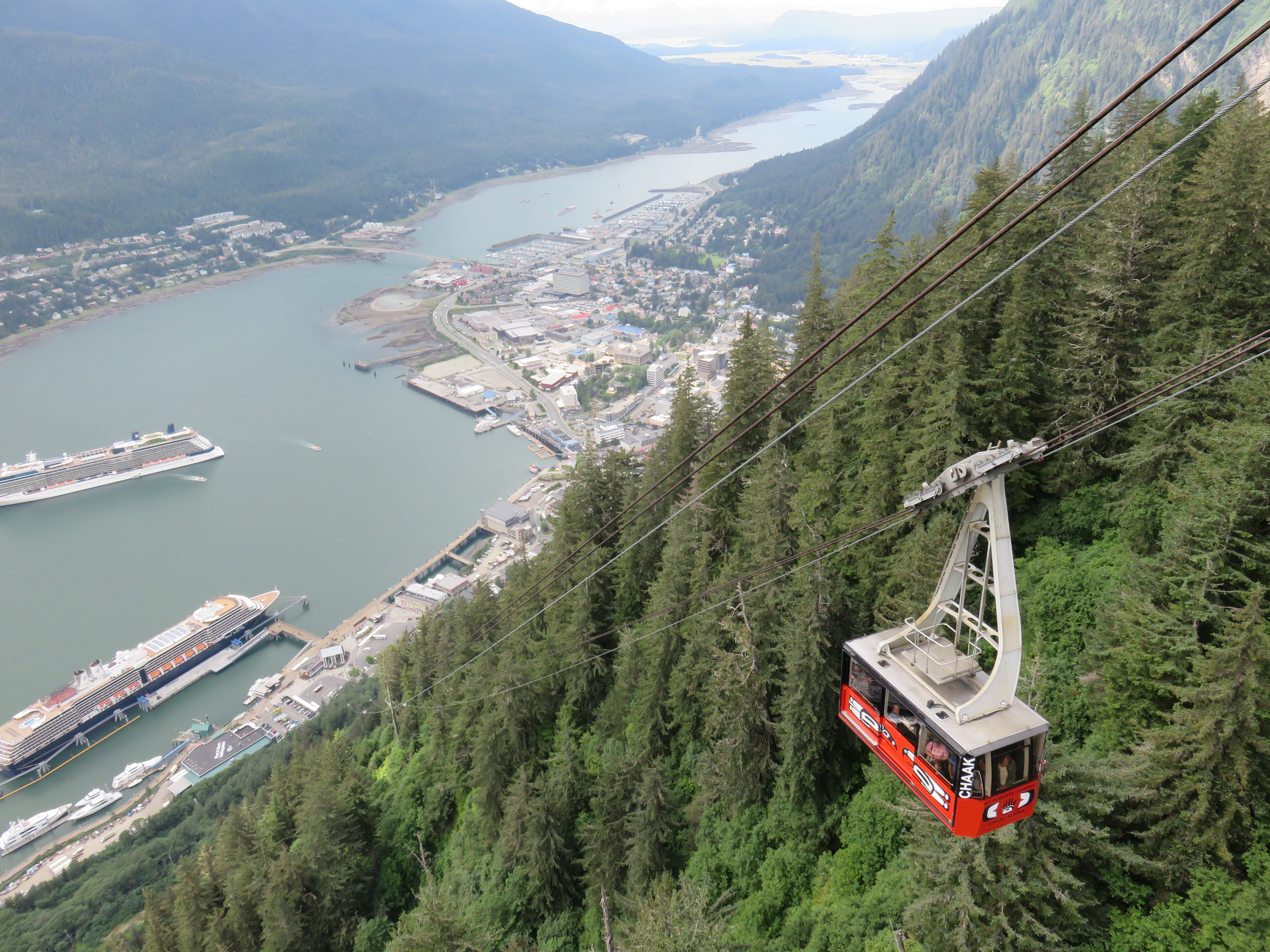
Opened in 1996, The Mt. Roberts Tramway flies above downtown Juneau from the city’s waterfront.

Rising from the cruise docks on the edge of Alaska’s capital, the Mt. Roberts Tramway is the undisputed steepest lift in North America with an average slope angle of 39 degrees.  The now-famous tram carried its first passengers 1,800 feet above Juneau almost twenty years ago. It’s among the newest large aerial tramways in North America and one of two in the U.S. built by Poma. The summit terminal soars 165 feet above the forested slopes of Mt. Roberts, downtown Juneau and the massive cruise ships below.  On August 10th, the tram will celebrate twenty years of service and more than 3.5 million riders.

IMG_7216
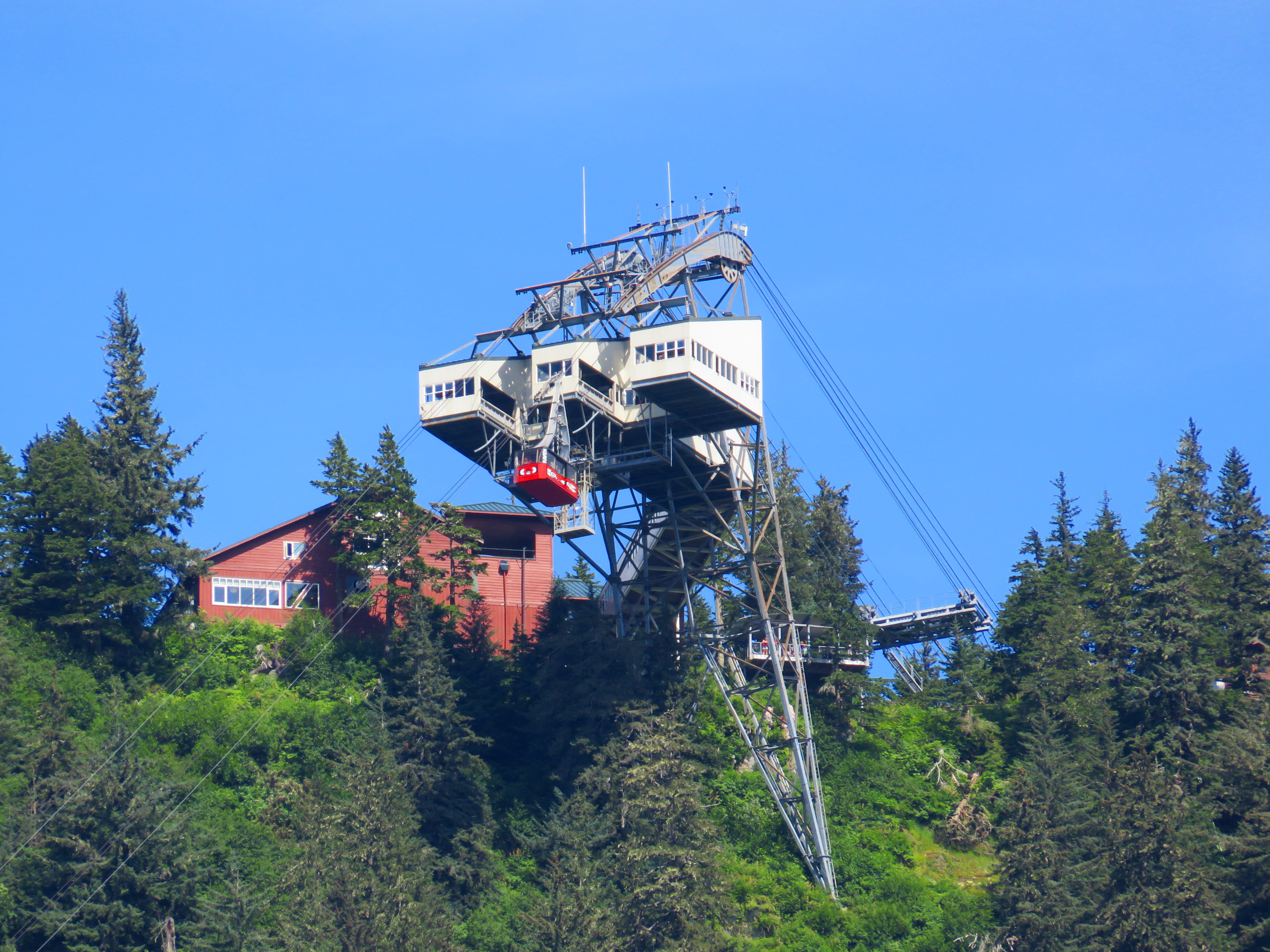
The top terminal is basically a tower, similar the Portland Aerial Tram but located in a more spectacular setting.

John Heiser proposed the lift in 1994, becoming President of the Mount Roberts Development Corporation before leaving to join Intrawest.  He financed the $16 million project with investments from Anchorage businessmen and Goldbelt (an Alaska Native Corporation) and leased right of way from the City of Juneau.  Goldbelt took 100-percent ownership of the tram in 1998.

IMG_8909
The bottom terminal fits the definition of a tram dock!  The motor room is located above rather than below due to its unique location.

Continue reading

News Roundup: New in New Zealand

News Roundup: Big Week

IMG_9491
Garaventa recently fabricated new hangers for the Grouse Mountain Red Skyride cabins so riders can stand on the roof for an extra charge. Photo credit: Max U.

News Roundup: Vail Effect

News Roundup: Skyline

  • Two men want to build an iconic gondola called Skyline along the Chicago Riverfront.
  • Sandia Peak unveils new tram cabins for its 50th anniversary.
  • Sugarloaf updates the public on its summer lift maintenance projects.
  • BMF wins contract for its first 10-passenger gondola to be built next year in Switzerland.
  • The owner of Gletscherjet 3+4 built last summer in Austria say it has already carried 3 million passengers, believed to be a record for a winter lift.  The system is an 8/10 combination lift interlining with a 10-passenger gondola.
  • Poma’s 2015 Reference Book is now online highlighting last year’s projects from around the world.
  • Are Vail Resorts and Powdr Corp. bidding on Eldora?
  • A New Zealand developer will test whether a Whistler-style bike park with its own high speed quad can stand alone without skiing.
  • Doppelmayr and its contractors take responsibility for a construction accident at one of the terminals under construction in La Paz that injured ten people on Saturday.

New Book Chronicles 80 Years of Innovation at Poma

IMG_9929
“This work is dedicated to the men and women who have been part of Poma’s innovative and epic journey. It is for our clients and partners who have placed their trust in Poma throughout the world – whether up in the mountains or in the heart of cities.”

The above dedication sits on the first page of a new book celebrating eighty years of commercial success called Poma: 80 Years of Ropeways from Mountains to Cities.  The 190-page work, written by Béatrice Méténier and Christian Bouvier, looks back at the firm’s more than 8,000 ropeway installations from the mountains of France to Colorado, South America and beyond.

A skier at heart, Jean Pomagalski installed his first surface lift in 1934 at Alpe d’Huez. He constructed it mostly out of wood and with a used Ford motor.  After building three additional tows, Mr. Pomagalski had himself a company and filed a patent in 1936 for a “carrying device hauled by a rope moving at a constant speed.” After a break for Wold War II, Pomagalski S.A. grew to 15 employees by 1953.  Even so, Mr. Pomagalski still found himself simultaneously a salesman, surveyor, designer and builder of lifts that were sent off as kits for installation by customers. The company’s first chairlift, a single-seater, debuted in 1955 near Chamonix.

IMG_4080
Workers assembled, then disassembled early fixed-grip chairlifts in Poma’s French workshops before sending them to the field as seen in this 1963 photo.

By 1958, Pomagalski was selling 120 lifts a year, many of them to customers in the United States and Canada.   Mr. Pomagalski decided to drop the latter part of his name from the company’s in 1965 to better appeal to English-speaking clients.  Poma delivered its first gondola systems simultaneously in 1966 at Queenstown, New Zealand and Val d’Isère, France. A small new company called Sigma Plastiques provided the egg-shaped cabins.  Poma trusted Sigma again the next year for the world’s first gondola with automatic doors and the rest is history.

Continue reading