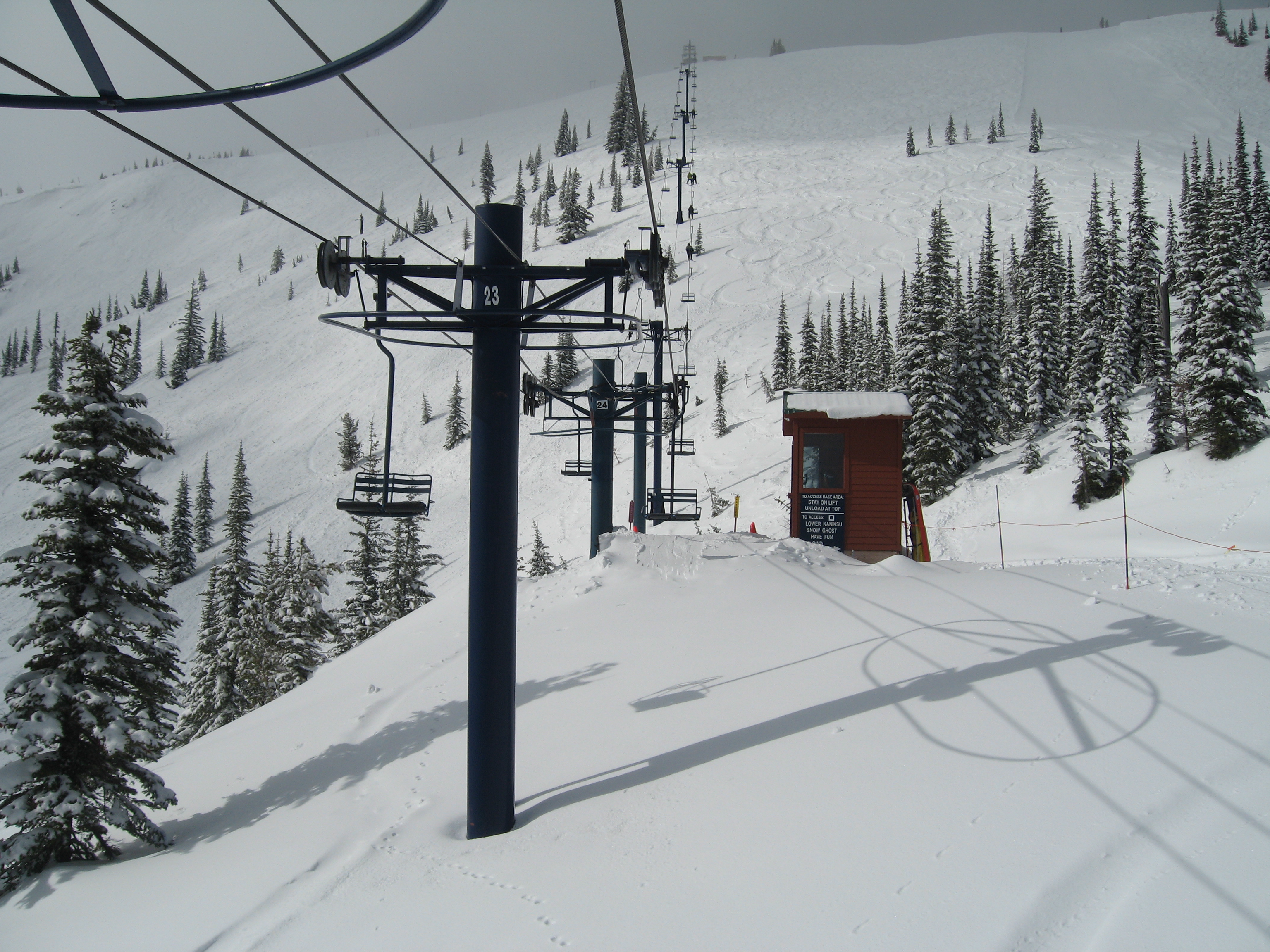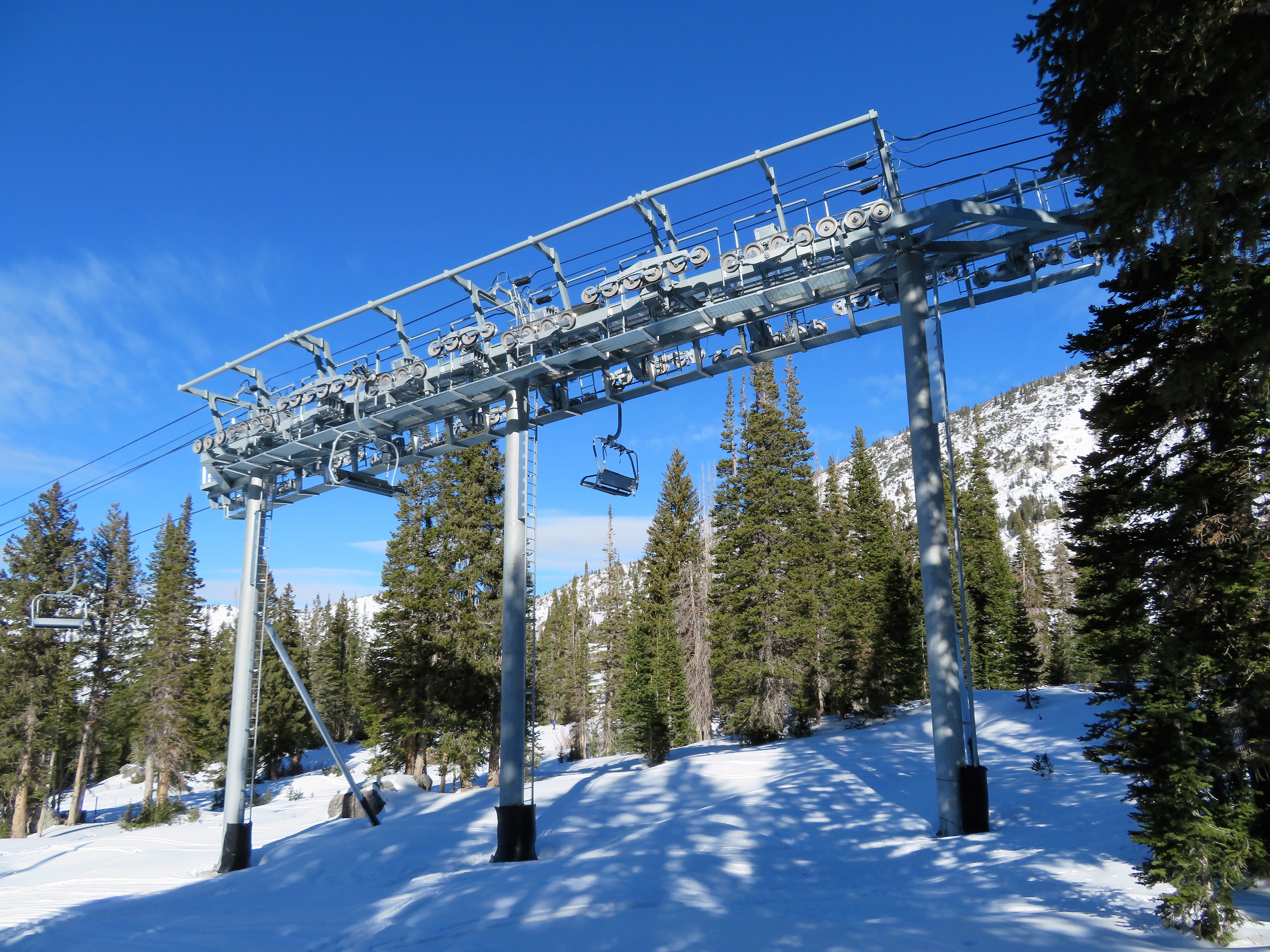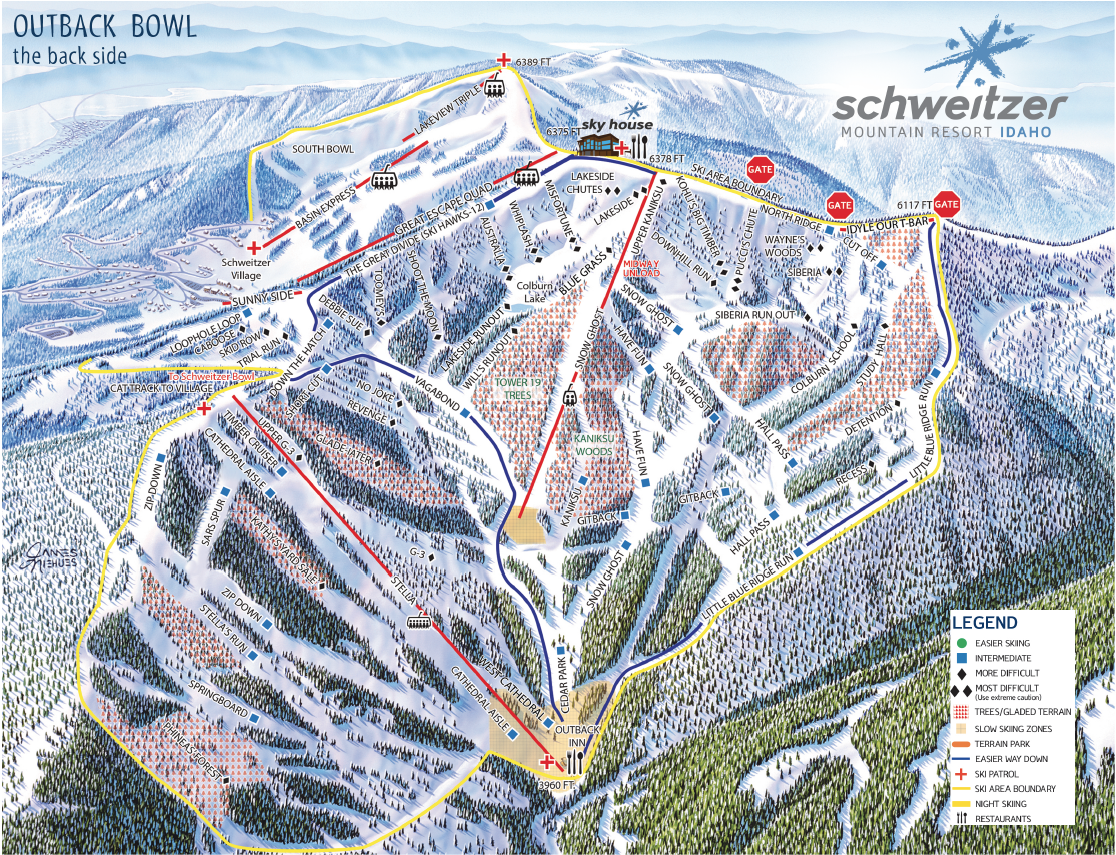
- Telluride weighs building at least one big detachable next summer as the Forest Service tentatively approves replacements for Plunge, Sunshine Express and Village Express.
- White Pass, WA retires its platter in favor of a 380’ carpet.
- LiftDigital goes live for testing at Winter Park.
- Taos says goodbye to two more chairlifts – that’s four in one summer!
- Song Mountain, NY is replacing its 1965 Thunderbird T-Bar with a chairlift.
Anyone know where it’s from? - The Rainforest Adventures crew gets one Skytrac back in action and works to repair the other following Irma’s devastation of St. Maarten.
- Scroll through these photos of a new high-speed quad in Switzerland with four stations, three sections, two haul ropes and only one drive!
- Albany gondola group to be led by former chief executive of the New York State Department of Transportation and Federal Highway Administration Thomas Madison, Jr.
- Authorities briefly seize Granby Ranch, site of last season’s fatal lift incident, over delinquent taxes.
- Spout Springs in Oregon won’t open for a second year in a row and remains for sale.
- Mi Teleférico’s Orange Line did 93,847 riders its first weekend.
- Frank F. sent over these photos of the new Skytrac Buttercup Quad going in at Mt. Hood Meadows:
Instagram Tuesday: Projects
Every Tuesday, I feature my favorite Instagram photos from around the lift world.
Record Fifth Urban Gondola Opens in La Paz
There’s quite a party in the urban gondola capital of the world tonight as Mi Teleférico (My Cable Car) opens the Bolivian capital’s fifth urban gondola line. The Línea Naranja (Orange Line) carried its first public passengers just after 6:00 pm and will serve some 30,000 La Paz commuters daily. Joining the Red, Yellow, Green and Blue lines already in service, the new 10-passenger Doppelmayr system features the world’s first underground gondola station and amenities such as free Wi-Fi, video monitoring and cabin lighting. As La Paz builds out its eleven-line subway in the sky, the Orange Line forms an impressive continuous gondola route 6.1 miles long with the Blue and Red lines.
Like its predecessors, the newest line is technically two gondolas with four stations, a combined 26 towers and 127 cabins representing a $66 million investment. One way ride time is 9.5 minutes with a capacity of 3,000 passengers per hour, per direction. The project uses a mix of UNI-G and tunnel-style terminals built into modern station buildings.
News Roundup: Selloff
- Owing $3.8 million to creditors, Deer Mountain, SD to be sold to the highest bidder in a sheriff’s sale today. The mountain has two Riblet chairlifts.
- Curbed counts down 11 gondolas changing the way people move through cities.
- Steamboat sells off triple chairs from Four Points in 28 minutes (the lift got new Doppelmayr ones in 2012.)
- Taos offloads 200 chairs from lifts 5 and 6 for $200 each with proceeds going to hurricane relief. As of this writing, 37 remain.
- Leitner Ropeways’ new gondola at the world’s largest hotel transported 3.5 million passengers in its first eight months.
- Aspen Mountain installs Bluetooth speakers in Silver Queen Gondola cabins.
- China Peak completes its first quad chair, the old Elkhead from Steamboat.
- The Burnaby Mountain Gondola is back on the table.
- Leitner-Poma of America inks contract to build a US$7.1 million high-speed quad at Falls Creek in Australia.
- Vail Resorts launches interactive website with lift downtime and wait time data for last season at Vail, Beaver Creek, Breckenridge, Keystone and Park City.
- Belleayre’s gondola cabins arrive from across the pond. Unfortunately, the name of the lift is spelled wrong on all of them.
- Ski Magazine predicts the KSL-Aspen duo will benefit skiers with a second Epic-style season pass and major resort upgrades.
- Skytrac and Timberline Helicopters fly towers for the new East Rim lift at Whitefish. Thanks Buzz D. for these cool photos.
Instagram Tuesday: Winter is Coming
Every Tuesday, I feature my favorite Instagram photos from around the lift world.
Bridger Bowl Invests $5 Million to Transform Beginner Experience


Big Sky Quietly Adds 27th Lift

We’ve heard little about the two lift projects surrounding Lone Peak this summer, even though they will bring North America’s largest contiguous ski complex to a record 43 lifts before counting carpets. As I covered before, the biggest development is at the Yellowstone Club, where a new Doppelmayr gondola, high-speed quad and triple chair will create one of the largest beginner skiing facilities in America, though few will be lucky enough to learn to ski there.

Over at Big Sky Resort, anyone with a ticket to the Biggest Skiing in America will be able to ride the new Stagecoach double chair this winter. Stagecoach extends the long tradition of so-called lodging access lifts here, begun with Pony Express in 1995 and followed by White Otter, Cascade, arguably all five of the Spanish Peaks lifts, and most recently Little Thunder. Amazingly, almost half of the 43 lifts on Lone Peak and the surrounding mountains exist to create ski-in, ski-out real estate. At Big Sky Resort, most of these machines are seconds from other Boyne mountains and they have their own color on the trail map: purple.

In the five years prior to the real estate bubble bursting nationwide in 2008, a crazy 18 lifts were built in Big Sky at four separate ski operations. One of those, Moonlight Basin, opened in December 2003 as Lone Peak’s second public ski resort. The development’s first two lifts had simply connected to neighboring Big Sky Resort in 1994 and 1995. Between 2003 and 2006, founder Lee Poole and his partners went it alone, adding four more lifts including Montana’s first six-pack. Three of these were among the last CTECs off the line following the Doppelmayr merger.
News Roundup: Another LST
- Mi Teleférico announces it will transport its hundred millionth commuter in early December, three and a half years after opening La Paz’s first urban gondola. Eight gondolas now operate with two more forming the Orange Line set to debut September 29th. The White Line will follow in the first quarter of 2018 and the network will transport some 50 million passengers next year.
- Waterville Valley receives approval to build a T-Bar this fall in place of the High Country double. It’s the second North American project for LST Ropeways, the French company that collaborated with Skytrac to build the Valar T-Bar at nearby Cannon Mountain last year (an arrangement made before Leitner-Poma bought Skytrac.)
- Saddleback begins removal of the Rangeley double in preparation for its replacement. The Cupsuptic T-Bar will now be repaired rather than replaced, providing access to the Kennebago quad until Rangeley is complete. “The scope of this project is partially what drove the decision to repair versus replace the T-Bar,” Saddleback says. “If we had replaced both, there is a chance that there would not be any skiing this year if early snow arrived.”
- LST’s first detachable lift, which opened on July 29th in La Plagne, closed August 17th, apparently so adjustments can be made before winter.
- Gould Academy’s new T-Bar on Locke Mountain at Sunday River will cost an estimated $750,000 and serve up to 1,200 racers per hour, rising 815 vertical feet.
- Sugarbush’s two new Alpen Stars are coming right along.
- Jackson Hole’s Sweetwater Gondola cabins are going inside this winter.
- Could a gondola from Windsor, Ontario help Detroit land Amazon’s second HQ?
- Now’s your chance to weigh in on New York’s proposed Capital District Gondola.
- The latest from St. Maarten, where a chairlift-based adventure park was slated to open just days after Hurricane Irma hit:
Instagram Tuesday: Upward
Every Tuesday, I feature my favorite Instagram photos from around the lift world.
In a Booming Region, Stevens Pass Looks to Expand

Once again in 2016, Seattle found itself the fastest-growing big city in America, and the only one of the top five in close proximity to major mountain resorts. The Seattle-Tacoma-Bellevue metro area is now home to 3.8 million people, seven figures more than metro Denver or the Wasatch Front and growing faster than both. Yet despite being generally outdoorsy and with high average incomes, Puget Sound residents have only three real choices for where to spend a day skiing. Unlike in neighboring Oregon, where three resorts flank Mt. Hood and another Mt. Bachelor, Washington’s large volcanoes never saw ski development before being placed under conservation. Most of Washington State’s ski areas lie far from Puget Sound, along which two-thirds of Washingtonians live, concentrating some 1.5 million skiers annually at The Summit at Snoqualmie, Stevens Pass and Crystal Mountain.
Crystal spun off from Boyne Resorts in April to become Seattle’s only locally-owned and operated mountain. The resort’s master plan includes new lifts but most of them have already been built. Michigan-based Boyne still operates The Summit at Snoqualmie, just 45 minutes from Amazon’s new 24,000-head complex in Downtown Seattle. The Summit’s approved plan includes a dozen new lifts but almost all of them simply replace very old ones. That leaves the place where I first rode a detachable chairlift in 1997, Stevens Pass, to meet much of the Puget Sound region’s growing demand for local skiing. As the second busiest resort in Washington, Stevens averages double the skier density of Crystal and Snoqualmie. Located along U.S. Route 2, Stevens Pass grew under the ownership of Seattle-based Harbor Properties, which also at one point held Mission Ridge and Schweitzer. In 2011, Harbor sold Stevens to CNL Lifestyle Properties with operations assumed by Karl Kapuscinski of Mountain High, California. Stevens saw one new lift during CNL’s tenure, a Doppelmayr detachable in Mill Valley called Jupiter Express.
As the 2007 Stevens Pass master plan notes, “demand for skiing facilities currently exceeds capacity both on the trails, on the lifts and in the base area. A a result, Stevens Pass frequently experiences days when these facilities are overcrowded, resulting in the use of satellite parking, long lift lines, lack of seating and a shortage of restrooms.” The introduction concludes by noting Stevens has been over-utilized every year since 1995. But with its ambitious upgrade plan approved in 2015 and new stability following the sale of CNL’s ski holdings to hedge fund Och-Ziff last fall, more lifts and less crowding are on the horizon.