We’ve heard little about the two lift projects surrounding Lone Peak this summer, even though they will bring North America’s largest contiguous ski complex to a record 43 lifts before counting carpets. As I covered before, the biggest development is at the Yellowstone Club, where a new Doppelmayr gondola, high-speed quad and triple chair will create one of the largest beginner skiing facilities in America, though few will be lucky enough to learn to ski there.

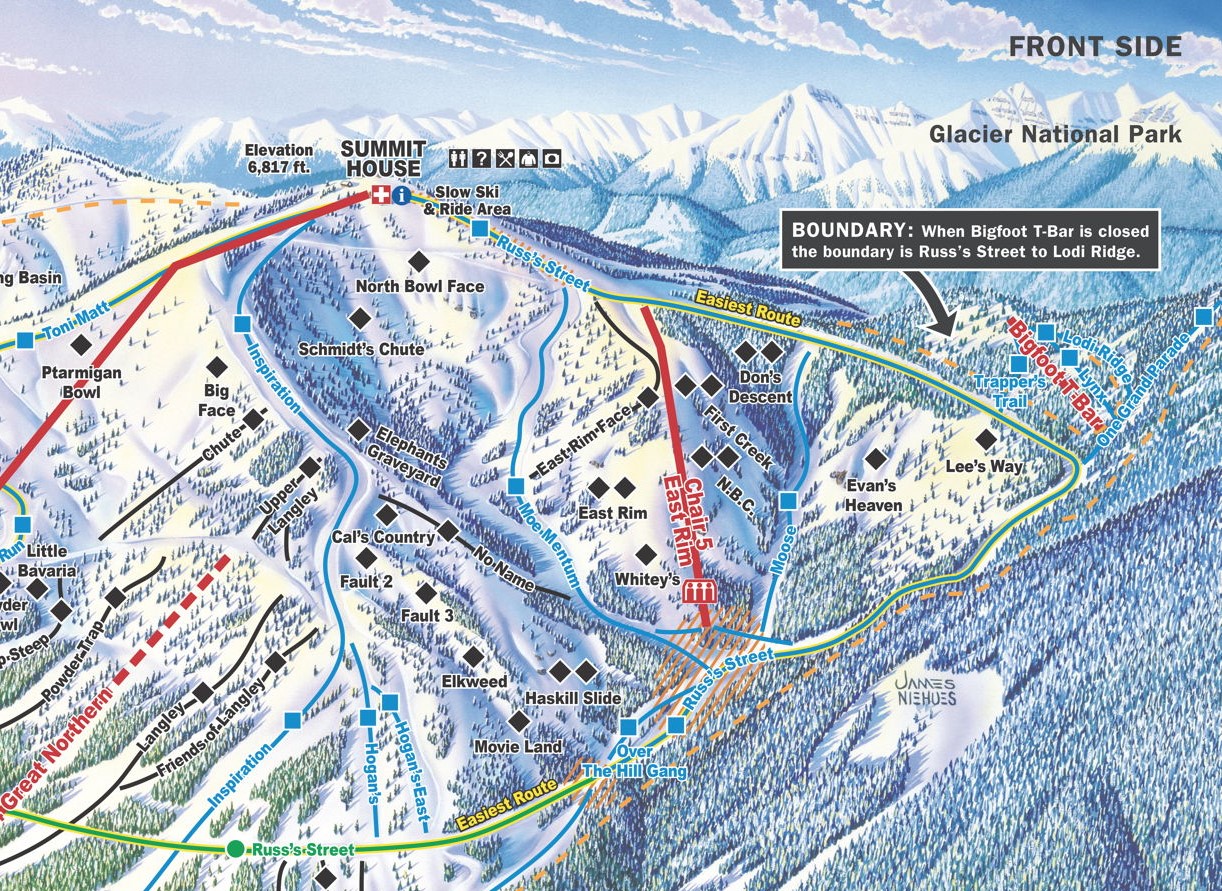
Over at Big Sky Resort, anyone with a ticket to the Biggest Skiing in America will be able to ride the new Stagecoach double chair this winter. Stagecoach extends the long tradition of so-called lodging access lifts here, begun with Pony Express in 1995 and followed by White Otter, Cascade, arguably all five of the Spanish Peaks lifts, and most recently Little Thunder. Amazingly, almost half of the 43 lifts on Lone Peak and the surrounding mountains exist to create ski-in, ski-out real estate. At Big Sky Resort, most of these machines are seconds from other Boyne mountains and they have their own color on the trail map: purple.

In the five years prior to the real estate bubble bursting nationwide in 2008, a crazy 18 lifts were built in Big Sky at four separate ski operations. One of those, Moonlight Basin, opened in December 2003 as Lone Peak’s second public ski resort. The development’s first two lifts had simply connected to neighboring Big Sky Resort in 1994 and 1995. Between 2003 and 2006, founder Lee Poole and his partners went it alone, adding four more lifts including Montana’s first six-pack. Three of these were among the last CTECs off the line following the Doppelmayr merger.
Every Tuesday, I feature my favorite Instagram photos from around the lift world.

Once again in 2016, Seattle found itself the fastest-growing big city in America, and the only one of the top five in close proximity to major mountain resorts. The Seattle-Tacoma-Bellevue metro area is now home to 3.8 million people, seven figures more than metro Denver or the Wasatch Front and growing faster than both. Yet despite being generally outdoorsy and with high average incomes, Puget Sound residents have only three real choices for where to spend a day skiing. Unlike in neighboring Oregon, where three resorts flank Mt. Hood and another Mt. Bachelor, Washington’s large volcanoes never saw ski development before being placed under conservation. Most of Washington State’s ski areas lie far from Puget Sound, along which two-thirds of Washingtonians live, concentrating some 1.5 million skiers annually at The Summit at Snoqualmie, Stevens Pass and Crystal Mountain.
Crystal spun off from Boyne Resorts in April to become Seattle’s only locally-owned and operated mountain. The resort’s master plan includes new lifts but most of them have already been built. Michigan-based Boyne still operates The Summit at Snoqualmie, just 45 minutes from Amazon’s new 24,000-head complex in Downtown Seattle. The Summit’s approved plan includes a dozen new lifts but almost all of them simply replace very old ones. That leaves the place where I first rode a detachable chairlift in 1997, Stevens Pass, to meet much of the Puget Sound region’s growing demand for local skiing. As the second busiest resort in Washington, Stevens averages double the skier density of Crystal and Snoqualmie. Located along U.S. Route 2, Stevens Pass grew under the ownership of Seattle-based Harbor Properties, which also at one point held Mission Ridge and Schweitzer. In 2011, Harbor sold Stevens to CNL Lifestyle Properties with operations assumed by Karl Kapuscinski of Mountain High, California. Stevens saw one new lift during CNL’s tenure, a Doppelmayr detachable in Mill Valley called Jupiter Express.
As the 2007 Stevens Pass master plan notes, “demand for skiing facilities currently exceeds capacity both on the trails, on the lifts and in the base area. A a result, Stevens Pass frequently experiences days when these facilities are overcrowded, resulting in the use of satellite parking, long lift lines, lack of seating and a shortage of restrooms.” The introduction concludes by noting Stevens has been over-utilized every year since 1995. But with its ambitious upgrade plan approved in 2015 and new stability following the sale of CNL’s ski holdings to hedge fund Och-Ziff last fall, more lifts and less crowding are on the horizon.

Every Tuesday, I feature my favorite Instagram photos from around the lift world.
Leitner-Poma is building a big new lift in Little Cottonwood Canyon this summer, the company’s first in the Beehive State since 1997. Alta Ski Area created a brand around being old school but the new Supreme high-speed quad will showcase the latest technology from Grand Junction and beyond. The new lift will bring detachable access to nearly all of Alta’s terrain and will be Leitner-Poma’s first lift to make a turn using canted sheaves rather than an angle station (there must be something in Utah’s water because Supreme will be the state’s fourth lift to make such turns of varying degrees for various reasons.) Alta Ski Area worked with LPOA and the Forest Service on an alignment that effectively replaces both the Cecret and Supreme lifts while reducing impacts to wetlands and surrounding forests in exchange for expedited approval. As I saw yesterday, it’s all coming together nicely.
The rugged Point Supreme is abuzz with construction. The new lift’s first few towers follow a direct path from the future drive station near Alf’s Restaurant to the former Supreme bottom terminal. Just above the old station site, a series of three closely-spaced towers achieve the necessary line turn. From here, the lift jogs steeply up, mirroring the former triple chair. Two Yan tower tubes near the summit still stand and might be re-used with new tower heads. Update 9/14/17: All 16 towers will be new.


Revealed in a surprise March announcement, Snowbasin Resort will debut its fifth detachable lift this winter on a slope rich with history. As chronicled in an awesome blog post, the upcoming Wildcat Express replaces a 1973 Thiokol, which itself replaced parallel Constam single and American Cableways double chairs. When the Holding family invested massively to build a new base area, two gondolas, a high-speed quad and aerial tramway in the 1998 run up to the Olympics, all of Snowbasin’s old lifts were left in place. Ten years later, Littlecat was swapped for a Doppelmayr detachable quad and now it’s Wildcat’s turn.

Like the Littlecat Express next door, Wildcat Express will be a green and white Doppelmayr Uni-G with torsion grips. The six-place chairs will feature slats rather than backrests for wind resistance along the relatively exposed profile. The new haul rope is manufactured by Redaelli and the lift will whisk 2,400 skiers an hour to Middle Bowl in just six minutes. Most components have arrived at Snowbasin and the Doppelmayr crew is working six days a week towards completion.