
Colorado gem Ski Cooper is thriving among giants. Over the past ten seasons, visits have grown 63 percent, fueled in part by affordable lift tickets. Last winter, a midweek ticket cost $45, regardless of the time or method of purchase. Peak days cost $110 with Fridays and Sundays running a bit less. Surrounded by Copper Mountain, Vail, Breckenridge and Beaver Creek; Cooper’s customer base naturally skews local. But the hill also attracts a growing number of skiers from the Front Range and surrounding states, owing to its accessible tickets and laid back character.
Cooper is an outlier, especially in Colorado. Lake County owns the fixed assets like buildings and the hill straddles two National Forests. Operations are handled by Cooper Hill Ski Area Inc., a 501(c)4 nonprofit organization. Last year the mountain brought in $6.8 million in revenue, more than triple its sales in 2011. Expenses have also creeped up but not as quickly as revenue. The ski area netted $1.1 million in 2024 and carries no debt. This model has allowed consistent re-investment including a new conveyor lift in 2006, the Little Horse T-Bar expansion in 2019 and overhaul of the Piney Basin triple in 2021. Future improvements will be funded by retained earnings, not debt or taxpayer funds.

Because Cooper sits on Forest Service land, it’s required to periodically file a Master Development Plan (MDP.) The current master plan dates back to 1999 and Cooper is in the final stages of perfecting its 2025 Master Development Plan. The ski area expects to submit the plan to the Forest Service in July for acceptance. Like with all MDPs, projects are conceptual in nature and subject to NEPA approval before implementation. Unlike most master plans, Cooper’s 2025 MDP includes projected costs and phasing. In true Cooper fashion, it was prepared in house rather than by a consulting firm.
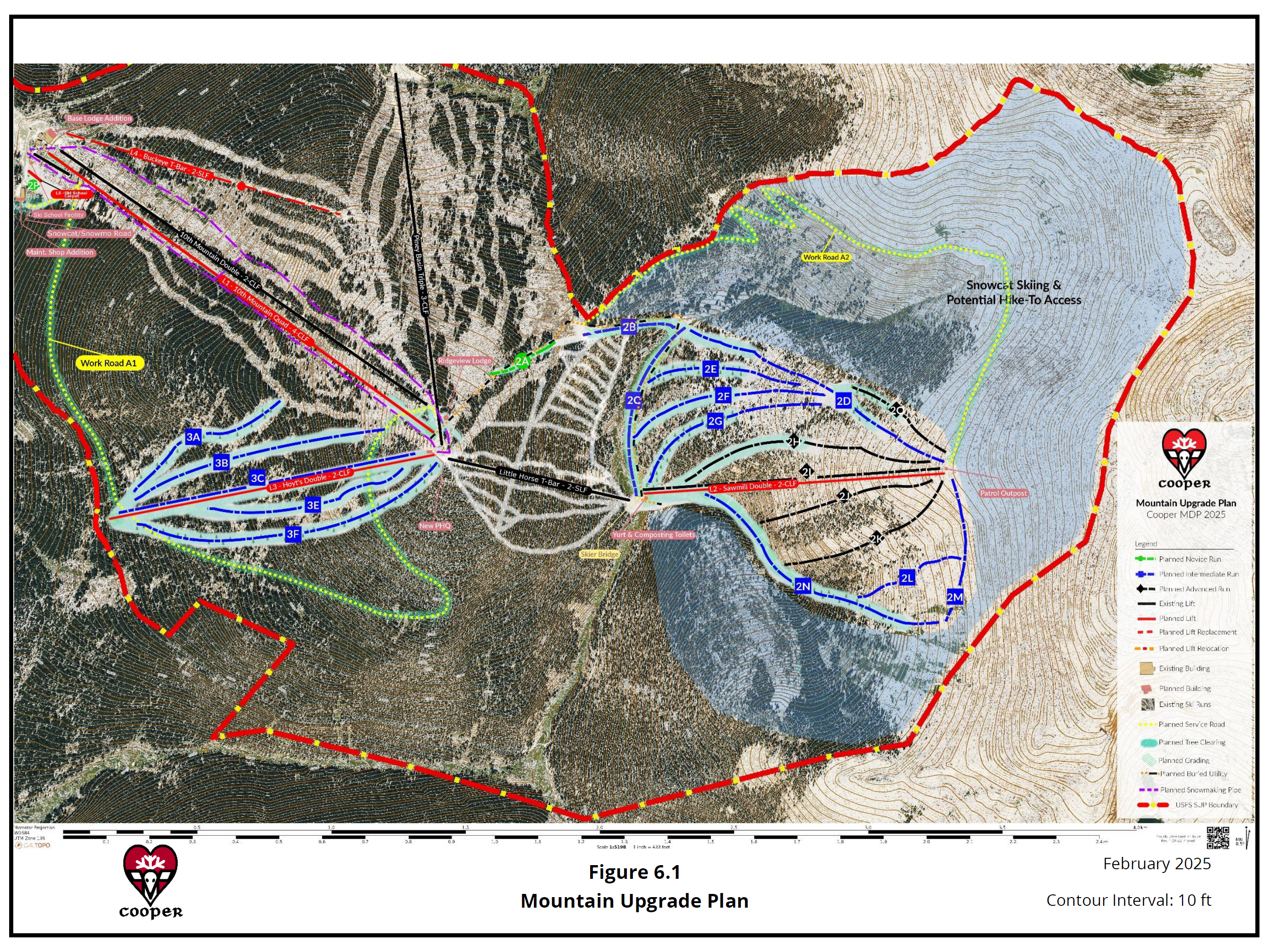
Phase one includes relief for the base-to-summit 10th Mountain Double. Replacement of the workhorse 10th has long been envisioned and was first approved in 2000. Instead of replacement, Cooper now plans to run a new fixed grip quad alongside the double and utilize both on peak days. The new quad combined with water/sewer upgrades, a lodge addition and parking expansion in phase one would cost $13 million.

Phase two would see a new lift constructed on Chicago Ridge called Sawmill. This double chair would serve 250 acres within Cooper’s existing permit area but never previously lift-served. Sawmill would rise 1,093 vertical feet and increase Cooper’s overall vertical drop by 382 feet. “A future Master Plan may envision further lift served use of the Chicago Ridge area within the SUP,” the plan notes. New double chairs are exceedingly rare in the United States with the last one installed at Arapahoe Basin in 2020. The last instance before that was six years earlier at Crystal Mountain, Washington. Like with those examples, a double would allow Cooper to service intermediate and expert terrain with a relatively fast lift (550 ft/min) at relatively low cost. Expansion up Chicago Ridge would also require a new patrol facility, skier bridge and trail improvements. Together with a second beginner conveyor in the base area, phase two totals $12 million.
Phase three includes Cooper’s first-ever snowmaking system and a second new double chair called Hoyt’s. This lift would service 60 acres of intermediate-pitched meadows on the west-southwest face of Cooper Hill. Hoyt’s double would span approximately 4,000 feet with a vertical of 942 feet and five new trails.
A third project in phase three is a replacement for the Buckeye Platter, which dates back to 1983. This project is planned as a T-Bar, increasing capacity by 120 percent. The mountain’s second T-Bar could run at a speedy 600 feet per minute with an intermediate unload station. Combined with a new lodge and additional parking, phase three is estimated to cost $14.5 million.
Cooper’s current comfortable carrying capacity (CCC) totals 1,819 guests but gets exceeded several times most winters. If all MDP projects are completed, the ski area could comfortably accommodate 3,682 guests, effectively doubling capacity. “Ski Cooper’s goals are to continue operating at less than full capacity, but add lifts, lift capacity, and terrain in order to improve circulation, keep wait times at lifts at a comfortable level, improve overall terrain offerings, and therefore maintain the reliably high-level ski experience Ski Cooper’s guests have come to expect,” the plan notes.
Lake County is currently soliciting feedback on the plan before submittal to the feds.
 Lift Blog

